
F28: War Always Changes has been around since 2018. The revised edition since 2021. This self-published ruleset from Karl Bergström, Thor Forsell, and Axel Klingberg has a fanatical yet modest following. Unfortunately, it’s popularity hasn’t quite exploded as perhaps the game deserves.
It’s difficult to stand out in the choked bog of figure agnostic miniatures games. This scene has swelled in the past couple of decades and players churn through new systems like Taylor Swift through romantic interests. This one is more of a Joe Alwyn than a Joe Jonas. That means it’s worthy of extended dedication. I don’t even like Taylor Swift and I’m not sure why I’ve committed to this metaphor.
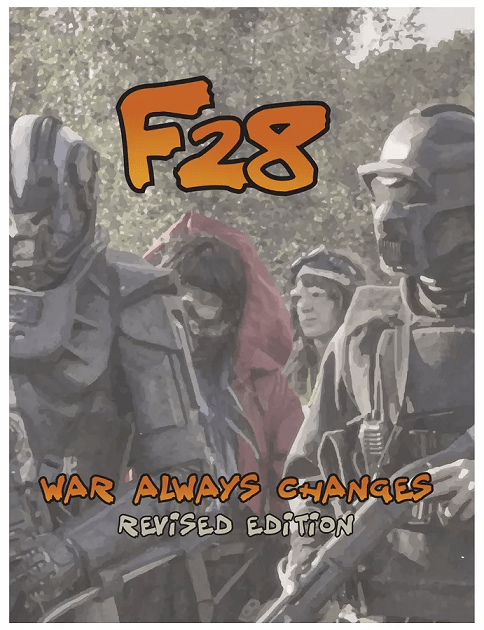
The “F” in F28 stands for “fast”. This system is all about speed. Play is never bogged down with heavy referencing or invoking exceptions. Instead, the rules are intended to provide the straightforward framework for tactical decision making. The essence of play is in tradeoffs and risk taking, not procedure or interpretation.
It’s a very flexible game. The rules govern maneuvering and attacking with units, which may range in size from a single model all the way up to a large group. The player with initiative activates their units, performing various activities in service to the scenario’s objective. The other player may respond with reactions, retreating from aggression or opening fire as their foes enter sight. You may only react if an opposing unit activates in your line of sight, focusing the combat to certain sections or lanes of the battlefield.
Once activated, units are spent. This means they will not be able to react once initiative flips. This is the primary challenge of the system, weighing opportunity and momentum while attempting to anticipate the development of the battlefield and your opponent’s strategic advancement.
The strongest flourish is in suppression. When units take hits but fail to receive damage, they instead receive activation tokens. This is a very sharp way to represent suppression, as it saps activations from targets that are under heavy fire. At round’s end, only two activation tokens are removed. So, a unit that’s been absolutely hammered will be unable to act in the following round. With enough effort you could effectively suppress a unit for many turns or before it even first activates.
This is rad. It opens up all kinds of interesting tactical decision-making. Much like the psychological effects of a system such as Tomorrow’s War, it incentivizes real-world solutions to complex battlefield situations. It also leads to a playstyle that stands somewhat separate from many similar titles. Support squads or a spread of grunts that can lay down a large volume of fire may not be as deadly as more elite or well-equipped units, but they can be utilized to lock down targets and control key positions. This suppression mechanism also intermingles with the reaction system to heavily influence the order you engage units and how you layer activations. It often feels more organic and less gamey than its peers, as the flow of combat is dynamic with much of the agency found in the player’s hands.

The core system is sturdy and highly engaging. But it really stands in service to the game’s extensibility. There is a shockingly high degree of customization, and this trait has come to define the identity of F28.
Most significantly, you can play across three modes of play. Each of these options also maps roughly to scale and shifts the degree of abstraction. Battles are large clashes between sizable forces. Each army consists of several squads of models and supporting vehicles. This is Warhammer 40k. Skirmishes are more akin to the standard for this type of system. Players field warbands of a dozen or so models, each figure given more personality than in the larger mode of play. Think Kill Team. Finally, narrative is the most ambitious as it features a game master and only a couple of models per participant. While utilizing the same core system as the other styles, there are some radical changes in philosophy and approach to play. This is totally old-school Rogue Trader.
Vehicle rules can be utilized or ignored. Tanks, transports, VTOLs, whatever. Terrain can be more abstract such as an area representing a cluster of trees, or it can be very specific with each chunk of rubble or cover modeled. Optional advanced movement rules feature climbing, leaping, dashing, and ducking. There are additional details for triaging wounded, permanent injuries in the spirit of Necromunda, fate points for re-rolls, even skill categories for narrative play. There are extensive scenario lists and then very broad guidelines for crafting narrative missions. There is just so damn much here, it’s mindboggling.
The ruleset is intended to be extremely flexible. Many of these optional subsets come across as suggestions. Take what you want, create your own flourishes if you wish. There’s even a full-blown campaign setting and faction lists which can be used, but it almost seems like all of it is included just to offer an example of what you can do with the game.
There is an optional supplement called “The Player’s Guide” which doubles down on this approach. Off-board artillery, sneaking, and signature moves are some the new inclusions. All of the existing content is padded out with a generous amount of new battlefield conditions, new scenarios, and new traits. There is nearly 300 pages of mostly content and guidance across both manuals. It’s wild and enveloping.
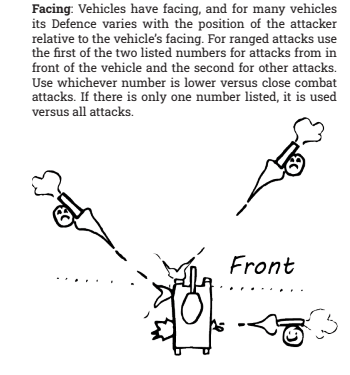
The books themselves are spartan. Diagrams are mostly hand-drawn and there’s an overt indie essence to the production. The writing is concise and pretty clear. You can tell the system as a whole has been iterated upon and cleaned up, as no space is wasted and everything is deliberate. Overall, I would say both books are solid products and present the game well, focusing on the energetic vision.
The charm of F28 is in in this creative spirit. It leaps off each page and gets your brain turning with possibility. The designer’s notes in each booklet farther this contagious spark by cogently presenting the intent behind the system and how the designers think and approach tabletop miniatures gaming. There’s even a callout to Ron Edwards’ GNS roleplaying theory that I’ve mentioned here in the past when discussing games like Oath. F28 is speaking my language.
All of this stuff does present a challenge. My first skirmish was somewhat difficult to get off the ground and start rolling. This isn’t because the core system is daunting – that part is nearly effortless – rather, it’s the extraneous bits like list building and deciding what extra rules to include. This is not a game you can really pull off the shelf and then throw a squad together with no preparation. It really requires a strong captain, someone to lead the experience and set the tone.
This is a central part of F28. It’s most evident in narrative play where someone must write scenarios and prepare a storyline in almost the exact manner as a roleplaying game GM. The referee runs all of the foes and springs surprises. They inject drama at every opportunity and maintain a proper pace of cinematic play. While the game never asserts this, I believe the narrative style is the heart of the game. The closest thing it has to a default mode. In this way, one person can assemble and craft the system pieces to their liking, choosing when to insert new rules – such as sneaking past guards or attaining mystic abilities – based on a campaign storyline. The game runs smoothest when creative control doesn’t need to be negotiated.
And in this state, F28 is a contraption of ingenuity.
What’s most fascinating is that this system appears avant-garde in 2023. Really, it’s rooted in the origins of the hobby. This GM-led playstyle was how many of us cut our teeth on miniatures gaming. This is how we played our home-brewed hybrid of Warhammer Quest and Warhammer Fantasy Battles, and how we approached Necromunda. It feels almost subversive now where everything is so regimented and competitive. It’s almost as if we’ve lost the imaginative glint that served as tabletop gaming’s foundation.
F28 is a call back to better days. It’s full of fantastic ideas and insight. I’ve only bruised the topsoil and used a few of the sub-systems, but there is just a killer amount of material to work with and lean into. It is a rich experience that offers so much more than many of its more popular peers.
The downside is of course that it’s not exactly accessible or inviting to newcomers. I can imagine many picking up this game and letting it languish on the shelf. I can also envision some being perfectly happy reading these books as sources of inspiration and out of curiosity, perhaps mining the text for ideas in other games or campaigns. This is exactly the way many engage new RPG texts, and F28 feels exactly like a hybrid of miniatures and roleplaying game.
Others will dive in headfirst and never come up for air. This is wholly suited as a lifestyle game, a Rogue Trader for a new generation. This is when F28: War Always Changes burns brightest.
A review copy of the game was provided by the publisher.
If you enjoy what I’m doing and want to support my efforts, please consider dropping off a tip at my Ko-Fi or supporting me on Patreon.
 Player Elimination
Glad you like it! If you’ve got questions, feel free to get in touch! We have a facebook group called F28 Community, where you can find all of us. We have endless designers notes if you’re interested! (Anyone who has spent a few hours in the company of the good doctor Karl knows this is not hyperbole :P) Cheers! /Thor Forsell
LikeLiked by 1 person
Thank you, and thanks for your work on the game!
LikeLike
Hello, this review is got me interested in trying this system for 10mm skirmish games (will be converting to cm by 2/3). This will be my first entry into the gaming world. For explosive weapons what does blast(D3) mean. I could not identify anything in the rules explaining explosive weapons. Is this the blast radius on a successful hit roll? Roll 3 d6. Whatever the values is the blast radius in inches?
Thank you!
LikeLiked by 1 person
Apologize, I’ve intended to look this up but keep forgetting when I get home from work and have access to the rules.
LikeLike