
Deckbuilding is such a natural pairing with a civilization game. Over time, each player’s deck evolves, incorporating new concepts such as metal casting, fortress building, and irrigation. Old technology and resources are culled, and the progress of each civilization is continually recorded in a collection of cards. This deck constitutes the power and potential of your nation, a physical representation of achievement. Such a system promises a vibrant and expressive method of tackling the civilization genre in board game format.
So, why then is Funforge’s Monumental so docile?
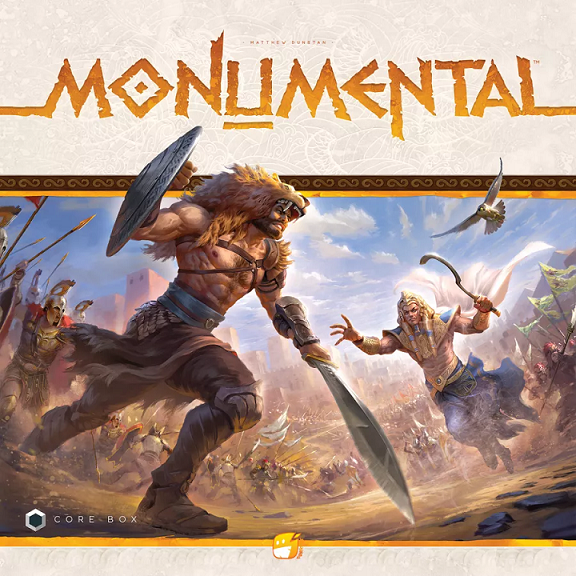
The action depicted on the box cover would better serve a different game. This is a tame experience focused on efficiently crafting your deck to eke out the most resources and points. It’s relatively clean and easy enough to engage, but it accomplishes such qualities at the expense of intrigue.
There is an attempt at Ingenuity. This is focused primarily in the activation system. Cards are not played from hand, instead they’re laid faceup in a 3×3 grid. Each turn you choose a row and a column, and then activate all of the cards included in that subset. This is a neat idea. It restricts choice and can provide interesting tradeoffs. Situations arise where you really want to activate a strong military card, but it doesn’t synergize particularly well with other options in its column or row.
But it’s only interesting occasionally. You’re activating five out of your nine possible cards, and most everything in the game works together to some degree, so you’re really tinkering in the margins. The mechanism also takes up a great deal of physical space – imagine four play areas, each with nine cards arranged in addition to other various accoutrements – and it’s hardly worth the trouble.
The cards similarly struggle to achieve distinction. A few have special abilities that are meaningful while stopping just sort of dramatic, but most merely offer resources. You spend these resources during your turn to buy new cards and move troops about the board. It’s all relatively orthodox.
As the game progresses more powerful cards are revealed in an Ascension-esque market row, but the bulk of options just scale their resource offerings in a linear and expected fashion. Everything feels predictable and bounded. With such a restrained offering it leads to civilizations that lack suitable personality. Even in this moment, it’s difficult to recall the traits or quirks my nations developed through deck construction. It’s all a morass of incremental gains to nudge yourself towards accumulation of cards and actions that award points.
So, that wonderful concept of etching your people’s history through the evolution of your deck? It’s akin to recording your famous deeds in sand on a windswept beach at high tide.

It’s really odd. Each civilization starts off with a nearly identical deck, a couple of cards offering unique abilities. You also have a leader with a special power that attempts to spice up the surprisingly lifeless board play. A secondary mechanism, culture cards, exist outside of your deck and each nation pulls from their own pool. These are somewhat interesting but only affect the game in occasional spurts.
And these sprinkles of flavor, ostensibly flashes of identity, remain entirely brief and subdued. Even the fantastical wonders – a common source of potency in civilization games – come across as harmless. They offer points at end game for being in your deck, but you really don’t even care about defending them on the board. The absurdity of the Atlanteans building the Taj Mahal isn’t even harnessed for giggles as the details of this market transaction is quickly forgotten. This is one of the main pointers to how divorced the troops on a map portion of the game is from the rest of it.
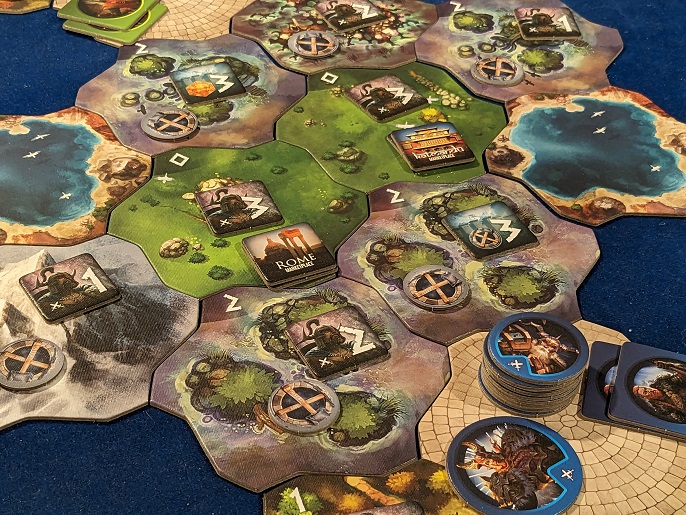
The map itself features spaces and soldiers and what looks like areas of interest. The terrain and illustrations barely matter, only affecting a static defense value. But they matter in so much that you can’t just throw out tiles randomly. Instead, you must commit to a burdensome setup for a portion of play that feels not at all worthwhile. The various prescribed layouts in the rulebook intend to balance tile placement for all sides, but they serve to emphasize how flat this entire portion of the game is.
Initially, you are pushing troops around and defeating neutral barbarians in order to attain resources and control territory. During the second half of play these resources have all been absorbed and board play transitions to occupying land solely for end game scoring. It’s very tit for tat, with players trading spaces with small victories.
Combat, unsurprisingly, is a muzzled deterministic process where you just need to send enough troops to hit a threshold. Accomplish this, utilizing military resources from cards activated this turn, and your foes return their soldiers to their home base on the board. There is no death or loss in life, just a loss of efficiency and time.
There is a secondary element of explorers that move around and scoop up resources mimicking concepts of exploration and trade, but in a farcical trick, they’re beyond the expiration date halfway through the game. At this point all of the tokens have been acquired and with explorers unable to fight or control territory, there’s nothing left for them to do. This particularly stings when a new card comes out allowing you to gain extra explorer moves on your turn. It almost feels as though portions of the design were developed in isolation, without a macro-level view of where play would lead.
The gestalt of map construction and interaction comes across as overly abstract. It has the same emotional connection of a track in a modern Euro-style design, offering incremental gains or adjustments without real context or dynamism. The whole thing is almost superfluous, ticking a box of player interaction seemingly for the sake of it.
Now, I did hold out some hope for the two large expansions on offer. Each includes new civilizations, additional content to boost the exploration token pool, and new modules to incorporate. Several pieces of these two boxes looked to even rectify my main complaints with the design.
The first aspect are the new civilizations. Each is more compelling than the offerings in the base game, as they utilize their own special rules and function with a larger degree of asymmetry. For instance, the Amazons have horses they can spend to fulfill certain cards or deploy to the map and boost their troops. The Aztecs can sacrifice their soldiers, effectively creating a new resource to juggle with an inherent tradeoff. Each of the several new culture options is more evocative and contains a spark absent from the original set. They’re not as inspired or rich as something like Root’s factions, but they push the game in a positive direction and are appreciated.
One of the additions I was eager to explore was the new map tiles. These contain actual special rules that add texture to the board and alter strategy. Unfortunately, there is a big misstep here in that the tiles themselves have no icons or ability text. A player aid could have rectified this, but that was seemingly missed as well. While none of the tiles are particularly difficult to understand, they will require flipping through the Lost Kingdoms rule booklet before each play and refreshing everyone on the various effects. Additionally, they’re not quite as impactful as I would hope. Again, this is a small nudge of progress, but it’s not the large swing I was hoping for.
The most significant enhancement is one which allows for near simultaneous play, eliminating much of the downtime between turns. Players gather resources all together and then alternate performing actions. It does a surprisingly good job at breaking up the stalled tempo and is one of the smartest mechanisms in the entirety of this system. It also has the knock-on effect of creating an additional layer of tension, as you really need to decide what to prioritize on your turn. If you dally, another player may grab the card you wanted while you were busy shuffling troops around. The base game lacks this pressure as you get to take your time and work through all of your various turn effects without someone else interleaving actions during your process. This new system in the African Empires expansion is a marked improvement and one I would heartily recommend.
The last element I want to touch on is the advanced economics module, also found in African Empires. I’m not sure I particularly like the additional overhead and rules complexity, but this adds purpose to the neglected explorer units. The trade routes are also nifty in that they allow you to trigger additional cards and pull off more dynamic turns. It’s almost enough to provide a measurable shift in satisfaction.
Sadly, while Monumental is enhanced with the new material, the fundamentals of the experience remain intact. It feels as though several desirable elements exist in the composition, but they’re not harnessed to produce compelling interactions or sophisticated strategic opportunities. The patching found in the expansions is meaningful, but it just can’t make up for the shaky framework the game is built upon.
I’ve spent a great deal of time disparaging this game as I simply don’t think it provides the type of expressive or captivating play that titles such as Clash of Cultures or Eclipse offer. The origin of my criticism is principally disappointment. This game is not awful or deserving of reproach, it’s merely dull and lacking any sense of swag. With the litany of truly moving board games available – this genre or otherwise – failing to execute with rigor is difficult to forgive.
A review copy of the game was provided by the publisher.
If you enjoy what I’m doing and want to support my efforts, please consider dropping off a tip at my Ko-Fi or supporting me on Patreon.
 Player Elimination
This is a fantastic review, Charlie. My group worked through a single play of this game last week (at four players, two hours and 45 minutes), and the downtime was our main criticism but I agree with the additional critiques you’ve provided here. I don’t have the expansion, but I don’t think I could get my group to play it even a second time based on the initial run. The Activate City step (to kick off each player’s turn) was novel and was still interesting even late in the game, but the rest was surprisingly weak. I’d play almost any other 4X-ish game (Voidfall, Scythe, Eclipse, Brazil: Imperial, etc.) before coming back to Monumental.
LikeLiked by 1 person
it would speed up a little on your next play, but I think downtime will always be a problem beyond two players
its really just unfortunate the core system didn’t have a better game wrapped around it.
LikeLike