
Many believe we are currently witnessing the “golden age” of board gaming. These people have it all wrong. Forget board games; this is the peak era of miniatures skirmish games. The genre of head-to-head plastic combat has exploded in the past several years. Omicron Protocol from Dead Alive Games is another such banger. This is a squad-based conflict design with atmosphere and punch. Its most significant challenge is establishing an identity and not getting lost in the sea of PVC.
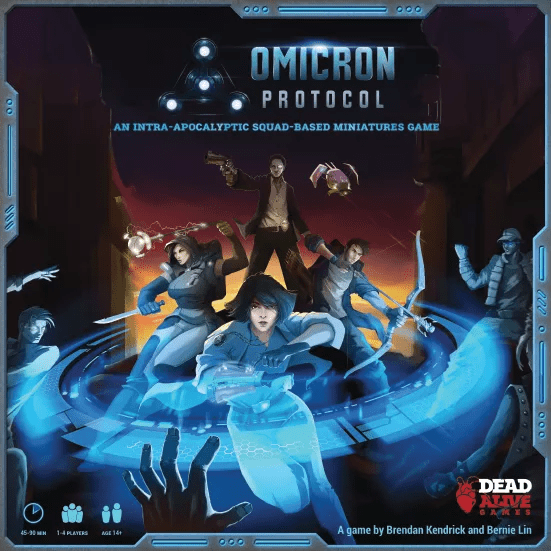
It doesn’t proffer a strong first impression. The illustrations are not particularly sharp, and it unfortunately shares a name with the noteworthy COVID-19 variant. The miniatures are roughly average board game plastic. They’re adequate and I’d put them on the same level as Core Space or Agents of Mayhem. They’re not as inspiring or as detailed as what we see in the Mythic Battles series or in various Awaken Realms’ titles. It’s just not a very attractive product. I may have passed over this game entirely if not for the consistent praise offered by Mark Bigney of the So Very Wrong About Games podcast.
Mark’s acclaim is not misplaced. This is an engaging miniatures skirmish game that offers a unique makeup of mostly pre-existing mechanisms. The gestalt of the experience comes across as distinct, even if it’s easiest to examine this game through comparison to its many peers.
Once past the lackluster appearance, this thing is rather inspiring. It’s setup as a complete product, something many of its peers do not offer. Both included factions – a rabble of lawmen called the “Peacemakers”, and a ragtag group dubbed the “Survivors” – are wholly furnished with many character options. The board is double-sided with multiple aesthetic environments. Terrain is comprised of 2D tokens that overlay the hex map, and there’s no need for measuring tape. The rules are sophisticated but feature an easing-in process as you’re invited to work through two small booklets before graduating to a larger reference manual. This feels a little like overkill, but it works, and it highlights that designers Brendan Kendrick and Bernie Lin wanted this product to stand alone, able to support hobby veterans as well as those unfamiliar with miniatures skirmish gaming.
This is Omicron Protocol’s ethos. It exists in its own sphere, seemingly attempting to poach board game players by offering a relatively straightforward product line with a rich and nuanced ruleset. This isn’t “my first miniatures game”, not by a long shot. It’s a fully featured skirmish title that is deep and interesting. But as a product, it’s succinct. You don’t have to wade through multiple expansion booklets as you do with Kill Team or Necromunda. You don’t need to order extra miniatures to experience the full game as you do in Godtear. You don’t need to buy additional card packs to tweak your faction options or open up new playstyles as you do in Warhammer Underworlds. You buy one reasonably priced box and you have the ability for extended play. It’s refreshing.
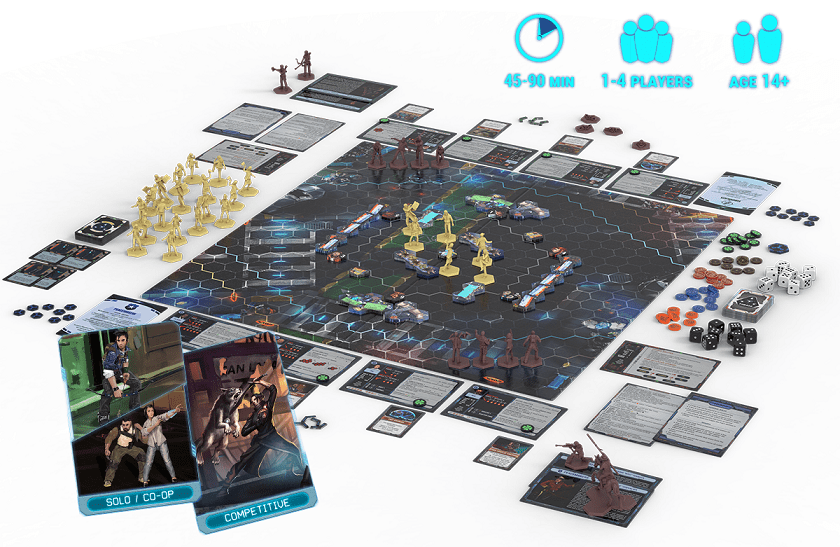
Core Space is the obvious parallel. They’re both games with broad appeal that exist in the lacuna between miniatures and board gaming. The large difference between these games is that Core Space is more focused on immersion and environment, while Omicron Protocol is more tactically centered.
The default mode of play here is competitive. The two factions square-off with players building their squad of four characters from a larger roster of options. Each model has its own card with a set of innate abilities and characteristics. While Core Space is miserly with the activation of character abilities, Omicron Protocol has you trigger active and passive effects nearly every turn. This is courtesy of its clever synergy between actions and attacking, and how each influences your cinematic budget of powers.
This is a modern alternate activation system where each player takes turns performing actions with one of their characters. You spend action points (AP) from a shared pool, creating a pressing tradeoff of spending more of the resource for immediate result, or saving the action points for a character later in the round. In addition to typical options such as moving and attacking, you may trigger certain abilities on your character by spending AP. For instance, you may be able to spend one action point to trigger hyper-aware, a passive ability that allows you to shift one space when someone gets close to you.
This interlocks with combat nicely. Attacking consists of rolling a pool of six-siders and then spending dice meeting minimum thresholds to buy outcomes. This can be damage on your target, but it can also be triggering character abilities or gaining luck tokens which can be spent later to modify dice. This expands the wealth of conflict options in wonderful and unpredictable ways, as you may open up with an automatic rifle and end up chaining together several potent effects. It reminds me of the quickly forgotten Space Cadets: Away Missions, a slick dungeon crawler that featured a similar “overkill” mechanic of spending successes for additional effects.
What’s interesting is how these systems influence the tactical breadth of a turn. You start looking down at your character’s menu of options and are afforded a degree of creativity in pursuing your desired results. There’s a level of engagement here that is fantastic and very gratifying. And the various potential outcomes only expand in scope when you start considering the Cyber-memetic Sociopaths.
These awkwardly named CyMS function as antagonistic zombies that harass both players. They instill a sense of dynamism to the board state, functioning as dangerous terrain that shift and pursue as the situation alters. The twist here is that the non-active player controls the CyMS horde following the character’s actions. This gives them a sense of malevolence, as you can perform crafty maneuvers such as leaving them blocking chokepoints or aggroing nearby characters. They’re not so much unintelligent combatants, as they are restrained ones governed by restriction.
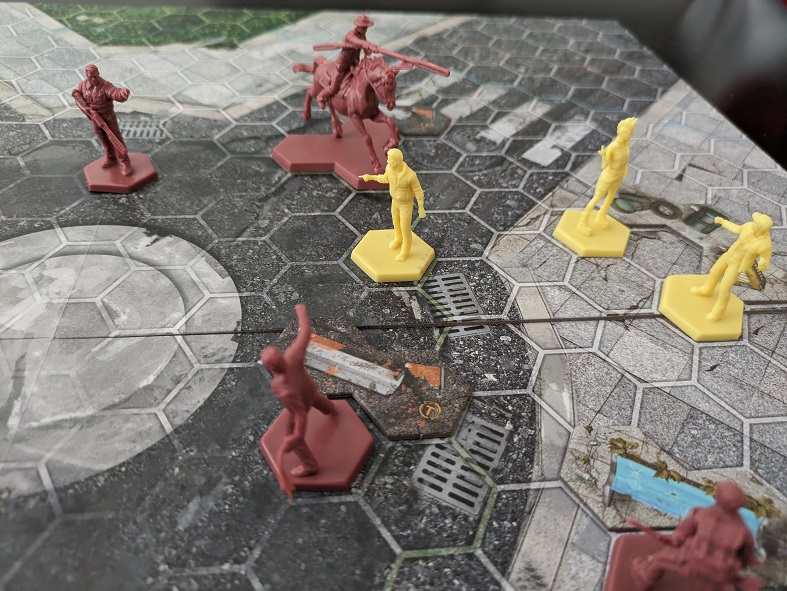
This brings me to my next comparison, The Walking Dead: All Out War. That excellent miniatures game from Mantic is back, and it’s one that deserves more recognition. Much like Core Space, All Out War focused on narrative play with scenarios that were framed around the graphic novel’s story beats. But when engaged competitively, it plays out much like Omicron Protocol as two opposing fireteams battle it out in a very dangerous slice of land. You have to duck and weave between claws and teeth, finding appropriate openings to make an offensive push. It has a somewhat different feel to the neutral opposition of Core Space, as that game’s opponents are more active and dangerous. In both All Out War and Omicron Protocol, the wandering combatants can be lured or manipulated as another tool.
This is another element that emphasizes the core of Omicron Protocol. At its heart, this game is about tradeoffs and difficult decisions. This is immediate, as you select your roster of characters from the larger faction subset, deciding what you will forego just as much as what you will possess. Then, each turn, you need to assess how best to burn your action points. Do you spend AP to trigger abilities or hope to engage them by rolling up extra successes in combat? You must assess the current board state and decide how your actions will influence the CyMS movement, and whether you can harness this as a benefit as opposed to a hindrance.
The CyMS also provide the framework for the game to go full-on cooperative. Unfortunately, I don’t find this mode of play particularly gratifying, but it is certainly an option for solitaire play that is not totally devoid of amusement. It simply isn’t as compelling as the standard versus format and leaves me unsatiated. It also serves to re-align my perspective and once again return to the comparison of Core Space. That competitor simply functions more strongly in the solo or cooperative approach, as the game is extended with all kinds of options through its various expansions. The emergent narrative is stronger with Battle Systems’ design, which diminishes this game when viewed under the same light.
Despite my lack of adoration for the non-competitive branch, Omicron Protocol is a solid system overall. I’m as impressed with how the ruleset is packaged and how every effort has been made to onboard the reluctant as I am with the core gameplay loop. I vastly prefer the method utilized for squad building as it’s streamlined and effective, allowing for a quick pickup game when you only have an hour or so.
I’m also delighted with the way Dead Alive Games has approached expansion content. It’s entirely unnecessary, but it opens up additional options in the form of new toys. Up to no Good is the sole faction box, offering the utterly cool “Animals” and ex-triad “Red Dragons”. The former is a collection of wildlife that is somewhat absurd. You can field Bob, a cybernetic bear that is absolutely fierce, or even an intelligent elephant named Jugger that will stomp on foes and unleash carnage. It’s one of the most pleasing factions I’ve seen in these types of games – in terms of just neat options and joyful abilities. The Red Dragons are interesting and a well-developed option, but conceptually, they’re never going to swing with the same power as a collection of enhanced beasts.
The second type of expansion are two small boxes of single figures. They add cross-faction mercenaries that have multiple affiliations, which is a stellar way to extend the system without pigeon-holding new characters into an obscure role. The two fighters here are interesting as well, including a crossbow wielding park ranger and a large iguana with a cyber jaw. Yeah, buddy.

One of the most interesting aspects of Omicron Protocol is how it displays the trend for miniatures skirmish games to adopt an old-school creativity with modern design tenets. This is not a strict competitive game that mimics the most troublesome of Warhammer 40K formats. It incorporates a vague sense of wild that permeated designs in the 80s and 90s. Those types of games leaned on referees to run scenarios and inject drama. This role functioned akin to a game master in a roleplaying game. Systems like Omicron Protocol and Core Space draw on some of these elements with the neutral foes and looser gameplay. This modernization of traditional ideals is occurring all over. Frostgrave, The Doomed, and F28 are just a few additional examples. It’s fascinating to see such a return to the hobby’s origins, particularly when its partially cloaked and not at all obvious.
Omicron Protocol is an excellent debut offering from Dead Alive, an outfit that’s intent on continuing to produce various types of games. As I noted in the opening ‘graph, my main concern is that this genre is overstuffed. There are simply too many options. I very much dig the tactical nuance of this game and many of its features. I think it’s restricted, somewhat, in its narrative scope. It doesn’t feel as alive and rich in setting as an expanded Core Space. Its lackluster visuals prove a difficult sell in comparison to Games Workshop’s balls-to-the-wall aesthetic. Both of these angles can be tough to overcome.
But there absolutely is something going on here. This is perhaps the perfect game for a skirmisher to lure their board game cohort. Or, for a cardboard adherent to dip their toes into this mad genre of miniatures goodness. It’s not overly bloated with quarterly product cycles, and you can engage the game on your own terms. The ruleset itself goes hard to teach you its processes. It’s portable and the barriers are few.
Omicron Protocol is a terrific work. I just wish there was more time in this world.
A review copy of the game was provided by the publisher.
If you enjoy what I’m doing and want to support my efforts, please consider dropping off a tip at my Ko-Fi or supporting me on Patreon.
 Player Elimination
Many believe we are currently witnessing the “golden age” of board gaming. These people have it all wrong. Forget board games; this is the peak era of miniatures skirmish games.
and
As I noted in the opening ‘graph, my main concern is that this genre is overstuffed. There are simply too many options.
A lot of times, I love your, what I will call, flavour sentences, as they are not the point of the critique (although, I particularly love the articles that explore these statements), but they are often saying something much larger than the critique itself. This time is not different (possibly because I own all of one skirmish miniature game (I think Jaws of the Lion qualifies) and I am unlikely to ever own another unless I find someone to play that with me, play through that one and that person wants to try something else after) and I would love to see the ideas presented in those statements expanded some day.
I note these two particularly as… they seem like opposites to me. When I think of Golden Age, I think of a games that are, well, built to last and built to stand out from the crowd. Games that have a reason to exist on a social level. Games that can stand the test of time.
I tend to feel like I am in the age of GOAT of the week. Where the fire hydrant is on full blast and the entire industry is dominated by planned obsolescence. The idea being I play a game once or twice before moving onto the next game which is almost exactly the same as this one. A consumerist treadmill.
Of course, it is quite possible, that I simply think of Golden Age differently than most.
LikeLiked by 1 person
Apologies chearns as, for some reason, WordPress flagged your comments as spam. I just noticed it in the spam filter and released it.
Those statements are somewhat contradictory, you’re right. I guess my thought process is that we are seeing so many indie skirmish games that are just spectacular, in addition to all of the larger studios doing stuff like X-Wing, Marvel Crisis Protocol, Warhammer Underworlds, etc.
There is a huge amount of quality here. But there’s also just so much and it’s difficult to differentiate unless you get to try them all. Kickstarter is partially the culprit here – as some of the traditional hurdles to publishing have faded – but also sites like Wargamevault and DriveThruRPG which have an unprecedented amount of miniatures systems appearing in PDF format.
I think my conclusion would be that it CAN be the Golden Age of miniatures gaming, while also not being perfectly calibrated.
I should write some more thinkpiece type articles, as I do love to include these little tidbits/observations in my reviews. It’s honestly what I spend a lot of time thinking about between plays, trying to frame games within the context of the wider hobby and culture. I hope that these types of insights and claims add value to my reviews that help elevate and differentiates my work from some other reviewers.
Sorry again for the spam filter, I see you had to type it out twice. Hopefully that doesn’t happen again.
LikeLiked by 1 person
It’s all good. I do not even recall typing it in twice.
While I said they are opposites… I also think I failed to think, well, clearly. Or openly would maybe be the better word. They may be opposites in a dictionary definition way, but so much of life fails to fit in to rigid definitions like that. Concept maps are a definitional tool that, unlike dictionaries, do a better job of helping explain how ideas and concepts can include what can at first glance appear to be contradictions. We can be in a time that is a golden age for the quality of what is available and also not be in a golden age because there is so much available that it can be hard to find the good stuff or even agree on what the good stuff is. And I can see how both ideas can be true at the same time.
As I cut back on buying new games (for a number of reasons: environmental, human rights, but also less lofty reasons like wanting to save up to buy an apartment, wanting to dive deeper into the games I already own and love, and the people around me preferring to play a game they know that to learn one they do not), I too find my thoughts going into new places between plays. Where once I would go to BGG and keep up with new releases or awards (more awards that generic new releases, but I did have my KS phase of acquisition), I now find myself thinking about what I love about games. What keeps me coming back. As I drifted away from the consumerism treadmill one of the things that happened around the same time was I stopped thinking about games in terms of mechanisms and started thinking about them in terms of dynamics. And yes, history and culture, as well.
LikeLiked by 1 person
Many thanks for the wonderful review! We loved how you were completely accurate in understanding our design intentions with the mechanics, the CyMS, and the rulebook. As our first game, we definitely wished we had more experience and funding to get the art/miniatures to stand out more, and your critique on those aspects are also very fair. =)
Ultimately, we’re so glad you enjoyed the game, and regarding lore, we do have a 350 page lore book that we created (about 120k words) for the Omicron Protocol world, that dives more into every character (including factions that are still coming) and the story arc of the world. If you’re interested in that, please reach out to us at info@deadalivegames.com and we can get you a copy.
Thank you again for taking the time to try out the game and for writing this review!
Best,
Bernie Lin & Brendan Kendrick
Dead Alive Games / Omicron Protocol Co-Designers
LikeLiked by 1 person
Thank you both for your great work on the game. I have a copy of Lunar Rush I’m also going to start exploring soon, and I’m looking forward to it.
LikeLike