
Close your eyes for a moment. The rasps and clicks off at the edge of existence, that’s people talking about Arcs.
As they should be.
Arcs is designer Cole Wehrle’s eighth release and his third with publisher Leder Games. The supergroup of Wehrle, Leder, and artist Kyle Ferrin continues to astound. I assumed we would be experiencing fatigue with this combination by now – particularly the look of Ferrin’s distinct artwork – but that’s not the case. The worlds wrought by this collaboration are as vibrant and inspiring today as they were yesterday. While I doubt Arcs will be more commercially successful than Root, it certainly seems like it has grabbed ahold of the shared consciousness of hobbyists in an unprecedented way.
There is something special here, something hard to grasp yet easy to see.
This is the first of two articles where I will examine the game and attempt to answer: what is Arcs?

Part 1 – Arcs is Vicious
Wehrle doesn’t make friendly games. Get your feathers jammed up while running the Eyrie and your dynasty will collapse. When a fellow Afghan supporter flips to backing the British occupiers, your board position crumbles. Sign the wrong ledger and witness the entire collapse of the East India Trading company. Arcs is beyond.
First, a prelude.
This is a 4X space game that, in its fully realized state, most closely competes with Twilight Imperium IV. While the base game is more comparable to Eclipse in length, the ambitious vision of Arcs includes the Blighted Reach Expansion, a massive box that transforms the experience into a three-chapter campaign.
Let’s talk systems.
The first noteworthy trait is that action selection is facilitated via trick-taking. Yes, like Brian Boru and Joraku, this is a game that utilizes the framework of titles such as Spades and Bridge to support something more significant, something with a wider scope.
That’s not entirely accurate. Trick-taking is more a general description of what’s occurring because we have no better label. It’s just as much Glory to Rome as it is Whist. A player leads a suit which influences how other’s play without dictating it. The suit names which actions can be performed and the value determines how many. One key difference is that you don’t have to follow suit, however you are only allotted a single action unless you can play an in-suit card with a higher value.
That’s really it. There’s no trump and no actual taking of tricks. There are two interesting details emerging from this streamlined base. The first is that initiative, which means playing the lead card, only moves to the person that tossed in the highest played card of the led suit. That can be dashed aside, however, if someone decided to discard a second card to seize initiative when they made their play. The latter, a tool resilient to poor card draw, is very costly as it means you will perform less actions than your opponents.
The second matter of intrigue concerns ambitions. This is the smartest touch of Arcs. The game does not dictate how players score victory points. Instead, it offers a number of goals that remain inert. These ambitions are optionally put into play by a person who leads a trick. The leader can declare an ambition active, but only if the card they played contains its symbol.
This may sound mundane. It’s not. It’s bananas.
In one round, the game may value war trophies accumulated from destroying foes. In another, points may be awarded for hoarding fuel and material. Yet another may emphasize relics unearthed from the scattered dust of the empire. This is entirely player-driven, adding to the intricacies of seizing initiative and managing your hand of cards.
And this system of tricks and ambitions and initiative is where the brutality is smuggled in. From there, it escapes and starts clawing its way into the recesses of the design, waiting to emerge. Waiting for violence.
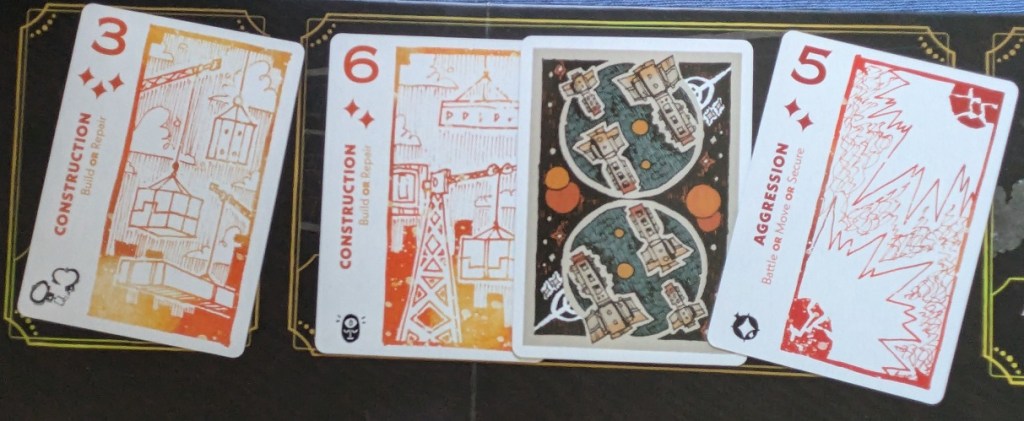
This game allows you to utterly collapse. The process of playing cards is simple, but the considerations are many. Each card must be weighed for the number of actions it offers, the usefulness of those actions, if it contains a desired ambition, and whether it can be sacrificed for initiative. All of this is undergirded by a shifting board state and an entirely unpredictable action configuration due to not knowing who will lead and what they will lead with.
The idea of perfect play seems to demand the embodiment of Paul Atreides. You must see all future possibilities and account for their branching outcomes. Engaging in this complex dance of hubris and awakening can be lunacy. For instance, you may receive a hand of one suit, and it may allow actions you have no use for. In another case, the player to your left may begin with initiative, and it may be claimed immediately by the following player in turn order, never giving you the opportunity. Then on the next turn, the player sitting to their left grabs the initiative just before you. All three of those players may have declared an ambition and you have little to no agency in steering the path forward. It feels as though the hand can go a thousand ways, with few of them going your way.
Combat also wallows in this fickle nature. In truth, I find it to be one of the most compelling battle systems I’ve encountered. The attacker is the only one rolling. They decide between three sets of dice with some being riskier than others. One type allows you to raid another player when attacking their infrastructure. This means, that with the proper roll, you can steal cards they’ve added to their tableau. A player could have a burgeoning engine that supports a buzzing combination of abilities, and then over a couple of unfortunate turns they could have nothing. Multiple actions and cards and finagling of opportunity, and it all crumbles like the ruins of a cast aside civilization. This is what the game begs. It’s chaos and destruction and death.
Arcs is much more brutal than many expect. That quality dovetails neatly with my chief criticism of the game and how it’s being touted. There’s this idea that it’s an accessible experience. The box claims 30-45 minutes per player. Many users even profess the ability to play this game in 90 minutes. I don’t believe this is a lie, but I think there’s an element of incoherence here that threatens to disillusion the ill-prepared.
Arcs is incredibly long and arduous in my experience. I have not played this with slow players, and we have yet to complete a session in less than three hours. Campaign play, while containing fewer total rounds in each game, extends the average playtime to four hours. In this format the game is also bulky with additional components and cards exploding everywhere. There are rows of new rules added to the game and tableaus that consist of a dozen special abilities that no one will recall. There is a floor to the playtime and complexity that I simply think will not be broached.
There seems to be a divide between players that seek more casual decision-making, riding on vibes and brisk reaction, with those that engage on a more analytical level. The profile of the game doesn’t feel like it wants snappy action buoyed solely by intuition. Arcs incentivizes thoughtful consideration. It offers you a hand of cards and asks you to envision several moves ahead. It’s all there for you to see and plan around. It asks you to weigh each card when deciding what to play, to consider whether you may need to seize initiative in the future and pivot to a new strategy. Your future turns exist in a Schrodinger-like state, able to be viewed but clouded with a significant uncertainty. And each play, each action, you must reconsider your plans as so much changes. I get the sense that it’s frankly impossible to evaluate your hand and successfully strategize far advance, but it does seem like you can absolutely scuttle your future with poor play. One crucial mistake, such as fruitlessly banking on your six to win initiative with only one player remaining in turn order, and it can all begin to break apart.
This is a game that offers little strategic handholding while also readily allowing you to completely bury yourself. It’s a thing of misplays and passed opportunities, the systems compounded by overlooked abilities and forgotten rules.
It’s maddening. It’s brilliant.
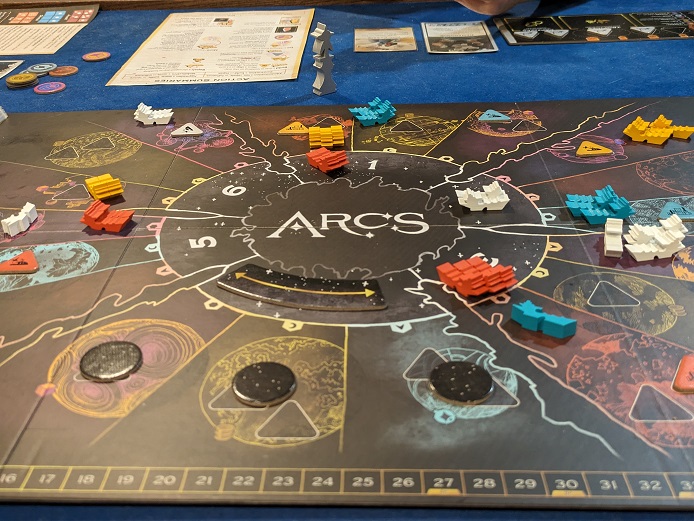
The vicious nature of the card system fabricates an immense tension. The good kind. The kind that rides up your spine and tickles the cerebellum. Most importantly, it fosters an environment of high stakes.
This is the impact of Arcs as a game system. The fallout of intensely sifting through your options and responding to the dynamic play of others, is that everything feels important. I grew restless when sitting through three hours of Kevin Costner’s Horizon. When deep into the vortex of Arcs, someone mentions the time and I don’t believe them.
The not-trick-taking system is fantastic. It throws a large chasm in front of players and then demands you leap. Making it across and orchestrating your destiny feels grand. It feels epic.
There is also a strong arc to the session itself. I’m not even talking about the campaign. A single game escalates as it progresses due to scoring increasing in potency. There is the possibility of large swings in the final chapter, partially ameliorating some of the smaller early blunders. This also means strong play consists of putting yourself in a position to succeed in the future. It’s about maintaining opportunity and grasping the demon when it shows its face.
The core system of Arcs is complete and fulfilling as a standalone game. With that being said, I don’t have a strong interest in ever playing it again in that format. The Blighted Reach campaign offers such a distinct and compelling adventure that it fully engulfs any lesser attempt of furnishing its offerings. When I think of Arcs, I think of the totally avant-garde narrative shed by the three-session epic and how it affects me in ways Eclipse and Twilight Imperium cannot. When we return to the Reach in part two, that’s what we will be discussing.
A review copy of the game was provided by the publisher.
If you enjoy what I’m doing and want to support my work, please consider dropping off a tip at my Ko-Fi or supporting me on Patreon.
 Player Elimination
Thanks for your thoughts. Will be waiting for Article 2 & 3!
LikeLiked by 1 person
Thanks for reading!
LikeLike
Thanks Charlie, thoughtful as ever.
I loved Root (at least, the initial game, the expansions less so), I enjoyed Oath (but most of my friends dislike it so it never makes it to the table). There is such a buzz about Arcs, so many reviews praising it, and it sounds like a game I’d like to like. But this (“The profile of the game doesn’t feel like it wants snappy action buoyed solely by intuition.”) and the issue that careless or unlucky decision can crater your game in a session that takes a couple of hours, I guess it’s not for me.
Still, I look forward to chapters 2 & 3!
LikeLiked by 1 person
Thanks, Greg. It’s a shame your friends disliked Oath. I really need to get back to Root, it’s been too long.
I would definitely be cautious with Arcs. It’s receiving a great deal of buzz, but I don’t feel it will suit a large segment (perhaps the majority) of hobbyists. It seems as though the current wave of praise is creating the illusion that it’s universally appealing, but that’s not so.
LikeLike
Indeed, after reading your excellent review it’s clear that I’d rather have a root canal than play Arcs. Glad you are enjoying it!
LikeLiked by 1 person
Ha, fair enough.
LikeLike
Nice review. Curious to see Parts 2 and 3. What player counts have you been playing at?
LikeLiked by 1 person
Mostly four player. One three player standard game. No experience two player.
LikeLike
2 player is much more mean, but it is super quick. Most games at 2 have wrapped up in an hour or an hour and a half. It has a nice mulligan mechanic for the 2nd player which I enjoy a lot. If you get a chance, you should try it.
LikeLiked by 1 person
Interesting, I will have to give it a shot.
LikeLike