
New York City is a walled maximum security prison.
Breaking out is impossible.
Breaking in is insane.
Have you seen Escape From New York? It’s from another time, when movies were on film and John Carpenter still had creative juice. This gritty thriller has a unique vibe, populating its desolate environment with over-the-top characters while still maintaining a level of sincerity. It’s delightful and holds up to modern scrutiny as a cult classic. But no one really makes movies like this anymore.
Maybe you don’t know John Carpenter, but you likely know Kevin Wilson. Back in the aughts, he worked on some of Fantasy Flight Games’ best titles. This included Arkham Horror, Descent, and Android, among others. Those games are of a very specific period, when every title wasn’t a hybridized Frankenstein’s monster of recycled board game design. The pure Ameritrash games of yore are nearly extinct. Particularly those of the FFG ilk.
Not anymore. It’s 2008 again and we’re gonna meet the Duke.

Escape From New York is such a throwback to Kevin Wilson’s early days that it really should have a “proof of purchase” punchout on its token sheet. This is not to disparage publisher Pendragon Game Studio, a company who had already impressed me with their other Carpenter adaptation, but this new release is such a specific style and completely evocative of FFG’s design methodology.
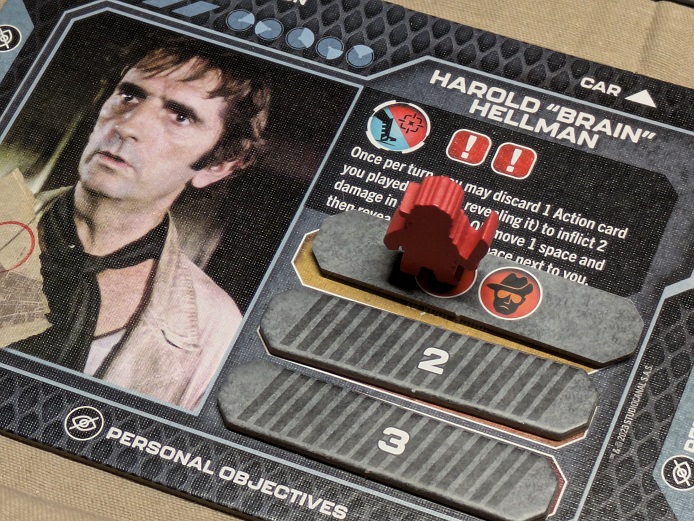
I would describe it as a cooperative adventure game brimming with tension and atmosphere. One player takes on the role of Snake Plissken while the rest select from among the colorful characters that assisted him in the film. The cast consists of Cabbie, Brain, and Maggie. Three interesting felons with their own motivations and agency. Kurt Russell is a badass, but any of Ernest Borgnine, Harry Dean Stanton, or Adrienne Barbeau are a hell of a consolation prize.
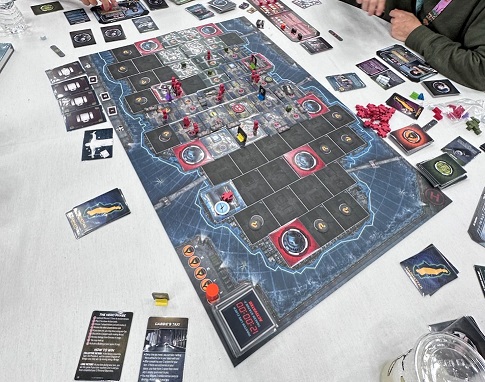
The goal is to fan out and explore the city, flipping tiles onto the board and making your way through the prisoner-infested streets as fast as you can. The group is up against the clock and must book it. You have to locate the President (“the president of what?”), find a lost tape recording that was in a briefcase strapped to his wrist, and then escort Donald Pleasance to one of the bridges on the outskirts of the island to make your escape. Oh, but the bridge is mined, so you must also find a secret diagram which will safely guide you across. None of this makes sense, but it doesn’t have to. Watch the film. Or don’t. The game is good regardless of context.

The exploratory adventure element parallels Wilson’s own Escape From 100 Million B.C., but also games like Sub Terra and Unknown. As you move to new sections of the city you will run into thugs, come across nifty items, and trigger dangerous events. Sometimes you will discover buildings that offer shelter or ammo. Eventually you make your way to special points of interest lining the outside of the island. This is where the fireworks go down. It’s where you will find the President, as well as the game’s three bosses.
The constraints governing player action add a nice wrinkle. Each turn you play two action cards from your hand and then execute them one at a time. Your hand of cards is tied to your character, offering an asymmetric slant on activity. So, Snake has more options for delivering a beat down, while Brain is more adept at tricking foes or manipulating bosses. The twist here is that there’s no traditional draw deck. Instead, your entire deck is available and in your hand. It’s more of a Concordia-esque mechanism, where played cards go to your discard pile and you have to pay a cost – in this case burning time from the game – to retrieve all of them in one fell swoop. This ties into health in a lovely manner, as each point of damage you receive is a random card discarded from your hand.
This card-system is pretty banging. It threads the narrow line between foisting too many cards into your hand and offering you too few options. It’s almost perfectly calibrated. The damage system also works well, as it creates simple but thoughtful tradeoffs. For instance, you may want to save some of your best cards for a later situation. Yet, as your hand dwindles, you’re more likely to discard them if a gang of prisoners corners you in the streets and works you over. You also have to be considerate on when you redraw your hand, as burning through the time deck too quickly will result in defeat.
This system also dovetails into another neat detail as you can upgrade your deck and add new powerful cards. This is done through the straightforward leveling up system, where you’re given the minor objective of either defeating a number of thugs or gathering items to level up. It’s not heavy handed and adds another small consideration when evaluating how to progress on your turn.
The strongest element of Escape From New York is the game’s tension. It parallels the uncertainty of environment found in the film, treating the city as if it’s a warzone. Beyond prisoners, traps, and bosses, you also must watch out for each other. That’s because, much like in the film, your pals could duck into the shadows and pull off an under-handed betrayal at the most crucial of moments.
In addition to the shared goal of rescuing the President, each player is dealt two cards. One names a specific mode of escape and the other an item you must possess. The former consists of getting to the helicopter in Central Park, the gullfire plane atop the World Trade Center, or a raft location at the outskirts. The latter may be the actual recording the group’s looking for, a fake version of the tape, or obtaining a Wanted status by defeating a boss. This pairing provides a personal objective that you can pursue in secret, hoping to assemble the necessary pieces so that you may slip away from the group and hoof it to safety.
The most thrilling aspect is that once someone has won – either the group or an individual player – everyone else playing loses. Yeah, suck it Plissken.
Again, Kevin Wilson feels totally in command. The pacing is excellent, as you can’t accomplish this victory until late in the game once the President has been rescued or the timer deck has been reduced to its final hours. There is inherent risk involved and the stakes are high. This leads to players wanting to keep their options open, only abandoning the group pursuit if the solo path seems more viable. I have witnessed betrayal. It stings. But it also leads to very dramatic climaxes that tell a magnificent story.
This conflagration of mechanisms working in tandem to produce adept storytelling is the game’s most powerful weapon. It feels consistent and faithful to the spirit of Carpenter’s film. The space this plays in is most similar to Star Wars: Rebellion in terms of narrative process, as it manages to produce story beats that are authentic to the source material while completely rewriting the script. That’s potent and an enormous accomplishment.
This is a splendid game. As I’ve noted, one that’s entirely reminiscent of Fantasy Flight Games brand of early Ameritrash design. This means it includes some of those warts as well.
The most awkward component is the New York phase. This is a portion of play that concludes each players turn. It’s fiddly, requiring someone to track noise on a track and perform a lot of small actions that ultimately determines whether a card is drawn to trigger enemy activity.
Let me lay it out.
After performing your actions, the noise value on each of your cards is totaled and added to a track on the New York board. Then, the top card of the enemy deck is discarded, and one more noise is added. This always happens. Now, we compare the current noise value to the new top card of the New York deck, checking to see if the noise track equals or exceeds the printed threshold. If it does, the noise track is reduced and the card is flipped, otherwise, the card is discarded and another noise is added.
There are additional rules for when the noise track is maxed out. Cards are also added into the deck when certain points of interest are explored, farther affecting the phase. It would be an overstatement to say it’s unwieldy, but it is cumbersome. When we play I always run this phase of the game and just avoid explaining it in detail to newcomers. It can be handled relatively fast, but the broken-up momentum and necessary detail can get in the way of the better parts of the design. It feels somewhat spiky and not as expertly woven into the flow of play as the other systems.
The noise system is important, however, as it enhances that element of tension that I’ve praised. It supports the sense of danger and produces a sensation of stealth and urgency that is excellent. I’m not totally down on this integration.
Unsurprisingly, the rulebook is poor. It’s better than Pendragon’s previous effort on The Thing, but it lacks both in clarity and flow. Everything seems to be there, and it wasn’t too terrible to internalize, but it certainly feels about as refined as an early days FFG title.
These criticisms are minor and more detail-oriented than large systemic issues. The core procedure of play, player agency, the tone, and the narrative are all praise-worthy. This is an excellent game, one that emphasizes how strong Kevin Wilson’s return to form has been. Ever since his work on TMNT: Shadows of the Past, he has been on a roll. His work on the Kinfire series is spectacular, and Escape From New York is another notch on the side of his silenced MAC-10 that for some reason has a scope.
A review copy of the game was provided by the publisher.
If you enjoy what I’m doing and want to support my work, please consider dropping off a tip at my Ko-Fi or supporting me on Patreon.
 Player Elimination
“Watch the film. Or don’t.”
Watch it! It won’t disappoint.
Thanks for the review, tempted by this (though that is probably nostalgia more than anything else).
LikeLiked by 1 person
Yes, the film is still great.
LikeLike
Thanks for the kind words, Charlie! I’ll just say that Mauro Chiabotto, the developer, really brought his A game and added a lot of wonderful twists to the design I turned in. He’s the one who added the leveling up system, for instance. Always a pleasure to work with a good developer!
LikeLiked by 1 person
Developers are certainly the unsung heroes in the hobby. Thank you for your work on the game, Kevin. I’m excited to see what you put out next.
LikeLike