
There’s this thing called Mass Effect. It’s a video game franchise that is kind of a big deal. It’s not a big deal to me. I’ve never played it.

There’s this other thing called Mass Effect: The Board Game – Priority: Hagalaz. The story here is brand new, but the gameplay seeks to adapt the cinematic adventure shooter from 0s and 1s to something stiffer. I care about this thing because it’s a sci-fi cooperative dungeon crawler designed by Eric M. Lang and Calvin Wong Tze Loon 黃子倫.
Eric Lang has designed some of the best board games. I’m talking about all-timers such as Chaos in the Old World, Blood Rage, and Cthulhu: Death May Die. But in recent years he’s focused on more approachable designs. After departing from publisher CMON Games, he’s stepped away from genre titles and produced fare more likely to appear at Target than Game Nerdz. So I was curious when I heard he had been working on a game that split the difference between a mass market and hobbyist approach. I also happen to love science fiction and dungeon crawlers.
Another reason I was interested in Priority: Hagalaz is Calvin Wong. To be up front – which is the only way to be – Calvin is a friend. He was a fellow team member of Ding & Dent, the podcast that I founded and co-hosted for several years. He’s a good human, someone who loves Twilight Imperium, dropships, and Mass Effect. Eric Lang sought him out as a co-designer because of his deep appreciation for this franchise. But as I said, he’s a friend. It’s why I was very hesitant to accept a review copy and write about this game. I’ve spent too many hours wrestling with this, and I’ve just decided to do it. I am biased. Technically, I wouldn’t consider this a review for that reason. Go check out other people’s opinions on the game. However, I do have some thoughts on this one, and I’m a writer, so I’m going to write.

This offering is another in the emerging tradition of spiralbound games. These replace the typical modular board tiles with full page maps depicted on a glossy booklet. Jerry Hawthorne’s Stuffed Fables is the first I can recall that did this. It was carried forward with titles like Gloomhaven: Jaws of the Lion, The Lord of the Rings Adventure Book Game, and fellow 2024 release, The Mandalorian Adventures. There is a pattern here of broad appeal and approachable rulesets. These are either family weight games, or ones intended to target a crossover crowd of both hobbyists and less frequent gamers. Jaws of the Lion is still pretty complex, yeah, but it’s designed to introduce Gloomhaven to an audience that would never have engaged with the larger intimidating product.
Mass Effect: The Board Game is definitely aimed at a crossover crowd. It’s positioned to pull in fans of the video game series first and foremost, prioritizing a clear and straightforward ruleset that is expertly taught with a strong rulebook. The experience is vibrant with slick components that are big, easily readable, and fun to fiddle with. This is a dice-driven action game, and the dice are chunky and a joy to roll. It just looks very neat and sleek all set up.
This desire to extend to the broader market while also presenting an engaging tactical system for more experienced personnel is also where my primary concern was initially. It’s a difficult thing to manage. Lang and Wong accomplish something pretty significant here.
The action system is the bridge between a degree of tactical dynamism and a process that is intuitive and easy to follow. The first player for the round grabs a huge mound of dice and tosses them across the table. They then choose three of the six-siders for their personal actions, each exercised one at a time. After resolving their turn, the remaining bones are scooped up by the next player and rolled anew.
It’s an interesting system that provokes some thought while also moving along quickly. Players later in turn order will naturally have less options, but there is the ability to lock in one of the previous results and carry it forward to assure some certainty. The pool of possible actions is somewhat narrow, which farther influences how this feels in practice. Truly, the roll mostly dictates whether you are able to perform a stronger version of some of your actions, such as dealing three damage instead of two with an attack, and whether you generate star results which trigger a character’s core ability. The calibration feels right on, as the roll certainly matters and influences play, but it doesn’t feel overly restrictive or suffocating, even if you’re the final character in order. In rare circumstances you may not get that move icon you were hoping for, but this is such an uncommon occurrence that it’s not worth fretting over.

Everything flows off this dice system. You can interact with the map to fulfill scenario objectives, trigger unique character special abilities, and fight off the swarm of enemy tokens clogging the corridors. Damage, much like The Mandalorian Adventures, is deterministic without a separate resolution mechanism beyond triggering the action.
This is the largest limitation of Priority: Hagalaz and potentially where it offers disappointment. The concessions to streamlined play necessarily reduce tactical depth. By simplifying the damage system, it achieves rapid resolution but also creates a vacancy of drama. All of the tension is backloaded into the enemy resolution phase, as it’s the primary element of uncertainty and risk. Even then, the foe activation system based on card draw is pared down and doesn’t attempt the sophistication of something like Gears of War the Board Game.
Similarly, line of sight is handled in a simple yet limiting way. Instead of the expected center to center method, the game limits sight lines to each adjacent space as well as an indefinite straight line of hexes emanating from the shooter. This means you can’t target characters that are between these vectors, even though it seems as if you obviously should be able to. This is a very gamey solution to alleviating issues found in many dungeon crawlers. It’s not the first time I’ve seen such a system, and I do believe it fits the design goals here, but it of course fights against common sense. No one should mistake this game as any sort of simulation, and the line-of-sight system reinforces that notion.
Cover is one dimensional and there are a couple of small but meaningful terrain elements such as elevation and doorways. The overall composition of combat and the environment produces a puzzle-like feel of assessing the situation and then responding with a plan. It comes across as more of a tactical logic challenge because the randomization is front-loaded with the dice action system. The actual action resolution is guaranteed, and the only chaotic nudge is not knowing which enemies will activate.
This is all fine. It works very well as a tidy way to present an interesting combat situation with minimal rules overhead. There’s just enough detail here to establish intriguing conflict and offer something to chew on. The extra oomph that helps propel the experience is found not within the confines of the carnage strewn rooms and blood-splattered halls, but in the framework of play and how sessions are organized. Enter, the campaign system.

There’s this neat structure in how the group is given agency over the narrative. It’s somewhat minimal, as this is not a prose-heavy game, but as early as your first session you’re deciding how to proceed with your ultimate goal. This dictates which of three starting scenarios you play, each relatively varied and interesting. Scenarios then branch to one of two options, flowing from a first chapter into a second, and then finally into a third where the campaign culminates. While scenarios aren’t entirely exhausted after a single play, the game offers the allure of exploring those other encounters you bypassed. It’s somewhat different than a typical scenario book as you can see the pathways bare on the campaign sheet. There’s an element of tease and curiosity floating above the surface. Additionally, each mission is roughly 60 minutes, so it’s an extremely playable campaign that will get finished.
But what I really am fond of are Loyalty Missions. These are optional side quests you can embark on twice per game. You select one of the characters in play and then engage a personal mission centered around that particular persona. This is interesting because it adds texture to the participants – something I was craving as a Mass Effect virgin- but it’s also another avenue of giving players authorial power.
Look, if I had to describe the heart of this design it would absolutely be the team of operatives. While a player must always choose Shephard, the other three characters are selected from a pool of four. These not only influence strategy due to varying playstyles and abilities, but they dictate what Loyalty Missions are available and thus the tone of the story.
The characters are the focus of play. Their asymmetric powers add juice to the dice system. They gain experience over time and allow you to tweak builds, adding ownership. And their most explosive and unruly abilities are unlocked in those Loyalty scenarios. Physically, the characters are nicely sculpted plastic miniatures while the opponents are two-dimensional tokens. They’re also spotlighted by huge character sheets that nearly overshadow the play space. Everything about this game points your attention towards the cast to establish the soul of the experience.

Some are not going to like that you have to play with four characters, regardless of player count. While the game is simple enough for a player to run multiple crew, the footprint remains relatively large for how straightforward the ruleset is. It’s something that afflicts the Zombicide series of games, and it’s not nearly as smooth as the combined deck solution in The Mandalorian Adventures.
An issue which is coupled to this four-person structure is the usage of main character Commander Shephard. The game does a fairly strong job of presenting Shep as the hero while also placing attention on the support team. You don’t feel like a background set piece when you’re advocating for Wrex or Tali. There is a rough quirk here, however. While most characters can be downed and then picked back up by another teammate, if Shephard is knocked unconscious the group loses. It’s a small detail that reinforces Shep as the primary protagonist in the overall Mass Effect story. But there’s a catch; this largely incentivizes Shephard’s player to act extremely conservatively.
Priority: Hagalaz is an easy game, something I normally find very off-putting but am able to forgive within the context of a mass market product. But if Shephard hangs out in the back of the line or in the safest nooks and crannies of the various maps, it can become trivial. Without a way to scale difficulty, this situation is a downer. When I have lost, it tends to be through risky (read: dumb) play with Shephard combined with bad luck. That’s fine, but it’s relatively easy to avoid this outcome if you play intelligently.
It’s hard to place the proper emphasis on how significant the difficulty shortcoming is. From my experience, those who play board games infrequently do not at all want a cooperative experience to be challenging. They don’t want it to be a breeze, but they do want to win. I can Image someone in that position picking this game up on a whim and bringing it home to a group of like-minded friends. I could foresee this particular set of players getting plowed their first few outings. While it’s not difficult to identify strong tactical play for veteran crawlers, those with less experience would play far from optimally, and Priority: Hagalaz will punish this. There are not exactly guardrails for success. But it would have been nice for an official option to increase the challenge.
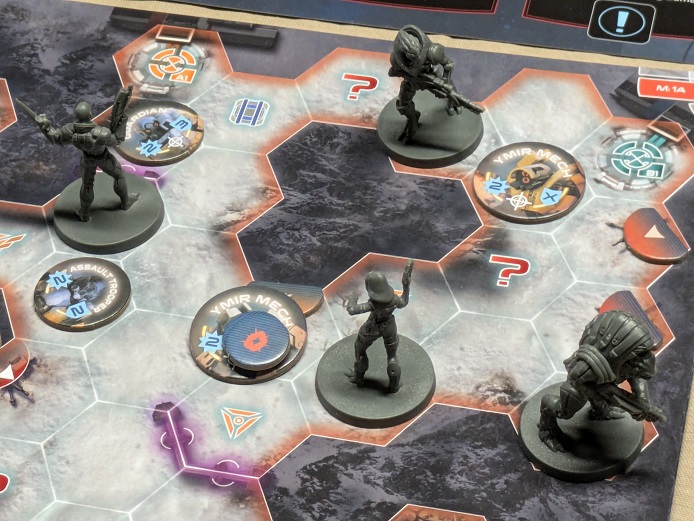
When I take a step back and really analyze what this game is and who it’s for, it’s obvious that it’s extremely successful in accomplishing a difficult task. It compares very favorably to the standard Prospero Hall-style of game, for instance, offering a more complete vision while similarly landing in a space friendly to newcomers. While the quality of mass marketed titles has risen in the past decade, this is easily in the upper end of that offering. Some will lament the small scope, instead desiring something like the recently Kickstarted Rogue Angels, but that’s a preference and not a shortcoming of the design. Priority: Hagalaz actually contains a somewhat broad scope within the restrictions of its price point and physical format.
This is really the key to critiquing this work. Its position as a title between mass and hobbyist markets strongly influences its capabilities. I believe this game will get a lot of praise for what it’s able to pull off within those restrictions. At a $50 MSRP, it offers a similar impression to hearing Godzilla Minus-One was crafted with just a 15-million-dollar budget. Sometimes the constraints are bare, such as the densely scaled maps lacking volume, but more often than not, the clever bits overshadow those aberrations.
I have to imagine that a Mass Effect fan would find an even stronger connection to this work. It feels lovingly crafted with passion. The combat is entertaining and the balance of simplicity with depth is enough to engage a relatively wide audience. This is a game I’ve greatly enjoyed, regardless of not understanding who any of these people are. Coupled with the similarly effective Mandalorian Adventures, Mass Effect: The Board Game – Priority: Hagalaz has inspired my optimism on what possible future games may be crafted in this emerging mass market plus category. Perhaps this is the legacy of Prospero Hall, shifting us towards a more involved and cultivated future. It’s a wonderful time to be a board gamer.
A review copy of the game was provided by the publisher.
If you enjoy what I’m doing and want to support my work, please consider dropping off a tip at my Ko-Fi or supporting me on Patreon.


Sounds like they accomplished what they were after. Great review.
How practical would it be to drop the load-bearing Shepherd and have a limited number of revives for the whole team?
LikeLiked by 1 person
That’s not a bad idea at all. It would need to be a low number, however, but it would be worth testing. Good suggestion.
LikeLike
While it’s consistent with the video games (if Shepherd dies you restart the mission) as you note it leads to a situation where optimal play is boring for the Shepherd player.
LikeLiked by 1 person