
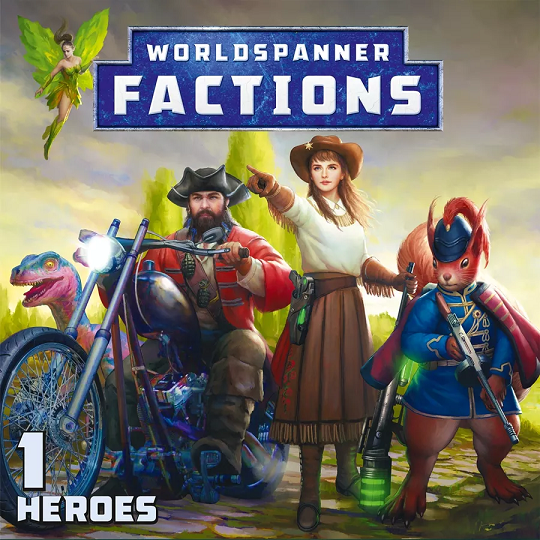
Brett G. Murrell’s Worldspanner Factions is effectively Duel of Ages III. The genealogy of this system stretches back 21 years to the original set. From the beginning, this game featured wacky competitive adventure full of oddball moments like Robin Hood riding around on a motorcycle wielding an assault rifle. It’s as nutty as it sounds. If you’re familiar with my proclivities, you’d likely be surprised to hear that I’ve never played Duel of Ages. That needed to be rectified.
This game feels like a relic. As if someone unearthed a historic curio that was later determined to be of great significance. That’s not to say the design is overly dated or out of touch, but rather, it has a distinct feel that is of a different time and place. This quality is daring and fresh in the current oversaturated market, as it imparts a sense of distinction that is often absent.
As a point of comparison, I recently played Endeavor: Deep Sea. This is an altogether new effort that iterates upon the original 2009 old-school Euro design. It refreshes Endeavor by coupling the core action system to a modern sandbox style of exploration, alongside a modular framework with varying setups and goals for extensive content-focused replayability. You can see where the fabric of venerable and modern design trends are stitched together, homogenizing the experience and bringing it in line with contemporary principles.
Worldspanner Factions is indeed partially a modernization of Duel of Ages II. My research tells me that it’s a faster game with a compressed map, streamlined systems, and a trimmed down ruleset. The adventure system has been tweaked, artwork is largely improved, and a new faction mechanism has replaced character types. Look, I don’t know the impact of much of this. At least not directly. But I do know that this current version does not feel like anything else I’ve played. This is not lacking character, distinction, or ambition. This is something else.
The format of play leans towards the MOBA style of video games. Games like League of Legends and DOTA. It’s an open arena, here comprised of modular tiles full of various terrain types and locations, where two teams square off in a head-to-head battle. It’s easy to assume this is a skirmish or combat heavy game, and while there’s some of that, the bulk of play is centered upon exploring adventure sites and performing skill tests to claim area control.
In board game vernacular, it’s sort of a third skirmish and two-thirds adventure game. Part of play is stalking your opponent and trying to catch them vulnerable for an easy gank. Another larger part is rushing towards scattered locations in order to best the challenges and claim ownership. This format explicitly works. It’s a bit of a race game, trying to control the most sites by the end of the 10-turn limit, and often the control of these locations will ping pong back and forth. In isolation, this action is somewhat rote and repetitive. However, there’s this dynamic flow of the battlefield with characters respawning in random locations, some unfortunately cut-off from their allies or fortuitously placed near a desired tile. The tension can be high as players engage in games of chicken, often attempting to lure weaker targets from the safety of their cohorts.
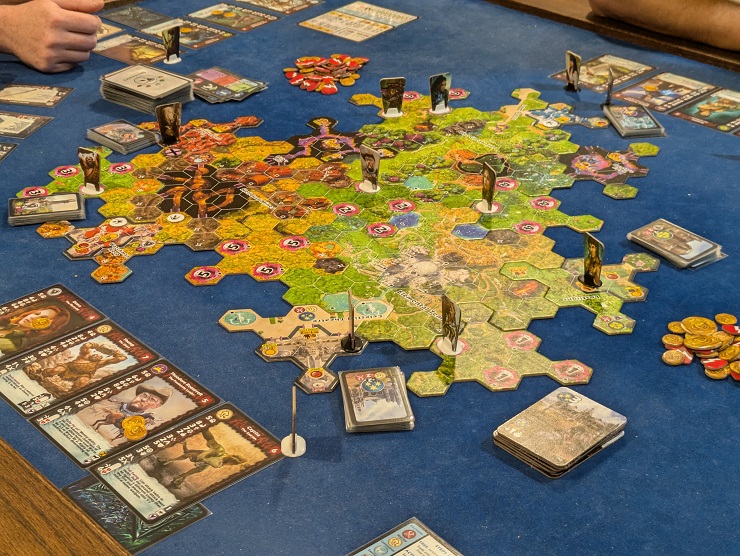
That description of skirmish by way of adventure game is a simple breakdown of a rather complex affair. There are over a hundred characters across the base game and expansion. Each possesses numerous stats applied to various skill tests at the adventure locations. Several different characteristics are used in battle, possibly combined with one of the many weapons or pieces of armor found in the various treasure decks. Each character also has a personal ability or effect. Their own movement and starting resources too. Oh, and each side controls eight of these unique individuals drafted from a larger pool at the beginning of play. That means in a two-versus-two game, you and your partner are responsible for four characters each.
It’s not quite as psychotic as it sounds. Each character only receives a single action each round. This is typically used to move, but it could be instead allocated to a ranged attack if you possess such a weapon, or to deploy a minion if you’ve scooped up a monster or drone when plundering. What is somewhat daunting is the actual structure of the turn, as it’s a multi-phase approach with free action, action, opportunity fire, adventure, and cleanup phases. Again, depending on your perspective and expectations, it flows relatively smoothly. All players on a team act simultaneously, cutting the length of a turn down tremendously. This works too, it’s not just a gimmick. Sometimes there’s strategy discussion as you divide and conquer or perhaps form a consolidated attack, but this is not a game where downtime feels significant. You’re invested in every action and every turn, as it’s either your side pushing to gain ground or the other side pushing for you to lose it.
While the flow of play is appealing and juiced with the right amount of pressure, Worldspanner Factions achieves much of its verve by riding atop an undulating substrate of anarchy. The cast, the conduits with which players interface with the game, are not random archetypes. They’re a mix of fictional and real-life characters. Combine these icons with an absurd armory of weapons and vehicles, and you have utterly farcical situations such as Genghis Khan laying down fire with a World War I Vickers machinegun, trying to nail Teddy Roosevelt as he rides a wave runner across a lake. It’s the type of thing that almost gets taken for granted after a few rounds, as you will have to stop and just assess how wild the whole thing is.
In a sense, the game is all about upending archetypes. Similarly to subverting expectations with the cast of characters, the test system takes an unusual turn by relying on card draws instead of dice rolling. This is utilized for combat as well as skill tests at adventure sites. At first I felt the system was a little clunky. I didn’t want to draw a card to check if I hit and another to test for damage, with both steps containing an awkward tempo due to comparing target and defender stats. It reminded me of the multi-phased dice rolling in Warhammer and felt incongruous to an otherwise fast resolving experience. After some time, the process began to smooth and we got into a rhythm. The benefits of such a system – such as shaping the probability curve and providing for multi-layered results more simply than the typical wargame CRT – emerged with familiarity and my appreciation grew. I’m now fond of the quirky card-based resolution.
The unique adventure game format is another smashing of archetypical structure. Most significantly, it solves a traditionally challenging design problem. The vast bulk of this genre tries and fails to integrate player conflict into the free-form sandbox of overland exploration. Games like Merchants & Marauders and Western Legends manage it best, but even there, these moments are relegated to rare occurrences due to the heavy risk or unusually complex systems involved. Worldspanner Factions completely avoids the deficiency by integrating skirmish game principles into its composition. It engages the benefits of such a format, injecting tension and texture into the game to elevate the other elements and produce a more wondrous work.
This also complements the team setup extraordinarily well. By framing this as a group-versus-group affair, it creates an element of direct competition that is not limp or passive-aggressive. There is confrontation, trash-talking, and a healthy dose of hollering when dramatic moments occur. It’s a wonderful feeling, adopting an almost sports-like tone that is expertly supported with the interlocking systems. It’s also frankly astonishing how well it works at nearly any player count. Lopsided teams, often a large issue in such games, function without a hitch. Perhaps unexpectedly, the weakest player count is one-versus-one. The absence of partnership leaves a bit of a void, and I find myself wanting for other games more suited to the task.

One of the strongest assets springs forth from the sports-like competitive footing. This is a battle royale, not a simulation of setting. Other games, such as Star Wars: Outer Rim or Dungeon Degenerates, are focused on producing moments of story that are faithful to the experience each promises. It’s just as much about world building and consistency as it is about dramatic schemes. Worldspanner Factions is not wed to a specific setting. There is no restriction. It’s balls to the wall nonsense, but within the competitive framework of the MOBA-esque clash. The explosive emergent bits are in the combination of wacky inputs and player-driven encounters.
This offers a feeling of inventiveness. The vision is clear and you’re intermingling in that chaotic slurry, thrashing about and trying to leave your mark. It’s fascinating.
Yet, the delivery is not guaranteed. Part of the nature of this retro approach to game design is the lack of guardrails. It throws you into the pit but doesn’t ensure it will all shake out first-class. I’ve already touched on the tit-for-tat nature of controlling adventure spaces. Without players participating in the sharper skirmish portion of the game, the grind can set in. Part of this conundrum is the adventure loop.
The main activity performed is spawning in characters and then making a bee line for adventure sites. Successfully completing the skill test at one of these locations places your team’s token on the space, claiming ownership. As long as you have the majority of tokens on a particular tile, then your team is actively scoring one point. This is the game. It’s the back-and-forth tug of war that supersedes the violent outbursts occurring throughout.
When you attempt these adventure challenges your character is removed from the board and respawns on a random entry tile. This occurs whether you succeed or fail. This means that ineffective play is not only inconsequential to the area control objective, but it also resets your character’s position. There’s a strong onus on identifying where you can actually find success, as risk-taking on pursuing the adventure locations is particularly ill-advised. You may spend two or three turns in a 10-turn game just moving to the spot you’re gunning for, so you better damn well make sure the odds of success are stacked in your favor.
Additionally, choosing characters in the initial draft that are poorly suited for the randomized map is death. You must choose characters whose abilities and characteristics work with the current setup. I witnessed a game where one side was wielding a ferocious tree-man who was legitimately scary in melee, but he was also as slow as a deep-rooted oak. He blossomed in wood or swamp terrain where his movement was free and he could bounce in and out of combat. Of course, our randomized board possessed very little of those terrain types and they should have binned the dude.

There’s also something to be said for the game’s expansiveness. Currently, three boxes are on offer. Set 1 is the base game and completely necessary. It has all needed components such as map tiles, decks of cards, and a large range of characters. Set 2 expands everything. Yes, everything. Maps, items, characters, they’re all nearly doubled. The third set is entirely devoted to a cooperative or solitaire campaign system, offering a multi-session narrative driven experience that seems just as wild as the core game’s ethos. I will be writing about this third set in a separate article, for that deserves undivided attention and a more thorough analysis.
What’s really nutty is that Murrell is not finished. This is only HALF of the content. Three more boxes will come in time, and the totality of this game’s vision is immense.
While I can take this game off the shelf and get it running relatively quickly with a scan of the player aids and reference cards, it seems positioned as a product that is a borderline lifestyle game. The content is already so vast that exploration of various party compositions and unusual map designs is indefinite. The emergent narrative is always curiously singular, and surprises materialize continually. There’s an element of skill that can be chased due to the game’s strong competitive structure, and it feels like the type of thing that could sustain a healthy long-term community.
One thing I didn’t expect to find in this game was a newfound discovery concerning self-awareness. Under the auspices of this experience, I came to realize that the genre of skirmish gaming that constitutes my favorite style of play are these games that bring a stronger sense of adventure and environment. My buddy Aaron quickly identified this as a macro take on Earth Reborn, my enduring favorite tabletop design. I see flits of the same qualities as Core Space, Dark Venture: Battle of the Ancients, and even the flawed Dungeons & Dragons: Trials of Tempus. This is the type of experience that populates an area with interesting geography and obstacles then throws players in competition to pursue goals outside of combat.
Worldspanner Factions is one of the most unexpected delights I’ve stumbled into. It’s complex, baroque even, and certainly the type of game that would be admonished by devotees of strict contemporary design. It can be a slog and regularly clocks in at three hours of concentrated playtime. It’s also loopy and nonsensical. But this quirkiness is divine.
A review copy of the game was provided by the publisher.
If you enjoy what I’m doing and want to support my work, please consider dropping off a tip at my Ko-Fi or supporting me on Patreon.


Id love to see a solo review of this game.
LikeLiked by 1 person
I am very behind on this. I started the solo campaign but got distracted. I plan on writing about it when I finish.
LikeLike
Distractions…they happen.
LikeLike
Duel of Ages was not a great game but I still loved it
LikeLiked by 1 person