
Listen up you sickos, I’m going to tell you about something magical.
Back in the early aughts I went to college in a small town near Kansas City. I graduated with a Computer Science degree. I met my wife there. And I played heaps of Halo. Heaps.
I didn’t spend a lot of time drinking or whatever the in-person version of swiping right is. My vice was hanging a sheet across a rope that ran from the top of the television to our dorm room wall. It perfectly bisected the screen, forming a vision blind to spying on the opposing team. I’m dead serious. We were dead serious. It was some of the best gaming of my life.
None of this should be too surprising as you’re reading an article about playing with little toy Spartans. Not even the Roman ones, but dudes in power armor blasting away at each other on an artificial ringworld. Dork.

Fast forward 20 years to Mantic Games announcing Halo: Flashpoint, a new miniatures game utilizing their massively underrated Deadzone system as a foundation. When I heard this news I pulled a Raygun hopping around like a kangaroo and shooting bottle rockets out my cheeks.
There’s just no way they could botch this, right?
Of course they didn’t. This game is exactly what it needed to be.

The beauty of the Deadzone system is the cube-based movement. Instead of measuring tape or range rulers, models move by large three-inch wide squares dubbed cubes to indicate their three-dimensional extension. It’s almost like board game movement with intuitive distances and minimal counting. But aha, this is not a board game. It’s definitely still a miniatures game as the freedom of maneuvering is retained through positioning within each square. When you move into one of these cubes you can put your model wherever you like. It matters, for line of sight and cover are still handled as a traditional miniatures game.
There are some downsides to this system. The terrain you use really needs to conform to the square grid. You don’t want to be negotiating whether an oddly shaped building is divided across two or three cubes in the heat of battle. Most terrain does work, but the native Flashpoint or existing Deadzone kits really do fit best.
There is also some weirdness with diagonal movement. To assess whether you can move into a square that is diagonal, you need to check the orthogonal border of one of the neighboring cubes, and then again, the orthogonal border between that neighboring cube and the destination diagonal space. It’s a clumsy way to adjudicate whether a corner is blocked, but it does translate to something that is fair in practice.
It also breaks down a little when you’re trying to stuff more miniatures into a small space. There are figure limits to cubes, and it can occasionally influence tactical positioning in undesirable ways. This is less of an issue with Halo: Flashpoint in comparison to Deadzone, however, as this game only utilizes four models aside.
What these awkward traits buy you is a unique system that translates dynamic movement to tabletop miniatures gaming extraordinarily well. It’s effortless to quickly assess movement options and carry out decisions. When moving the actual miniatures, you don’t have to get a tool down into tight spaces or pick the figure up and count a half dozen squares one-by-one as you would in a standard board game.
While this up-tempo system is a pleasure in its own right, it’s an absolute brilliant match to Halo. One of the qualities of the video game franchise is a ballet-like physics engine. Players are crouching and dashing and jumping. Grenades are exploding and bodies are flying. It’s carnage, beautiful carnage.
The cube movement system is about as loose structurally as a miniatures game can get. It allows you to pick up your miniature and liberally place them in the destination square in whatever position you’d like. Feel free to carry them through the air as if the Spartan is jumping and gliding through the low gravity while everything burns down around them. The system actually captures these vibes and it’s stellar.

The combat system is less noteworthy. Attacker and defender roll opposing D8 dice pools and compare results. The margin of course translates to damage and it’s all sort of expected and routine. It works fine.
I do appreciate the “headshot” mechanism, which mimics the traditional exploding dice twist. If you roll an eight, then you get to toss an additional die. This can keep going. Endlessly if you’re so lucky.
Exploding dice systems are an excellent way to inject dynamism and unpredictability into combat. They produce drama as there is no strict ceiling on the result probability. It’s exciting.
I also dig the shield system here. Shields are ablated before health, but the shiny flourish is that they partially recharge each round. This is very Halo, as you often need to pursue a damaged target and hit them hard before they recover. It incentivizes aggression and desperation, two things you want in FPS-style gaming.
Much of the character of the game’s many firearms is conveyed through a large library of keywords. This mimics the Deadzone methodology, and it works to add distinction with minimal rules text printed on the weapon profiles. It does cause a bit of consternation in that you will need to continually flip to the appropriate pages while first learning the game and your team’s capabilities. I wish there was a large player aid sheet with all of the current keywords listed, but alas, you won’t find it in this box.
There are some killer tracks here. The gravity hammer, energy sword, sniper rifle, and Covenant carbine are all represented. These weapons are often joyful to employ, and best of all, the game doles them out like it’s Halloween. While each soldier profile has a native weapon such as a battle rifle or shotgun, they can pick up new firearms that spawn across the map. These create focal points for conflict to ensue as well as spontaneity in terms of tactical decision-making. It’s neat to acquire a new toy mid-turn, immediately locking on to a foe and letting it rip.

In addition to weaponry, there are a plethora of items you can snatch up. Things like active camo, thrusters, and frag grenades. One of my favorite implements, the plasma grenade, is represented expertly with the ability to stick to a target and ignore their shields. These are fun gadgets that shift play in various ways to provide for an ever-changing environment. But again, we run into the niggle that these items are represented by tokens and their details are listed on a chart that is buried on page 37 of the rules manual. This is an especially confusing start when trying to teach the game.
Another element of the system I’m conflicted on are the Command dice. This is a roll made at the onset of each round where custom dice are tossed for both sides. They depict symbols that may be spent during the round, such as to grant one of your characters a bonus action or die. You can pull off some neat combos such as activating two models in unison, bypassing the standard alternating activations. I do favor the momentum enhancement this injects, allowing you to chain together wild turns and bust the game wide open.
My grievance here is in the lack of fluidity. There are some exceptions around these rules that must be remembered, such as a model only being allowed one Advance or Shoot result during an activation. You can also use the Special Order result to trigger a team-wide ability. These are detached from the core profiles with a Spartan opportunity fire order appearing on its own reference card. This reminds me strongly of the Kill Team ploy system, which is worrisome. That approach to special abilities became bloated and scattered across innumerable products. I grew exceedingly weary with constant card referencing in the midst of play breaking down my morale. Let’s hope that doesn’t occur here.
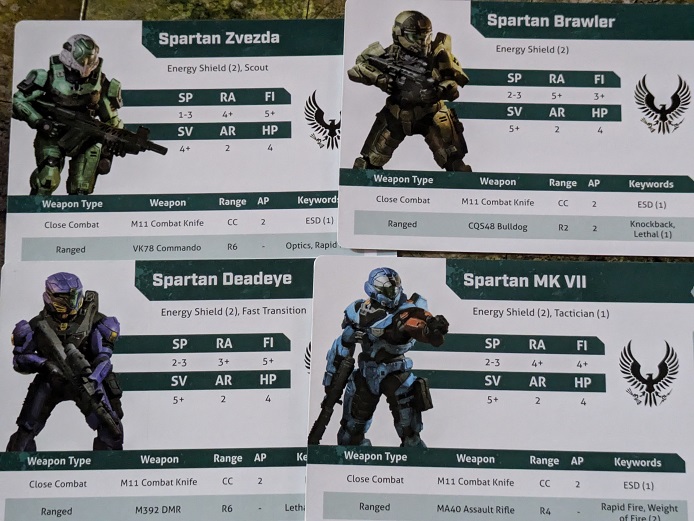
One of the key considerations of this launch is minimizing hobby friction and assisting players in getting this to the table. This is important due to the game searching for a footing with a wider audience familiar with the video game more so than miniatures gaming. It’s worth noting that the ruleset is not overly streamlined or dumbed down in any sense. This is a rich game when it comes to strategic thought and decision making. It’s not the equivalent of a gateway product attempting to onboard you to some other property.
While the lack of detailed reference materials is a substantial miss – one that threatens to damage an all-too-important first impression – the rest of the box is well executed. The miniatures, unlike Deadzone, are pre-assembled and of high quality. There are no large gaps or shoddy construction. The terrain is easy to put together and comprised of thick cardboard. It’s great stuff, offering a solid mixture of crates, half-walls, and small buildings. I cut my teeth on Necromunda and have always loved traversing a table populated with sharp cardboard structures. It also follows the Deadzone approach of printing a tutorial of sorts on one side of the paper mat. This functions well enough, although experienced tabletop gamers will have no issues bypassing this and heading straight to the full ruleset.
What’s particularly praiseworthy is how flush with content this boxed set is. There are multiple modes of play that are all given full attention. Capture the flag, strongholds, even oddball where you carry around a sphere in a deadly game of keep away are all present. I’ve played several different formats and they all have provided for delightfully unique interactions.
This also points to the risky yet smart decision to lean into the multiplayer FPS angle. This is not a narrative dungeon crawler with a 30-hour campaign. There’s no leveling up or enhancing your troops over multiple sessions. You don’t need to paint scads of Covenant or Flood miniatures just to get a proper game in. Instead, it’s ripping nades across the skybox and shoving an energy sword into your foe’s jaw. Ragdolling and respawning makes sense as the game loop is true and tested. This approach allows for the toyetic inclusion of weapon and item drops, as well as syncing with the very confined 2’x2′ Deadzone battle space.
Another key component of this jumping off point is that the competitive multiplayer format means they don’t need several armies immediately. There’s some innocuous fluff about training, but none of that matters. We don’t need a story. It’s just pure combat, Spartan-to-Spartan, with fistfuls of dice.
There is a lot up in the air. I’ve only played with the Recon Edition of the starter set; this is an introductory box that contains a small amount of terrain and eight fighters. This is just enough so that it doesn’t feel like a handicapped offering which only captures a glimmer of what the system feels like in play. Many larger miniatures games really suffer in this regard. I’d compare the Recon Edition to a Kill Team or Warcry starter.
It does leave you somewhat wanting in terms of customization. It’s difficult to form a complete picture of how the game will shape up, but it seems as though fireteam customization is a legitimate consideration. I get the impression it’s not an optional addition for tinkerers, but rather the standard way to engage with the game and utilize an extended offering of future products.
A larger Spartan Edition will soon be available with additional figures and terrain, as well as a swathe of new weaponry. I’m curious to see if there’s a logical upgrade path for the Recon box, or if that content is locked away behind the larger set. I did lament the absence of iconic weaponry such as the needler in the Recon Edition, and it will be a shame if those jumping in here feel as though their money was wasted on the smaller starter set when they ultimately burn extra funds for the larger product.
There is one more thing. Mantic will have trouble dodging the big question: what about Warthogs and Banshees? A huge part of Halo are the vehicles and how they interact with and influence some of the more memorable sequences of the video games. They won’t work in this Deadzone-derived system, but I wonder if it’s possible we see a sister-game launched in the far future that more closely aligns with Mantic’s Firefight. The Firefight ruleset exists in a liminal state between mass battle and skirmish formats. It’s the logical next step, even if Deadzone is the stronger overall system.

I’m looking too far ahead and need to just focus on the immediate. Halo: Flashpoint is a fantastic experience, one with a firm structure that begets energetic and captivating conflict. Movement flows like a high-energy sport, with warriors hauling across the battlefield and scaling scenery. Bolts of plasma and high-speed projectiles sear flesh and score concrete. If you can clear the item and keyword reference hurdle, this thing just darts along like the high velocity multiplayer shooter it ought to be. This isn’t just a reskin of an existing game, it’s a thoroughly riveting system that fits the source material perfectly. Yesterday, without hesitation, I would have named Deadzone as Mantic’s best game. Not today.
A review copy of each game was provided by the publisher.
If you enjoy what I’m doing and want to support my work, please consider dropping off a tip at my Ko-Fi or supporting me on Patreon.
 Player Elimination
Great review! This might be the minis gaming that I can actually get on the table – Halo is still my most-played multi-player game and I’m glad to see the gameplay shine through.
The lack of well-designed reference card is truly baffling. You can’t have a game be aimed as a gateway game and make you pass the rulebook back and forth every other turn.
Luckily, The Esoteric Order of Gamers already put together a fantastic reference here: https://www.orderofgamers.com/games/halo-flashpoint/
If they didn’t want to do it themselves they should have just commissioned from him and added it to the box. I also don’t understand that if these companies wanted true crossover appeal, they would do something similar to Crisis Protocol and have the characters sheets or weapons just explain what they do instead of list a bunch of keywords. Pet peeve that makes it just a little harder when introducing these types of games from friends, while adding it would give them the board gamer crossover appeal they’re looking for.
Regardless I just preordered a copy partially because of the resource above and this insightful review.
LikeLiked by 1 person
Thanks, Zak! That’s a great player aid, always pleased with Esoteric Order’s work.
The reference to Crisis Protocol is perfect, that game is so easy to teach a newcomer and have them play characters you aren’t even familiar with due to the plain text user on each character card.
LikeLike