
Plato’s theory of forms posits that there are abstract and unchanging ideals that exist in another realm. These are the non-physical beatific essences of all things. Imagine conceptually the ideal chair in size, shape, and beauty. That’s the form existing in its perfect state. Plato offers that objects in the material world are imitations of these abstractions and are in fact less real than that which they represent.
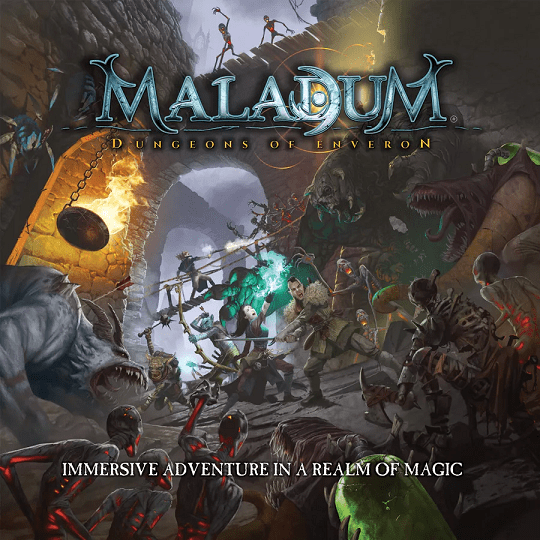
If the ideal form of a dungeon crawler exists, Maladum is the closest object in the material realm.
Escape From Enveron
What is a dungeon crawler? It’s not a straightforward question. If constructing a list, we’d include bullet points like “treasure”, “exploration”, and “tactical combat”. There could be a dozen or so criteria, and you or I may even disagree on some of the finer details. Cool. The takeaway here is that this is a malleable concept, one that’s stretched at times to include things like Street Masters and Betrayal at House on the Hill. But those are edge-cases that draw inspiration from the category, they’re not genre-titles themselves. More traditionally, I think of games such as HeroQuest, Descent, and DungeonQuest. Now those are Dungeon Crawlers™.
Maladum is not traditional. It hits on almost all of the bullet points on our list, but it’s an unconventional approach to the format. It hews closer to video game extraction shooters such as Escape From Tarkov and Call of Duty: Warzone DMZ. That’s because your primary objective is to get in and get out.
This is a survival game, albeit one played with specific scenarios possessing their own goals. While not a strict requirement, anyone who plays this game seriously will be playing it as a campaign. Your characters are retained and improve across many delves. Scrounged loot carries forward, and whatever you take into the dungeon you risk losing. Gold is of the utmost importance, as you must pay out your crew in addition to spending it on supplies and new gear in the town phase between scenarios.
The structure of Maladum is what makes it a singular tabletop experience. Standard missions are offered, such as rescuing a prisoner or slaying a particularly menacing beast, but you always have the main tasks of looting as much as you can before making your escape. The scenario does not end until you exit from your entry point of the dungeon. As time extends Doom accumulates, resulting in an increased intensity and quality of enemy spawns. Event cards triggered each turn also become more acute the longer you dawdle with your fingers in the loot bin. The farther you stray from this point of safety, the more significant the oppression and tension. With each room you push deeper, you feel the water in the kettle begin to bubble and gasp.
The extraction format significantly alters the feel of play and distinguishes this design from traditional crawlers. It’s woven throughout the design and is the primary factor to shaping the game loop. Loot is often abandoned or left behind in haste. Scenarios typically offer sub-objectives which you must triage as you can’t accomplish them all. Characters will eventually need to abandon the mission and make a break for it, sometimes being left behind.
The scenarios can be presented as isolated missions tackled in any order, or as a structurally linked preset story with branching pathways. The prescribed narrative is relatively light for this genre. There may be a paragraph of flavor text at the onset, but that’s usually it. What’s interesting is that you can jump between these two styles, taking a break from a structured series of story scenarios to play a one-off mission in the middle.
This flexibility is the fabric of Maladum’s ideology. It’s a primary contributor to its supremacy.
It’s important to understand that this design is rooted in miniatures gaming. Old-school miniatures gaming like Rogue Trader and Warhammer Quest where roleplaying concepts bled into skirmishing and the resulting solvent was inseparable. Similarly, Maladum embraces creativity and entrusts players to regulate and author the experience. For those wanting something rigid and structured like a modern board game, this may be unruly and frustrating.
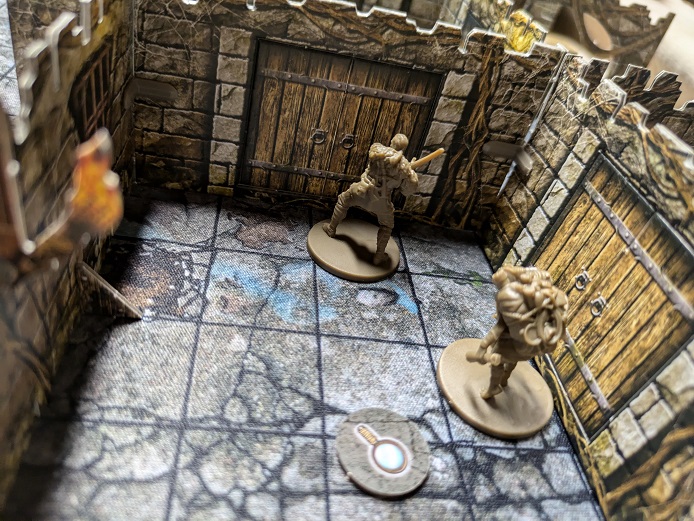
The flexibility of the campaign format is only one such marker. That liberated approach is found all over the details. For instance, someone in the Maladum community asked how far the hinged cardboard doors should be opened as they affect line of sight and cover. The doors punch out of the walls but are attached on one side, allowing you to fold them open and closed during play. But do you open them 45 degrees? 90? It doesn’t matter. Just open them and play. Do what feels right.
Another example: when searching a room, you draw a random item from the treasure pouch. This pouch is a neat system as it contains a whole host of little cardboard counters that function as items of various utility. Weapons, armor, potions, food, and many other things can be found in the bag. With just a few icons and numbers, each treasure is unique and intriguing. But there are multiple sizes of tokens. Some are square and others are smaller rectangles roughly half the size. Now, you know that weapons and armor are larger than consumables, so a ne’er-do-well could easily cheat when drawing out of the bag if so inclined. The rules state you are supposed to draw a token randomly, but someone used to an Uwe Rosenburg or Chad Jensen rulebook would wonder how?
The movement and map interaction also have quirks. This game is built upon Battle System’s Core Space rules framework, transfigured through alchemy for this fantasy experience. Beyond the fact that it takes 20-minutes to setup the 3D walls and scenery, the actual coordination of physical and ludic structures is, at times, awkward. Its predecessor used a classic miniatures game free-form movement system with measuring tools. Upon realizing that this game appealed strongly to the board game market, they shifted to using one-inch squares as the default in Core Space: First Born, the second title in the series.
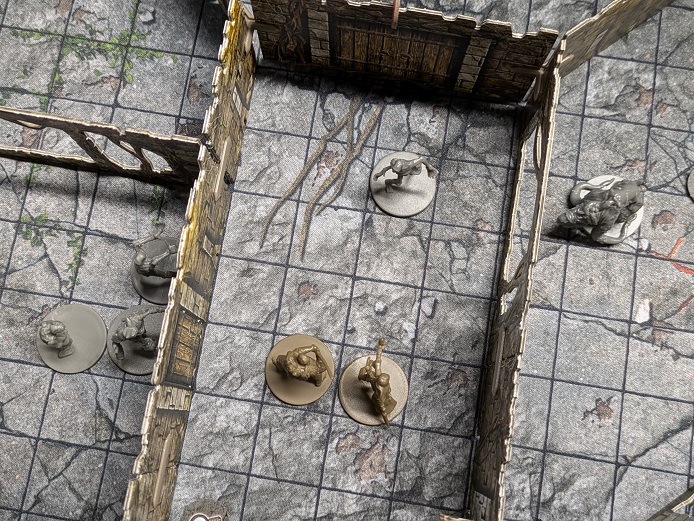
This is carried forward to Maladum. While it speeds up play and certainly opens the game up to those who reject rulers, it remains clumsy. Sometimes squares are bisected diagonally by walls resulting in half-spaces you cannot move into. Occasionally terrain will be shifted or slightly askew, which leaves fractional spaces that are a no-go. It also places a heavier burden on setup, as there is an assumed pressure of really figuring out which exact squares the well or table or whatever occupies. When measuring with inches instead of squares things don’t need to align perfectly. You can be off a little because it doesn’t really matter. Now, precision is of significance as any square-misalignment has a possible effect on gameplay. You can agree to just ignore obvious situations where the restriction shouldn’t apply, but it requires adjudication and reading the vibes of the table. This feeds into the game’s overall squishy disposition. With all that being said, you can of course still use inches and the rulebook calls this out, but it feels somewhat like using a variant and bucking norms.
These elements form a good philosophical test on whether this game will scrape against your soul like dollar-store sandpaper or wrap around it with the warmth of a weighted blanket.
If you’re down with such freewheeling nonsense, then there’s something extraordinary here.
The emergent narrative is top shelf. Event cards produce wild output like spawning a bear that’s now protecting a corner of the dungeon as its lair. It may even maul some of the revenant horde that perpetually stalk you. Another event will scatter your entrance to the far side of the map, forcing you to quickly shift your path through the dungeon and reformulate a strategy on fly. There’s a quality of unpredictability all throughout.
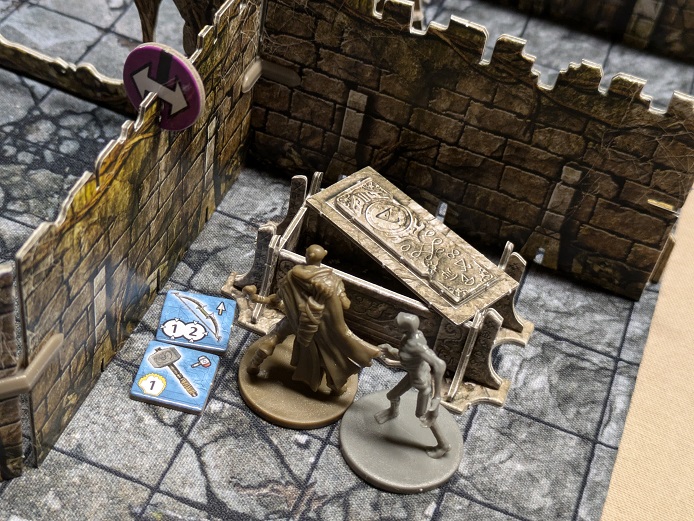
Many of the environment details are interactive and dramatic. Popping open the 3D chests on the board and sifting through physical loot is toyetic bliss, but it’s also terror when you stumble into a trap that causes an explosion and breaks half your party. You can pick up a chair and use it to beat a foe or bust through a locked door to flank the Rot Troll barreling down upon the group. You can grab torches from the wall and then use them to set people and things on fire. Cracking open tombs results in wonderful treasure, but it also creates a new entry point for the skeletal bastards hunting you. There are secret doors, hidden rooms, and neutral adventurers that arrive on site and may even hire your services – yet none of this is scripted as part of the scenario, instead emerging from the collision of various system elements. That’s not to say that the scenarios aren’t interesting and evocative in their own right, because they are, but the scenario writing is an additional layer that intermingles with the spontaneous narrative equity to create a cleverly cobbled together golem of revelation.
The mechanisms that govern the small stuff, such as activating characters or rolling dice for combat, are all perfectly fine. The engine is solid and surprisingly streamlined. Fighting consists of building small dice pools and subtracting your target’s armor from rolled successes. It’s quirky in that it can be easy to generate a small amount of hits but very difficult to roll a large number. This means armor is incredibly strong on both sides and can largely influence play.
But as I said, it’s all fine. No one plays Maladum due to the enemy AI or how the status effects work. There are no sophisticated arrangements like dual-use cards or stamina management. It gets most inventive with the magic system, where your intended result can go haywire and produce the odd spectacle. It fits with the wily storytelling approach, just as you’d expect.
No, people play Maladum for the canticle of the unexpected.
Core Space 3.0
While my enthusiasm for Core Space hasn’t faltered since 2019, I must admit that my desire for Maladum was relatively low. To understand why this is, we must talk about Core Space: First Born.
Astute readers may have noticed that First Born did not make an appearance on my 2021 best of the year list. I am one of Core Space’s loudest evangelists, so what gives? Assuredly, First Born is a well put together product that expanded the setting and system reach. It enriched solitaire play and was a solid step in adapting the game to its audience’s preferences.
But it was also ordinary. Yes, the new enemies were interesting, as was the temple environment. There is some fantastic content in the game with material such as the Insane God. But the gameplay was familiar. Many of the new flourishes were lateral additions, as the compatibility with the original game is overstated. Are media crew and hunters better than gangers and galactic corps? Not really. It’s a trade-off.
Several system alterations also hampered the ease of crossover play. Class boards were changed and incompatible, new options such as mining don’t port over, and the event decks don’t mix well. You could transition between both environments, but it becomes messy, and it is far easier to treat them as separate but similar games. First Born also never really manages to capture the chaotic circus that was OG Core Space with every expansion mixed in, so playing it is always time spent away from the stronger experience. Thus, I appreciated and played quite a bit of the follow-up title, but my fervor just wasn’t quite there as it was back when the original landed. With all that being said, there’s a possibility I never return to either Core Space box.
Maladum is a significant improvement.
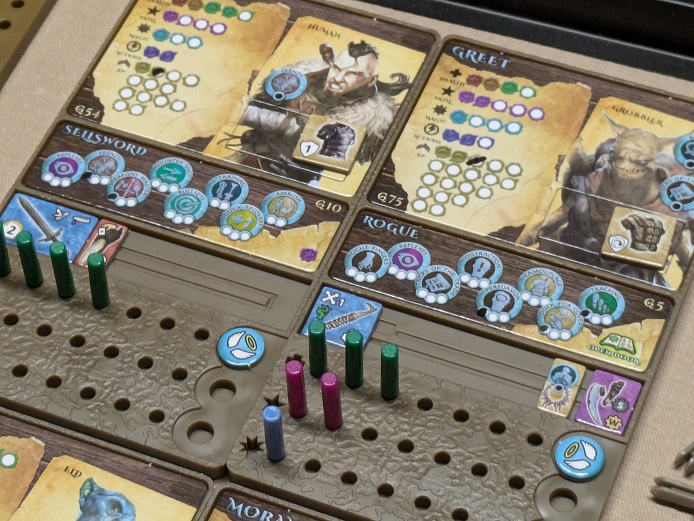
There’s not one big swing here, instead it’s a bundle of small tweaks compounding to a momentous shift.
The more solidified story campaign with forked pathways is a spectacular addition. Keywords are utilized in a similar fashion to Tainted Grail, so the game can respond to previous decisions you’ve made or outcomes you’ve endured. This expansion of consequences allows for more creative objectives and event triggers within the scenarios themselves. It also reinforces the pressure on the group, penalizing you for taking too long in a dungeon or neglecting campaign progress with a new “delay” mechanism. This approach is harnessed to strong effect and results in a satisfying payoff. Sensibly, this new format doesn’t interfere with the old way to play, as you can still partake in disconnected scenarios with your crew just as the Core Space campaign system functioned.
The extraction of fallen party members is also more strongly focused. If a character was left behind unconscious in Core Space, you could embark on a rescue mission, try to teleport the crew member back to your ship, or roll on a chart and have the character fend for themselves. Teleportation is eliminated here and leaving someone behind to fashion their own escape is much riskier, almost always resulting in equipment loss. This is such a great change, as it actually incentivizes you to perform rescue missions. They were rarely worth the effort before but they’re such a neat idea. One benefit is that they work to alleviate one of the game’s primary pain points since you don’t need to setup a fresh dungeon to play your next scenario. Instead, you simply return to the previous map and attempt to find your lost comrade. I’ve long lobbied for the creation of multiple scenarios that utilize the same exact dungeon layout for this exact purpose, and rescue missions naturally appeal to this request. It’s fantastic to spend more time playing and less time connecting walls or carefully placing terrain.
The between scenario stuff is greatly enhanced. It’s still not as complex as something like Shadows of Brimstone’s Frontier Town expansion, but there is an interesting decision between staying in the wild on the cheap or kicking in coin for an inn. Each has its own events table that can throw harsh realities or pleasant surprises your way. The between mission stash size is also influenced by this decision, which adds nuance and restricts item hoarding. Party upkeep is more fleshed out and active from the start. It’s similar to the system from Core Space: Dangerou Days, but it’s integrated into the core rules structure and not tacked on via supplement. The general economy is more developed and mature. Consistently, it feels as though you’re scraping by and barely cutting it. I find this state highly desirable, as you want that Cowboy Bebop or Firefly atmosphere of hard times. It heightens the actual reward of finding a special item or discovering a huge pile of loot in one of the secret rooms.
One of my favorite elements is how the treasure bag was tweaked. It now includes trap tokens which add a constant threat even in the quiet moments. This can be something simple like an alarm bell ringing, or something as dastardly as an explosive or swinging blade. Secret rooms and hidden doorways are also mixed into the treasure pool. Numbered tokens have you reference a paired card from a large deck which includes farther instructions. Entire rooms can be spontaneously added to the map, rooms full of both loot and danger. This is fantastic and such an organic extension of the existing mechanism. It also balances out the increased risk with traps, making for a search mechanism that is more dynamic with a wider band of possible results.
Challenge level is another area of improvement. Core Space never really scaled as crews grew stronger. Some of the expansions added nasty additions such as the Purge spider entity “Mother” which could devour a character permanently killing them. But there was no actual framework for escalating difficulty over time. Maladum rectifies this by including event cards tailored to your party’s ability. It does require you add up the value of all equipped items, but the total rating of your group establishes whether you add a subset of easier or more difficult event cards to the deck. This is a solid addition to the system and should inject new life into the game late in a campaign.
One new crowd pleaser is the Rest action. This allows you to effectively pass your turn in order to recover a health or skill peg, as well as some other benefits such as removing negative status effects and restoring mana for spellcasters. The skill peg is the important thing here, as a common complaint in Core Space is that the heroic abilities could only be used once or twice per play. I actually appreciate this detail as it leads to a more grounded and realistic experience. This works well with the gritty sci-fi setting of the original game. Here, allowing you to squeeze some more juice out of your abilities is probably a good thing. This is Warhammer-like hyper-real dungeon crawling that leans towards bravado. It makes sense, and it’s executed in a way that enhances tactical decision making. It works on an emotional level as well to widen the gulf between this game and its predecessors in terms of setting and tone.
While there are fewer neutral combatants – civilians filled this role in Core Space – the interactions with what Maladum calls “denizens” are now more meaningful. Sometimes a random adventurer you come across may offer a side quest that rolls over to the next scenario. These typically provide a secondary goal atop the mission objectives, adding increased texture to the adventure. On the other hand, denizens can be concerned with their own priorities as they often possess more sophisticated and varied behavior. There is also a wider range of beasts and monsters that fight for neither the players nor their undead adversaries. This means more dramatic collisions of interests between various parties in the dungeon, altering the topography of danger and forcing tactical adjustment. This type of interaction is the core of Maladum and what makes it special.
A big economic and progression change is the separating of items in rarities. This allows for a gradual scaling of reward as the treasure pool grows in potency over time. It’s also easier to sort the tokens and feels well thought out compared to some of the growing pains in Core Space. There is still the occasional rough spot, such as needing to search through the treasure pouch to find a particular food item or potion as the result of another effect, but it’s mostly a cleaner implementation than Core Space presented.
Much of this has that intonation. Maladum feels a mature effort, one which has leveraged design lessons across the length of Core Space’s existence. It feels built from the ground up to support these new systems and embellishments, unburdened in a way that First Born couldn’t be. There’s less flipping between books and support material, as the overall holistic experience is more coherent and focused.
This is why you will see Maladum: Dungeons of Enveron on my best of the year list. It’s constructed with a sharp precision that points back to the original Core Space. Content is integrated more naturally, systems flow more smoothly, and it comes across as an orchestrated effort where the notes are layered in unison. If I could snap my fingers and the dungeon could set itself up, this would perhaps be the best game to ever grace my table. I guess it will have to settle for the near perfect representation of the dungeon crawler form.
A review copy of the game was provided by the publisher.
If you enjoy what I’m doing and want to support my work, please consider dropping off a tip at my Ko-Fi or supporting me on Patreon.


”If you’re down with such freewheeling nonsense, then there’s something extraordinary here.”
I’ve found this to be the most important mindset when approaching Core Space and Maladum. Its beauty is in its emergent chaos. I’ve seen some board gamers (as opposed to miniatures gamers) struggle with the looseness of Maladum/Core Space, but it’s ultimately rewarding once they let themselves be open to the freewheeling nonsense. Maladum is still a little clunky, but in the best way possible. I love it.
LikeLike
”If you’re down with such freewheeling nonsense, then there’s something extraordinary here.”
I’ve found this to be the most important mindset when approaching Core Space and Maladum. Its beauty is in its emergent chaos. I’ve seen some board gamers (as opposed to miniatures gamers) struggle with the looseness of Maladum/Core Space, but it’s ultimately rewarding once they let themselves be open to the freewheeling nonsense. Maladum is still a little clunky, but in the best way possible. I love it.
LikeLiked by 1 person
Due to the looseness, I think there’s a lot of best practices that are not outright stated, things I’ve learned or developed over the years to help with some of the fiddliness. I may write an article about that at some point.
LikeLiked by 1 person
Great review, as per.
We had a brief dialogue about core space a while back.
I like the sound of what you discuss here very much, but have two problems with the nature of this particular offering from Battle-System, being, as it is, so firmly planted in generic Fantasy (i.e. I think the problems, or the first one below at least, more conspicuous here than they are with Core Space and spin-offs).
Firstly, I find, as a first-generation DnD’er, the great strength of the better DC boardgames to be the gradual ‘visual’/ physical revealing / exploration of space / enivironments. This creates a lot of the enjoyment / immersion for me, and is a key aesthetic pleasure too in terms of the overall ‘look’, if tiles are well done.
As a result I’m having a serious look at Descent again (the second edition at this point – although I’m much encouraged by your review of 3.0 to give that a go).
I find Maladum’s approach of having the entire terrain set-up present and viewable at the outset a bit contrived in comparison (I appreciate I’m talking degrees of contrivance here!); it’s certainly closer to a miniatures skirmish game in this way, and I suppose is indeed a hybrid approach, so perhaps my comparison is unfair.
Given how good and atmospheric the terrain looks in itself, it’s quite the irony that I’m discouraged from getting into the game due to its monolithic presence from the get-go.
And in this context, I’m intrigued by your mentioning the addition of rooms on the fly – difficult I would have thought, particularly in the case of dense original scenario layout-outs?
Secondly – I’m assuming the retail terrain components for the game are still a glossy-ish finish?
This is a key issue for me – if you look at the stuff used in BS’s product images (many of them anyway) they’re ‘matt’ – and this greatly increases their effectiveness as terrain pieces.
Presumably due to robustness concerns, the commercial pieces are kind of glossy (more on one side than the other) – at least everything I’ve seen up to now has been (not seen the Maladum pieces).
I’ve attempted to matt them down without success.
And yet more irony – it’s the more naturalistic excellence of the pieces in the 3D sense that makes me want to have non-shiny. I don’t have such a problem with 2D tiles.
Anyhow … a couple of thoughts. TBH, I’m still tempted to give Maladum a go, after reading your review.
LikeLiked by 1 person
These are all fair concerns.
I don’t find Maladum overly shiny. The tokens and dry-erase stuff (like character boards) certainly are, but I think the walls are indeed matte finished.
The setting is generic, for sure. It has its own races and background, but it’s not particularly inspiring. I had some words in the review dedicated to this, but it was getting too long and I cut it. I find I don’t really play Core Space for the setting beyond the Purge and an open sort of cyberpunk canvas. I view Maladum the same way. But it is indeed as generic as it looks.
Although, there is a tiny bit of appeal there in a nostalgic way, hearkening back to HeroQuest.
Exploration is non-existent and that can be a big negative for some. The way the secret rooms work is that you put down a little hidden trapdoor tile on the room, and then setup the new room by itself off to the side of the map. The trapdoor space is adjacent to the room’s entrance, so you can move between them. It’s pretty clever and very neat during play. It’s not something you run into extremely often though.
FYI – unless I’m misremembering, Descent 2nd edition didn’t have an exploration element either. Dungeons were fully set up to begin with. 1st and 3rd edition do have an exploration element.
LikeLiked by 1 person
blimey – re: Descent 2nd edition not placing tiles as you go.
I was looking to play solo with the app, and a dry-run or two seemed to work that way (gradually revealing the scenario terrain …).
Hmm, I have an ebayed copy of the core game coming soon I hope – so will soon find out I guess.
LikeLiked by 1 person
I’m ‘Marc’ btw – seemed to have been changed to ‘insightfule’ which has got be an improvement …
LikeLiked by 1 person
Ha!
LikeLike
Ahh, I don’t know about the app, my bad. I played it extensively earlier in its release cycle before the app. Never mind me.
LikeLike
I agree with your article, and can attest that this is the H.O.L.Y. G.R.A.I.L. of dungeon crawlers: I’ve been playing them since the original release of Heroquest.
The BIGGEST enhancement over vanilla Core Space was the decision to include all supplementary rules in the vanilla rulebook in order to support emergent narrative. In doing this, the designers have created a more open system, tailored to the preferences of the player/s, rather than expecting an additional purchase.
The only serious limitation is the setup / tear down time which combined can take 1.5 – 2 hrs per scenario. Alas I’m not blessed with the extra space for a gaming table, which means a rather significant time-sink and translates to Maladum only reaching the table when all players can commit to 3+ scenarios over a week.
I’d finally comment that finding a game like this has diminished the appeal and draw to all other medium-heavy boardgames, which pale in comparison in terms of enjoyment and entertainment.
LikeLiked by 1 person
Setup and tear down is a big cost to the system. 1.5-2 hours sounds a little excessive, but if you’re taking your time and doing it carefully I could maybe see that happening.
LikeLike
And I’ll just add – apropos my comment above, that I wonder if the ‘Beyond the Vault’ expansion for Maladum effectively answers my problem with the fully-revealed nature of scenario terrain … need to find out more about it.
LikeLike
The supplementary rules do allow for the presence of a dungeon master to run the NPCs and also mention optional ‘fog of war’ if you choose to go this route.
I don’t find the pieces overly shiny as they’re cardboard, not plasticy and the sombre rubber mat kills any reflection / uplighting. Played with the main lights off and one or two table lights, this really oozes atmosphere (especially with dungeon effect ambient background track).
I’ve yet to find a comparable tabletop experience.
LikeLike
While the advanced rules do mention revealing terrain as you go, I’m not sure I can see anyone seriously playing this way. It would be very slow in terms of gameplay due to having to setup stuff mid-session, and I also don’t know how you’d handle movement for a monster spawning on the other side of the unexplored map. I don’t remember it discussing how to handle this, but I only skimmed that portion of the rules.
LikeLike
1.5 – 2 hrs includes pegs, card sorting and stocking chests.
Re: fog of war, I think it it says to either stockpile monsters at relevant unrevealed entry points or, if preferred, to migrate to nearest entry point. To speed things up room layout could be setup beforehand and room contents added as you go (like Heroquest).
That said few folk who’ve tried Maladum would be willing to sacrifice joys of dungeoneering to be DM. HOWEVER it would permit 5 persons at the table, if DM was round robin’ed…
LikeLiked by 1 person
More board game reviews should start with a precis of a philosophic concept.
Nice review, thanks Charlie!
LikeLiked by 1 person
Ha, I agree. Thanks!
LikeLike