
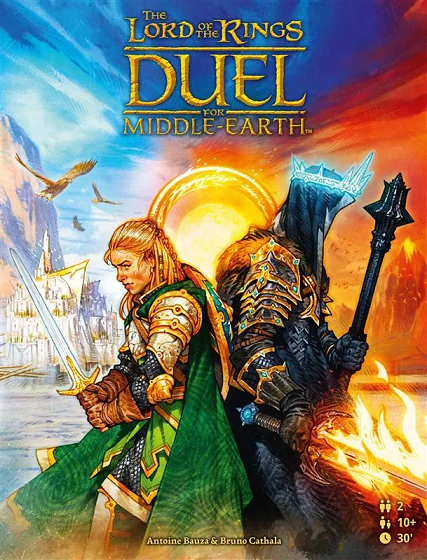
Duel for Middle-earth is hot out the gates of Mordor and flying along the wind like a fell beast. It will assuredly occupy many top lists for the year, following in the steps of its predecessor, 7 Wonders: Duel. It takes the clever two-player drafting system of that previous title and re-works it with content tailored to the Lord of the Rings intellectual property. It’s tight, tense, and a resilient design. It’s also hollow, as if it’s been carrying the burden of the one ring far too long.
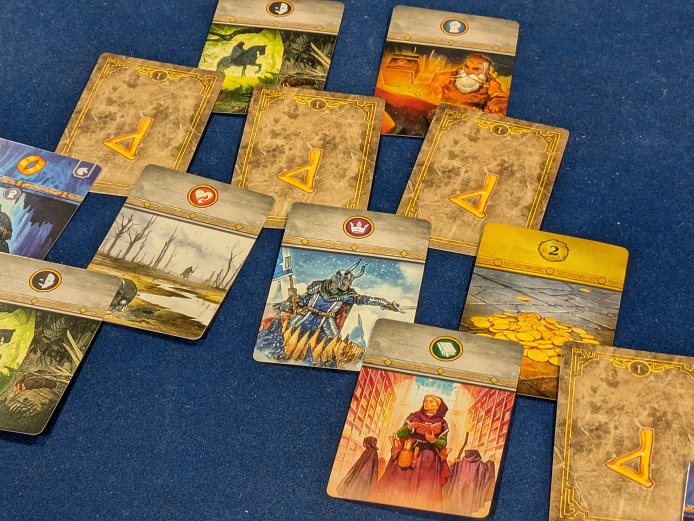
The best aspect of this game remains the draft mechanism. It’s identical to 7 Wonders: Duel as cards are arraigned on the table in a hierarchical pyramid. Players alternate turns, selecting one from the bottom rung. Once a particular path to the next tier has been completely drafted, new cards are revealed. This can create little pathways of opportunity through the available cards and fosters a nice texture in the draft, a quality that most drafting games accomplish through the unpredictable nature of multiple opponents.
In terms of interesting and tense decisions, designers Antoine Bauza and Bruno Cathala have once again leveraged this system well. The cards you draft either push you along one of three victory conditions, or they provide resources you will use to gain cards later on. The delightful strain presents itself in possibly blocking your opponent by hate drafting a card or choosing a less-than-optimal selection simply to delay unlocking a new tier of options. There are micro decisions here that are full of weight and can turn the momentum of play against you. It’s the reason the system has found so much success and why it deserves it.
All of the Lord of the Rings specific grist layered atop? Well, it’s a loaf of bread. Not the good stuff. No, this isn’t lembas. It’s a stale husk that’s hardened. It tastes like the cardboard chassis of its manifestation.
There’s a penchant here to shirk away from zest and instead elevate simplicity. The game suffers for it.
This is entirely a symptom of the three victory conditions.
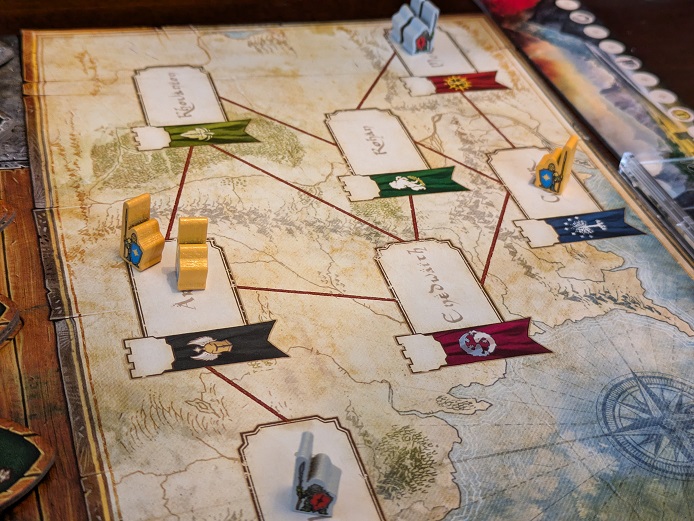
Most prominent is the new area control portion. One of the actions you may draft places little soldier meeples on a diminutive map of Middle-earth. Sometimes you can move your troops into adjacent areas. When soldiers are placed in the same space as an opponent, casualties are suffered one-for-one. If a player is able to establish presence in all seven areas on the board, then they win.
Conceptually, this is all fine. There’s a solid tug-of-war feel here that is distinct from the other spheres of victory. But it’s one of the most staid games of area control I’ve ever played. There is no distinction to each of the areas. The map means almost nothing. Troops are all identical and neither side boasts personality. It’s frustrating because it does not at all feel as though Middle-earth is in contention. The stakes are incredibly small, mirroring the little people tossed on the map itself.
Next is pursuit of alliances with the various kingdoms of the realm. This diplomacy is secured through drafting green cards with various allegiances printed on them. Hobbits are represented by a pipe, humans a horn, and so on. If you draft a card representing all six races, then you win. It’s straightforward, and it’s again, unexciting and lacks spirit.
There is an attempt at enriching this direction by awarding bonus effects through tokens. These tokens are acquired when you possess either two matching or three different allegiance symbols. The abilities gained are things such as one wild resource each turn, or gaining an extra gold if you decide to trash a card you draft as opposed to choosing its effect. If there’s a deeper contextual meaning to these effects, it’s a mystery no one will unravel during play. It’s all mechanical and light and devoid of emotion.
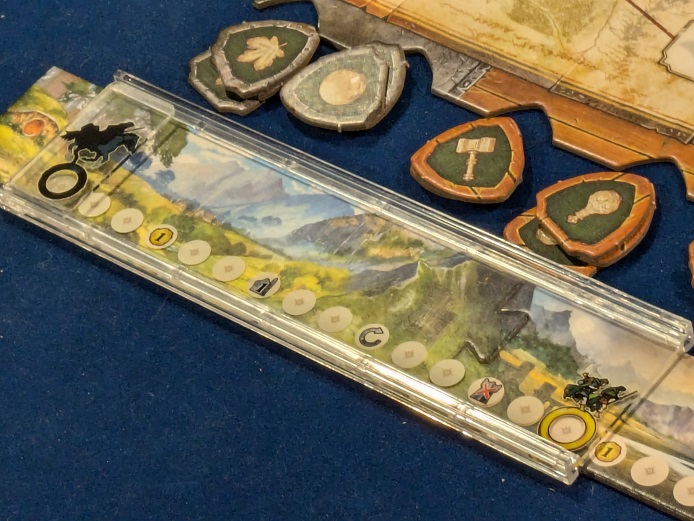
The final victory angle is delivering the ring to Mordor or catching the ring bearer if you’re playing as Sauron. This is the neatest setting flourish in the entire game, as this race is depicted not as two separate tracks, but as a single unified track. This is accomplished with a transparent overlay that pulls the Ringwraiths along when Frodo moves forward. It’s functionally identical to two separate faction tracks, but there is an illusion of pressure as the minions of darkness remain on the heels of the hobbits.
All of the interesting moments are in the card selection, front-loaded during each of your turns. Actually resolving cards, the most interesting moment in most thematic card games, is a workmanlike task with faint narrative yield.
While this a mechanically sound design, there is one quality of the three-path victory system that rankles me. Because the atomized actions are either select a card to pursue your own victory, or choose one to prevent your opponent’s, it’s an incredibly incremental affair. Progress is generally parallel, with both players nearing victory at a somewhat identical rate. It’s certainly possible for one participant to edge ahead of the other, but it’s a result of micro-decisions that eke out incredibly small gains. Usually both players are within an action or two of victory simultaneously, ensuring a tight and stimulating finish.
This can feel artificial and lackluster. Tempo feels manipulated by virtue of the card draft’s on-rails pace, and it highlights how there are no moments of huge swings or drama. This is a steady and deliberate design. It’s one that dazzles through tough decisions in the card selection, not by offering shocking reversals or unbounded effects.
Perhaps this is expected. It’s not an enormous knock on the game, but it’s a quality that I noticed relatively quickly. It’s the type of thing that functions better when you’re not aware, instead living in the feeling of the finale and not overanalyzing the structure that got you there. I suppose it’s too late for that.
Duel for Middle-earth lives entirely on its first-rate drafting mechanism. It must, because all of its other segments are thin. Simply, this game lacks a creative appetite, it’s content riding on the coattails of its predecessor’s accomplishments and repackaging that success with a shiny new facade.
The complete lack of any asymmetry is shocking. Each player could be recast as red and blue and it would make no difference. When you think back upon a play of this game, your mind does not navigate the memory through the context of setting. In fact, you may not even remember what faction you played as it doesn’t matter. This is a fundamental failure.
Because the 7 Wonders: Duel drafting system is so well-crafted, this game is not absent of entertainment. But it’s entirely a different story when viewing this creation as an artistic work. The theme here as applied is the equivalent of throwing a party where you hang a Frodo banner on the wall and serve cake on Nazgul paper plates. Some will appreciate this, for even if it doesn’t feel like you are living in the world of Tolkien, it still brings a smile to your face. No one can take that from you and it’s certainly understandable. Just as no one should blame me for wanting something more.
If you enjoy what I’m doing and want to support my work, please consider dropping off a tip at my Ko-Fi or supporting me on Patreon.
 Player Elimination
DISAAAAPOINTMENT
LikeLiked by 1 person
Unfortunately.
LikeLike
Thanks Charlie, no punches pulled! I was interested in this for my son, but Spacebiff’s review made me think twice, yours confirms that. It sounds fine, but I don’t think fine is enough anymore. Shame, as the artwork is lovely.
LikeLiked by 1 person
Thanks for reminding me, I still need to read Dan’s review.
LikeLike
Do I LOOVE it, no. But do I like it, yes. I am a big LotR fan and I liked Duel so for me it’s an enjoyable short game. I have a small collection of 2 player only games I play with my son and this one will fill that niche nicely. I like SW the deckbuilding game for just 2 as well.
I do find the area control piece not worth going for really unless you get perfect card draws. We’ve played a handful of times and I have just been trying to win a different way each time just to learn it better.
LikeLiked by 1 person
I totally get why you like it and why it’s gotten such high praise this year. I hope you continue to enjoy it.
LikeLike
I agree with your assessment. I also didnt like 7wonders duel too much. In this version they did resolve some of my issues with the original (victory point buildings being relatively weak (here replaced by the ring cards), military being relatively weak, wonders being imbalanced making the wonder draft an exercise of picking the strongest) but the theme is really thin and underused.
They couldve made mordor start with a ton of troops, but all of them in mordor, while the humans have forts. They couldve disconnected the hobbits and ringwraiths so the hobbits have to run away when the ringwraiths come too close, or them being able to run far away from the ringwraiths if sauron does not bother searching for the ring. The cards could be marked good/evil/neutral, meaning that some cards are only useable by one side, rather than sauron being able to buy gandalf.
As a result it just feels like 7 wonder wonders duel 2.0 with a LOTR skin. I love the changes they made to the game, but it’s not a LOTR product.
LikeLiked by 1 person
Yes, totally agree with some of your suggestions as I had similar thoughts. It’s a shame, and I’m a little shocked so many people are placing this game along the very best of the year.
LikeLike