
Arcane Wonders’ Video Game Champion has been ushered into the North American market via the Dice Tower Essentials line. This series of games are titles personally selected for publication by prolific board game reviewer Tom Vasel – or, in the case of originally titled O Bom do Video Game, chosen for import. Overall, this has been a worthy pursuit with excellent releases such as Sheriff of Nottingham and Tiefe Taschen brought to wider distribution. Pair this selection process with an intriguing setting of 90s video game nostalgia, and it must be a winner, right? Right?
Insert Anakin/Padme meme here.

Patrick Matheus and André Luiz Silva Negrão’s Video Game Champion is a warm vision of the past. A chunk of the playspace is occupied by oversized cards depicting game cartridges. The illustrations and feel are perfect, with wonderful visuals supported by equally spirited spoofed titles. Many of these fictional games point to classic releases, and part of the joy is a new cartridge entering play and then someone pointing out this connection. It’s certainly capable of eliciting smiles and massaging the youthful tissue lingering in the heart.
The rest of the game is surprisingly unattractive. A large focus of play is on a grid of action tiles, the bulk of which are large button tiles that have four symmetric ovals in a cross pattern. Each oval holds the same number oriented in their respected cardinal direction so all sides of the table can identify its value. The goal here was to mimic a button configuration on a controller, but that doesn’t quite come across due to the garish nature of the graphic design, combined with the choice of numbers over symbols. The tiles at the edge of this grid are less busy, but the low-fi icons present are awkward and crude. They don’t manage to express the 8-bit throwback intention, instead feeling like placeholders for future artwork.
Panning across the playspace leads to several sections of cards representing various spheres of the overall system. These are game cartridges you can rent (pour one out for Blockbuster), game magazines you can buy (pour one out for Nintendo Power), and another smaller selection of games you can coerce a family member to gift you (pour one out for mee-maw). The cards will often have tokens, meeples, and generic plastic crystals on them. China must be pumping those chunky crystals out on the reg due to how often they’ve appeared in games over the years.
In totality, Video Game Champion’s aesthetic is that of a prototype. It feels both cluttered and sprawling. There’s an intonation of disorganization due to the lack of board to frame and delineate each separate area of play. The graphic design is unattractive, and the unfitting crystals are exactly the type of thing you see en masse at prototype development sessions.
This is far more words than I typically dedicate to aesthetics, but this disconnected bearing is an unfortunate commonality with the implemented systems as well.

The main source of disconnect is with the central action system. It’s a mechanically interesting piece of design, parroting the core conceit of the two-player game Targi. Player turns consist of selecting a button tile from the spreadsheet-like grid and then performing one of two actions that intersect at that point. Actions largely allow you to spend time at the rental store, buy a mag, or receive a game as a gift. There are other nuanced options such as grabbing cash in exchange for IOUs, burning off those IOUs by performing chores or studying, and manipulating the next round’s turn order.
The focus is mostly around resource management. You have a very limited inventory where you can store button tokens, as each slot gets clogged by IOUs you’ve acquired. Money is important as well; it’s how you pay for rentals and buy the latest gaming issues at the newsstand.
Video Game Champion’s game loop is centered around picking out a game you’re going to focus on, acquiring the necessary button tokens to fulfill the cartridge’s recipe, and then executing on that plan when the timing aligns. You do this over and over again across the game’s five rounds and 15 total actions.
Timing is important. Rented games are blocked for the round, effectively functioning as a worker placement space that is occupied. Games you’re eyeing in the gift queue may be claimed by someone else before you nab them. Same with magazines. The restricted inventory places pressure on completing games as quickly as possible in order to free up your button slots for the future.
The restriction here feels overly harsh. Not in that it’s difficult to accomplish any one task, but in that it’s impossible to focus on more than one game at a time. This creates a very narrow tactical pathway with limited flexibility. You’re constantly centered to what you can accomplish now, while trying to be mindful of the randomized public goals that push you towards completing certain game genres or difficulty types.
Because the game loop is so atomized, there’s not a large degree of tactical variance or approach. You’re always doing the same thing with the same methodology. When you complete the loop and finish a game, you’re on to the next one. Beating games awards points and may edge you towards the completion of certain goals, but it doesn’t empower you in any way. There’s no real engine building or arc here. You don’t get better at any specific task or attain new abilities. Once a game is completed you move on, eyeing a new recipe that conforms to what tiles you have left over, or which are still available in the grid.
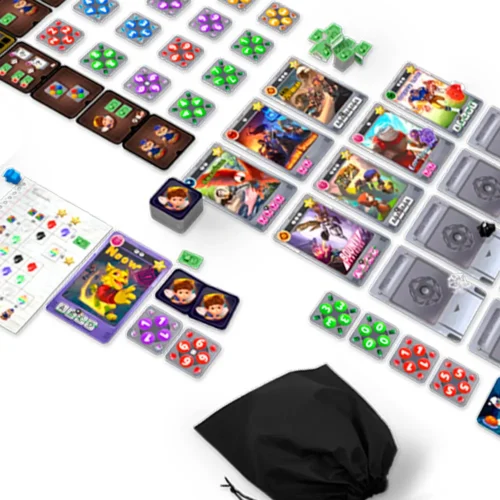
The action grid is interesting as I said, and there are some amusing technical flourishes, but much of Video Game Champion is uncoordinated.
Take rentals for instance. Instead of grabbing the cartridge card and placing it in your play area, you leave it in the public offer and place your meeple on it. This signifies you’ve rented it for the round and no one else can play the game until it’s returned. By not physically taking the card, it reinforces the abstractness of setting. I get it, you don’t want players moving cards around that have completion tokens and crystals on them and such, but instead of addressing the messy nature of componentry, thematics take the hit. By leaving the card alone, in conjunction with the lack of cleanly delineated space, there is no sense of movement or traveling. There is no context to the activity. It doesn’t feel like you’re going to the store. It doesn’t feel like the game is coming home with you. There’s no emotion to any of it.
This ideology is found throughout the design. The overriding tone is that it’s heavily focused on mechanisms in and of themselves, sparing little agency for setting. The setting then serves as a cute overlay, certainly enhancing the game, but not achieving a coherent holistic self.
The crystals are another irksome example of this. They’re placed on magazines and video games that are new to market. The first player to use the magazine or beat the game is rewarded the crystal. These gems consist of various colors and they are drawn randomly from a large bag. When awarded, you place them on a little grid you have in your play area, attempting to fill certain spaces and gain rewards. None of it feels integral. As mentioned previously, the crystals look as though they’re from a large bin of misfit components. They don’t really align with video game icons or tradition and appear out of place. It’s another mechanism though to add additional consideration to video game and magazine selection. I just wish texture was brought into the experience in a more fulfilling or immersive way.
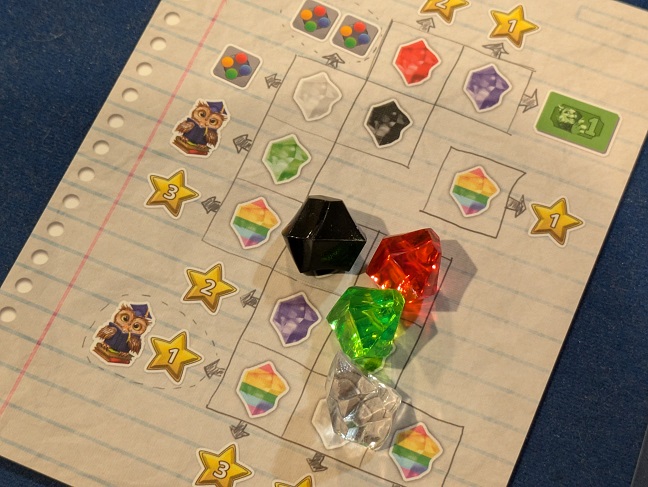
These lesser issues compound. The net result is a game that offers a very confounded view of its theme. If you study the process of play and the design’s motif, it’s unusually cynical.
This is a work that distills the wonder and nostalgia of the golden age of video gaming to a workmanlike competition. In this imagined world, playing games is not magical, no, it contains all the splendor of arranging a tablespoon of sugar, a cup of milk, and a quarter pound of beef. And it’s about playing these games faster than your neighbors, diminishing the adventure of play and instead focusing on assembling a respectable body count.
I can imagine an alternate take where your daily actions were divided between the rigors of childhood – studying, working, chores – and carving out time to play games. But the actual playing of the games should be a highlight. It should be a push-your-luck affair with drama, or at least something with measurable impact. Those at the table should care about how you perform and express their interest via audible cheers and boos. Without the focus on playing the games, we’re left with a vapid collection-oriented purpose that is more akin to business than pleasure.
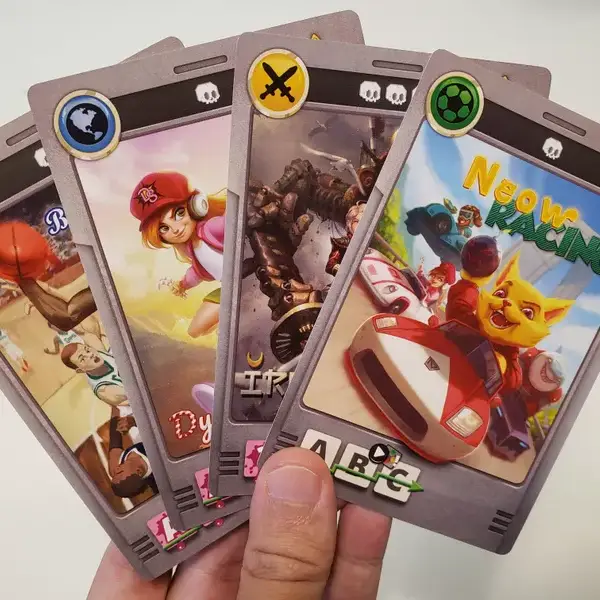
Video Game Champion’s primary failure is that it feels like you’re playing a board game that’s about nothing at all. You’re navigating an action grid, collecting tokens, and spending them to score cards in the market. The video game veneer rubs off right away, and what’s left is a technically viable tactical game that lacks amplitude.
It’s important to understand that the actual mechanisms here are not poor, and the resulting game is something that can certainly be enjoyed with the proper perspective. But as an expressive work it does not come close to fulfilling its potential. This is the standard we should hold games to. With the flood of products and deluge of offerings, enough manage to come out every year that are revelatory and thematically insightful, and it’s a complete bummer when one fails to realize its concept.
A review copy of the game was provided by the publisher.
If you enjoy what I’m doing and want to support my work, please consider dropping off a tip at my Ko-Fi or supporting me on Patreon.
 Player Elimination
1 comment for “Button Mashing – A Video Game Champion Review”