
When I first saw Tiny Laser Heist I held my breath, crossed my fingers, and said my prayers. It looks so utterly cool as if it should be wearing shades and smoking a cig.
Let me set the scene. Plastic pillars frame a stylish board depicting a jewelry store. In their locked cases sit chunky diamonds, patiently waiting to be pilfered. You, a lifetime criminal, put together a team of specialists to commit the heist and split the profits. But in order to accomplish this daring job you have to reach into the locked down rooms and carefully lift the diamonds from their enclosures. Unfortunately, your adept burglars have sticks for arms and little rubber hands. Oh, and there are red lasers strung between the support pillars that you must not trip.
Godspeed.

Rarely do these types of games actually deliver on their appearance. Often, they rely on table presence to obfuscate deficiencies in gameplay. Tiny Laser Heist actually works. Mostly.
Up to six people sit around the table, eyeballing the diamond vault. The Mastermind – a role which rotates each turn – puts together a crack team for a job. This is accomplished through open discussion that includes promises, cajoling, and perhaps some devious manipulation. A target diamond is chosen from several on the board. There is a strategic element here, in that these jewels are not all identical. They have padlocks stacked atop them of various colors, which restrict interaction and alters payout. To move a padlock, at least one member of the team must have a special lockpick card of the associated color. Additionally, the number of lockpicks stacked atop the diamond determines the amount of cash cards the group splits if they succeed. Thus, riskier targets require more effort and perhaps more teamwork from multiple contributors, but they also award larger scores.
All of this is hashed out prior to the actual heist. Players will often discuss special cards they can contribute. Besides the aforementioned lockpicks this can include effects such as adding additional time to the 90-second clock or allowing the group to utilize a helicopter and enter the vault from above. There are several varieties of abilities that can be triggered, and you must formulate a solid plan to harness them when given the opportunity.
Once the team is assembled the clock starts and mayhem ensues. The little hands you wield are imprecise and clumsy. You must grip the stick at the end, so it’s difficult to apply force on the open rubber hand or its fingertips. Each player only utilizes a single stick, so you must pair off with another and work in tandem. While this is occurring, klaxons are sounding, and the timer web app is squawking at you. Fumbling around with your implement is awkward and subsequently hilarious. This is important, because a large portion of the table won’t be participating in the heist and will instead be observing. The short timer combined with the difficulty in actually accomplishing the goal results in entertaining hijinks. Indeed, this is the type of game that passersby will stop and watch. It’s even more amusing when you have a stake in the outcome and are booing the group, hoping they fail.
This is a challenging activity. While the lasers that cut across the play area are actually difficult to dislodge, if you do trip one you instantly fail the heist. Beyond the lasers, the hands themselves are crude and unwieldy. It’s certainly possible to nab a diamond and make out with some cash, but it’s less common than dropping a stack of padlocks, cursing your partner’s mother, and bumbling around on the floor of the vault like a blind clown looking for change.
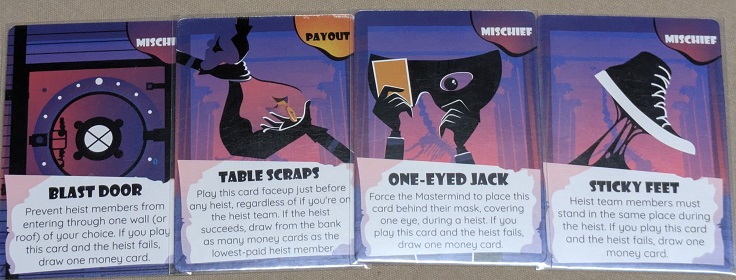
Remember those players that weren’t selected for the heist, the ones sitting on the sidelines with a handful of pins and a voodoo doll? They increase the hardship by playing cards that handicap the team. These include painful jabs such as requiring a player cover one eye with a card or prohibiting criminals from entering the vault through one of the sides, limiting their options. This is neat. It adds another element of interaction, allowing those cut out of the deal to invoke some agency. It’s also where the game is most clumsy, even more so than the use of the ham-handed sticks.
These card effects, particularly the negative abilities, have too large of an effect on play. Timing can be messy as well. There’s too much of Jim playing this so Pam plays that and then Michael jumps in. Often, the cards which cripple the heist reward the participant that played the card, snatching a reward from the deck if the group fails. Conceptually, I’m behind this. Booing the caper and making out with a little sweet treat when it fails is a nice bump in dynamism when it comes to altering scoring and creating more ambiguity.
The problem is that the heist itself is so challenging by its very nature, that this harassment feels overly punitive. Nearly half the scoring – perhaps more if your group is feeble with their tiny hands – is earned through these negative cards. This is poorly calibrated. A game of tiny laser heisting shouldn’t be determined by card draw and rewards for others failing. It should be primarily decided by soft hands and hard minds. The heist should be the focus of play, not the carnival surrounding it.
Another quirk is that the payout cards are entirely unpredictable. When you first negotiate the heist and select which diamond you’re hunting, you deal out a number of cards equal to the padlocks atop the target. You must commit to how you will divide these cards among the team-members and cannot change your mind later. The catch is that the cards are face-down and no one gets to see them until they’re received. The values range from zero to four, so scoring is often wild and arbitrary. This will drive a certain type of player mad. Luckily, the dopey plastic hands should work to filter out these people.
One small quibble that’s bothered me is that heists reward too few money cards. A typical job will have two or three payout cards, with some larger gambits offering four or five if you go for the jewels with the most padlocks. This means that heists will commonly result in the Mastermind agreeing to give each participant one card as they have little leeway for deal-making. When working through this arrangement I often pine for the more nuanced opportunities of creative payouts in Tiefe Taschen. That game allows you to come up with very lopsided splits that still manage to satisfy all recipients. Tiny Laser Heist could offer double the current number of cards for each job, which would afford more opportunity for uneven rewards and imaginative team construction. Of course, this has its own problems such as increased swings in end game scoring and the requirement of a thicker reward deck. Still, it’s something to chew on.
It’s also a little mushy with player count. The more participants the better the spectacle, but the game can end extraordinarily fast due to all of the card play and money siphoning. At six, the final player in turn order may never get a chance to be the Mastermind. It’s got a Cosmic Encounter flimsiness to it in that respect.
But you definitely want more players. Three is hardly worth the trouble as the activity is blunted. Four works, but there’s texture lost in team building. You also don’t get the spontaneous relationships via alliances or spite that a fuller game delivers.
While there are some persnickety qualities here and Tiny Laser Heist feels a little rough around the edges when it comes to development, there’s also a unique and mesmerizing experience that is unlike anything else I’ve seen. The core action of the game is spirited, with successful heists feeling incredible due to the difficulty in carrying them out. The lasers weaving across the play area function expertly, as they offer some leeway in the activity while still creating a threat. Their best asset is that they form obstacles you must weave around, adding terrain to the board that complicates navigation.
This also passes the necessary dexterity game test of spectacle. It’s hilarious to observe, and just as lovingly goofy to play. It does require the right approach. If you invest too much of yourself in the outcome, you may be discouraged and turned off. But the short playtime, blissful components, and utterly random payouts work to ensure you are never overly concerned with how well you did. Like the best in the genre, this isn’t a work of strategic purpose, it’s a playful game of pretend with toys that mock their participants.
A review copy of the game was provided by the publisher.
If you enjoy what I’m doing and want to support my work, please consider dropping off a tip at my Ko-Fi or supporting me on Patreon.
 Player Elimination
I did back this, but haven’t had the right group to play it with yet. After reading through the rules, I am also a bit puzzled by some of the design decisions. Things do look punitive and arbitrary, and your experience seems to confirm that. But I really want to like this game, so I wonder if simplifying the “game” part would work. I’ll have to think about some house rules, because one bad experience can tank a game in my group…
LikeLiked by 1 person
I would say just play it as is, as the game isn’t terrible, just flawed. But if your group will get heavily turned off by a less than ideal introductory play, well, you probably are best off modifying some things. I’d consider reducing the number of negative cards in the deck.
I can’t really offer much else in terms of advice, as everything else would be pretty radical.
LikeLike