
Cthulhu: Death May Die is a fascinating story. It originated as a combined effort between Eric Lang and Rob Daviau under the auspices of CMON Games. Elements are clearly carried forward from Lang’s previous effort, The Others. That game was a one versus many affair that didn’t quite deliver despite several inspired details. The Others is mostly forgotten. Cthulhu: Death May Die endures.
At minimum, this flagship line will boast nine separate large boxes, two enormous miniatures the size of a young human, and several smaller expansion options. More is likely coming. The Great Dreamer is never satiated.
Ph’nglui mglw’nfah Cthulhu R’lyeh wgah’nagl fhtagn!

Fear of the Unknown is effectively season three. It’s the first standalone set since the core box came out in 2019. As I said in the open, there’s a fascinating story here. While Death May Die was reasonably successful with its initial pre-COVID crowdfunding campaign, it really took off once it arrived at retail and had time to settle in. The popularity of this game grew over the years and CMON was ultimately compelled to wring more capital from one of the best games in their lineup.
But things change. With a five-year gap between the original release and Fear of the Unknown, it’s indiscernible whether Lang or Daviau had any involvement with this new material. Marco Portugal is listed alongside the duo on this box, and since Lang vacated his position as lead designer at CMON prior to this game’s release, it’s difficult to know who worked on what. I suppose none of this truly matters, but it’s worth acknowledging for there are some suspect decisions within this release that stir curiosity.
Let it be known Death May Die is a fantastic system. It bears many similarities to the Sadler brothers’ MDS line of games whose identity hinges on modular content. Here, players choose characters, a scenario, and a Great Old One in any combination from the vast array of boxes. This means that every new expansion you get also enhances or twists all manner of previous content. It’s thrilling for hobbyists as it breaks down any possible internal objections and allows you to justify hedonistic consumption. Some would say this game is the very spirit of crowdfunding in its current incarnation.
With that being said, the modularity here is somewhat clumsy. It’s unfortunately cumbersome to work with this product line, and tapping into the true potential is often not worth the trouble. A typical example would be opening up the original box to grab Cthulhu, then heading to season two to collect your investigators, and finally Fear of the Unknown to supply the scenario and the core components such as dice and health tokens.
It’s only gotten worse.
One of the key features with this third season is the introduction of two new mechanisms. The first is the concept of Unknown Monsters. These are a horrid addition to the game. Sorry, I’m not in the mood to hold back.
A new set of cards allows you to select two random foes and put them into play as additional threats for any given scenario. It’s a fourth modular element whose primary function is stated to be a difficulty enhancer. They definitely accomplish this as they ratchet up the challenge to a ridiculous level. As a piece of design, they’re a complete misstep. The difficulty isn’t so much in a new adversary which requires a fresh tactical approach, but in clogging up map tiles to make movement more restricted and kill the pace of play. It’s harmful malfeasance that slices through skin nicking artery.
While some may certainly disagree with the gameplay implications, few would argue that Unknown Monsters don’t add considerable setup aggravation. These creatures can come from any of the releases in the line. That could certainly be seen as a benefit if you spent hours painting the core box and are done with those scenarios, but for the vast majority of people it’s an additional burden. Worse, the Unknown Monster cards don’t tell you which set the miniature even come from. Yes, unless you have the mental cataloging acumen of a librarian, you’re going to need to fashion a reference system or mark the cards in some way.
Strike me down Sleeper of R’lyeh.

Difficulty scaling is indeed a minor problem with this system. A two-character game is much easier than one with four, mostly due to the concentration of sanity loss and more rapid ascent in skills with fewer players. But the solution as constructed is devoid of creativity and forethought. There had to be a better way. They could have taken a cue from Unmatched Adventures, offering a deck of event cards that modify rules to customize the challenge level. Or there could be simple universal tweaks in the rulebook such as automatically advancing the summoning track one space when the game begins. Anything but focusing on the game’s largest weakness – content sprawl.
The second module in Fear of the Unknown piggybacks off the first. Relics are mysterious artifacts drafted at the start of play. They offer a new persistent ability that grows in power once you’ve hit the third upgrade step on your madness track.
These are slick. Sometimes you will pull a relic that combos with your investigator in a satisfying way. One of the new characters, my favorite of the lot, can even acquire more of them if they reach the final space of their unique skill.
Sometimes they’re not so slick. They don’t feel equally effective or thoroughly balanced. It’s assumed that you include them alongside Unknown Monsters, but they don’t make up for the deficiencies in gameplay and the difficulty spike. However, they’re often too strong to just toss in on their lonesome. This is the worst possible result as it leaves them shoved into a crate and banished to a warehouse only to be forgotten. Additionally, there is an overt downside in that it’s another component off to the side. Relics are easy to overlook, even more so if you possess one that triggers infrequently.
With the two main features of this box being duds, surely there’s hope in the rest of it?
Yes, mostly.
The two included Great Old Ones are a mixed offering. Tsathoggua is the better of the two. This sloth-like bastard afflicts fatigue on the heroes, requiring more frequent resting to shed tokens off the health and stamina tracks. This works as a creeping threat of lethargy that causes sluggish response and requires group coordination to actively thwart. It’s not the toughest of bosses, but it’s an interesting one that I’ve enjoyed punching, stabbing, and shooting.
Azathoth is a menace. This fool boosts monsters through cosmic tokens that you must place next to certain miniatures. The administration is ugly. You have to move these tokens with the monsters, taking care not to overlook them as they can blend in with the terrain and graphic design. You also have to bring new ones into play quite frequently, creating this ongoing shuffling in and out of tokens when I’d rather be ingrained in the narrative and focused on the task at hand.
Another stifling attribute is that Azathoth has the shortest timer of all the Great Old Ones. There are several Mythos cards and effects that push the awakening faster than normal. I think this could be interesting and I do understand the desire to meddle with this design space, but the execution is haphazard as some scenario and investigator combinations will have no shot against it. It forces you to rush headlong the entire time, as you can’t afford to let up. Beyond making for an extremely punishing experience, it also exacerbates the worst qualities of Unknown Monsters due to the clogged board. Only a masochist would combine the two. Both Cthulhu and Black Goat are much more interesting options for players wanting a difficult Great Old One.
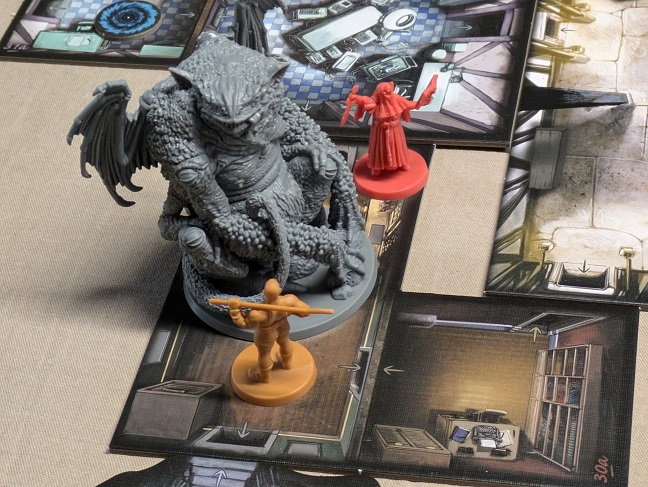
Everything else is quality.
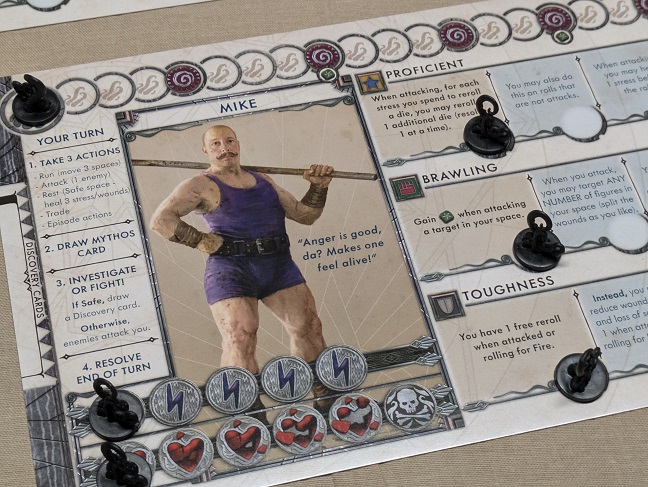
The character lineup is solid. Some of the concepts are thin – such as a toddler and a carnival wrestler in a unitard – or are just slight modifications of existing archetypes we’ve seen. The unique abilities, however, are all interesting and carve out new space to experiment. It’s clear though that the mixture of standard skills is well beyond any creative application at this point, which I’m certain is why the latest season is implementing a new set of basic options.
Scenarios are the lifeblood of the game. They’re the single modular component that most influences tone, tempo, and narrative of play. This is the primary reason to add additional boxed sets to a Death May Die collection, and season three delivers the goods.
The first two offerings are a little underwhelming. Scenario one feels tame and very basic. If you haven’t played the game in a while or if this is your introduction to the system, it does its job in a workmanlike fashion. The second story is more interesting, holding the potential for wild swings in pace and some memorable moments with players scrambling to unlock doors while hell closes around them. Both of these encounters rely somewhat heavily on variance and can be off-putting if that factor delivers the hammer. Still, I’d play either of them freely, especially the second.
The third scenario is the high point of the whole set. I found this archeological adventure superb and now consider it a member of my pantheon of top Death May Die scenarios. The fourth option is also interesting with a unique setting that almost devolves into camp, but it’s elevated by a solid suite of discovery cards. The fifth is the weakest of the bunch, relying on a dexterity gimmick for a portion of the objective that I did find humorous at first. Unfortunately, it creates such an unreliable difficulty prognosis that the whole thing can devolve into utter despair relatively quickly. It’s responsible for the single moment I’ve ever felt like cheating in this game. That’s not a great characteristic of distinction. Thankfully, Fear of the Unknown closes out on a high point with an interesting ghostly adventure that features the most tactically nuanced map construction of the sextet.
As a concerted whole, this scenario selection is valuable. The strongest moments are compelling adventures full of drama and tension. It’s only a thin stroke below the quality of the original release, successfully buffering the available content to explore. One often underrated aspect of this game is how replayable the scenarios actually are. I’ve had a wonderful experience tackling the very first adventure from the OG lineup again and again. I’d estimate I’ve fought through those fiery hallways 10 or 11 times. I’d still play that scenario today, as I would dozens of others. These are not one-shot quarrels predicated on mystery. Season three follows this trend, offering exciting adventures that are worth returning to.
This is also one of the reasons why you likely don’t need Fear of the Unknown. I know, it’s difficult not to unhinge your jaw and devour each offering the content gods bestow upon us, particularly when the game is engineered to integrate new components organically. But nothing here – or indeed in any Death May Die expansion – is unbelievable or transformative. At best, we’re chasing that high the game first delivered in our initial foray.
And that high was remarkable, wasn’t it? This is such a grand game, perfectly capturing a sense of escalation and cataclysm. The sanity system is truly one of the best board game mechanisms devised, for it both enhances the potency of your character while also bringing you closer to extinction. It’s a deal with the devil, one necessary to thwart alien gods intent on annihilation.
Death May Die is an odd mashup of dungeon crawler and adventure game. It’s primarily the former, but with a static board and constantly spawning enemies, it feels akin to Arkham Horror at times, albeit zoomed in on a single location and with all the constraints that entails. The adventure cards and scenario design are of such consequence that the best cuts bring the game to new heights. They add beneficial context to the narrative and provide unique goals that require a special approach.
One aspect of this game that I have really aligned with is the over-the-top pulp setting. At first, I found this aesthetic disappointing. It’s why I avoided this game until word of mouth propped it up. But what I came to realize is that the setting of this game isn’t Lovecraft’s work. Instead, its setting is a farther degree removed as if Lang and Daviau were playing Telephone with Elder Gods. It’s a love letter to the trashy fictional extraction of Cthulhu that has become popular. The intellectual property isn’t H.P. Lovecraft, rather, it’s an expression of the Fantasy Flight Games Arkham files. It’s a cover of a cover. And it absolutely shreds.
No, none of us need another season of Death May Die, particularly one with some underbaked ideas and additional clutter. But we’re still going to unhinge our jaws and say thank you.
If you enjoy what I’m doing and want to support my work, please consider dropping off a tip at my Ko-Fi or supporting me on Patreon.
 Player Elimination
Nice write-up.
So I’ve got the game and have played the base fire scenario 3 or 4 times. I really like the game. I have all the expansinos and seasons and so forth but haven’t played them yet.
Can you just use the 6 scenarios and the characters from this latest set and keep the unknown monsters, relics and 2 new GOO’s in the box?
Also I already have so many characters I will never play through them all – are there any new characters that are so good they really need to be included?
It sounds like I should just pull the scenarios out of the box and stick the rest in the attic.
There are more seasons coming too.
At what point is it just too much and they should just stop?
LikeLiked by 1 person
Hey Ian!
I miss talking. Thought about messaging you in Facebook a couple of times but never did. Hope you and your family are doing well.
Yes, you can just pull the scenarios (you need the monster minis too) and use them with GoOs and investigators from the first set. The scenarios are the best part of the box and I highly recommend doing this. Then, if you want more investigators or want to try a new GoO at some point, you could dig out that stuff.
I wouldn’t say any investigator is can’t miss. I think they’re all fine, with the Indiana Jones woman being my favorite in this new box (she requires you have relics nearby as she can gain them mid-game). But the iconic ones like Rasputin are in the core set.
Oh, you’d also need the room tiles from this set too. Thats slightly annoying because you really don’t want to mix them with other boxes’ tiles if you don’t have to. It will make rifling through them and setting up take longer.
I’d worry about just focusing on that core set and playing through it when you have time. Then when you feel the need, check out this new stuff. The exclusive boxes will always make pledging worthwhile, as you should be able to sell them in the future if you ever change your mind on owning everything.
LikeLike