
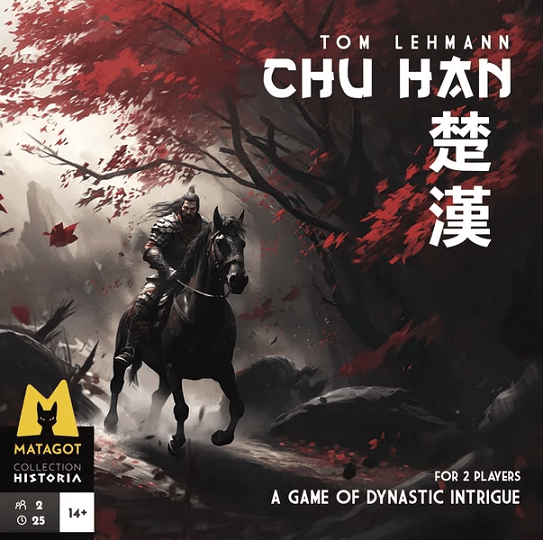
Chu Han is unusual in that it’s a card shedding/ladder climbing game for exactly two players. This is a format best defined by multi-player stalwarts such as Tichu, Haggis, and a recent favorite of mine, SCOUT. But Chu Han is also unusual in that it combines trick-taking with its card shedding. And then it’s even farther unusual in that it smoothly coalesces special abilities, event cards, and even a surprisingly deft thematic integration with its lovely core principles. Perhaps the only thing about Chu Han that is not unusual is that it’s indeed captivating, as it comes from Tom Lehmann, designer of Race for the Galaxy and Res Arcana.
This is a simple teach. The deck is roughly evenly split between the two players and a draw deck, with four unknown cards burned from the round to add some uncertainty. The deck consists of suit-less numbered cards with higher concentrations towards lower values. So, there are nine 1s, eight 2s, and so on. One player leads the trick by playing like numbers. You know, a pair of 8s, or three 4s. The other player must respond with the same number of cards but of a higher value. If they’re able to, play keeps going back and forth until one player passes, ceding the trick. Play then continues with the winner of the trick leading the next play and so on.
What you’re trying to do is shed all of the cards in your hand. There’s a race to the bottom, as the player who is able to burn through all of their cards scores points equal to the number of cards the other player is still holding. There’s a strong momentum of barreling forward at top speed, as going out as quickly as possible earns you the highest scoring potential, pushing you towards a goal of 31 total points and winning the game.
This is all a relatively standard structure. It’s not what makes the game roar or the hair on the back of my neck bristle. The Lehmann details are the perpetrator of this desired spectacle.

The first twist is that many of the cards have special effects. Some modify a played hand – such as one of the 3 value cards allowing you to play a run of cards as a set – others allow you to pull off powerful moves such as passing without ending the trick. There are even neat scoring options such as playing huge sets of 2s for immediate scoring mid-trick. The calibration here feels nearly perfect, with a seemingly wide range of powers to play with, while being relatively easy to internalize after a couple of plays. It strikes a strong balance between variety and restraint, never overwhelming with too many strategic considerations. After several plays, the depth of field widens as you’re able to flirt with new uses of these abilities and perhaps even learn how to counter powerful moves by preparing for them.
This leads us to the second ploy. The tensest aspect of this design is that Lehmann tempts you with poison. On your turn you may take a writ, effectively a token, and then draw two cards from the communal deck. This imparts agency in shaping your hand and provides a possible Hail Mary during key moments in the game. It’s an effective tool for allowing serious reversals and unexpected dramatic plays.
But it also can ruin you. Those two cards you draw are points your opponent will score if they take the hand. Furthermore, each writ the loser possesses serves as an additional point the winner scores. So, every time you draw two cards, you’re possibly sacrificing three points towards your foe’s goal of 31.
This is a brutal twist that is absolutely delightful. It functions as an ongoing escalation technique that gives players control of the throttle. It’s the best part of the design, particularly in how it interacts with the information players possess on probability concerning what cards have been played and may still be available. It’s just a devious thing that really sits comfortably at the heart of the Chu Han’s identity.

Another flourish that is far better than it has any right to be is the event deck. These cards are optional by law of the rules, but they are absolutely not by the law of Theel. Again, they feel so well designed and thoroughly considered that they touch and alter the game in just the right ways. Only one such card is drawn each hand – meaning you will draw only two or three per game – and they change one fundamental aspect of the rules.
One event allows you to swap a card from hand with one of two faceup cards in a public display. This occurs instead of drawing from the deck when you take a writ. Another removes an artificial, yet important, five victory point limit you can score when winning a hand. There are numerous interesting and meaningful events, alongside several “no effect” cards that keep you on your toes and changeup the tone of play.
These event cards are supremely intriguing in that they combine with the special effects and writ system to create evolutionary pressure on strategic thinking. There are no automatic plays or tactical heuristics you can develop for best practices. This is a somewhat straightforward core game with layers of odd contraptions and instruments to fiddle with. How everything intermingles and collides is the sauce and what makes the event worth pursuing.
The downside to some of these elements is an inescapable sense of chaos. It can feel like you were screwed due to poor draws – both with the initial hand and with writ top-decking. It has that Condottiere effect where players can be outright discouraged and feel as though they were led to their doom by the game’s internal fickleness. I think this is in part an illusion, but variance is a core aspect of the design. The variance is likewise accented through the volatility and swinginess of the card effects.
Chu Han can also feel somewhat underwhelming due to its standard profile. There are some absolutely neat curlicues here, but the central process is not far afield of other shedders. It’s different than something like the trick-taker Fives which turns over its focus and challenges you to rethink genre standards, instead Chu Han chooses to provide deviation through how you reshape your hand and manage constraints. It’s sort of a different perspective.
A completely different challenge this game faces is that its unique attribute – two-player shedder/climber – is also a detriment. Instead of slotting in as a short in-between title on a typical game night, it’s relegated to dedicated duo time. This means its competition is more narrowly focused, including things like Netrunner, Magic, and 7 Wonders Duel. It’s difficult to determine whether this will win out over the best-in-class titles of this more specialized player configuration.
Finally, a commonly cited central criticism of the design is in how it handles its setting. That criticism would be terribly unsound, however.

From a macro view, Chu Han does not seem to capture much of this historic contention. This conflict spanned 206-202 BCE as the Han and Chu clans sought to overturn the Qin ruler and establish China’s first dynasty. It’s a shedder/climbing/trick-taker where you meld sets of like numbers. What could it say about this war and its human combatants?
Well, something. Maybe not a lot, but certainly something.
One oddity is that the cards represent individual Han and Chu soldiers. Each player ends up with a mix of people, which appears incoherent. Naturally, one would expect the Chu player to wield a hand of notable warriors from their own clan, and similarly for the Han participant.
As the rules text explains, your hand represents a collection of your own troops, as well as captives, spies, and volatile agents. It can be interpreted as a hand-waive for neatness sake, but I don’t take it in bad faith. Particularly, the experience of play feels messy and unruly. The way combos are built and explode off the various effects propels this sense of chaos and battle. Nothing feels uniform or straight, as everything could go topsy-turvy depending on how cards are played and the risks undertaken.
As Sun Tzu spoke, you must know your enemy and yourself, otherwise you are certain to be in peril. He also said to know your enemy is to become your enemy. This rings true with the game’s metaphor of jumbled personnel and the way they are assembled into melds to secure the upper hand. There’s an element of deception baked into this fog of war, one highlighted by the unknown cards removed from the deck and inability to be sure of whether certain effects are available.
Another excellent metaphor is that prolonged warfare leads to cataclysm. It’s paramount that the fighting end quickly and your blows are struck, for delaying by drawing cards or overlooking opportunities to dump a large portion of your hand will lead to large point losses. You can’t allow for the battle to rage endlessly, or your bounty of writs will suffocate your progress. You must know when to fight and when not to.
These qualities are buoyed by a selection of two historic scenarios that offer alternative setups. They configure certain starting positions and card allotments, resulting in a light deference of standard initial variance to historical simulation. These don’t drastically change the framework of the game, but they’re neat inclusions that point to its respect for the source material. I don’t think many will seek out this game with a historical-first approach, but these two scenarios function as bonus material to fill out a wider possible appreciation for the design.

There’s a beauty in the chaos of this game and its underlying tension that really grips me. Chu Han is a rich card game that offers a tension-laden metaphor for a crucial moment in Chinese history. It’s also quite the unique take on shedding and ladder climbing, offering a few valuable quirks that land hard.
Chu Han lives up to Tom Lehmann’s pedigree and is one of the more interesting small profile designs I’ve come across recently. I can only hope to carve out the time to explore it in more depth, for that’s exactly what it deserves.
A review copy of the game was provided by the publisher.
If you enjoy what I’m doing and want to support my work, please consider dropping off a tip at my Ko-Fi or supporting me on Patreon.
 Player Elimination
I dunno, I still really wish they’d gotten a cultural consultant in or something. Sure, the historical theme is flimsy at best (but hey, if I can forgive Scout for its “theme” I can forgive this) but what really bugs me and actually stopped me from buying the game is the lazy, overused Hong Kong Phooey font for the English text and then the bog-standard Times New Roman equivalent for the Chinese characters. That overly cartoony dragon scoreboard also doesn’t gel well with the rest of the game’s aesthetics. Call me superficial, but (as you pointed out) the 2P/trick-taking market is so crowded these days there’s no room for humdrum.
LikeLiked by 1 person
Fair points, Lee.
These details were something I didn’t catch, kind of disappointed the stereotypical and lazy font choice eluded my notice.
LikeLiked by 1 person
Oh no it’s fine, I studied Chinese at university so I’m a bit more attuned to this kind of stuff anyway – and if you didn’t notice it, I’m sure plenty of other people wouldn’t either and it’s not like it affects enjoyment of the game!
LikeLiked by 1 person
Right, but I’d say that people not noticing it actually shows that this is a problem. Something to think about at least.
LikeLiked by 1 person
For the recond, we had two Chinese cultural consultants on this project, as listed in the credits. Their sensibilities may not match yours, but it’s not a result of us doing due diligence. One example of the feedback we received is that they felt the art for Fan Kuai — a peasant butcher who rose through the ranks to become a general — was not respectful enough, resulting in our adding a note to the Who’s Who section emphasizing that the art depicts him early in his career.
LikeLiked by 2 people
Thanks for chiming in Tom with clarification (and your work on the game).
LikeLike
Thanks for the correction, Tom 🙂
LikeLike
Thanks for the review Charlie, I was intrigued by this from other reviews, you may have swayed me on it. Res Arcana is one of my favourite small games and I’m still finding depth in it. It sounds like this has the same longevity.
LikeLiked by 1 person
I really enjoyed Res Arcana when it came out. Played it a number of times and thought it would rise to be a classic game for me..
I’m not sure if I burnt myself out or something else happened. It’s been several years, I should revisit that one.
LikeLike