
Everyone loves Mario Kart. Daughters, sons, mothers, fathers, even grandmas. Everyone.
It’s arguably the most beloved Nintendo property, and it’s certainly the most popular racing video game with cumulative sales of 152 million dollars. I don’t want to pay $80 for the shiny new version either, but that doesn’t change the fact that this sucker is iconic.
So, it’s about time we got a Mario Kart board game, even if it swaps out Bowser for King Croak and Donkey Kong for Killa. It’s basically the same thing. I swear.
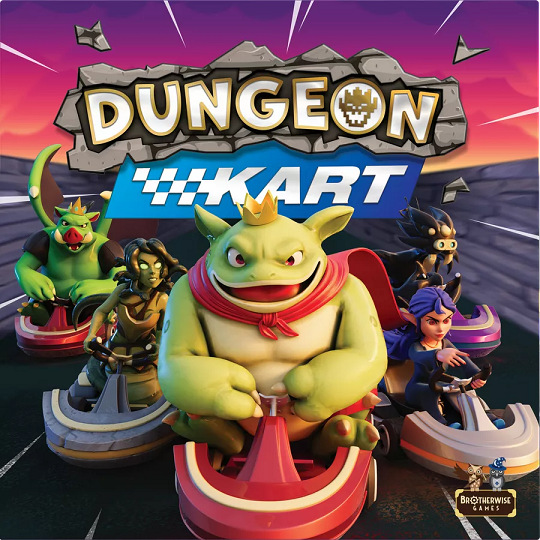
Dungeon Kart is Brotherwise Games’ kart racer, replete with N64 style artwork. It knows exactly what it’s doing.
The Mario Kart spirit extends well beyond aesthetics, as the soul of this game wonderfully captures all of the kooky full throttle aggression of its influence. This is unlike any other tabletop racer you’ve played. It’s also kinda like every other tabletop racer you’ve played.
This is the inner turmoil sputtering beneath the hood. Dungeon Kart arrived at a time when the racing genre has seen some of its strongest titles emerge. Heat: Pedal to the Metal may be the best of its ilk, evolving the card play of Flamme Rouge into something grander. Dungeon Kart is more complex and zanier, committing to the anarchy of its filed off IP. Yet, it’s not quite as chaotic as Thunder Road: Vendetta, the phenomenal Mad Max-inspired reworking of the 1980s Milton Bradley release. So, Dungeon Kart is not the most thrilling or wild of the recent racers, but it’s also not the most cerebral, as it doesn’t come close to matching the thoughtful play of Rallyman. It overlaps each of these in subtle ways, but I’d hesitate to say it outdoes any of them. Instead, it occupies a soft middle ground, sharing the space with Osprey Games’ Joyride: Survival of the Fastest. But even there, the two are not at all identical and converge in a multitude of vectors.
Dungeon Kart’s track system is certainly a strength. It utilizes double-sided tiles, but they’re big suckers which cover a lot of ground. This splits the difference between the painful modular setup of Rallyman and the breezy instant gratification of Heat. The track selection is generous and there are some very creative layouts, so it’s not all straight loops with little distinction. I would go so far as to say these circuits and their various terrain are the most interesting of the bunch. Much of this comes down to randomized obstacles.
In addition to printed on features such as item boxes, mud, and walls, many spaces throughout the map will be populated with features drawn from a bag. These present randomized obstacles such as banana peels zombies, impassable rocks, and special heroes. The heroes are neat as they each come with an associated reference card. They typically modify the track at setup, adding in stuff like obscuring fog or changing the nearby surface to a different terrain type. Some add permanent rules such as drawing everyone one space closer to them.
There is a smattering of hazards. Piranha plants cause you to crash, boosts throw you forward a random number of spaces, and Smashinators are slot machines with pain and fortune. This assortment of features defines the game, putting it into a more hectic category while retaining a loose and low stakes feel. By deferring to Mario Kart with aesthetics and environment, it appropriates its tonality of carefree violence that is more focused on fun than determination.
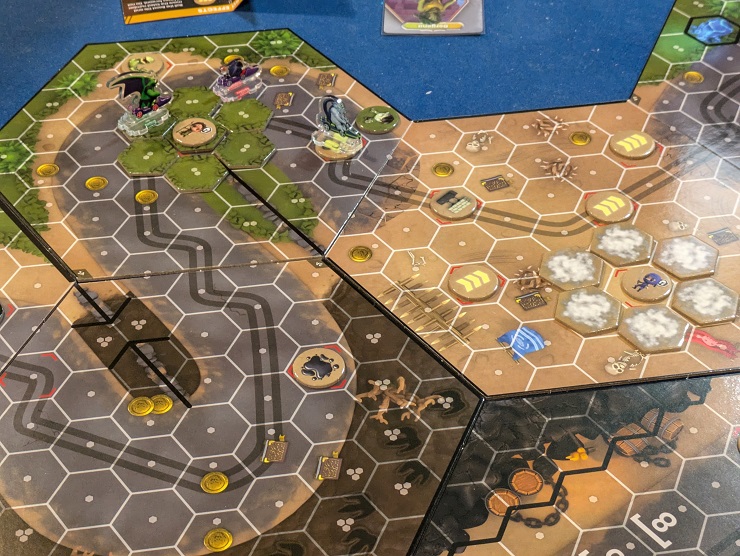
The movement system is straightforward yet kinetic. Each player has a personal board with a gear shift that determines the number of movement points you receive. Every turn you must shift up or down – because coasting is for chumps – and then spend the allotted movement. The cost to enter a space is dictated by the type of terrain, with rougher ground like grass and mud slowing you down. In what is one of the best quality of life details I’ve seen in a racing game, dots are printed on the center of each hexagonal space which indicate the number of movement points spent to enter it. There is absolutely no need for a player aid in this regard, and all decisions are clear and direct. This of course comes at the cost of visual clutter, but it’s a godsend for speed of play.
Friction comes via restraint. Players are only allotted a single 45-degree rotation and a single diagonal sideslip each turn. These limitations force difficult decisions while also simulating forward momentum. Most of the time, the two in unison allow you to pivot around obstacles or crashing into the course boundary. What they most often do is restrain your vectors in combination with the various surface terrain. Couple this with key spaces containing item boxes and you have a scattered field with no perfect racing line that cuts the corner and puts you in the best position.
This is a very fluid movement system that balances limitation and freedom very well. It feels like you’re driving a kart that’s not overly agile, and you really must think ahead and try to anticipate where the other racers will be. The only hitch with this engine is that it’s prone to take-backs. Players will pick up their kart and perform a careful move, then hesitate, cock their head to the side, and rewind it all with a frown. There’s a lot of counting and recounting spaces. A lot of, “oh, wait, I can get to that item if I turn hard here instead.” It’s definitely not the heady and cold plotting of Rallyman GT, but it’s far more hesitant than Heat. Nuanced pathing requires nuanced decision making.
Carnage erupts from two cornerstones of the design: items and ramming. This is Mario Kart, so of course it’s violent.
Item boxes manifest as spellbooks in Dungeon Kart. They are cards drawn from a hierarchical deck, with those farther behind gifted stronger effects. This is a splendid system, as long as you’re A-OK with the Mario Kart method of catchup. Just like the video game, the really powerful effects are nasty here, many targeting those in the lead. Since you can hold a single spell card in your hand, there’s a neat dramatic element where you can save the effect for the right moment. However, this is in tension with the incentive to use it as fast as possible so that you can pick another up. It’s a clever counterbalance that leans into player agency without additional rules weight.
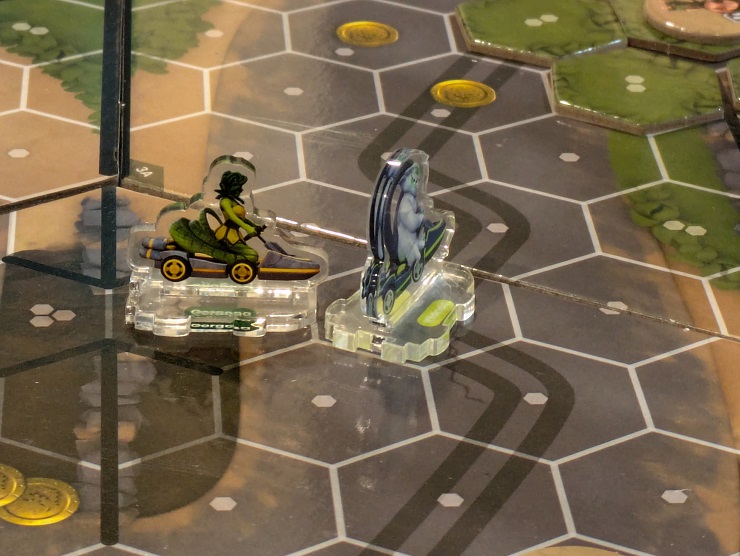
Ramming is fun. It’s easy enough to deliver, as you only need to spend one additional movement when crossing through a player’s hex. If you give the shove, you then move them either straight ahead or diagonally forward one space. You can only ram each player once during your move, paralleling the restrictions on turning.
This is a very effective mechanism that plays with vulnerability in an interesting way. It means no single player can really take someone and drive them along a stretch of road into a wall. It does force you to be careful when ending your movement though, as you don’t want to get too close to a hazard or impassable object. It really comes alive with teamwork.
Momentary alliances form, seemingly out of nowhere, as track positioning dictates. Since the lead player goes first each round, they are particularly vulnerable to multiple collisions. With a little bit of help, players can ram a target one turn after the other and cause them to careen off-road into a wall. This is a brutal tactic that, once again, consists of conflicting incentives. While ramming someone into an obstacle is downright hilarious and will put them in a bit of a pickle, it’s often not worth the cost of damaging a single player and losing position against the rest of the pack. It must be weighed against the current circumstances, which makes for a more complex dynamic.
Colliding with a wall is not great, but it’s also a pill that can be readily swallowed. You immediately drop to first gear, with this loss of speed being the only wound. This is certainly impactful, as it can take several turns to shift all the way to top speed, but it also manages to not feel extraordinarily punishing. It’s not the anguish of spinning out in Rallyman, rather, it’s a speed bump that pulls you towards the back of the pack.
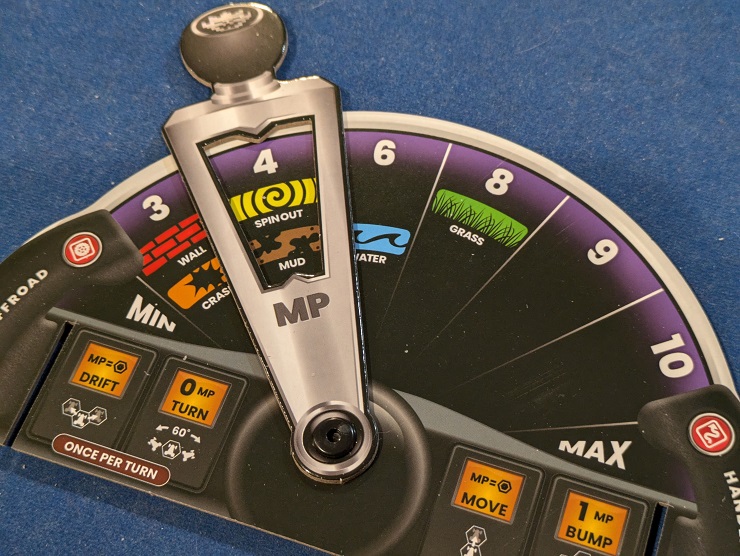
One of the interesting aspects of Dungeon Kart is how it applies downward pressure to speed through several different governors. This implementation acts as a form of rubber-banding for competitors. I mentioned how crashes drop you to first gear, something which happens often at the head of the pack. But another factor is the terrain. Not only does it cost more movement to drive over rough ground, but the various surface types also drop your maximum speed. For instance, if you’ve driven through even a single space of mud you must adjust your speed to second gear at the end of your turn. It can be very difficult to stay on-road and avoid rugged ground, which works as another consideration when working out your optimal racing path.
The end result makes for an exciting challenge to reach top speed. It’s a rare feat, one which tends to draw fire from those wielding spells. What’s worth looking at more deeply is how it emotionally impacts the match.
A primary complaint about Heat: Pedal to the Metal is how it artificially lifts those in the rear through the draft mechanism. It’s a fair criticism, one which I don’t think overly harms the game – and indeed serves a virtuous purpose – but it’s a detail that undermines its simulative elements, slight as they may be. Some would say it just feels wrong.
Dungeon Kart is able to overcome the challenge of supplying a robust catchup mechanism more naturally. This is another area where leaning into the Mario Kart setting works wonders. Players are already conditioned to recognize that driving off road slows your kart to a crawl. They’re already conditioned to accept item boxes paying out with a progressive system. While some may not enjoy this system, it’s rationalized and even expected due to the IP it draws from. It’s an element of kart racing that is intrinsic at this point. This is really a fascinating psychological facet, as it gets to the heart of the idea that vibes matter above all else. The vibes here are Mario Kart, which is above reproach.
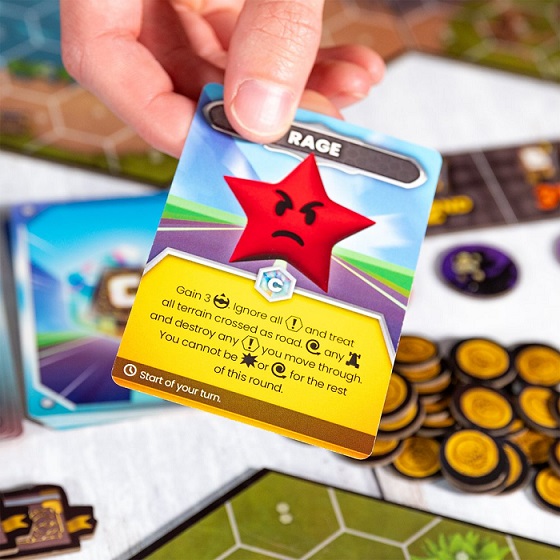
There’s an impressive balance of abundant variables with an approachable ruleset. Once players internalize the restrictions and hazard effects, movement is easy to compute while still providing tactical depth. Obstacle types intersect road conditions which play off opponent’s positioning. All of that is further twisted by asymmetric character abilities and unique kart traits. These include abilities such as allowing an extra rotation each turn, increased acceleration, and off-road performance boosts. If you really wanted to analyze all possible effects and try to determine what your opponents may be able to do on their turn, the game could grind to a halt. That doesn’t happen, beyond the occasional slight delay in calculating moves, as the general playful tone overrides any sensation of cognitive noodling.
These factors are why I pegged Dungeon Kart as a tweener positioned at the center of the recent racing lineup. I wouldn’t call this a family-weight game, and it doesn’t attain the universality of Heat, but it’s perhaps a single step beyond. It’s chaotic but it’s not huffing spray paint with nipple chains on the Thunder Road. There’s a strong sense of actually racing here as well, with the added qualities of silliness courtesy of the Italian plumber’s union. It’s a solid design that is joyful and appropriately messy. It accomplishes the unique feat of implementing take-that style of play without the baggage of emotional turmoil, at least for the most part. I can’t promise grams won’t be bitter if you nail her with a lightning bolt just before the finish line, but that’s a rare outburst.
One of the strongest qualities of Dungeon Kart is that it’s expertly paced. It’s a 60-minute game that plays well with large player counts and moves along at a good clip. I would not reach for this one with just two or three, as the Rallyman series is much stronger in that slot. With larger groups, if you’re looking for that kind of zany yet tactical game that elicits some rowdy negotiation and trash talking, this certainly attains the goal.
It’s also a rather generous box. I’m driving the retail version, and it has a large assortment of tracks, racers, and karts. The visual design is a thing, gunning for that retro video game look. It’s a little cluttered and not exactly striking, but it has some charm. Regardless of looks, she has it where it counts.
Do we need another racing game? Probably not. Dungeon Kart is not exactly innovative or wildly distinct. With that being said, I’m having a hard time not wanting to keep pulling this one out of the garage to take another lap.
A review copy of the game was provided by the publisher.
If you enjoy what I’m doing and want to support my work, please consider dropping off a tip at my Ko-Fi or supporting me on Patreon.
 Player Elimination
Mario Kart is only $80 if you don’t get the bundle. And I don’t know why you wouldn’t just get the bundle.
LikeLiked by 1 person
Fair point, I’m not getting a Switch 2 at all, just was trying to include a semi-relevant recent reference.
LikeLike
I played this once and had a great time. Think there were 5 racers and it was snappy and chaotic. I own Heat and ThunderRoad Vendetta so while I do like this game a lot, probably not buy it yet since it’s owned by someone in my board game group.
LikeLiked by 1 person
Sorry, I didn’t get my user name prior to posting. -Todd
LikeLiked by 1 person
I definitely like Heat and Thunder Road more than this one, but Dungeon Kart is still a lot of fun and hits a certain unique feel. I like it at higher player counts due to the chaos.
LikeLike