
Emerson Matsuuchi’s been through the ringer. Whispers of his Metal Gear Solid adaptation first arose in 2018. The game was commissioned by IDW’s board game imprint which resulted in cautious optimism due to their success with the TMNT and Batman Animated Series adventure system games. This was also shortly after the release of Matsuuchi’s Specter Ops, an exceptional hidden movement design that sits in the upper echelon of the genre. It seemed as though him tackling this cinematic stealth action game with IDW facilitating was a perfect fit. Anticipation was high.
Then IDW Games went Game Over and fans were left yelling, “Snake?…SNAAAAKE!?”
Seven years later. Things have changed.
CMON Games has partnered with Matsuuchi to resurrect this fallen warrior. Some may doubt the efficacy of this duo or perhaps worry about the clouded history of the design. Worry all you want. Metal Gear Solid: The Board Game goes hard.

It’s clear the team behind this is a fan of the property. The small touches are choice. This includes the graphic design, the component styling, and even a booklet of codec entries that provides supplemental rules and FAQ information.
The bigger touches are about as good as we could hope for. Details such as an excellent stealth system, a wonderful depiction of environment, and a strong vision of storytelling all contribute to the definitive Metal Gear experience.
Let’s break it down.
The stealth system is simple yet evocative. It has shades of Burgle Bros. and S.T.A.L.K.E.R. The Board Game. Snake sneaks around a grid while guards make semi-unpredictable movements. The system provides direct yet tense encounters through a strong integration of a player-driven action point system opposed by a deck of AI behavior cards. Snake can move quickly at greater risk or slowly creep around the base and avoid unnecessary noise. There is an artificial time pressure that may rankle some, but it’s necessary within the structure of this design to facilitate risk-taking.
If Snake crosses a guard’s line of sight or blows a noise roll, an attention marker is placed in his space and acts as a focal point for guard movement – this is very similar to the system used in S.T.A.L.K.E.R. Instead of patrolling the corridors in a deliberate way, adversaries beeline for this hotspot on their next activation. Some levels feature rotating security cameras, traps, and even scripted events that can alter and subvert this model.
While the roots of this design lie in the tactical miniatures genre, there is a strategic layer born from the stealth system. Scenarios function as dynamic puzzles. They ask the player to assess the environment, consider their goals, and devise a plan on how to conquer the challenge. Strategy of course must adjust during play. Sometimes a guard will make an unexpected about-face, or maybe a fresh genome soldier will arrive on the scene and press your flank. Things go haywire and the stealth framework begins to buckle, giving way to pure action as you start throwing .45 caliber slugs at the nearest threat while jetting for the exit.
Combat is simple. Dice are thrown against target numbers with guards either being knocked unconscious or outright killed. A myriad of equipment can modify or supplement attacks, occasionally providing new vectors to accomplish the objective. Snake is somewhat brittle. Getting caught out in the open by multiple guards will result in a swift execution. Be careful where you leave bodies and stick to the shadows.

If the stealth system is the foundation, the narrative is the skeletal frame, the plumbing, and the electrical infrastructure. The Shadow Moses storyline from the Metal Gear Solid video game is lifted almost wholesale and utilized as the engine for this tabletop adaptation. Hideo Kojima’s signature narrative-focused design is the essence of the franchise, and it’s a critical detail to capture.
Matsuuchi took a bold direction, one which is just as likely to alienate as it is to endear prospective players.
The plot unfolds across 14 linear scenarios. They are mechanically independent yet narratively linked. Each major beat is captured, with the results ranging from solid to outright impressive. Variety is of course strong, and it manages to avoid repetition with ease. There are many wonderful little touches, and, as a fan of the video game, it’s a joyful moment to approach a section of the storyline knowing what’s next. There’s a natural anticipation in trying to guess what creative solutions will be used to express these ideas in the analog form.
What proves a thoughtful yet potentially deal-breaking philosophy is to adhere the scenario structure so faithfully to the original storyline as to restrict player count and character selection. This means that the first several missions must be played solitaire or with just one other player. For solo enthusiasts there’s no problem here, the entire game can be tackled by your lonesome. You can also juggle multiple asymmetric characters with relative ease if you’d like to alter the dynamic. But those with a full group of four – you know, the most typical meetup structure – you’re restricted to a smaller selection of mission options. This limitation is supplemented with non-story VR-Missions that are actually worthwhile diversions.
Despite this bone, it’s difficult for Metal Gear Solid: The Board Game to escape the niche of its artistic vision and appeal to a wider audience. Really, this experience is most fulfilling as an owner playing the early missions solitaire or with a partner and then bringing the game to larger gatherings with the express purpose of playing through specific multi-player missions. In this way, the satisfaction of playing through the campaign is asymmetrical, with the owner and perhaps one other participant receiving the full payoff. Others act as passengers only able to experience slices of the greater fulfillment. It’s an odd thing, an approach we haven’t seen much of as it unfortunately restricts devotion.

VR scenarios do offer the ability to extend the multiplayer lifespan with a clever carrot that adds some punch. Succeeding in these one-off encounters unlocks equipment cards that you can then wield in the main storyline. This borrows from the soft-Legacy games that have begun to spring up in recent years, ones that offer roguelike experiences such as the Dead Cells and Slay the Spire board games.
What’s most appealing about this structure is that it doesn’t bend to appease everyone. It makes sacrifices in useability for its aesthetic as well as maximizing the influence of its storytelling. With the narrative forming the heart of the game, this is the correct maneuver. The campaign is affluent in killer set-pieces and big moments. All of the rad boss fights are represented, including the absolute high point with the Psycho Mantis encounter.
Each of these significant confrontations function as bespoke tactical puzzles. They utilize the general action point system and enemy AI framework, but they layer atop new actions, abilities, and configurations to examine. From a critical view, they’re somewhat one-note. They will often require multiple plays to best, but once you conquer a specific boss you likely won’t want to replay the encounter anytime soon. They’re gimmicky as such, but the particular gimmicks used are splendid in most cases. It’s shocking just how much juice Matsuuchi can squeeze from the basic system, presenting strategic challenges that are nuanced and dramatic. These big boss fights could have been sluggish and a drag to the overall story. Instead, they’re just as exciting and rich as they appear in the video game. This is why Metal Gear Solid: The Board Game is a righteous endeavor, and frankly a very fulfilling adaptation.

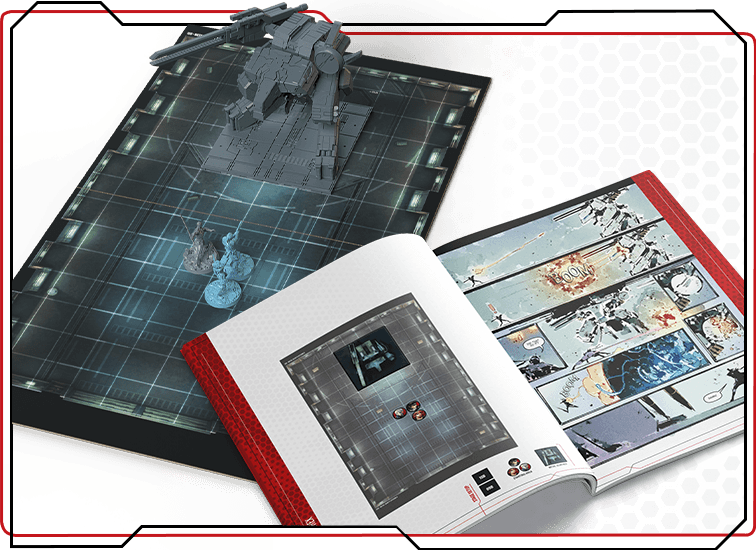
While this CMON effort can be precisely described as lovingly produced, it can also be recognized as flawed. There is a divide here in execution that is fallout from the decision to produce two versions of this game. The Integral Edition was a pre-order exclusive that is no longer available. The retail edition is identical to this special format save for two features. The first is a large Metal Gear Rex miniature that replaces a cardboard token. While the mini is sharp and impressive in size, it’s wholly unnecessary and of limited use. This piece alone increases the box size significantly, and it’s no big loss for the standard edition.
The second item is more pivotal and a great absence. Instead of the scenario book containing brief story introductions with minimal context, the booklet is beefed up with a full color comic. Multiple panels link each mission, filling in the gaps in time and doing a wonderful job of conveying all of the video game’s most iconic visuals. Characters are presented with stronger personalities, and the significance of certain events are captured splendidly. This is such a neat addition to the game that is hard to define in terms of signficance. It’s something you need to experience side-by-side to totally understand.
This is also more than just introductions and conclusions to the missions. It’s vital cut scenes that occur mid-scenario, breaking up the action. Some of these moments had to be re-written to facilitate this, as the illustrations factor into the actual gameplay. This graphic novel approach provides such a strong companion to the powerful scenario writing, with the totality forming a symbiosis that is fundamental to the experience.
What’s unfortunate is that the comic also serves a necessary aid for those unfamiliar with the video game. This adaptation is awash with excellent design touches, and it’s certainly something that could be appreciated by those who were never fortunate enough to experience one of the best video games ever crafted. But that’s problematic when the retail edition is missing large chunks of story framing.
There is a solution.
YouTube user Davey “davo” put together a playlist with cutscenes to accompany each scenario. It’s brilliant and an invaluable asset to those lacking the comic. While the illustrations and extended panels are still a marvel to behold, this cut scene playlist may create an even stronger emotional connection to the material, whether you’ve played the video game or not. Top marks for the effort.
One concern I have for this game is in its extended viability. There is a satisfactory amount of content within the box, but the heavy reliance on the Shadow Moses storyline means that there is a confined sense of exploration within each scenario. The experience has a heavy editorial hand, not allowing for a large variance in experiences or outcomes.
The most obvious comparison here is to Corey Konieczka’s Mandalorian Adventures, a 2024 title that sought to transfer several core scenes of the show to the tabletop. This game had a more liberal philosophy, defaulting to a prescribed character set but also allowing for alternate re-imagined stories with a wider cast. This resulted in several different ways to play the game, with this creative ethos carried forward to bonus scenarios that sat atop existing maps. There was an aspect of modularity that is totally absent from Metal Gear Solid: The Board Game. I can’t help but wonder “what if?”, as this result could have similarly been achieved.
I don’t think a single scenario is frivolous or dull. But I do think there are many which are one-dimensional and don’t beg to be replayed, particularly a couple of the boss encounters. Perhaps with a certain amount of time passing this will change. It’s honestly not too different from approaching the classic video game. It’s something you may want to do a few years down the road to re-experience some of the clever touches and key moments. This isn’t unreasonable or problematic, it’s just one area where the game fails to exceed expectations.
Regardless of that quibble in modularity, this is an accomplished design. The genre of stealth action games has received several notable entries in recent years, so the competition is rigorous. Beyond the hidden movement category that includes wonders like Spector Ops and Mind MGMT, this stealth grouping holds titles such as V-Sabotage, Earth Under Siege: Flashpoint, and SAS: Rogue Regiment. You can also toss in the aforementioned Burgle Bros. and the S.T.A.L.K.E.R. board game.

I have a similar enthusiasm to when I was first examining SAS: Rogue Regiment. That was a design that impressed due to its sheer creativity and inspiring play. There is a similar sensation with Metal Gear Solid. However, that World War Two special forces game is focused on a more open sandbox approach to solving its missions. The scenarios are wider in scope and lengthier to overcome. MGS is more directed and narrower. The storyline is pre-determined and the quality of emergent narrative situations is less variable. While I tend to prefer games with less directed and more organic story invention, the Kojima-penned arc is so emotionally satisfying that it’s difficult to knock this aspect.
Additionally, I am impressed with the midpoint this touches in not quite tipping over into the gluttonous trap of multiple expansions that is so common amongst this publisher’s releases, while also offering something substantial that is well-stocked with scenarios and delivers a mature and considered storyline with bombastic presence. It’s full of plastic and a bit much, but it’s a standalone release that doesn’t seek to chain you to an ever-evolving product line or extract several hundred dollars for the complete experience. It does have that Integral Edition conundrum, but as I established, there’s a more than suitable workaround.
Metal Gear Solid is simply an iconic game that helped shape the future of video game narrative construction. Just as The Sopranos altered the makeup of television and redefined the criterion for quality, Metal Gear Solid shook an industry and elevated the medium. Expecting an equal accomplishment from this board game would be foolish, for its restricted to telling someone else’s story as an act of translation. Yet, it manages to produce something exquisite, meeting the lofty expectations established by the pantheon of stellar board game adaptations in recent history. If I can overlook its limitations in format and structure, this is a fantastic experience and has a reasonable shot to be one of the standout titles of 2025.
A review copy of the game was provided by the publisher.
If you enjoy what I’m doing and want to support my work, please consider dropping off a tip at my Ko-Fi or supporting me on Patreon.
 Player Elimination
1 comment for “There’s No Happiness in Death – A Metal Gear Solid: The Board Game Review”