
I’m all about high falutin experiences that treat games as Art, but sometimes I just want to punch a cretin in the mouth and send chiclets flying. This is the hard knock life that Aldarra comes from. You might not know it by the Elvish sounding name or the pastoral cover, but this honkin’ beast is old school as hell. Its enormous oblong box pairs well with the pugilistic gameplay to capture the spirit of early days Fantasy Flight Games. But this isn’t FFG, it’s Sordane Publishing, a newcomer to the scene that’s kicked off their existence with zeal.
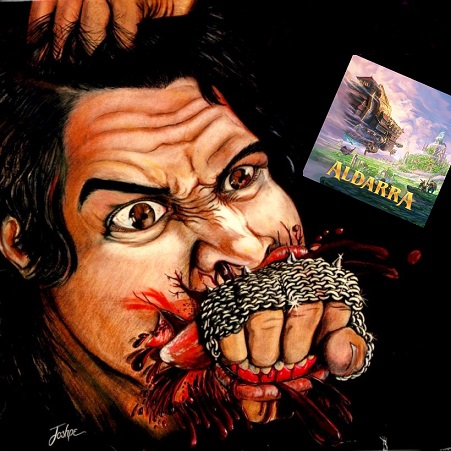
We really need to talk about the box. Hauling this game around requires a lift belt. It’s obnoxiously big, even in a world flush with gluttonous crowdfunded product. The causation here is the multitude of GameTrayz which house each faction’s steampunk airship armada. Let’s get real, if you jettisoned the plastic inserts and bagged everything – the ships are surprisingly durable – you could get away with a storage system half the size. Maybe even a third. This will be a substantial downside to many would-be owners, for both transportation and storage deficiencies. If you’re the type of person that really needs their shiny new game to fit in a Kallax cubby, ha, eat steel.
As noted, this is really channeling the soul of yesterday’s Fantasy Flight Games. I’d pitch it as the size and scope of Twilight Imperium with the sheer brutality and pace of Nexus Ops. It resides between those two classic designs, offering a lengthy conflict that lasts about an hour per player. But it doesn’t feel that long. The emotions and fire bursting from the surface demand attention, and it is so possessed by battle and aggression that the pace remains higher than most games of this ilk. This is not the posturing Cold War of Twilight Imperium, no, it’s the unrelenting roar of diesel engines as German tanks surge into Poland. For three or four hours straight.
Aldarra’s onslaught is all about incentives.
A major chunk of a player’s points will be through battle. Every conflict that you initiate and win earns a victory point. The size or position of the defending force does not matter. This means that you should be battling as often as possible, aiming to strike fast and eliminate smaller armies which are vulnerable.
While the reward is evident, the deterrents to conflict are also minimized. Holding land offers no benefit beyond resources for building more units. That’s certainly something, but it won’t win you the game without accompanying aggression. Each ship lost in combat confers a one-coin reward to its owner. For cheap units, this can be a significant portion, if not all, of their construction cost. This limits the sting for the defender as well, shielding play from some of the negative emotions associated with high conflict designs. Finally, if the defender wins the combat they receive no victory point reward. They get nothing.
This is a neat device. It means bulking up and creating a defensive wall is nigh useless. You want to maximize your efficiency in killing, and you want to wield that with maximum momentum. This creates a hectic battlefield with massive turnover, as players throw units into the pit and blow the hell out of each other. I don’t know if I’ve seen a game with this much wanton destruction and such a completely unpredictable board state. Perhaps in the latter half of Dune when the tanks are flooded and the desert runs red.
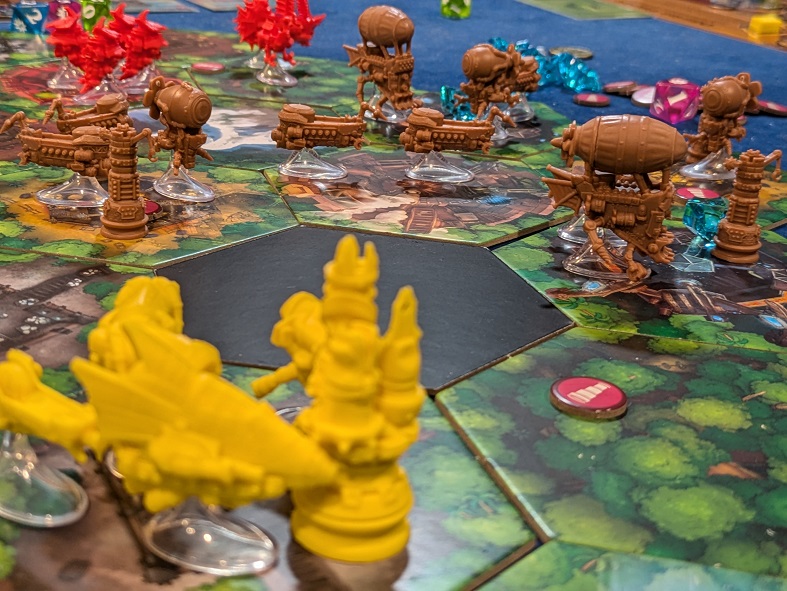
A second source of victory points are personal objective cards. You receive a new one each round, and they include goals such as starting multiple battles in a single activation, winning a conflict without losing a ship, and occupying certain dangerous spaces. They heavily influence how you attack the board, what units you build, and when you decide to take risks. They blend rather seamlessly with the overall macro elements to produce this lawless sea of carnage, and I’m totally here for it. This again reinforces that Aldarra is not the plodding and deliberate Twilight Imperium where a large portion of your points come from achieving certain technologies or holding specific planet configurations. Aldarra is more about being opportunistic, and less about grand strategic machination.
Feeding this offensive-heavy philosophy is the elegant activation system. It has the contours of TI4‘s command markers, where you place a token in a system to activate it. Here, unsurprisingly, it’s more flexible.
On a player’s turn they place one of their activation markers in a hex. Then, they can either make as many moves to or out of that hex as they’d like, but they must choose – one or the other. The former allows for consolidating large swingy attacks, while the latter supports a lightning strike strategy of facilitating multiple battles. Crucially, the marker is removed after the turn and the hex can be re-activated in the future, a rules flourish that makes this distinct from its influence.
The ideology throughline continues in battle. Each unit has special abilities by type, which allows for some fantastic combined arms doctrine. Once you’ve assembled your force, players roll attack dice by initiative phase. Instead of the more nuanced Eclipse style ship activation, there are simply two distinct phases. Lighter ships attack and resolve hits first, followed by the heavier aircraft. There’s a clever twist here in that damage never persists. You either assign enough hits to kill something, or it remains unscathed. This opens up some finagling with combined fire, and the allowance for players to delay their light ships until the second phase of combat. Of course the tradeoff is that those smaller units may perish before they get to roll their dice.
This is such a neat system juiced with exploding dice rolls, upgraded units, and the occasional hidden card play. It’s essential that Aldarra nailed its approach to battle, as it’s the focal point of all other systems. It’s the way players pursue victory, and it’s the game’s overriding identity. There is no doubt here, as it’s one of the most effective and interesting combat systems for my preferences.
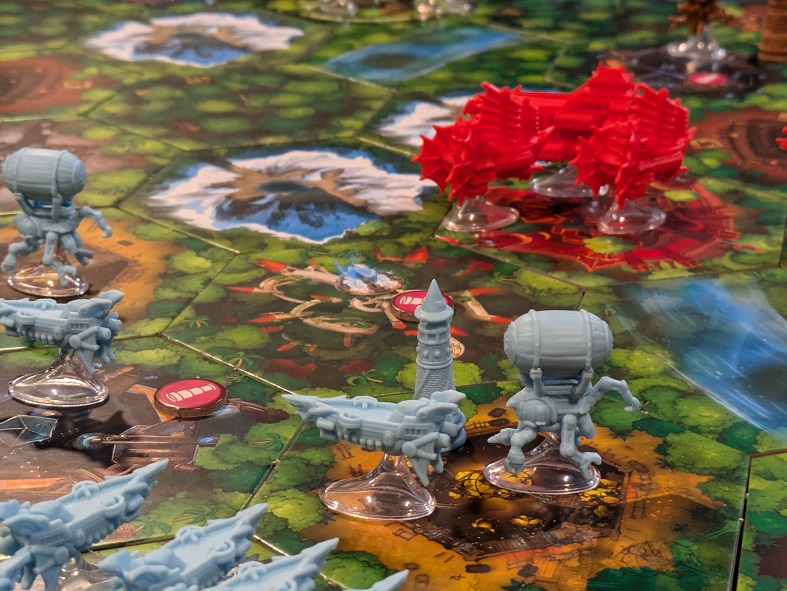
I’m doing a reasonable job of making Aldarra sound like it’s going to set the world on fire, but realistically, this game is for a somewhat restricted audience. In addition to the assault-focused ethos, it’s similarly devoted to flagrant instability across multiple sub-systems. This is a game of chaos and unpredictability, and the most prominent feature is the card play.
There are several different types of cards in this game, and they’re all wobbly. I’ve already mentioned the hidden objective cards. This system – as seen in other designs – is a strong tool for maintaining secrecy and pushing players into various specialized behavior. However, Aldarra struggles with balance. This is something I wouldn’t criticize Twilight Imperium for, but I think you’d be hard pressed to find someone that doesn’t have some level of discomfort with the implementation here.
There are just obvious cases where things are unequal. One objective card for instance requires a player to hold eight spaces on the board, and they must do so without being last in initiative order. This is a very difficult feat, and even if it’s possible, it’s one that will leave you in a terrible spot. To hold that much ground you’re likely committing several smaller forces to defense, and they make the most alluring targets for other players. To make matters worse, it rewards only a single victory point while there are two point objectives which are far easier to attain.
Another ugly objective is destroying fortifications with an upgraded engineer unit. The unit upgrade system is gnarly. Between each round, players take turns drafting new special abilities from a faceup offer that is dealt out. It’s very similar to the power draft in Lords of Hellas, and it’s a wonderful system that develops meaningful asymmetry over the arc of play. But you have no guarantee an engineer unit upgrade will appear, and even if it does, a player earlier in turn order may gank it before you get a selection.
The concept of this objective card isn’t erroneous, it’s just that it’s a very niche goal that a player may have no opportunity to accomplish. This becomes an issue when others draw cards with much easier tasks, which will happen often.
Exploration cards are both worse and better in terms of upending the sanctity of balance. After moving units and battling, players may place a token on an unexplored hex they control and draw a card. It’s a great little slice of the 4th X without requiring a great deal of rules overhead. Additionally, the effects on these cards are wild and at times, unhinged. I see this as mostly a boon supporting the anarchy of conflict, but some will be downright upset at how Aldarra plays favorites. You may draw a card that allows an immediate attack on every neighboring hex, which may consist of only friendly spaces. Then I may draw an exploration card that awards a free destroyer, or perhaps even a victory point. Yeah, there’s an exploration card – with multiple copies – that simply rewards a victory point. Some fools need to hold eight spaces and feed the opposing warmachine a selection of tapas to devour, while others may draw into a no-strings-attached victory point. There’s a fortune divide at times that is as wide as a canyon, and it can feel egregious in a three or four hour game.
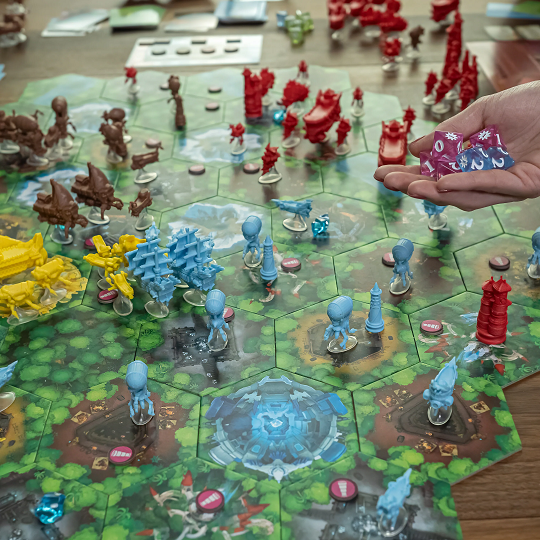
The final type of card are events. There’s a running gag in my circle that “every game needs an event deck.” That’s not at all the case, but Aldarra certainly benefits from one.
This addition is found in the excellent Savage Skies expansion box. This extension includes two new asymmetric factions that are a joy to play, as well as the event card module. I’d include this deck every single time, even with newcomers if I’m able to facilitate and walk them through the experience.
A main benefit is that it alters the tactical landscape in various effective ways. There are cards that cause certain resources to produce extra in a given round. There are also events that swap out the standard movement rate of ships for a die roll. Another interesting option has players passing one of their objective cards to the player on their left. Sometimes it’s pure chaos like this. I’ve found the various elements of disorder collide with the other game functions in tasteful ways. It breaks up some of the pattern found in continuous conflict and will cause players to rethink their approach.
One aspect of this module that alleviates some of the turbulence is that the event card effect is known a round in advance. It allows for preparation and a degree of strategic adjustment. This element reflects the general consideration given by the design team. There are several similar details which highlight how the trio of Matt Fantastic, Benny McLennan, and Andrea Pincumbe put a great deal of thought into this game.
An example is the symmetric design of units. While factions have a few standard asymmetric abilities that modify rules, their individual units are all identical. At first this was a disappointment. It seemed like an opportunity for characterization that was ignored. I realized quickly, however, that this design team approached the game with care.
While this is still a lengthy affair, the tempo of play is fast. It’s a speedy thing that wants you to make quick decisions and get to wrecking. One of the largest pitfalls in games with conflict and high unit density is a cluttered board state that hinders assessing the probability of victory. It can get very hairy when trying to understand all of the different unit abilities, their damage output, and what tricks to be aware of. By maintaining a symmetric unit assortment, players can quickly assess army potential and lean into their intuition on decision-making. Wondering what a dreadnaught does? Look at the card right in front of you. This eliminates many questions and shortcuts the determination process.
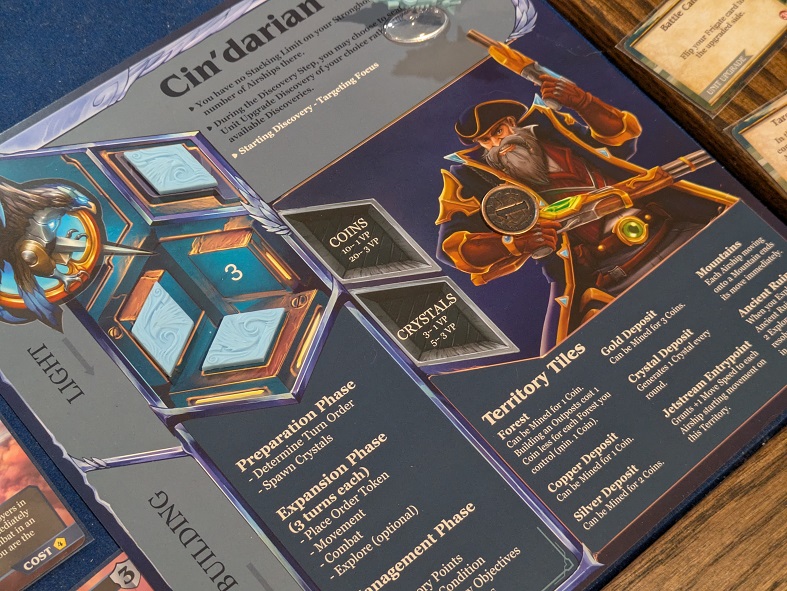
A second illustration of the directed nature of the design is the faction boards. They list abilities and provide space to hold activation tokens of course, but they also function as a detailed player aid. All of the various phases are listed – there are quite a few – as well as terrain tile effects. This is paramount to keep the flow of play dynamic and allow participants to enact rapid tactical decisions. It’s also strong evidence that this was playtested rather thoroughly from a user interface perspective, a quality which is absent from many designs in the tabletop simulator era of game design.
Given this fastidious approach to several areas of the game, it leaves me all the more curious about the unbalanced objective cards. I also must point out that the sheer volume of content has resulted in a general lack of precision. Some effects reference terms that appear to be keywords, but they’re subsequently never defined. Certain ability interactions are difficult to untangle, and it’s generally the type of experience that is going to spring uncertainty upon its players. These foibles are problematic and soften the strength of the design. They’re also roughly in line with the retro FFG nature of this product.
This is a largely chaotic and messy game. These traits mean some may decide to house rule or alter certain features. I don’t often subscribe to such a thing, but there is one detail I plan on adjusting in future sessions. The default condition of 20 victory points to end the game is too long in my experience. I’ve found 15 a more reasonable number, as it shaves off a round or two without any serious loss of game arc or emotional payout. I could see purists strongly disagreeing with this assessment, but I felt it worth mentioning for completeness.
As is often the case, I’ve spent a great deal of time thinking about this game. In addition to the commonalities shared with Twilight Imperium and Nexus Ops, several traits remind me of Clockwork Wars. This is an unheralded 2015 area control title that deserves so much more praise than it has received. The core systems of these games are very different, with that Hassan Lopez design offering a very measured deployment and conflict system that contrasts heavily with the pure Ameritrash blunderbuss of Aldarra. However, both feature immense verve through uneven card effects that can absolutely demolish expectations. They’re wild and unruly games at heart that prop up dynamic action over long-term strategy. Both also seem relegated to cult status, unlikely to ever break into mainstream consideration for the genre.
I’m hesitant to declare the niche acceptance a shame. This is a game of a particular era, bred in the vats of offal drained from husks of relics that once commanded the souls of a fiery people. It’s the type of screed meant for a certain few. That’s unequivocally Aldarra’s legacy.
A review copy of the game was provided by the publisher.
If you enjoy what I’m doing and want to support my work, please consider dropping off a tip at my Ko-Fi or supporting me on Patreon.


Great review, thanks!
“the tabletop simulator era of game design”
What did you mean by this? Do tabletop designers commonly prototype games on tabletop simulator these days?
LikeLiked by 1 person
Yes, exactly that. Maybe not a majority, but there are a large number that play test primarily electronically. This is a habit that really kicked off during COVID.
This can lead to certain design decisions that hinder the game.
LikeLiked by 1 person
Ah, yes. I can see how that would be helpful for playtesting. But, as you point out, there is so much to a tabletop game that happens via in-person presence. I can see how that would be very limiting.
LikeLiked by 1 person