
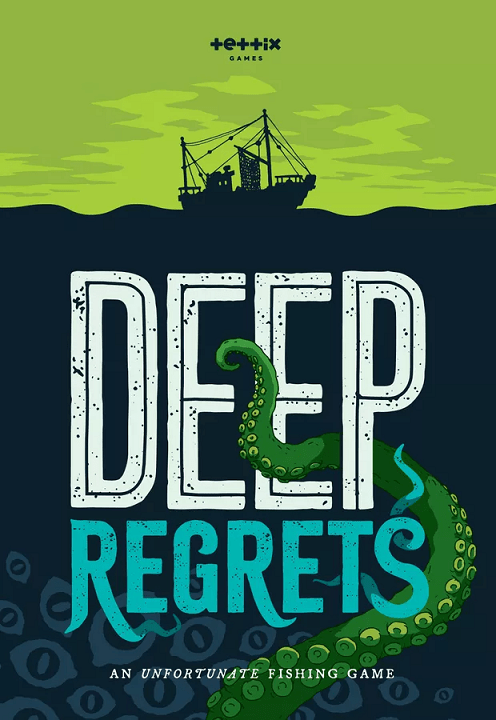
“Deep Regrets is an unfortunate fishing game about pulling progressively more horrifying things out of the ocean. Decide what to eat, what to sell, what to mount, and how many regrets you’re willing to carry, as you push yourself too far and spiral towards a conclusion in this strategic horror fishing game.”
Sometimes you can’t outdo the marketing blurb and you just have to let ’em cook. While clearly tipping a fishing cap towards the video game Dredge, this inspired concept goes beyond its influence to establish a spooky and vivid setting. The world of Deep Regrets is full of tentacles, skulls, and rows of teeth. The fish are mad and the people are madder. This is a game that sails entirely on vibes, offering a choppy seascape that tickles the gills.
And the name of the ship was the Billy o’ Tea
The winds blew up, her bow dipped down
Blow, my bully boys, blow
This strong vision is courtesy of designer, artist, and publisher Judson Cowan. He’s in the Ryan Laukat role of doing it all, presenting a unified ideality that grabs a hold of a player’s mind through their eyes. This game, while a surprisingly small product for a modern crowdfunded title, is a delight to view, touch, and drown in. A full page of introductory text, evocative graphics, and imaginative quarries all work together to rightly sell this bill of goods. This impressionistic setting, and all that it explicitly touches, is the best of Deep Regrets and the reason to give it your time.
This is not a complex game. Across seven rounds, players decide whether to spend their turn out in the vast untamed brine or in the more docile yet uneasy port. This is one of the most significant decisions in the game, for a turn at land suggests wasteful inactivity, despite it being a necessary stop. Hauling fish out of their deep hidey-hole is the primary pursuit, the one that awards prizes and glory.
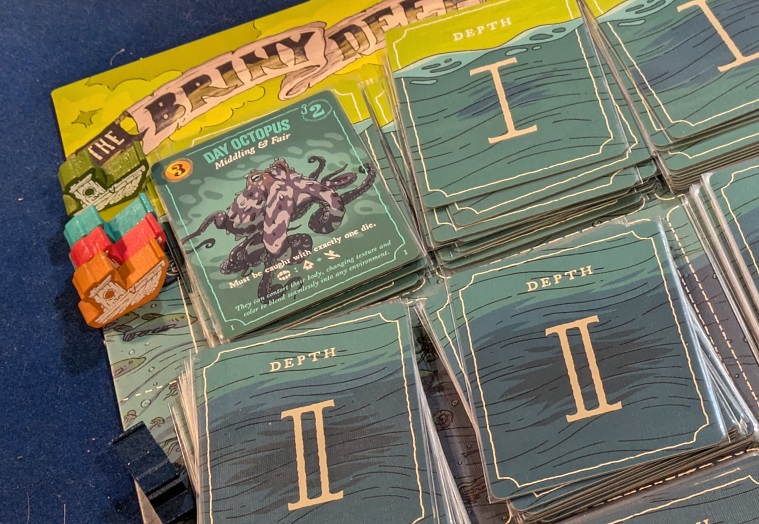
Fishing is a relatively straightforward process of assessing risk and committing to action. Dice are rolled at the start of each round and are then spent for various actions, including reeling in the hideous creatures below. The fish are spread across nine face-down decks, with three sets at each level of depth. The deeper you go the crazier the catch.
Over the span of the session you will acquire new tools, such as poles and rods and additional sinker dice, which will aid in the pursuit of catching the most prized beasts at the bottom of the abyss. While the tone remains consistently macabre, the arc of play is more jagged. Once you’ve acquired a pole and reel, you don’t gain much of a benefit to heading to port. You can effectively catch a couple of fish at the start of play, head to port in turn two or three, and acquire your strongest implements immediately. Likely, you will return to dock near the end of play to mount your prized catches for additional scoring bonuses.
This formula can be tweaked. You can stay out at sea longer and pursue smaller quarries. You can head to port irregularly, perhaps using the subtle benefit of re-rolling your dice in order to improve your odds for the next round. Deep Regrets doesn’t present an overriding optimal solution, and it doesn’t appear to be solvable. But regardless of the path you choose, the overall arc of play is relatively similar. You fish a little, gain your best stuff, and then you get to work riding out the rest of the game. It’s not stepped or unpredictable progression. Each play doesn’t unwind in extremely volatile ways. In fact, the primary driver of any session’s story is the underwater horrors you encounter.
These fish are in some ways the best part of Deep Regrets. They’re also a little underwhelming.
When down on her a right whale bore
The captain called all hands and swore
He’d take that whale in tow
The first time you grab ahold of a skull whispering green malignant tendrils or a shape changing terror Kelpie of Scottish legend, you smile and examine the card with intent. You really look at the thing, admiring not just the value of the catch but also the visual dread and weight of the creature. There’s an initial moment where it’s alive and defined, birthed into the awful fictional world and spread like an infectious disease spewed from the great ocean. As time goes on and you see those dreadful fish again and again, they just become fish, the descriptors washed away like stone eroded with the bloodletting of time. Then they become numbers. Then the vibrant world full of malice and imagination crumbles, and it’s just a game.
Any game played excessively will snuff out its spark, but Deep Regrets lives on this sense of exploration and wonder. The moment it rusts is the moment things begin to fall apart. A major source of the design’s inability to overcome this anchor is a sensation of internal conflict. The soul of the game feels at odds with itself, not quite able to lift the catch from the water. This is most evident in the math.
The setting is both horrific and slightly whimsical, it has a distinct mask that you could call charming. This fits well enough with the overall weight of its systems which straddle the line between light and medium weight. Yet it seems unsatisfied with embracing the turmoil of its thesis. This isn’t a wild or over-the-top game. Larger and more misshapen fish can trigger powerful effects, but they never feel as though they’re yanking on the tension of the line, ready to snap the game and send the whole thing tipping overboard.
It never feels unsafe.
This is most evident in the player aids that highlight the odds of catching certain sized fish at the various depths. It lists the upper and lower ranges of difficulties, allowing players to cast their rods and snatch up their prey with strongly calculated risk measurement. Those playing conservatively seem to have the upper hand, as throwing caution to the wind and fishing for long shots is unwise. Wasted actions are particularly defeating, as the math frames the endeavor as a pursuit in efficiency.
The whole process of fishing is somewhat unexciting. You roll your dice first, and then you head to a certain spot and draw the top card of a shoal. If you have a strong enough roll, sometimes due to simply possessing a ton of dice, you’re practically guaranteed to nab your target. Other tools allow you to peek at cards or adjust their difficulty after reveal. Only once or twice in a game is there a sense of real tension during the hunt, and that’s ultimately a disservice to the core themes.
Deep Regrets boasts a push-your-luck core focus, but it can often lack teeth in executing this procedure. It feels as though it wanted to be a chaotic and exciting experience, but it chose to tone this attitude down and defer to modern Euro-sensibilities and subsequently elevate efficiency as a strong characteristic. By reducing fishing as an activity to flipping your target and no other process, it decentralizes some of the emotion of this gambit and flattens the sense of drama.
To bring us sugar and tea and rum
One day, when the tonguin’ is done
We’ll take our leave and go
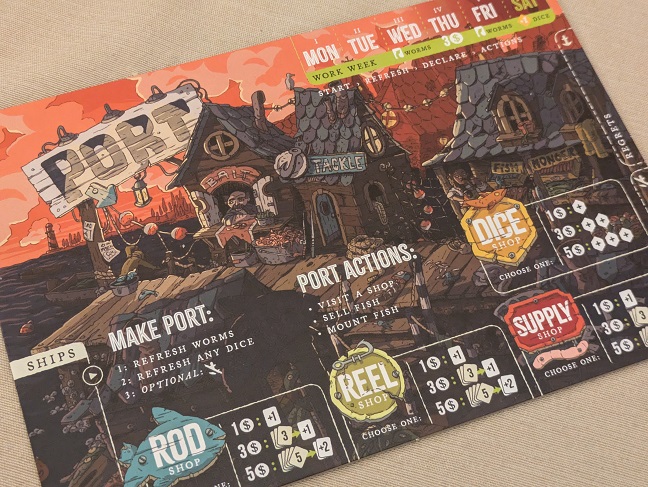
Beyond fishing, the port action also features tendrils of this incoherence. There is a surprising amount of disparity in the items you can acquire. When purchasing a rod or reel you pay a certain number of fishbucks (yeah, really) and then draw a quantity of items to peruse correlating to your expenditure. Go cheapo and just top deck a rod. Halfsies gets you three to choose from. Full-on moneybags allows you to view five before choosing.
There are only 10 rods and reels in each of their respective decks. So, you can effectively view half the options randomly and then take your pick. This feels far too calculated, allowing you to excessively curb risk. There’s an explicit sense of control here that feels at odds with peering into the alien depths of the ocean and yanking out a cluster of sinew and eyeballs. This game offers both a sense of bizarre and zany and then contrasts that sharply with calculated and fine. Perhaps worst of all, that sense of control can vanish if you are unlucky enough to miss the best in class and then a happy-go-lucky fool comes moseying into town and plucks the best rod in the game with a single pull. It simultaneously feels as though there’s too much player oversight, and still not enough.
Many are going to complain about the balance of the items. This isn’t up for debate, there are rods which offer you a boosted effect when reeling in a certain type of fish, and there is another that gives you that boost always. For every fish. This is all over.
This doesn’t bother me. I just wish there were twice as many of each item. Maybe even three times as many. It feels far too tight and expected in its current incarnation. If shopping is meant to mirror the wily variance of fishing, it should parallel the large selection and present a whole swathe of items that seriously alter play. This would aid in substantiating a narrative of a particular session, as currently, each play of this game blends together somewhat with only the smaller details changing.
Madness is another area reflecting this juxtaposition of ideals. A core conceit of the game is that catching foul fish drives you mad. This is beneficial, as it allows you to utilize more dice and sell the most bizarre prizes for additional profit. The downside is that madness is paired with regrets, cards which may cut you down at game’s end if you accumulate the highest total.
Consequently, there’s a natural tension of wanting to gain madness for benefit while needing to avoid overdoing it and eliminating your chance of victory. Shooting for second highest is ideal.
But regret cards are too transient. You can acquire them continually and in bunches. And you can also dump them often enough to work your way out of the hole. It seems as though the game wants you to walk a tightrope, but it makes the impact of regrets feel less substantial. The impact of regret would feel more meaningful if the economy was more conservative, with key moments in the game piling it on you and only a few crucial chances to shed some of that anguish.
With how it currently works, you’re intended to read all of the superlative descriptions on your regret cards at the conclusion. This is a sort of narrative retelling of your escapades and descent into derangement. But without the context of causation – primarily because so many come and go you have no idea what foisted any individual card upon you – it’s all a little generic and meaningless. After a couple of plays, I found myself not wanting to spend the time reading these details because there’s no actualized benefit.

The whale’s tail came up and caught her
All hands to the side harpooned and fought her
When she dived down below
While I do not wish to appear lacking in conviction, I do want to soften the blow of my criticism as this is not a poorly crafted or ineffectual game. Deep Regrets is spectacular as a visual and aesthetic work, and even its imperfect mechanisms provide enough interest to sustain initial plays.
Its systems are strongest when paired with smaller player counts, primarily because less of the game is borne out. At five, the design feels pushed to its limits and overtly uncomfortable. It will stretch over two hours (closer to three if playing with guppies), and the flat nature of game arc will be most apparent when put under the microscope for a lengthier period of time.
At five there’s also a content issue. Dinks, a type of benefit card doled out to players who pass prior to round end, run dry far too often at the upper limits. This defangs the threat in taking long turns, causing some cracks in the bow of one of the design’s more interesting elements. Additionally, with so many players it is likely that a significant portion of the most interesting fish cards are encountered. This accelerates the timer on the setting’s novelty. It’s much more interesting if something like the plug or treasure chest cards are discovered as a rare encounter that can shape the contours of play. When they’re turned over frequently, they lose their magic. Five also ensures the most severe discrepancies in item balance arise, with a wealth divide emerging mid-session and apparent for all to see.
At lower player counts, these smaller blemishes are avoided. The bespoke solitaire mode is also intriguing, allowing a player to go it alone and push themselves to the limit in order to haul in a large bounty of fish. While I enjoy the multiplayer game more, I found this a worthwhile endeavor and could see it expanded upon in the future. An expansion would actually benefit several areas of the game. It could pad out the item decks, maybe even add fish if the internal ratios of fair to foul fish could be allowed to run wild. More would simply add a variety to the encounters during each session, allowing individual plays to garner distinguishing characteristics and support stronger storytelling.

To bring us sugar and tea and rum
One day, when the tonguin’ is done
We’ll take our leave and go
Deep Regrets is a fun game. It’s not a vapid design and it certainly has soul. The effort involved in the craftsmanship is obvious, and I know Cowan is dedicated to this work. I have certainly enjoyed my time with this title, even if it doesn’t stand up as well as I’d like to finer scrutiny. A possible trap with this game is that it will appeal conceptually to a wide range of gamers, but it may only land on solid ground with a select few. I think its mechanical framework is more niche than it initially appears, striking a balance between variance, agency, and theme that will harbor discontent, yet manage to attract a cult following.
A review copy of the game was provided by the publisher.
If you enjoy what I’m doing and want to support my work, please consider dropping off a tip at my Ko-Fi or supporting me on Patreon.
 Player Elimination
That seems like… one in a kind game… Thanks for sharing – would probably never discover this on my own!
LikeLiked by 1 person
It’s definitely a unique one.
LikeLiked by 1 person