
My kid is all in on ducks. I don’t know why. I’m not sure she knows why. But a year or so ago, at the age of 10, she decided she was all about fowl. I will tell you, it’s difficult to find a board game about ducks that is not awful. Oussama Khelifati’s Duck & Cover offered the only respite.
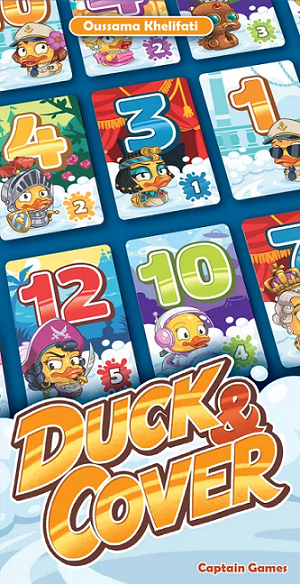
Sometimes there’s a quality evident in a game, an attribute that’s difficult to define. This game has it, whatever it is.
Broadly, I’d describe Duck & Cover as a BINGO-like experience driven by a central deck of number cards. A shot-caller pulls a card and announces it to the table.
“FOUR!”
No one yells BINGO in this game. It’s not BINGO. Instead, some will perform a quiet activity of manipulating their personal grid of 12 cards, and others will audibly quack. As the game progresses, more people will join team quack. If you’re playing this in public you’re getting curious stares. The quiet group solemnly playing Caylus in the back corner probably isn’t happy. QQMF as the train gamers say.
Each person has a similar set of cards numbered 1-12. You shuffle before the round starts and lay ’em out in a four column by three row grid. Then, when a number is announced, you can move the declared card to an adjacent position, covering the card below.
Pretty simple. If your 4 has a 12 sitting next to it, you can pick the 4 up and cover the 12. Now you have a stack. The next time 4 is called, you can move that stack and cover up the 2 that’s now adjacent. This keeps going with numbers being called and players performing atomized actions of moving cards around.
But you don’t have to cover a card. You can instead pick up the 4 and place it on any open space in the grid. Imagine the grid extending infinitely in all directions. The only restriction is that it needs to be orthogonally adjacent to one of your other cards. No, you can’t fling it across the room you degenerate.
But what if the 4 was covered by another number already? That’s when you quack. Go ahead, do it. It will put a smile on your face.
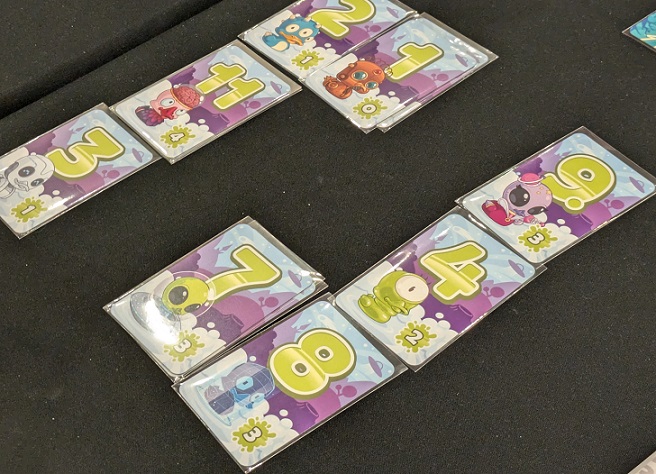
Now you can play Duck & Cover. Really. That’s it.
Oh, you care about scoring? That’s simply a technicality. Once someone has reduced their grid to a single stack of cards the round ends for all players. If this takes too long, there is the possibility of a timer forcing everyone to stop. In this instance everyone is dissatisfied with their current board state. It happens.
When the round stops, each player totals the scoring values printed on the corner of all of their visible cards. Higher numbers, such as 12, will have higher scores. This is golf scoring. You don’t want points. That’s why you need to cover up the big ducks as soon as possible.
There is one neat little trick – if you are the player that reduces their grid to a single stack, you subtract the score on the top card instead of adding it to your total. Scores are totaled over three rounds, with the lowest total then declared Lord Rubber Ducky.
Look, if you said Duck & Cover was a little dumb, you may be right. But it’s more than that. There is actual strategy in how you manipulate your grid. This emerges relatively early in play as you begin to see how creating gaps around cards is problematic. Often, Duck & Cover forces small yet difficult tradeoffs. Do you cover the 12 as soon as possible? What if you can only cover it with your 10 and that creates a little island off in the corner? Maybe better to wait for a different card to be called and tackle the 12 in another way.
When the 4 appears, maybe you have the option to cover the 6 or the 2 sitting next to it. The 6 is an obvious choice as it scores you more points at round’s end, which is usually bad. But the 6 has already been covered by all of the other players, which means you effectively get a bonus turn each time it’s called going forward. Everyone else has to just watch. And quack of course.
Giving up a turn to re-position a card is both wise and perhaps damaging. The game is on a timer, one primarily driven by the other players. Passing a turn to setup stronger future turns can waste precious time. You can also “shoot the duck”, our obviously clever twist on shooting the moon, and save a high value card hoping to have it land atop your single pile and reduce your score significantly. Of course that can backfire, in which case it’s the duck shooting you.
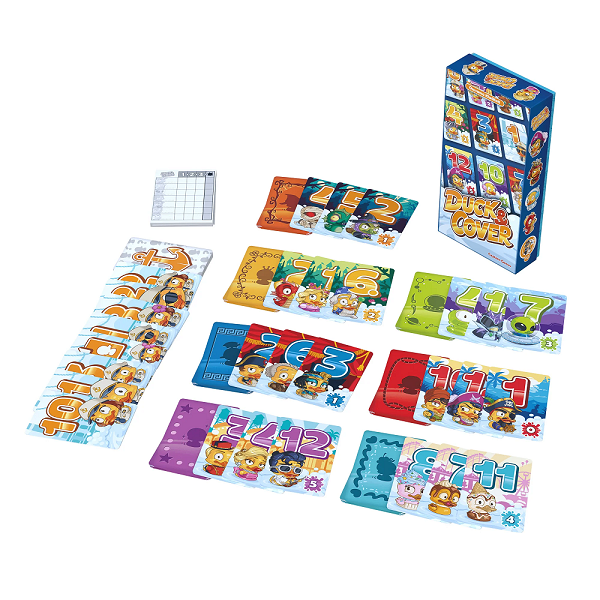
This is almost the ideal family game with a hobbyist bent. It’s surprisingly thoughtful at times, allowing for some latitude in agency while also requiring only the slightest retention of rules. Everyone is always playing, rarely having to wait more than a few moments. Pair that interesting yet restrained experience with lovely duck artwork, a table full of people quacking, and a breezy 20-minute commitment, and we have something. It’s difficult for this game not to tease out smiles and appreciation. At worst, it leaves you kind of numb and disaffected, like you’ve been sitting in bathwater for too long.
That wasn’t the case with my waddle, however. We’ve found Duck & Cover has that special quality. There’s something about its central puzzle that doesn’t require the furrowing of brows but still rewards a touch of analysis. But it’s just a touch, like sugar dusted atop a sweet treat.
The most appealing trait is that you don’t receive immediate feedback to your action. You don’t really know if covering that 4 with a 6 was the right call. In this environment, that leads to a sensation of all moves being competent. Sure, time may run out and you may score too many points, but it usually feels like things could have turned out differently had the cards fallen a certain way. This is an illusion at the center of the experience, as stronger play has better odds of prevailing over enough rounds. But that illusion is a crucial benefit when playing with people of varying interests and ages. This combination of qualities is ultimately what allows Duck & Cover to hit with a widespread audience.
QQMF.
A review copy of the game was provided by the publisher.
If you enjoy what I’m doing and want to support my work, please consider dropping off a tip at my Ko-Fi or supporting me on Patreon.


Do you get more corporate sponsorship if I admit that I just bought this as a father’s day present based solely on your review? Quack, quack.
LikeLiked by 1 person
Ha! No corporate sponsorship here. Thanks though, Randy.
LikeLike
you need to find a copy of Duck, Duck, Bruce by Gamewright. no idea why they don’t keep this fabulous push-your-luck game in print. dw
LikeLiked by 1 person
Haven’t heard of it. I will check it out. Thanks!
LikeLike