
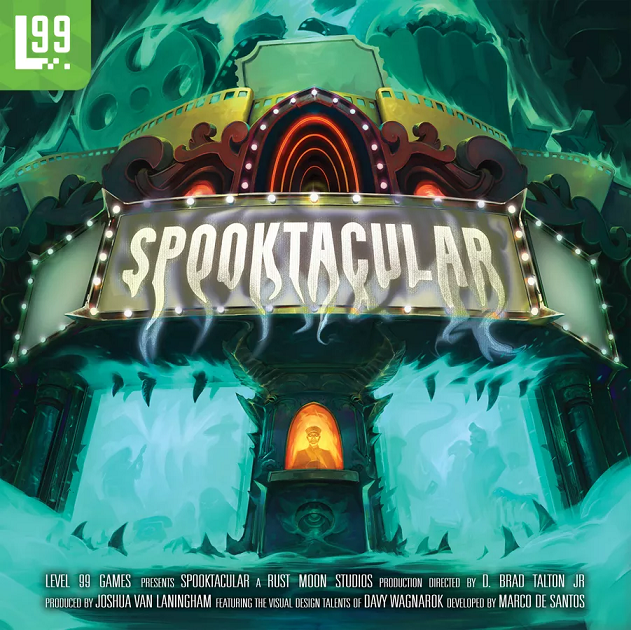
Spooooktacccular.
An amusing name to wail? Right-o. Killer movie poster box cover? Absolutely. Asymmetric player powers that inevitably draw a negligent comparison to Root? Hell yeah.
Level 99 Games is known for their eccentric lineup. Millennium Blades is totally mad. Argent: The Consortium is likewise ill. Bullet♥︎ and Empyreal and many others fit this unconventional profile. Their latest, Spooktacular, is a game where players take on the role of monsters busting out of horror films and wreaking havoc. You get to terrorize a multiscreen cinema and devour guests. It sounds wild and maybe even unhinged. The truth is it could be nuttier.
We’ll have to come back to that.
It may not be readily apparent, but Spooktacular is of a particular ilk. It sits comfortably in the category of Survive: Escape from Atlantis and Downfall of Pompei. This type of game has wide appeal. It relies on a relatively modest ruleset that facilitates interaction and a semblance of strategy. They’re designs with friction and emotion, ones that speak to an old-school sense of spite. In Survive, you tip over other player’s boats and rip apart their little people with sharks. In Pompei, you scoop up fleeing citizens and chuck them into the mouth of a 3D-volcano. In Spooktacular, you drive around a possessed car and capture movie goers. Or stomp around as a mummified alligator – a mummigator – and chomp ’em in half. You might even get to inhabit the skeletal husks of telephones vibrating with static and malice. Yeah, people answer and bad stuff goes down.
From initial trailers to end credits, Spooktacular lives entirely on its cast of asymmetrical monsters. They are driven by unique systems, such as action programming, set collection, and engine building. Surprisingly, they’re not baroque or bloated with detail. While there are three complexity ratings, mirroring the approach of Cosmic Encounter, even the advanced characters are simple enough to understand and internalize for hobbyist gamers. The selections rated “easy” are perfectly weighted for less experienced gamers or those wanting a more straightforward system to wield.
I do think that the more sophisticated monsters elevate the experience. A setup comprised entirely of less complex entries can result in a more benign environment with fewer considerations. This limits some of the game’s tactical scope and can result in a poor first impression for those craving something more substantial. Even just including one or two intermediate or advanced options will force the entire table to contend with a new challenge, such as navigating Re-goo’s spreading slime blobs, or trying to avoid Doctor Terror’s assortment of traps. The contours of the game change as various entities collide creating a unique scenario depending on the monster lineup. This is a quality Spooktacular shares with Root, even if the rest of the design and its underlying principles vary significantly.
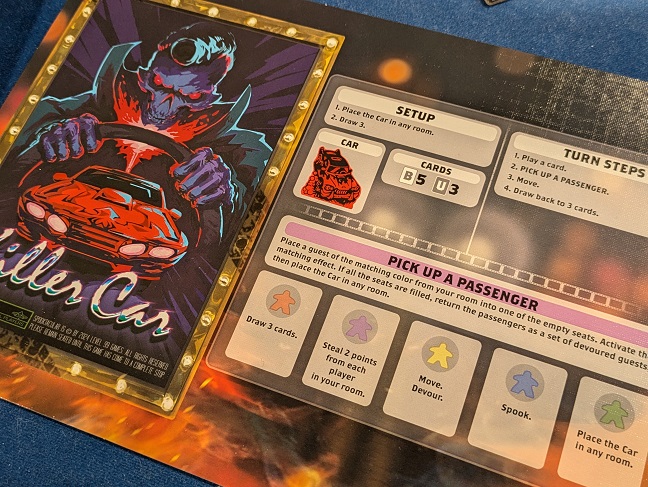
The monster roster is excellent. One could quibble with balance, but that’s something difficult to determine without the benefit of time and dozens of plays. The integration of abilities with art direction and general creative expression is strong. With 20 options, anyone can find a fiend or two that speaks to them.
The challenge Spooktacular faces is not in its character design, but in the foundational systems supporting this cast. As I mentioned earlier, the core game loop could stand to be nuttier.
Turns consist primarily of playing a card to perform a generic action and then triggering your monster’s central mechanism. It’s very simple and the majority of cards come from a symmetric pool of basic actions with only a subset being character specific. They allow you to do things like move between connected rooms in the theater, scare all of the guests in your room, or devour a cinema-goer. Once the enigma of your monster fades, the macro activity begins to emerge as a pattern of repetitive actions. You will quickly come to realize that the majority of turns are spent shuffling meeples around room-to-room, possibly grabbing one or two to put in your pool of devoured guests. Sometimes you push your fellow monsters away, which is the height of player interactivity. Usually, you’re just ganking peeps or shoving them into inconvenient places to stifle your opponent’s ability to score. And sadly, that’s it. The whole thing is quite restrained.
It noticeably lacks the texture of its peers. It doesn’t possess the killer instinct of Survive where you’re at each other’s throats. It doesn’t have the dangerous edge of Downfall of Pompeii with its scorching volcano. It feels more a modern Euro-style design than either of those, firmly hitting the same weight on the scale and appealing to a similar demographic, but not reaching the same heights or theatrics. The pieces even belie this underbelly, as the guests are standard meeples of various colors and stand out in contrast to everything else which is greatly stylized. They bear this trait because you want to devour them in sets. This form meets process to capture a very gamey exercise that is emblematic of modern design. This focuses your thoughts on process – “which colors do I need?” – rather than conflict or setting. Instead of cutting loose it turns backwards.
It’s understandable that the game leans on these contemporary conventions. I imagine it was thought to ground the experience so that the wilder character abilities had a firm footing. But this deference to tradition and expectation ultimately isn’t enough to uplift the game into something noteworthy. Instead, it functions as an anchor, pulling the game down from its ceiling and establishing a modest demeanor.

The asymmetric abilities and playstyles partially make up for the lack of drama. The execution in character design is so strong in this regard that it alleviates what could otherwise be a severe injury. There is a joy in pulling out a new monster and trying to work your way through its various crooks. This obfuscates the rote exercise everyone is participating in and combines with the brief playtime to produce a certain level of amusement.
I do have concerns regarding this reliance on content. 20 monsters is a lot. A great deal of work clearly went into their design. But once you’ve experienced all of these creatures and spanned the game’s extents, will there be a reason to return? I have doubts. Picking up and moving those meeples around feels more like a simplified game of Five Tribes than the hopeful carnage of Horrified or Camp Grizzly. Indeed, just like that Days of Wonder hit, you cannot plan ahead or evaluate the board until it comes back around to you, for too much has changed with the game state. I’m not sure selling this game as a streamlined horror Five Tribes is going to really hook many guppies, but it’s a truthful synopsis.
This may all sound harsh, likely more than it’s intended to be. I think Spooktacular is a perfectly ordinary modern board game. It has promising moments, and Talton executes well on the subtleties of asymmetric character design. I wasn’t bored by Spooktacular, but I also wasn’t thrilled.
A copy of the game was provided by the publisher for review.
If you enjoy what I’m doing and want to support my work, please consider dropping off a tip at my Ko-Fi or supporting me on Patreon. No revenue is collected from this site, and I refuse to serve advertisements.
 Player Elimination