
I’m a child of the 90s, so when I hear the words tag team, I think of the Bushwhackers, Harlem Heat, and the Outsiders. Gricha German and Corentin Labrat’s Tag Team isn’t that. Well, maybe it sort of is. Instead of prescribed duos, each player slams together two distinct fighters to form an impromptu team up. Then they hit the table and start beating the hell out of each other. It’s like Smash Up meets Yomi.
Can you dig that, sucka?
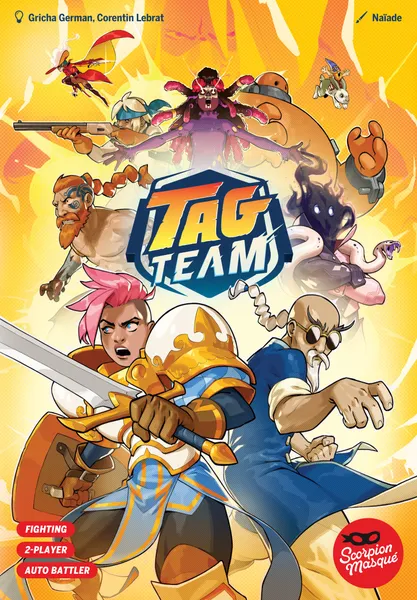
Tag Team is an auto battler. This format is a relatively new experiment in board gaming, with 2022’s Challengers being the precedent. This type of design is functionally equivalent to the traditional game War. You know, the one which is beloved by small children and has you mindlessly flipping cards. The “auto” is the revealing of a card from the top of the deck with no choice or tactical agency. The “battler” is the simultaneous execution and comparison of the two cards.
Challengers twisted the composition by having a large number of players compete in a round robin tournament. The most intriguing element consisted of drafting new cards to each participant’s deck between bouts. This evolution of deck composition over time allowed for some potent escalation and was effective within the scope of the experience. The mechanical bones of the design weren’t particularly riveting, but framing the game around a large event helped make it more distinct than a typical party game. It’s a fine effort, wholly indicative of the steadiness of modern design trends, but the needle remained unwavering in its gaze.
Tag Team reaches a little higher. It takes the auto battler format and positions it in the two-player dueling realm headlined by heels like Unmatched, Yomi, and Dice Throne. This is a popular type of game that delivers some oomph coupled with ease of play. These games are also endlessly expandable.
Tag Team is going to make some noise.
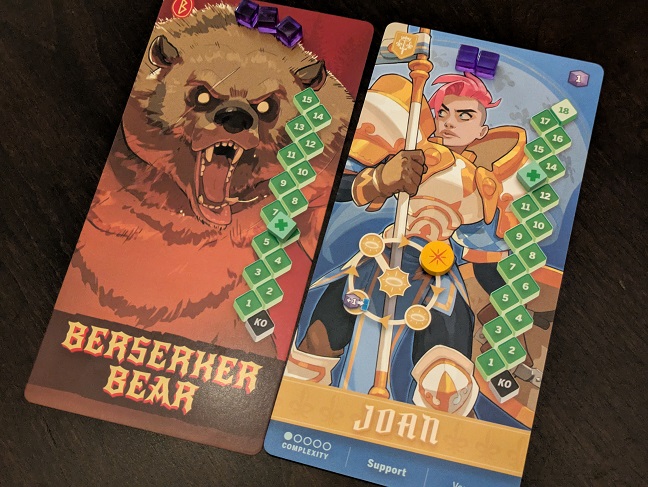
The first asset is content variety. There are 12 fighters included, and they are meaningfully unique. Some utilize extra components – such as Mephisto having a twin serpent token that flips between colors and Shango who places flame chits on opponents to blow them up – but there is quite a bit of color thrown on a seemingly small canvas. Bodvar is my favorite, he’s a weak dude who slowly gets angry, eventually transforming into a terrifying bear. But the mischievous Fey Folk are no slouches, comprised of three distinct characters with their own health meters while functioning as one deck. Oh, and Maman Brijit is a pretty gnarly witch who can rattle her opponents and even return from the dead. Look, they’re all damn interesting without a jellyfish in the lot.
It’s not just that each character possesses a strong identity and interesting mechanical flourishes, it’s also in how these combatants unite with that Smash Up ruffle. Many of the abilities can influence or interact with each other. Certain strategies emerge, such as shielding one fighter with another and delaying until the right moment to execute a one-two-punch. Sometimes you can power a partner up or create openings in your opponent’s defenses. This tinkering with the way characters play off each other is one of the most compelling aspects of the design, and it combines with the variety of content to fuel a lengthy exploratory relationship with the game. Furthermore, this evaluating of characters and content discovery aspect is actually achievable as it only takes 10 minutes to throw down. Experimentation giving way to earned results is a strong combination.
We haven’t even gotten to the best part yet. That would be the deck construction. It’s deliberate and novel.
Context is needed. While a complete session of Tag Team is one fight, this conflict takes place over multiple rounds. Each player begins with a deck of two starting cards, one from each of their fighters. However, they aren’t shuffled together, instead each player secretly decides which card is placed on top of their deck and the other below it. Then, the combat begins in earnest with both players flipping and executing their top card. The process is then repeated with the next card, and the next, until their decks are empty. That’s the round.
In between each round a single card is added to each player’s deck. This is chosen from a random draw of three upgrade cards, which in turn come from another deck. This game likes decks.
The upgrade deck is comprised of a pool of cards from both of a player’s fighters. Each round it spits out three random cards, and you need to carefully decide which single selection to add to your main deck. There is a surprising amount of consideration here. For one, if you repeatedly favor a single fighter, you may undercut your ability to manufacture combos or execute an unpredictable attack structure. Furthermore, all damage dealt by an attack targets the active fighter. This is the character whose card is currently being executed. So, if 90% of my deck is bear-man, bear-man is going to be taking all of the damage. A player loses if either of their fighters is reduced to zero health. There’s a tightrope to walk here that requires thoughtful play. You can’t immediately pivot so planning is crucial. The unique abilities and playstyles obviously will influence this process.
But here’s the kicker: your deck is never shuffled. Remember how you chose the order of those two starting cards? They stay in those positions. Each new card you add to the deck can go at the top, bottom, or between any two cards. This is the procedure for the entire game. You can never reposition cards within your deck. And it continually grows and extends in different directions with different abilities.
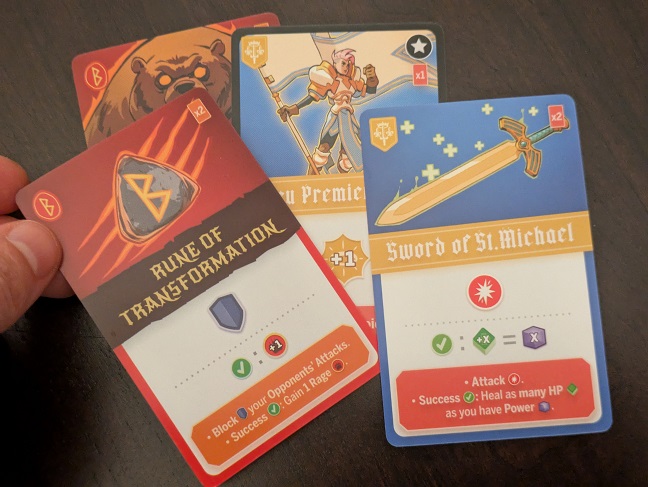
The implication, which is understood quickly when you start getting roughed up, is that you not only can craft your deck in a particular way to construct a deliberate queue of successive effects, but you can also shape this queue in order to thwart your opponent’s blows. Imagine a situation where your foe has two cards in succession that power their character up and then deliver a devastating attack. You can draft a defensive option, perhaps a block that reverses the damage, and place it in your deck as the second card to be executed, which is where that enormous offensive from the other team occurred.
When this works, it feels outstanding. It sounds onerous, but this isn’t a mental grind where you need to have an eidetic memory to play well. More simply, there are standout positions during the execution phase where you can flag a particular effect and note it for response. Play consists of a blend of adversary awareness and your own personal deck considerations. There are enough little pieces of information that persist under casual play to instill this sense of cleverness. You can feel as though you’ve worked out that ensuing combo or sidestepped a nasty lunge. The unwinding of decks frames these moments expressively, and they’re what lingers in the aftermath of the session.
The real trick of Tag Team is that this tactical jig is illusory. Even after many plays, you will only be able to faintly deduce what your opponent may be adding to their deck, as you won’t know the three cards they’ve drawn. Furthermore, you won’t have any idea in which slot they’re placing the new card. This means that the underlying physics of the game are as chaotic as the quantum realm.
Let me explain. Let’s go back to that powerful attack the enemy is delivering in the second position of their deck. Imagine that they have four total cards at the moment, and you both are currently adding a new card into your sequence. So, you’ve drawn this wild counterattack option which will certainly foil that incoming assault. Where do you place it in your deck?
In between your first and second card is logical, as it would now occupy the second position to be resolved. This is the timing window of the enemy damage. But that’s only still true if they didn’t add their new card in the first or second position in their queue. If they did, that would shift the attack to a later slot in their deck, and your counter would whiff. No bueno.
I’m sure you can imagine how this decision process extrapolates when your deck has grown to six, seven, maybe even eight cards. Successfully landing a huge punch or breaking up a nasty effect is fulfilling. These are the fist-pumps and standup moments. They feel earned. When carefully examined, however, we can see that a whole lot of particles are bouncing around and occasionally landing in just the right position.
I don’t even view this as a criticism. The fundamentals are strong enough that anchoring the emotional response on a fuzzy reality is perfectly in accord with the overall system. What matters is how the experience feels, and as I said, it comes across as compelling and of sufficient merit.
This philosophical approach is what broadens the game’s appeal. It’s how the entirety of play can wrap up in a diminutive 10-minutes. The mood is one of nonchalance and casual competition. If the card play dug in and offered a more serious mechanistic spine, then this would be an altogether different design, one which I contend would be less successful. As it stands, this is a head-to-head filler that manages to compete with its strongest peers.
In comparison to Unmatched, Tag Team boasts more robust card dynamics. Unmatched decks are not altered or tailored to specific circumstances. They also include many duplicates as well as hinging on carefully timing the ubiquitous feint card. Participants can come to learn an Unmatched character quite quickly, and the game’s longevity is predicated on a large pool of fighters. What Unmatched loses in card play it gains in environmental variety and its positioning aspect.
Tag Team achieves its amplified card dynamics without any additional weight. It feels like the disparity is significant, but as illustrated, a majority of that is an apparition. Still, there is an evident separation between these titles in this regard.
This trait of sophistication is due to the customization of fighter decks, both as a product of the fighter team as well as the card sequencing. Because of how cards are added to the deck and their positional significance, repeating the same fight back-to-back can yield a different experience. This variety within a single skirmish is more pronounced than Unmatched and a powerful asset in Tag Team’s arsenal.
Comparing Tag Team to Dice Throne is even more pronounced. The latter finds success purely through its dramatic dice rolling, which is admittedly a crowd pleaser. But it’s far less tactical and agency is very limited, confined solely to adjudicating which dice to re-roll and which symbol recipes to target. Tag Team feels far more cunning and novel.
In terms of evaluating direct comparisons, there is one problem. Admittedly, it’s more of a personal issue and unlikely to affect you. The magnetism of this quick resolving duel-style of game is losing its potency. In many ways, I always imagined the pull stronger than it actually was.
If you read my evolving thoughts on Unmatched in the past, I always genuflected to this notion, pointing out that it never quite manages greatness. Ditto for Dice Throne. And ditto for Tag Team.
These games carve out a niche, but I find myself not fully committed. They operate in a groove that is cousin to the miniatures skirmish realm. I’m talking about games like Mythic Battles, Warhammer Underworlds, and 6: Siege. Unmatched bridges the gap, placing the bulk of its prowess in the card play but still retaining some spatial miniatures gaming qualities. Tag Team defers completely to cards, cutting out that minimal plastic fat. They both admirably find their way.
When I pursue these concise duelers, I often am left craving a richer experience. A 10-minute card battler just can’t compete with a 45-minute raid in 6: Siege or even a sturdier game like Android: Netrunner. Frankly, it shouldn’t have to. But the chords struck vibrate in the same wavelength. This isn’t the fault of Tag Team or Unmatched, yet I have a difficult time putting that aside. They almost feel like a sample of a larger composition, a tune extricated as a single measure instead of a whole song.
Perhaps I’m an unreliable narrator when it comes to this sort of critique. I hesitated to even include these last few paragraphs as they’re only tangentially related to the contents of this review. Regardless, I find this level of meta-analysis useful as it can help to firm up my thoughts by articulating them here, and I’ve seen a greater contextualization can lead others to various forms of introspection. Despite this unfortunate realization, I still find Tag Team a pleasurable outing. Its design elements are intriguing, and it’s a superior implementation of the auto battler framework. This game functions as an astute filler, even if I want it to be something more.
A copy of the game was provided by the publisher for review.
If you enjoy what I’m doing and want to support my work, please consider dropping off a tip at my Ko-Fi or supporting me on Patreon. No revenue is collected from this site, and I refuse to serve advertisements.
 Player Elimination
No Demolition? I guess they were more 80s
LikeLiked by 1 person
Demolition are cool as hell.
LikeLiked by 1 person