

There are two ways to look at Kingdoms Forlorn: Dragons, Devils and Kings. You can either view this unbelievably massive box as a vast world waiting to be explored and conquered, one of untold treasures and tragic stories. Or it can be seen as a crushing boulder whose massive weight embodies headache, labor, and anxiety. This is not an altogether different bargain than publisher Into the Unknown offered with their breakout hit Aeon Trespass: Odyssey, although it’s more cogent in this follow-up title. Many may view it as a little of both – equal parts thrilling and suffocating.
It’s difficult to think about Kingdoms Forlorn without orienting it as a product first and foremost. That enormous physique is not only imperious in terms of matter but also in the realm of thought. Unboxing the thing is its own little sojourn into another realm, one which must be carefully planned and organized. The inserts and storage system are masterfully designed. You can certainly navigate your way and succeed on this adventure, but it’s a serious undertaking nonetheless. The cognitive task escalates when tackling the 100-page rulebook. You read that correctly. It’s what I imagine someone in 2025 falling into Advanced Squad Leader must experience.
Despite the imposing stature, there was obvious care taken by designer Marcin Welnicki and the team behind this game to facilitate onboarding. A dedicated Learn to Play manual attempts to ease newcomers into the experience. Through a guided series of turns and phases, it elucidates the flow of action as well as the game’s central loop. I think it does an adequate job of spoon feeding some of the crunch, although it may have been more effective to be broader and seek brevity over its more detail-oriented approach. I imagine those completely unfamiliar with this studio’s prior outing may get lost in the weeds somewhat, if not outright intimidated. Digging into an introductory booklet that rivals the length of other campaign game’s full rulesets requires some dedication.
This touches on one of the first important key points I want to raise, which is that Kingdoms Forlorn grapples with a natural conflict of building on the complexity of Aeon Trespass: Odyssey while also trying to separate itself from that previous effort. This is not the same game repackaged with a new setting. But core system elements, such as the Inverted Combat Paradigm (ICP for all you juggalos), persist with new flair and reinterpretation. Launching into this game is actually more arduous than stepping into ATO. Yes, Kingdoms Forlorn jettisons things like item crafting and mnemos cards, but it adds additional phases to play, beefs up the zoomed-out exploration, and introduces a much larger quantity of adversaries with their own complexities.
This was pointed out to me by my friend Dave, but even the most basic of enemies in Kingdoms Forlorn have multiple abilities and effects. There’s no equivalent to the relatively basic gameplay of the level one Hekaton, the boss players fought in the early stages of Aeon Trespass. There’s not really a shallow end of the pool for players to acclimate in beyond the learn to play. Furthermore, there’s a need to internalize some very specific rules and exceptions between old hat boss fights and an entirely new concept of mob clashes where protagonists square off against many weaker foes. A third type of conflict even exists, an abbreviated mini game called an encounter, and all of these various flavors create a demand for rules mastery that is a step beyond its predecessor.
In many ways, it feels like this game was built to expand Aeon Trespass: Odyssey in a new direction, and all of its layers were placed atop much of the existing foundation.
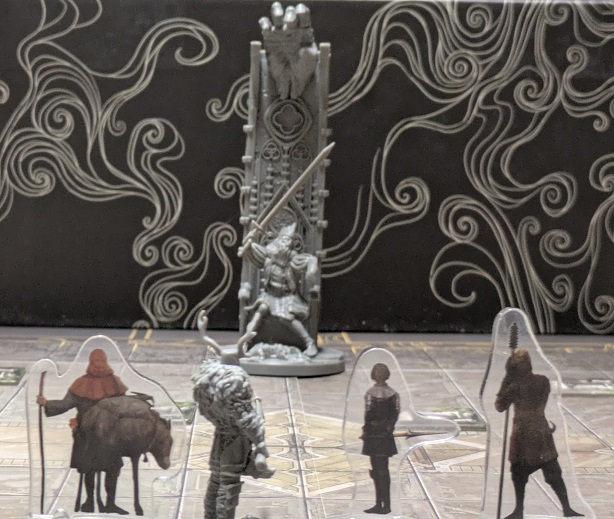
The game starts off with a familiar pitch. Cooperative boss battles in the tradition of Monster Hunter. Each player controls a unique character with their own abilities, personality, and equipment. Bosses are represented by large miniatures, and all combat takes place on a central board which is populated with various terrain tiles.
Conflict consists of alternate phases where the protagonist knights move and activate, occasionally using special powers such as their character specific talent cards. The combat system is more nuanced here than peers like Tidal Blades 2, Vagrantsong, and Kinfire Chronicles. It’s dice based with custom symbols and ability triggers, but it’s formulated around a central philosophy of players chaining turns into one another. This is formalized with tokens placed into a pool through certain character powers, often after they are finished attacking. These tokens can then be used by the next knight to add bonuses to their attack roll or boost damage. Many of the abilities feed into this element of teamwork. As characters grow in power and the campaign develops, a wider range of tokens may be provided with new effects for your allies to take advantage of. It’s a clever combat ruleset that will take several hours to grow comfortable with. Eventually your understanding will blossom, and the degree of cooperation and strategy fostered will be immense.
The second key component of conflict is an escalation in power over time. Both friends and foes grow in strength and unlock new effects as turns go on, ratcheting up the tension and creating a natural crescendo of emotion. Enemies get more powerful AI cards each time you wound them, while knights become more emboldened by attacking as well as taking a beating. It feels immensely powerful, stroking one’s predilections for power fantasy.
I made the central comparison to Kingdom Death: Monster with Aeon Trespass: Odyssey, and while that core framework is still here, Kingdoms Forlorn wastes no time in deviating from the familiar.
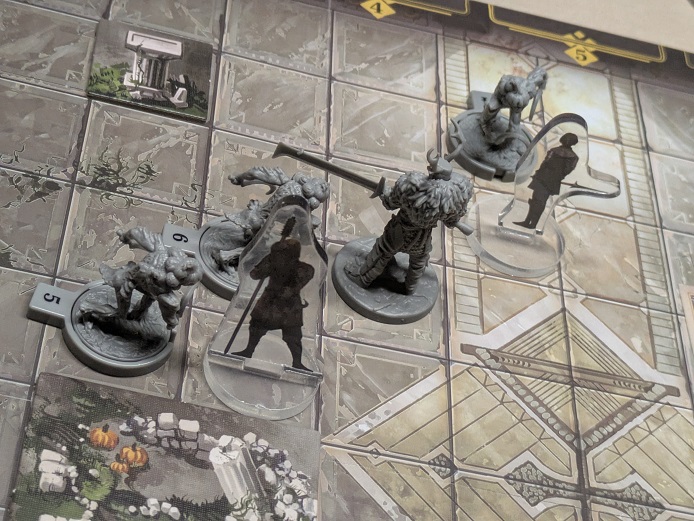
The most obvious detour is the inclusion of mob clashes. These function under the same core scaffolding of the ICP system but introduce multiple enemy miniatures, each with independent health and agency. It bridges the gap between traditional dungeon crawler and boss battler. This works rather well, although it does expose a couple of limitations of the existing system and requires several dedicated rules. The enemy initiative system is the most pronounced, and it highlights how Kingdoms Forlorn is a much easier lift when one’s already trained on Aeon Trespass. Beyond the inherited intricacies, there is a new track with tokens to manage activation sequencing. Each smaller foe gets their own Body Part card and receives a unique AI draw. It’s not onerous, especially within the context of the system it exists within, but it can be difficult to grasp when learning the game.
The real benefit here is that this opens up the space for many new enemy types. And this game is packed with them. There is a whole suite of foes that vastly outnumbers the antagonist count of its parentage. The creativity is as inspiring as one familiar with this studio would expect, and this is one of the strongest traits of Kingdoms Forlorn, particularly when compared to ATO. You no longer need to bang skulls with the same enemy profile repeatedly, instead you are battling new adversaries every single clash. This includes weirdos like pumpkinhead creeps, the ferocious white ape troll, and a malicious twist on the typical undead. They all have their own decks of AI and BP cards, and they also yield their own equipment.

Speaking of equipment, loot is an oddity. I understand the desire to ditch the complex crafting of ATO where players harvested organs off slain Primordials to manufacture their own arsenal, but I am a little perplexed at the straightforward nature of treasure in Kingdoms Forlorn. Most equipment is gathered after the clash, the big climactic moment of the adventure. You fell a beast and then select a subset of reward cards which allow you to pick loot from larger decks. None of this is randomized. Monsters aren’t the typical treasure pinatas seen in most dungeon crawlers, instead, they’re tickets to select what gear you want from the treasure shop. Of course, you’re often going to select the best equipment available, which means returning to the trough is less exciting. There are a few more considerations when you dig into it, such as only receiving the best gear if you actually win the clash, but at a high level this is a fair representation.
It’s a system which sacrifices drama and excitement for a more direct reward cycle. The gear is just as gnarly and impactful as it is in other boss battlers, it’s just the effort to attain it is more ordinary. This approach reminds me of the recent hit Oathsworn, which de-emphasized treasure and instead focused the game on the gargantuan monsters players hunt. This simplification of item rewards extends philosophically to other areas of the design. There are no secret decks or envelopes hidden in the box. The players, just like their characters, don’t search and discover new wonders. This is one of the areas where I prefer Aeon Trespass, although I do appreciate cutting out the crafting rules for the sake of reigning in complexity. It feels as though a touch of something magical was lost, although one can argue this was made up for with new areas the game explores.
I can’t be sure, but it appears Oathsworn also influenced another important aspect of Kingdoms Forlorn. This feature is more intriguing and a large part of the identity of the design. Instead of this game being centralized around a static cast wed to a lengthy prescribed storyline, it’s framed around a potentially shifting group of characters, each with their own isolated narratives.
This is a progressive concept and extends far beyond the simple drop-in and drop-out mechanism of Oathsworn. The game includes five knights, each a named character with their own background story, fighting style, and role. They have unique abilities, equipment, and quests. They’re also packaged in these gnarly little dedicated tuckboxes with full art that remind me of the old Warhammer Quest ’95 expansion characters. That may mean nothing to you, but it gives my heart a jab.

A session of Kingdoms Forlorn is built around one of the group’s characters stepping up and becoming the focal point. All of the session’s narrative, including the objective and the location where the mission will take place, are determined by the lead knight and where they currently are in their character’s overall campaign arc.
Campaign progression is individualized. In order to farther their own story, characters typically must complete three investigations, which are fundamentally sessions spent as a background character in terms of the narrative. During these sessions you engage all of the aspects of play, but your objective is determined by the lead knight. These supporting characters do collect progress in the form of clues, which is an abstract representation of their own personal journey in pursuit of their goals. Every fourth session or so, the focus swings back onto your character and their story.
This is such a neat methodology. It’s reminiscent of RPG sessions where the game master spotlights different characters. It also reminds me of ensemble shows like Lost where each episode may delve deeper into a specific cast member. This narrative structure works. It provides variety in terms of ongoing story and objectives, while not completely overshadowing the background characters. Since investigation sessions are mandatory, it doesn’t feel as though your progress is being wasted or slowed when it’s not your turn to take point.
There is also a tremendous amount of flexibility included. You are explicitly encouraged to take your character and join another group temporarily. This allows you to make progress on your overall goals while slipping seamlessly into another coterie of knights without disturbing their campaign. It’s also hunky-dory if a regular in your group misses a session. This is such an enormous boon with these baroque campaign games that require dozens of plays. Since the storyline is decentralized, the absent player is not missing anything essential. Each session is an episodic narrative for the spotlighted knight, and you will not be left behind if you rejoin the group at a later date. Perhaps most wonderfully, this affords a chance for someone to sample Kingdoms Forlorn. They could hop into a game and experience just a taste of the system in order to determine if it’s worth committing to. You cannot do this in Aeon Trespass: Odyssey, Kingdom Death: Monster, Frosthaven, or dozens of other games. At least not in such a way with the game’s blessing and explicit support.

This unique narrative structure is a touchpoint for the most significant departure in technique. I’ve mentioned how Aeon Trespass: Odyssey is built around a central plot, with the entirety of the game orbiting this storyline and influencing it in various ways. There are branching vectors and player input absolutely matters, but the prescribed narrative functions as a beating heart for the rest of the systems to draw blood from.
Kingdoms Forlorn doesn’t have such a hub. Instead, it has three spokes that connect and support each other to form a wheel. This wheel propels the game and is the vehicle for the emanating vitality.
The first spoke is the setting. One of the narrative silos consists of storybooks, passages, and cards all in service to a specific region of the world. The core game includes two such major areas, the Principality of Stone and The Sunken Kingdom of Utrebant. Both have their own distinct geography, traits, and secrets. They are fully featured entities with lengthy backstory and well considered history. Game flow is primarily a function of visiting these locations.
Unlike ATO where the story unfolds continually from the central storyline, Kingdoms Forlorn builds sessions around the notion of an expedition. This consists of multiple phases of play. The group first decides who the lead knight will be for the session, which determines the narrative structure of the adventure and dictates many of the details. Then they outfit for the journey by taking settlement actions where they can visit shrines, shop for equipment, and hire mercenaries in the form of guides or warriors. This is a neat little interlude that is similar to games like Warhammer Quest and Shadows of Brimstone where players conduct town actions and prepare to confront challenge. It’s a little shallower than those peers, but it also consumes just a small moment in the overall session.

Then the adventure proper begins with the party travelling through the wild suffocating mists and arriving at either the Sunken Kingdom or Principality of Stone. These locations consist of cards that connect to form a larger map of the area. Players explore these depictions of cities and ruins by moving between cards, revealing areas, and resolving various effects. This plays out like a juiced-up 7th Continent, or more appropriately, an enhanced take on Aeon Trespass: Odyssey’s exploration.
Story passages are occasionally triggered, but world building also occurs through a deck of events, random monster encounters, and the eventual full-blown clashes. There is a wealth of environmental and contextual information that parcels out the setting in sometimes vague and sometimes precise snippets. The characterization of each area – and the world as a whole – is an everlasting carrot dangling just beyond your maw.
Furthering this representation of setting is the Ten Thousand Succulent Fears expansion. This sizable box opens the world up to sub-kingdoms that can be entered from the main area during exploration. This additional content is not necessary, but it hooks into the game’s soul of tossing out breadcrumbs of lore for the starving players embarking on this monumental journey. It also integrates so smoothly with the existing game that it never feels awkward or bolted on.

The second spoke of the wheel are the creatures, both big and small, that inhabit the gutters and tunnels of this lost kingdom. While the most enrapturing and interesting foes are the large bosses that cap off each session, the smaller mobs are nearly as compelling. The cast is huge, which is a primary distinction between this and its forefather, and again the world itself is given colorful strokes and vibrant words as a result of dancing with these vile denizens.
One new element that springboards off this wide array of monsters are encounters. I’m not entirely smitten with this system. This is a post-ATO twist that features a single round of abstract combat. Miniatures are placed on a confined map full of various symbols. Each figure is afforded a single turn to attack foes and prepare for any return blows. It’s halfway between a brief miniature skirmish design and a traditional abstract game like Chess or Arimaa. It’s an odd thing sort of inserted into the design to represent the danger and threat lurking in these alien places while trying to reign in session length by avoiding yet another full clash. My criticism mostly concerns how incongruent it is with the rest of the game, adding a layer of rules that doesn’t adequately justify its budget in terms of complexity and time. Often, I find myself not exactly thrilled to setup the combatants and work through this process. In that way, it’s a speed bump to the good stuff.
Clashes are still the spectacle of the game. While the mob fights are not dull nor unworthy of attention, I do find the boss fights that form the finale of each expedition the defining aspect of this game. All of your decisions in preparation and exploration culminate in two fights, one midway through the delve and another at its climax. It’s where the ICP system is let loose and crackles with energy. It’s where the characters draw their weapons and assert their heroism.
And those characters are the third spoke of the wheel. The lead knight dictates the accompanying story and the objective of the quest. They read from their personal booklet and guide the group through various branching decisions. Passages are occasionally triggered mid-delve and surprises ensue. The way this narrative interweaves with that of the location and the emergent conditions of the clashes comes to define the experience of Kingdoms Forlorn. It’s more a gestalt of these three entities, rather than a single throughline of dictated fiction.
When thinking about this game, I always find myself returning to this concept of emergent story built from this epic system’s core tenets. The blending of myth is fascinating and gives way to the mystery of Kingdoms Forlorn. In a sense, it’s a continual tease, as the fragmentation of story between these silos only gives a partial view into reality. This is also where the game further exposes its Dark Souls influence, not only capturing the vibes of that series, but also its approach of unveiling its truth in bits and pieces elucidated through various vectors such as environment and artifact. This act of piecing together the lore, of experiencing it over the long-term, it’s the enticing aspect of this design and the manifestation of that metaphorical carrot just out of reach.
This is quite a game. Gratification does hinge on players finding joy and allure in untangling the narrative mystery of this large-scale game. The reward is less fungible than Aeon Trespass and even designs like recent hit Vantage. This is all about deducing fragments of lore and then stewing in that intellectual and creative fortune. It’s a departure reflected in the lack of secret decks and envelopes that I discussed earlier. The procedure of play is never massively shaken up. There is no escalation in mechanisms or system as seen in the chapter structure of ATO. If nothing else, this will be the quality that may ultimately leave players unfulfilled, so it’s best to recognize this upfront and embrace the bedrock of narrative prize.
The charge here is understanding the essence of Kingdoms Forlorn. Of what it feels like to suit up and walk into the mist. Like its predecessor, this game offers the campaign lifestyle game that is wholly feature complete. You don’t need to buy endless miniature add-ons to attain variety or keep you going long-term. It’s not a serialized product, rather it’s an overstuffed singular beast. One that is mysterious and demanding and contemplative. But also, heavily rewarding.
A copy of the game was provided by the publisher for review.
If you enjoy what I’m doing and want to support my work, please consider dropping off a tip at my Ko-Fi or supporting me on Patreon. No revenue is collected from this site, and I refuse to serve advertisements.


Great write up. The size of that box and rulebook unfortunately are just too much for me. It may be just a phase I’m going through, but the fatigue of these giant boxes is real.
I’ve seen things you wouldn’t believe- I’ve braved Middara’s YA novel/rulebook, survived the depths of Dungeon Universalis’s rules labyrinths, gazed upon towers in my garage of Solomon Kanes stacked on Brimstones, stacked on Folklores. And now, I’m tired, boss.
These days when I want to explore a new world, I succumb to the inviting blue glow of the Play Station, which asks so little of me.
But if there’s one place that can sometimes rekindle my enthusiasm, it’s here. So keep up the great work!
LikeLiked by 1 person
Thanks, Ryan. I have played all of those games you mentioned, except for Dungeon Universalis, and I agree, I am fatigued myself. I make rare exceptions for these big campaign games nowadays, as they’re just too much at times.
LikeLike
I’ve enjoyed most, but I don’t think I’ve finished or gone through all the scenarios in any of them. And unlike my video games that quietly take up an unassuming corner of a shelf, my wall of dungeon crawlers looms oppressively as a reminder of overconsumption (for me), so it’s harder to justify new ones.
I did discover Burning Banners and Escape From New York through you this year, and those have been a lot of fun.
LikeLiked by 1 person
It is very difficult to finish these huge games. They’re more aspirational purchases than realistic ones unfortunately.
LikeLiked by 1 person
Good write up, thanks Charlie. Not for me, although I appreciate the fact these ambitious games exist.
I appreciate even more the use of an apple for scale in the first pic!
LikeLiked by 1 person
Thanks Greg. These do have a very specific audience and won’t appeal to a lot of people.
LikeLike