
Vantage has been cooking in my mental oven for half the year. I first wrote about this open world sci-fi adventure game in July, with my review appearing at entertainment site IGN. If you haven’t read that or don’t know much about this peculiar design, my apologies, but the rest of this piece may befuddle you. I want to expand upon that review and write more about this enigmatic game. I’ve now experienced a considerable amount of Vantage. With all that time across all those plays, I have thoughts still to proffer. Boots to dirt – let’s get going.
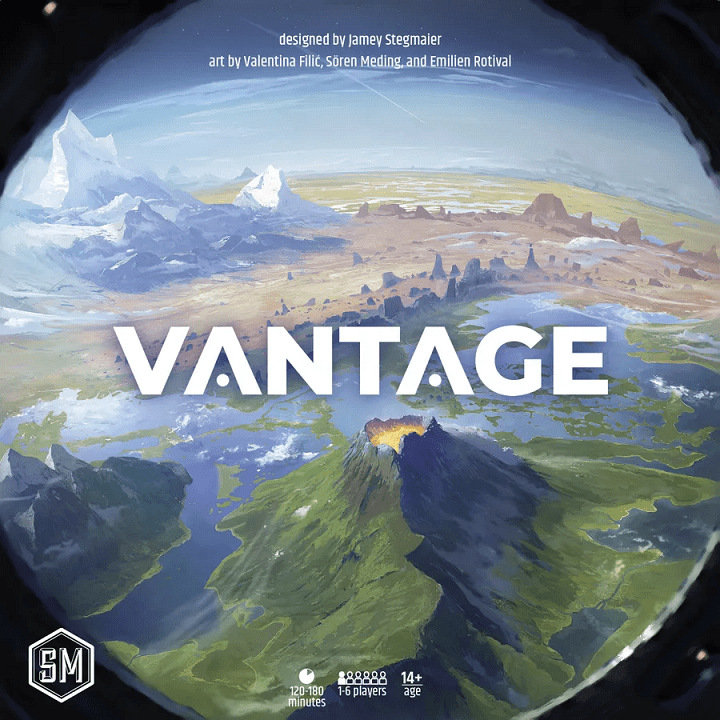
Vantage is a mercurial experience. This nature has really dissatisfied some. The contents of its story are a roguelike grab bag of everything. It’s as if you’re spinning an enormous wheel when you sit down to play. You could run into a cybernetic being the size of a skyscraper. Or a wilderness village of ethereal sentients. Maybe even a massive cube floating above the ground that you can fly across the skies. I’m making all of this up. But they’d all fit because this world is vast and all-encompassing.
The content is not orchestrated or directed in a formal sense. You aren’t intended to uncover a narrative beat and pull at its thread, loosing one stitch after another. It’s not Tainted Grail or Sleeping Gods. Instead, the bits and pieces uncovered of this world are best thought of akin to traditional adventure board games. Think about Arkham Horror or Merchants & Marauders. When you head to a passage in one of Vantage’s booklets, this is functionally similar to drawing a new encounter or event card in those other games. They’re bursts of flavor text paired with a mechanistic backbone. They’re not telling you a story in one breath. These passages and cards are giving you a piece of something. Something for you to grab a hold of and shape. Over the course of play the game wants you to combine them with others and form a distinct whole. Instead of unravelling thread, you’re stitching it together. In Vantage, this is emergent narrative by way of storybook.
There’s a fundamental difference between this type of emergent narrative and the prescribed narrative of story-driven campaign games. Jamey Stegmaier isn’t authoring a story for you to find. He’s placing props for you to purpose. These are interesting and unique people. Wondrous places. Peculiar artifacts. Breathtaking visuals.
This authorial sovereignty is woven all throughout the design. We see this in the game loss condition, where you’re given permission to keep playing if you’d like. This is inherent in the function of success as well. Often, you can end the game on your own terms, choosing whether to pursue your mission or follow a destiny, perhaps both. Side quests highlight this trait. Even the way you’re given complete latitude devoid of judgment in how you interact with each encounter. Another shocking example is how the game puts enough trust in the player to have them remember state changes in the environment without physically noting said outcome with a component. That’s wild as it’s a wholly immaterial fragment of the game that exists only in your mind, more similar to tabletop RPG than board game. That rule alone provides a strong first impression of what this is doing and how it’s going to get there. Revulsion is a valid response, even if I don’t share it.
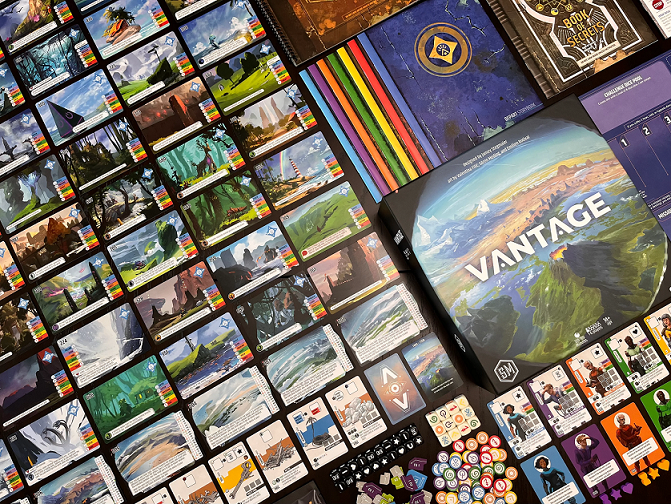
One of the pitfalls of this approach is that the content of Vantage can sometimes be incongruent. Nods toward other science fiction properties or iconic stories can be off-putting. The pieces of your character arc may be fragile or nonsensical. There’s a fragility to the whole thing which makes the outcome unpredictable.
Part of this is the structure of the design. Because Vantage is a one-off experience without a directed story, there is an inherent dichotomy between two primary narrative experiences. The first is the short story, a vignette that is slighter than some may be expecting. You hop into this world, have a couple of rad encounters, kick up some dust, and then punch out. It’s almost chill, with vibes that appeal to those weary from the oppressive format of lengthy campaign games. There’s nothing quite like this out there. There’s almost no setup to the game. Actions and game states are permissive. There’s no stress as the stakes are low. Sometimes really gnarly things happen that you can hardly believe the game is capable of. Other times it’s just a quiet stroll punctuated by a brief encounter with an interesting bystander and some bizarre fauna.
But every once in a while, things get real. You find something powerful or significant that allows you to overcome challenges or preserve your wellness. It’s possible to even bend the game to your will, where the loss condition seems distant and impossible due to the collection of cards you’ve amassed in your tableau. These sessions can result in something greater. Something epic. This longform story emerges out of seemingly nowhere and it’s almost impossible to predict its occurrence. Instead of a one-hour episode, you’re looking at a three-hour film in need of an intermission.
This volatile disposition is more prevalent at lower player counts. With additional participants, everything slows down and the vignettes turn into shared stories that cut back and forth between the individuals. The combined length of these parallel short stories often exceeds what is practical or desired. It muddies the waters and clouds the unique quality. This dichotomy of narrative experiences is one of the most fascinating and peculiar traits of Vantage, so nullifying its potential really harms the game’s force.
While the lengthy epics clearly justify their own existence, there is an allure to the condensed sessions that spans beyond the vibes. One characteristic that emanates from these tales is reminiscent of the short story format in Sword & Sorcery, a genre of pulp fantasy popularized in the 1930s. Robert E. Howard’s Conan: The Cimmerian comes to mind. These are a series of stories focused on the titular barbarian. While Conan’s presence as the protagonist is a constant, the world around him is under continual change. The Cimmerian himself is often represented in vastly different roles and stations. There are large unspecified time jumps between stories, with some featuring Conan as a king or a thief or a pirate. You never quite know what will happen or who will show up.
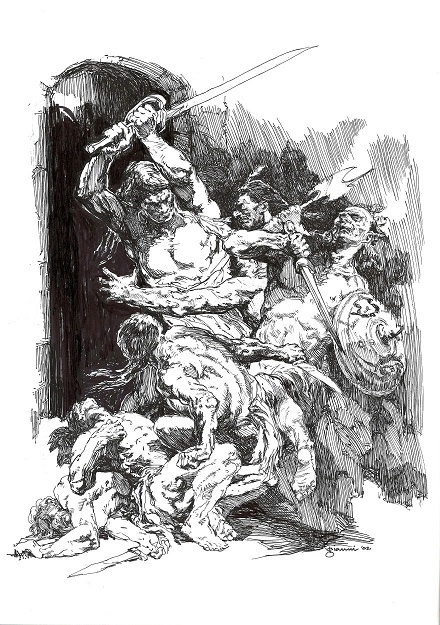
Vantage is its own kind of pulp fantasy. Each session you crash land again, falling back towards a planet that is familiar, strange, comfortable, and fresh. You take part in a vignette featuring discovery and growth. Then it ends and your time is done. Until you decide to pick up the book and read another story where it all begins again, and you don’t know what to expect.
While reading Howard’s tales you can form connections across passages as you begin to understand a broader view of Conan. This form of character development exists in Vantage by identifying elements of the world and embracing their unique existence. At times, it feels as though the planet itself is the multi-faceted and complex center of the story. Repeated plays are rewarded, just as reading the larger oeuvre of Howard is. None of this works if your suspension of disbelief is shattered. Or if you feel as though the contents of the game are thrown together without care, and the existence of nearly everything means there is actually nothing. I don’t know how to square that circle. From my vantage, this work is beautiful, mysterious, and engrossing.
A copy of the game was provided by the publisher for review.
If you enjoy what I’m doing and want to support my work, please consider dropping off a tip at my Ko-Fi or supporting me on Patreon. No revenue is collected from this site, and I refuse to serve advertisements.
 Player Elimination
Was not expecting a comparison with the original Conan stories! Interesting take on an intriguing game.
LikeLiked by 1 person
Don’t get me wrong, the stories in this game don’t actually hit a similar vibe to Conan, I’m only comparing the narrative structure/format. But yeah, I haven’t seen anyone else make the comparison to short stories in this form.
LikeLike
Definitely sounds up my alley! Several of the Fantasy Flight narrative-heavy games are kind of a scramble of story elements that you’re supposed to stitch together something thematically consistent for yourself. Sometimes it works, sometimes not, but it’s usually interesting at least!
LikeLiked by 1 person
“Interesting at least” is a great way to put it.
LikeLike