
I find it hard to believe the Company of Heroes board game is five years old. This splendid adaptation of the popular real-time strategy PC game was a story in 2021. My review contained a healthy amount of enthusiasm, and it occupied a key position in my top 10 of the year. A lot has happened since then and my appreciation for the game has only grown.
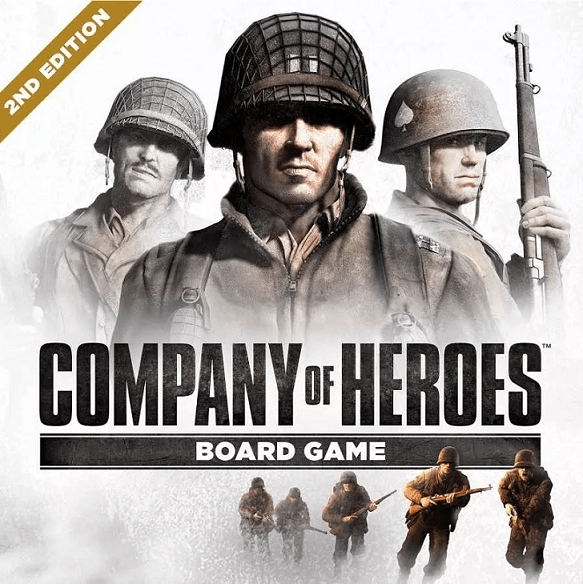
When the crowdfunding campaign fired off for a revised 2nd edition, I did not hesitate to enlist. The changes sounded encouraging. The design team of Chris Gabrielson and Bryan Kromrey seemed to really understand the game and what updates were needed to nudge it closer towards its ideal state. My confidence level was high.
Then, something terrible happened. Gabrielson, who also founded and owned Bad Crow Games, passed away unexpectedly at the Essen Spiel trade fair in 2022. A horrific event. While it was reasonable for people to have some concern about the future of Company of Heroes, the real tragedy was the loss of a passionate 48-year-old and the effect it had on those he loved. Many crowdfunding campaigns have experienced various forms of catastrophe, but this was the first time I’ve witnessed a creator passing away, especially at such a young age.
Without hesitation, Chris’ brother Brian Gabrielson stepped in. He worked with other members of the studio to usher the second edition forward. “Our greatest wish is to deliver the game and honor Chris’s memory,” Brian wrote.
Company of Heroes 2nd Edition arrived in late 2025. There was trepidation around this release as the system received some large revisions, and the product line had been expanded heavily. I would be lying if I wasn’t concerned it would be riddled with typos, lacking development, and totally rushed. After all, this is often the case with crowdfunded games that don’t suffer such upheaval.
I couldn’t have been more wrong.
Mission accomplished, Brian.
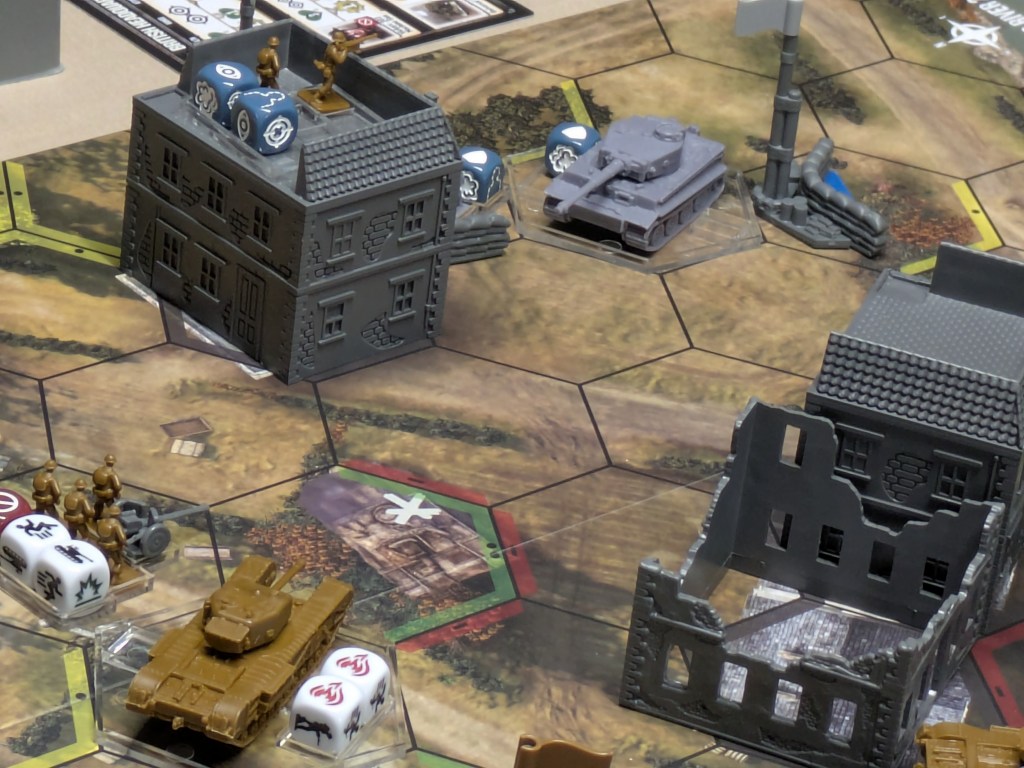
This second edition is a significant step forward. But let’s pull back and talk broadly about the game for a second. It’s been overlooked in the market, and the majority of you will not be familiar with it. The quiet acceptance is likely due to limited availability and exorbitant entrance cost. This is a shame, because it’s a hell of a time.
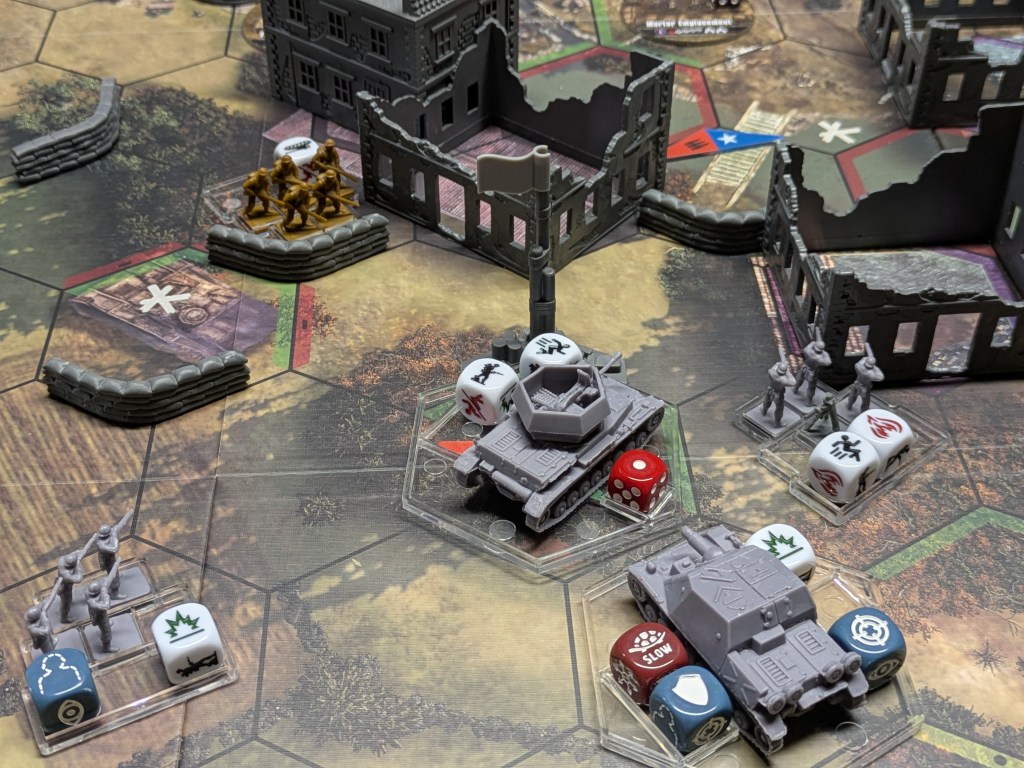
The killer move here is in combining a hybrid skirmish/company level World War II miniatures game with macro-level real-time strategy elements. Its complexity rides somewhere between Memoir 44 and Tide of Iron. It’s closer to the latter than the former, especially with the increased scope of rules in the second edition. Combining these two types of games affords a very playable tactical experience with some of the coolest toys in the business. The infantry appear as little army men that slot into movement trays and carry around chunky dice denoting their special abilities. The tanks will have you making explosion and engine sounds, as they’re detailed and stylish with fully rotatable turrets. You can deploy mortars and jeeps and Tiger tanks. It’s like a toy chest exploded on top of a smart and sophisticated wargame.
As I explained in my prior review, the core movement system uniquely captures the essence of micro-level actions in an RTS system. It’s a neat focus-centered action point foundation that splits your agency across a multitude of options, effectively forcing tradeoffs. What elevates this is the macro-level base building, development, and unit purchases. There’s a back-and-forth rock-paper-scissors system of countering builds, and the responsive nature of unit acquisition hums along at a smooth tempo. Typically, games of this ilk don’t have an economic backbone underpinning the conflict. This adds a necessary strategic layer that is novel and interesting.
There’s a lot of components and moving parts in this warmachine. All the screws have been tightened and the gears oiled. The second edition is a strict improvement.
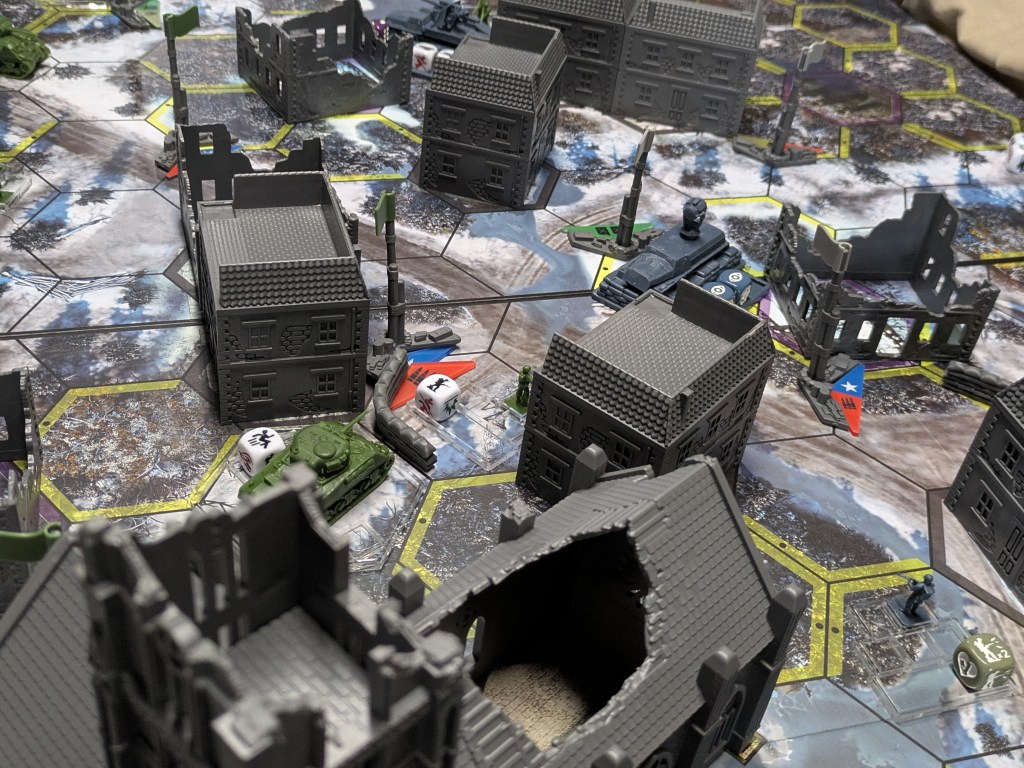
One aspect which I took issue with was the arc of play. Due to the tension between army development and playtime, there were compromises made that resulted in the most satisfying units receiving little actual service on the table. This particularly afflicted iconic tanks like Panthers and Churchills and ISUs. When you finally brought them to bear, you had almost no time to have fun with the buggers.
Several changes in the system have caused this niggle to fade. This includes increased resources, tweaked unit costs, and some subtle manipulations of round structure. This is a crucial change as kicking up sand with the bulkiest of toys is a huge pull. I want to blow apart buildings and chew up vehicles with my Tiger. I don’t want it to spawn and then fail to get to the front before the end game is triggered. In the latter case, it’s just a tease. A promise unfulfilled.
Now, the big dogs come out to play. They appear more rapidly and more often. The tight editorial control on pacing remains, however, as they do not arrive too early. The role of weaker units is not relegated and everything maintains its place. Company of Heroes remains an infantry-centric game which is ideal. It’s a wonder this was accomplished so skillfully.
Another problem, one which I failed to call out in my initial review as it only rears its head in certain conditions, is that it could occasionally be annoyingly difficult to capture control points. If an opponent was dug in and holding a location, you could not uproot them and capture it in the same sequence. Instead, you’d have to destroy the unit and then move in during the following round. Of course, if the opponent had initiative and a nearby unit, they could swoop in during the first activation and re-occupy it, delaying your control even further.
A session tends to last roughly five or six rounds total. This means requiring multiple rounds to capture a key position on the map is too long. It’s degenerative, because it encourages players to toss in roadblocks and sacrifice their soldiers in order to eke out another turn of victory point accrual. As players gain more experience, this technique becomes more common.
This has been excised completely. Now you can assault.
Assaulting allows you to move into a space and attack it in the same turn. If you eliminate the enemy unit on defense, you occupy its position and control it during scoring. It’s simple and effective.
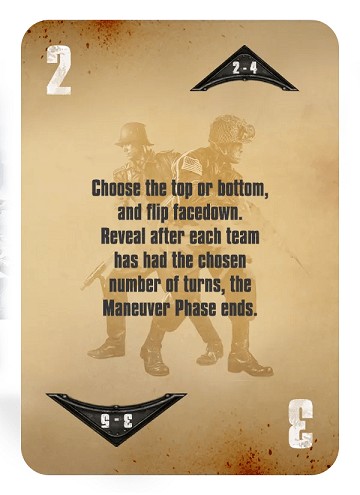
Perhaps the largest change is the Operations deck. This is a set of small-sized cards that perform an entirely new function. The player with initiative draws the top card of the deck. Each card has two values. One number lies somewhere between 2-4, and a second number falls between 3-5. The lead player selects on of these values by orienting the card a certain way and then slides it under the edge of the board. Their opponent can see which band their selection falls in, but not the exact number.
So, the first player may be aware that the number chosen is 3, while their foe will only know that it falls between 3-5. This value is how many turns each player receives before the round ends.
What a superb mechanism.
In the first edition, you’d have perfect knowledge of how many actions you’d receive. It allowed you to math out your turn entirely, only necessarily altering your plan to take into account your opponent’s moves. The damage system in this game is already deterministic, and this was another element which pushed it towards a calculated and heady affair.
Now, there’s more uncertainty. There’s gut-wrenching tension as you try to ascertain if you will have another turn to activate a squad and make a fearless charge. Ideally, you wait as long as possible for your riskiest maneuvers so your foe has less time to react. This has such a profound effect on setting up weapon teams, pushing out of cover, and moving in supporting units. It results in more drama while not undercutting thoughtful play. If anything, it’s a strict enhancement of all desired qualities. Mad applause.
There are other changes. Large sweeping tweaks to the game’s dozens and dozens of units. Shifts in language and redefining of abilities. A complete overhaul of the game’s commanders – unique asymmetric special abilities chosen prior to game start. Maps are touched up and altered. This game has undergone such extensive playtesting and refinement that it’s almost dizzying to comprehend the amount of work involved.
Not every change is class, however.
One issue that has creeped up in magnitude is playtime. This was always a long game with unexperienced players. Now it’s even more persnickety and demanding. We’re talking at least two hours in the standard head-to-head mode and three or four in the team format.
The rules are bulkier. Simple additions such as the Operations deck and assaults add weight. Clarifications and less intrusive nudges also extend the text. While I’ve always considered this game as a relatively simple endeavor, teaching this once again to newcomers completely undercuts this feeling. There’s nothing too opaque here to grasp, but the multitude of rules is quite extensive at this point. Particularly if you include the expanded product line.
And that’s really where this game is most toilsome. In order to facilitate a retail box, the core game has been reduced down to two factions from the first edition’s four. Those other nations are available as separate purchases, as are multiple terrain packs to upgrade scenery, small and large boxes with new commanders and units, and even a highly desirable map pack.
In order to play this game at four players in the team format – which is an excellent experience – you need to purchase a core set, two additional factions, and the legacy map pack. Most will also find Terrain pack 1 near mandatory, as it adds three-dimensional capture flags which greatly enhance readability of the board state. The included buildings are also a nice add, not only for visual appeal but to clearly denote the primary terrain element that blocks line of sight. That’s a lot of cash just to get this to the table with a standard group. Too much for many.
I do foresee Company of Heroes 2nd Edition as a game that will remain relevant for a lengthy period of time. There is a strong and dedicated fanbase, and it will soon fund an additional Africa Korps extension. I’m sure this next campaign will do well and Gabrielson’s legacy will endure.
Look, some people derisively describe miniatures games as playing with dolls. Others want to shirk or turn away from the infantile aspects of the genre. I don’t care. I can admit that a real appeal of playing with miniatures is the playing with miniatures. They look rad. They’re fun to handle and set down and to marvel at. There’s a reason Eurogames are moving towards upgraded components and bulkier productions. An enormous part of this hobby is the kinetic connection between player and game. And there’s no better connection than making explosion sounds with plastic army men and vehicles.
But there’s a big incongruency here. The sheer bulk of this thing pushes it into lifestyle game territory. There’s an irreconcilable contrast between toy and cost. In truth, nearly every game is a lifestyle game now and it’s become exhausting. Fortunately, I’ve found this worthy of the small coterie of titles I’m willing to dedicate an entire shelf to. The combination of miniatures wargame with base-building RTS-style improvements is seductive and skillfully adapted. It operates in a niche space, but it absolutely kills it in that category. Sadly, many hobbyists will never know the joy of pushing little plastic army-men across a bridge with Shermans and Priests in support while MG42s tear up your flank. Rarely does such a clear connection between toy and purpose exist, allowing for a faux element of maturity to justify pure childlike delight.
If you enjoy what I’m doing and want to support my work, please consider dropping off a tip at my Ko-Fi or supporting me on Patreon. No revenue is collected from this site, and I refuse to serve advertisements.
 Player Elimination
Was looking forward to reading your masterfully written thoughts. I am delighted to hear that you’re enjoying your time with it. 🙂 Thanks for giving it the time. It does seem while the cost can certainly work against it, it does seem to be going under covered between both the board game and war game audience, so it is sincerely appreciated.
LikeLiked by 1 person
Thank you! Let’s hope it gets more recognition and the next campaign does very well.
LikeLike
typo ? 😛
“Conflict of Heroes remains an infantry-centric game which is ideal.”
LikeLiked by 1 person
Yes, totally. Thank you for pointing this out, will fix it.
LikeLike
Great review Charlie! This looks so solid and I’ve heard nothing but praise from multiple people. In some ways, it almost looks like the game Time of Legends: Joan of Arc wanted to be; very different games but both tried to capture a large-scale war game in a board game, and only one succeeded.
I just wish it was a different theme. I realize it was likely made by a long-time fan of the IP, so no shade against their choice. It’s just not one that grabs me. If it was a SciFi IP (StarCraft for example or better yet, 40k?!?), or if they had obtained the lisnces for the mentioned ToL:JoA, I’d be all-over it. I just can’t justify the cost at this point when I’m not fully sold on the game mechanically and thematically – theme is always important to me, but especially so in a game of this scale and depth.
Maybe one day my tastes will change (getting to my mid-40’s which I hear is close to when I will automatically become interested in war games, lol) or they will release a new version under a different IP.
LikeLiked by 1 person
I will add it does not help that my son (my main gaming partner) would have even less interest in this theme. He’s never had much interest in any realworld war themed video or board game.
LikeLiked by 1 person
Thanks Derek!
ToA: Joan of Arc is a great callout. I haven’t played it, but I’m very familiar with it (I almost bought it second hand several times and followed the second edition/reprint as well). This does seem similar in terms of what kind of feel and scope it’s aiming for. This doesn’t suffer the many problems Joan of Arc ran into, from what I can tell.
Good news, I think one of the designers hinted at the team possibly working on a new game which would utilize some of the same systems in a new setting. I don’t recall if they specifically said what setting, however, and if it was IP based. Probably a long ways off though.
LikeLike