
It’s 1998. Goldberg is dominating the only wrestling league that matters. The Wolfpac is running wild, and that damn cattle prod is about to make an appearance at Starrcade.
But that hasn’t happened yet. Right now, a Totino’s pizza is crackling to life in the oven. My buddy Chris is spending the night, and we are about to experience one of the best games on the best console ever made.
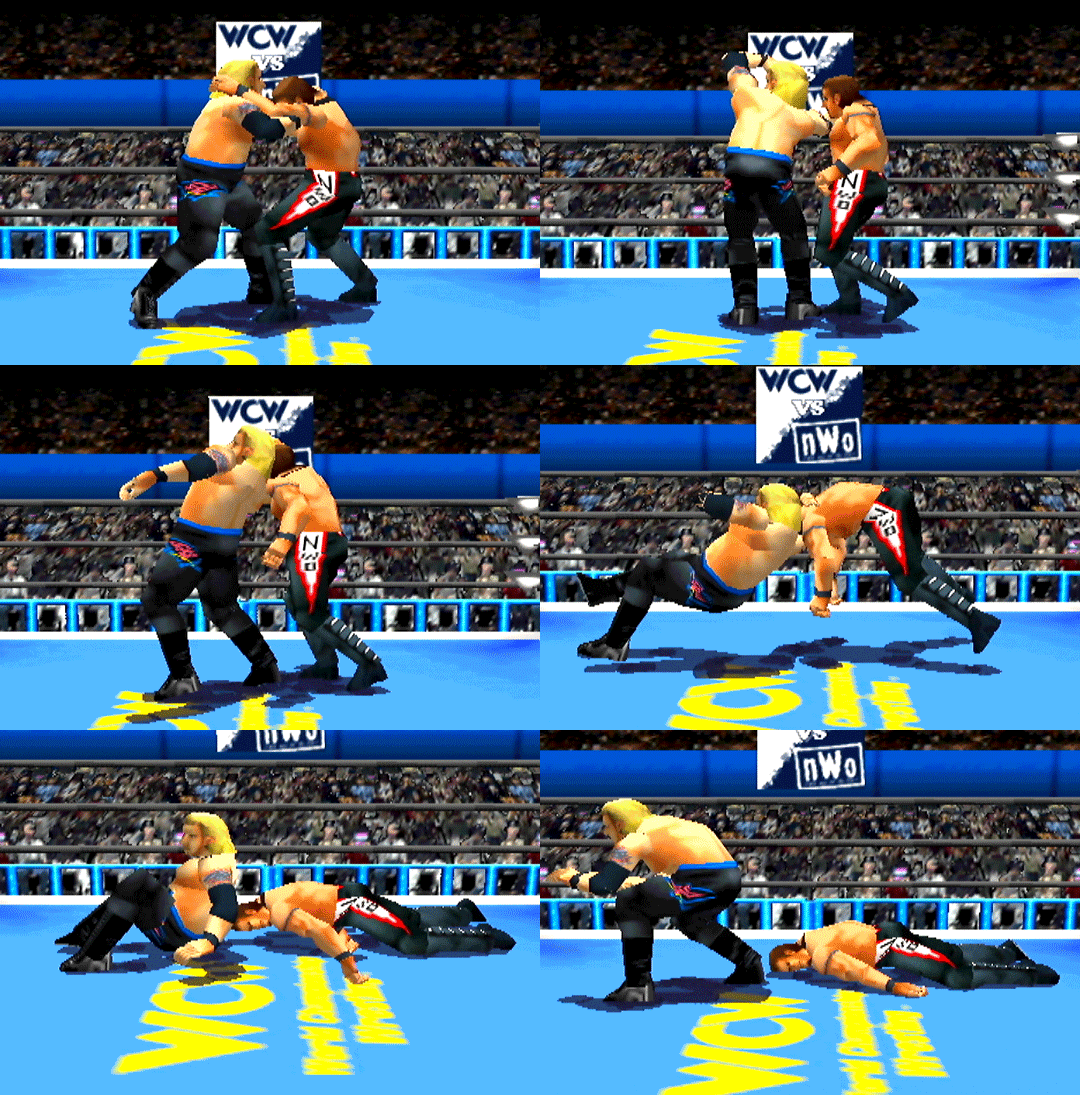
If I develop carpal tunnel, it won’t be from my years of software development or time spent writing, it will be from smashing buttons to break out of a pin on that bulky malformed N-64 controller.
WCW vs. NWO World Tour, WCW/NWO Revenge. WWF No Mercy, and WWF WrestleMania 2000 are the legendary quartet of video games published by THQ during the height of the wrestling ratings war. These games are phenomenal pieces of design, all relying on a core grappling engine that was intuitive, dynamic, and sophisticated. These are works of art that have never been reached in the decades since release.
As is human, I’ve spent much of my adult life reaching backwards, desperately trying to recapture my youth. This has translated into the search for a WCW/NWO Revenge tabletop game. I’ve played WWE: Know Your Role, Luchador! Mexican Wrestling Dice, WWE: Superstar Showdown, The Supershow, even Wrasslin’ which predates all of these. Nothing has come close.
Wait. What’s that?
The Lights cut out and darkness seizes the throats of the crowd. A Thunderous guitar riff rattles spines. Flames erupt and faces are melted. Shock turns over into exhilaration and not a soul remains seated.
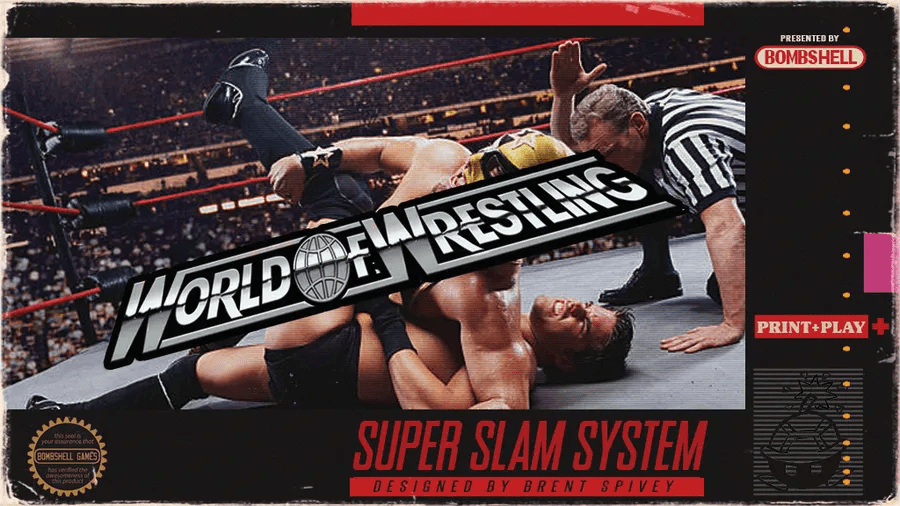
With Techno Bowl, Brent Spivey designed the best football board game ever made. Now, he’s designed the best wrestling board game.
World of Wrestling is a head-to-head 30-minute bout of tactical positioning, combo’ing cards, and yelling “Woo!” until your throat is shredded. Much like Techno Bowl before it, there is a surprisingly nuanced mid-weight ruleset here that leverages Spivey’s miniatures game design chops. The system itself is quite flexible with beginner and advanced rule sections, as well as a chapter of variants and options.
The heart of the game revolves around card play. Each player has their own deck of moves. These are symmetrical and consist of Runs, Punches, and Slams. Every maneuver, from a suplex to a flying elbow drop off the turnbuckle, is segregated into one of those categories.
The bulk of play consists of sequences called an exchange. Succinctly, this is both players simultaneously playing a facedown card from their hand and then revealing and resolving their selections. This is where the Run/Punch/Slam (RPS) system cranks the volume. As its cute acronym relays, there is a Rock/Paper/Scissors circular counter system in place. That is Runs beat Punches which beat Slams which in turn beat Runs. Once cards are revealed, the maneuver with hierarchical priority is resolved and the other is discarded without effect.
These moves are logical and what you’d mostly expect. Runs allow you to move your wrestler around the ring. Punches chip away at your foe’s health meter. Slams also deliver direct damage, although they result in the target, and sometimes the active wrestler, being laid out prone on the mat.
The deafening volume is about to get distorted. The game loop is not simply repeating this process with both players selecting another card to compare. Rather, the wrestler who won the exchange attains momentum. They may continue to execute moves by chaining off that original action. This requires you play another card in sequence with a value that escalates, like the makings of a straight in Poker. Your first move was a two value Run? Second needs to be a three Slam or three Punch, or even another three Run. You can keep going. After that three, you can now play a four, and so on. You can string the combo out to a maximum of seven cards. With some hand management and a bit of luck, you can powerbomb a fool, climb atop the turnbuckle, and then drop the elbow on that sucka.
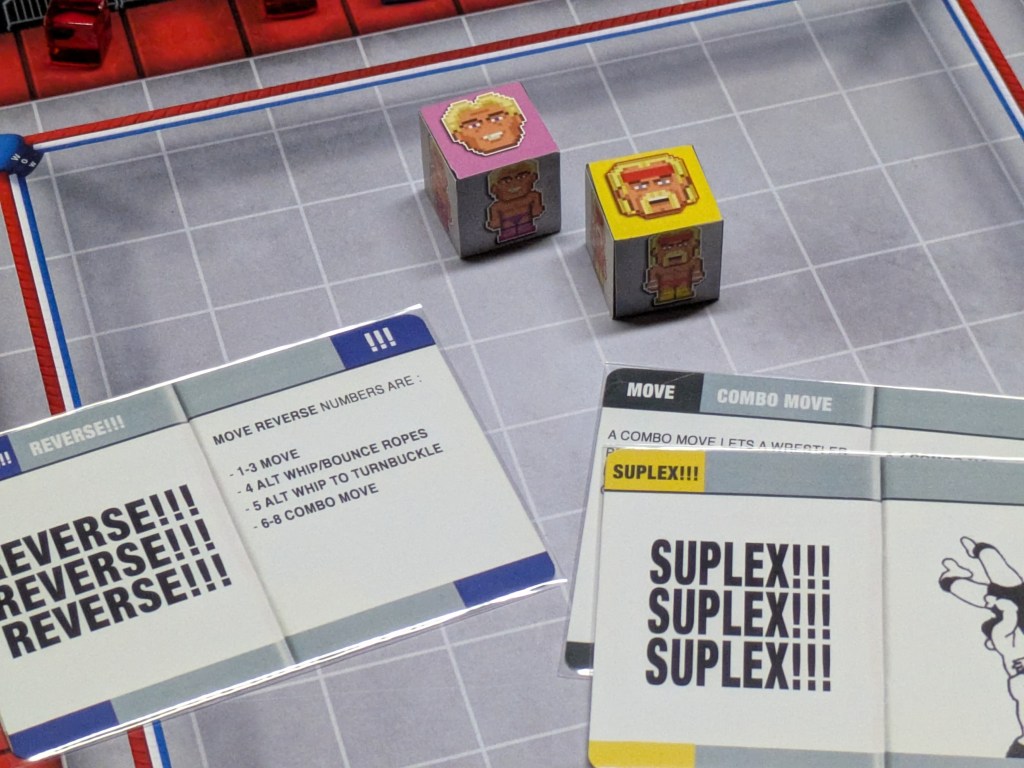
While this sounds easy as 1-2-3, there’s actually some intricacy here. The kind that adds nuance and depth in developing tactical acumen, but also the kind that acts as a low blow to a fresh babyface. For instance, one and two-point moves are straightforward, allotting that many spaces of movement. A three move, however, must be executed in an “L” shape like a Knight in chess. A four? That’s four spaces but only in a straight line orthogonally. A five is diagonal only. Six and above lets you perform a combination of the aforementioned moves that adds up to six.
Weird, eh?
The result is constriction that forces occasionally sub-optimal maneuvers as well as adding depth to how you hold back certain cards in preparation for the right moment. But it also results in dead actions where you don’t really want to perform a seven-value combination of moves, but you do want to play that card so that you can chain up to your eight-strength slam. You can always play cards into a combo and not execute them, merely using them as steppingstones to other values. That can happen quite a bit, particularly more so as you’re learning the ropes and playing sub-optimally. It’s also possible to get stuck, not sure how to get into position to use the last few cards in your hand. This can feel bad as you stumble about trying to suss out the way forward, but it’s a position that’s isolated to inexperience.
Slams are also a little elusive initially. Some cards are bog-standard tosses where you pick up your foe and hurl them to the mat in an adjacent space. Others are Powerslams where both wrestlers are dumped. Throws have you move your target three-spaces – in an “L” – from your character’s position. Suplexes are throws but the active wrestler also falls onto their back.
None of this is unreasonably complex or difficult to grapple with. It’s just enough of a barrier, however, to keep your head in the rulebook during your early sessions. Combine that with other quirks, such as what happens when both players execute a move of the same type as their lead card, and this otherwise lightweight bout can cause players to stumble a bit as if they’ve just been clocked with a steel chair.
Techno Bowl had similar idiosyncrasies. In some respects, these traits add to the unique nature of the game, affording players a wide toolset of options. In fact, the details serve as the roided-out muscles atop the skeleton.
These flourishes are myriad. Alternative actions are present on many moves, including high value Punches allowing aerial maneuvers instead, or some Runs letting you whip an opponent into the ropes rather than moving your own wrestler. Between actions, the active grappler can also discard a card to move a space, standup, or pick an adjacent foe up off the mat. Some moves stun your target, allowing you to combo cards sideways in addition to “up” in the chain. If your enemy is on their belly, you can even combo “down” to lower numbers. Individual wrestlers have unique signature and finishing move cards. There are pins, submissions, and knockouts. Reversals seize momentum and fire off a retaliatory chain. You can even spend an action to excite the crowd or alternatively taunt the numbskulls in the front row.
Let’s talk about crowd interaction for a second. This is one of the most colorful moves in WoW’s arsenal.
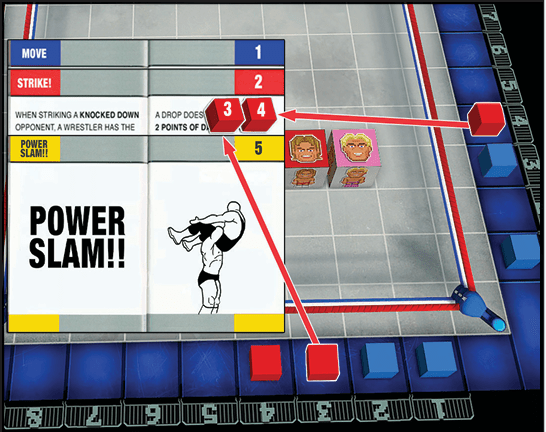
Whenever you interact with the crowd or perform a sufficiently entertaining maneuver, you gain cubes to place on one of four tracks surrounding the board. Placement is a mini game of sorts, as you can choose to push a single cube far up a meter, or place a few on lower values. These cubes are eminently useful. They’re spent to take the place of a card when you’re dancing around in a string of combo’d moves. So, say you just played a four-value Punch and have your foe recoiling in pain. Now you want to deliver a devastating blow with a six-point Slam, but you don’t have a five card in your hand to play first. You can spend a cube from the five-position on one of the crowd meters, bridging the distance between your four and six-strength cards.
This system is wonderful. It adds texture to the card play without much rules heft. It also perfectly encapsulates the additional energy leveraged from a raucous crowd, your moves feeding into fans’ excitement which feeds back into your moves. This models that interplay and co-dependency surprisingly well.
It’s easy to imagine how all of this requires careful thought. When deciding how to begin an exchange you need to consider what cards are in your hand, your crowd meter control, and how both of those intersect with the current positioning of the athletes. Wrinkles abound, for you need to make sure you save cards to pick a foe up after they’ve been knocked prone if you want to deliver a slam. Or time your movement and positioning just right if you want to climb on a turnbuckle to deliver an aerial maneuver. Maybe you even want to throw the exchange and allow your opponent to take momentum. This could prove effective if you have a reversal and want to rope-a-dope them into a vulnerable position.
Another important element of hand management is timing the redraw. You only refill your hand when it empties, but in doing so you lose momentum if your final card isn’t played into a combo. Pins and submissions require multiple cards to be played as well and take some setup. All of this forms a relatively sophisticated puzzle of variables that collide with the game state and your enemy’s plans.
The real benefit, and triumph of this system, is that this thoughtful play is a brisk activity that ignites emergent narrative. Much like the drama of professional wrestling, WoW is all about stories.
Narrative-driven gameplay is Spivey’s own signature move. It’s an element that’s been central to all of his work. HAVOC: Tactical Miniatures Warfare allows you to field a giant that literally clubs characters across the board like you’re playing a round of 18-holes. Rogue Planet presents absolutely wild character powers and a unique movement system which is highly cinematic. Techno Bowl captures the intense emotion of sports, including huge bone-crunching hits and desperate last-ditch efforts. World of Wrestling is his latest effort of executing on this methodology, and it delivers a high-octane over-the-top drama that only could exist as a natural continuation of those previous projects.
Such a large portion of this 30-minute experience is spent on your feet. I cringe and clutch my torso when ribs bounce off the canvas. I holler and pantomime lifting my leg into the air when a brutal leg-drop connects with bruised flesh. This, in a way Spivey’s previous designs never managed, is an affair of theatrics.
When I reflect on this game, one of the most interesting elements is the underlying fluidity that emerges once you overcome the hurdles of complexity. This is found in the flow of play. In the notion that players don’t perform alternating turns, instead they seize momentum. They grab control. This simulates the micro contest of strength and coordination that occurs, one wrestler ultimately dazed and stumbling about at the mercy of the lead grappler. Everything flows from this foundation as momentum is built or dashed, as the crowd screams or goes silent. It’s really a stunning system whose obtuse surface belies an inherent grace.
Brilliant, so what’s the catch? There’s always a catch.
Well, you can’t just order this game and have it arrive ready to go. It’s only available as a print-and-play product from Wargame Vault. You can grab the cards and some other paraphernalia through print on demand. There’s a handy guide on BoardGameGeek that can give you the rundown.
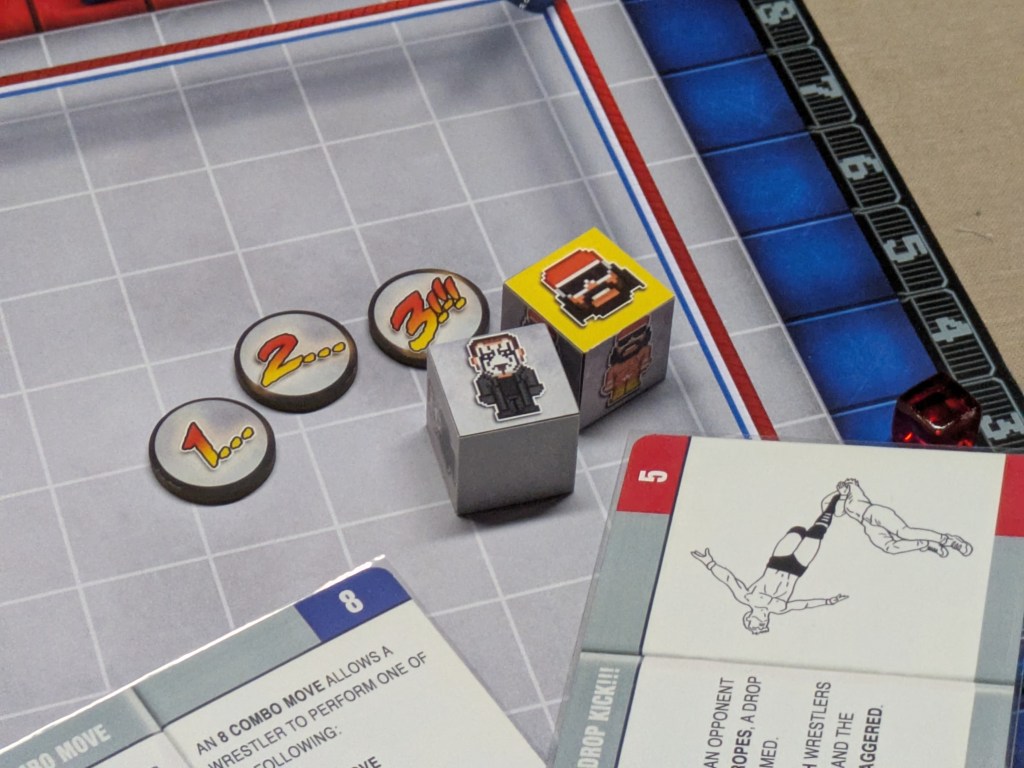
Don’t judge the game by its DIY label. The graphic design and visual presentation are top notch. Health dials, cards, and tokens are all sharp as can be. Assembled pixel block wrestler figures are as spectacular as they were in Techno Bowl. In fact, let’s detour for a moment and talk about these.
The stable of characters are all parodies of existing wrestlers across multiple eras. You have studs like Bulk Brogan, Metro Man, and Devin Clash. This CMON-esque cavalcade of cheesy references usually gets stuck in my teeth like errant spinach. I tend to abhor such practice. Somehow, as was the case with its predecessor, it just works. Instead of acting as an anchor, it’s an accelerant for the nostalgia. The low-fi contours of the product softens the image enough to invite playfulness.
Much of this game is designed with such weaponized sentiment. The cards resemble pages from an old video game instruction manual. The pixel block wrestlers confer an eight-bit Nintendo aesthetic. The grappling and move system are unabashedly N64’s No Mercy. Not least, the health dials resemble SNES controllers, acting as a bridge between these eras and unifying the aesthetic into a nostalgic homogeneity. I would call the end result manipulative if it wasn’t so damn impassioned.
This game is the marvel I expected it to be. The only real complaints I have, beyond it not being available as a mass-produced title, are that it’s a fussy thing to learn due to those aforementioned idiosyncrasies. As is common in Spivey’s designs, there’s some weirdness which requires a mental adjustment. It doesn’t help that breaking the game into basic and advanced rules results in your first few games being far too long as players struggle to orchestrate the pin sequence. I’d suggest most people call their first match prematurely once they’re’ comfortable and then hop right into the main event.
It’s also clear that this is not a fully finished game. While what’s here is fully implemented and an outright joy to fiddle with, the WoW line seems poised to deliver additional rules modules such as tag teams, hardcore matches, and league rules. I’m eager to find out how this fantastic game will expand.
I do have one large regret when it comes to World of Wrestling. I wish I would have played this sooner so that it could have made my best of 2025 list.
An assembled copy of the game was provided by the publisher for review.
If you enjoy what I’m doing and want to support my work, please consider dropping off a tip at my Ko-Fi or supporting me on Patreon. No revenue is collected from this site, and I refuse to serve advertisements.
 Player Elimination
I’ll probably never play this game but I’m delighted that it exists
LikeLiked by 1 person