
Tom Lehmann is one of the sharpest card game designers in the biz. Responsible for highly regarded engine builders such as Race for the Galaxy, Jump Drive, and Res Arcana, he has branched off to ply his trade in the somewhat creaky deckbuilding realm. The result is a mashup of traditional aspects riffing on Dominion and Ascension, coagulating with some newfound vitality courtesy of Lehmann-esque engine redlining. Dark Pact is an old beater strapped to a Saturn V. That sound you just heard was this little golem breaking the sound barrier.
Let’s get our footing before I talk about how it takes off.
I mentioned the inspiration of Dominion. This is overt. Each turn you play one action and then all of your treasure cards in hand. Actions consist of drawing additional cards, adding more actions to your pool, and manipulating elements of your deck. New cards are purchased from the market at the end of each turn. One action, unlimited buys. Simple.
The market is in the tradition of Ascension. This means it’s 10 random cards dealt from a central deck. When a player is finished buying, the empty slots are refreshed. You have no idea what may pop out and it’s wily in nature.
The goal here is to complete a titular Dark Pact. These are a dozen or so cards that function as objectives. They are each unique, boasting requirements such as having the entirety of your deck in play, including nothing left in your hand, draw, or discard pile. Another wants you to reveal treasure cards from your hand worth 15 total money. One wants you to possess 20 unused actions on your turn.
I kind of love these cards. Play shifts from the standard of accruing victory points that water down your deck and wind down the game, to instead grabbing a goal card which either fits your deck or is within reach. Selection here isn’t perfect, as they’re shuffled into the main market and must also be purchased during your turn. This can create an unruly environment where you can’t count on the perfect Pact appearing. Strategic flexibility is thus emphasized.
But what’s enthralling about the Dark Pact cards is that they’re seemingly absurd. They are harbingers of how violently the game will accelerate. 20 extra actions sounds ludicrous. You get one action on your turn. What the hell?
Enter the multiplier. The Lehmann redlining.
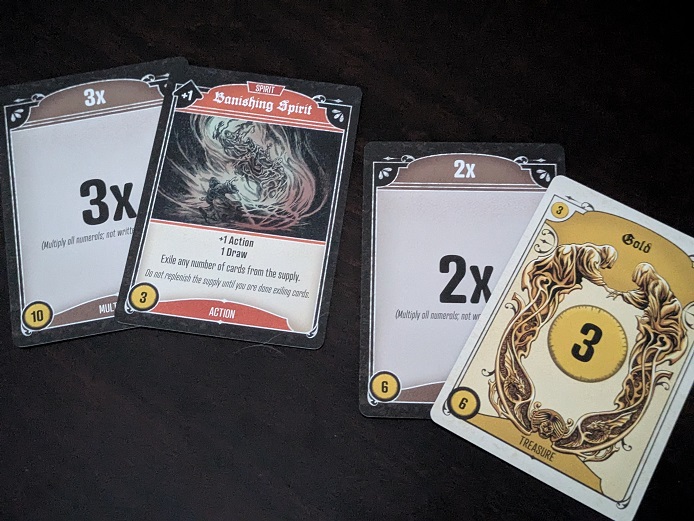
The multiplier cards are played alongside an action or treasure card. They literally multiply every number on the card by the stated value. Play a spirit card that gives you plus one action and plus one draw. Give it a x2 wingman and you now get two additional actions and draw two more cards. What if you include a third card, a x3 multiplier? Well, now the effect is increased six-fold. Gonzo.
This is why Dark Pact is truly all about collecting the multiplier cards. They’re the turbo-charge for your engine. They’re flexible and work with every single strategy. They’re completely necessary.
This requirement for amassing multipliers also creates a fissure for pain.
Dark Pact is a sluggish experience with a full count of four. The game arc results in players drawing through the bulk of their deck in the latter half of play, and the experience is placid when you’re waiting for multiple people to take their turn. Worse, the variance of the market will result in unequal opportunity that exacerbates this issue. I’ve been in sessions where every multiplier popped out and was acquired before I even got a chance. I’ve seen players mill the market to discard multiplier cards they couldn’t afford, just so I wouldn’t be able to nab them as the next player. This feels like being deliberately walked by a pitcher when all you want to do is smash the ball. It subverts the design’s promise. This is a Tom Lehmann game after all.
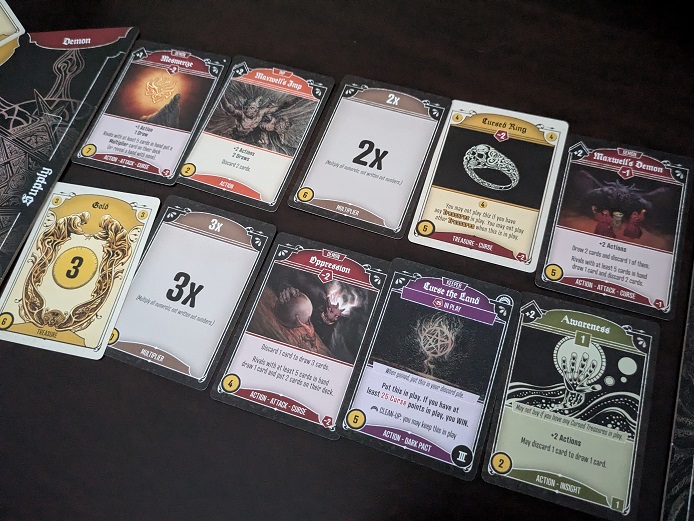
There is an asymmetry in engine-building due to the sheer luck of how the market shakes out. It’s exacerbated at three and four players, where the haves and have nots become divided quite quickly. The beauty of the multipliers is that they’re functionally bucketloads of lighter fluid to pour on your fire. Grab a couple and your deck blows up like none other. It’s wild and unhinged. The first time you put it all together, Dark Pact feels spectacular. Like you’re mainlining rocket fuel. This is a fast 45-minute game, and you hit that breaking point relatively quickly. At first everything is straightforward and turns are fast. Then all of the sudden you eclipse a terminal point and it’s the finale of a fireworks show.
Watching that finale from a distance and feeling impotent is a drag. This effect can happen in Lehmann’s other games, but it’s not nearly as pronounced. When you’re getting thrashed in Race for the Galaxy, you’re at least acting simultaneously for the most part. This diminishes some of the agony. In Dark Pact, you’re a remote spectator for the detonation.
With two players, Dark Pact is a thrilling affair. It takes the Dominion chassis and does something novel with it, stripping away all the excess and building a muscular vehicle that knows how to scoot. Turns are brisk and even when you’re getting pummeled, it’s over quickly enough to curb frustration.
While its engine building functions as an overclocked Dominion, it can’t really compete with that seminal title’s card pool. Dark Pact is restricted in its card effects due to its straightforward nature. Cards tend to function broadly similarly – with many seeming to be a variation of Dominion’s Laboratory. Their performance ultimately comes down to nuances that aren’t outright sexy. These interact with various features such as different categories of trashed cards, card sub-types, and a selection of abilities that directly harm other players.
It also does some neat things with efficiency. New cards go straight to the hand. You may also keep cards in your hand at the end of your turn and are not forced to discard them. This duality is empowering. You can grab a x3 multiplier and hang onto your card that adds multiple actions and allows you to fish cards out of your discard. This sets you up on the following turn to draw half of your discard pile and fire off a ton of additional cards which compound in effect. Synergies emerge and dopamine floods your gray matter.
There is quite a bit of mileage for the size of this game, it’s just that those who have become accustomed to the modern trend of content discovery may feel as though they’ve seen everyone of this game’s surprises after only a few plays. It wants you to dig into the subtleties and learn new ways to leverage existing effects, combining them with other cards and squeezing out a few more horsepower.
But really, the pull of Dark Pact is in straddling a hellion and riding it into the sun. More cards won’t necessarily enhance that.
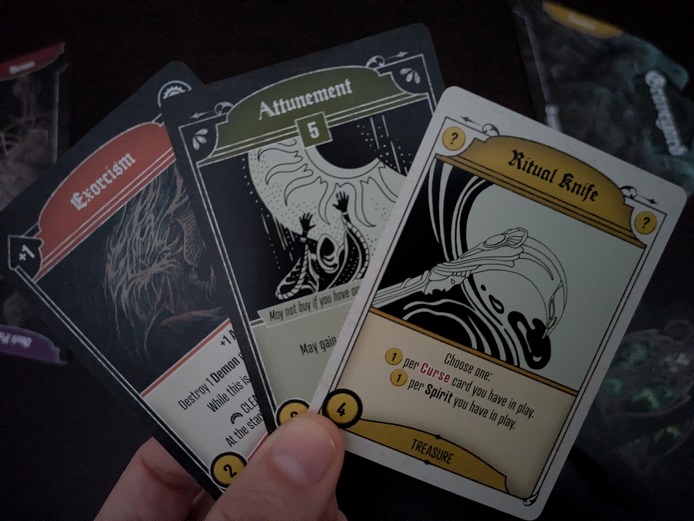
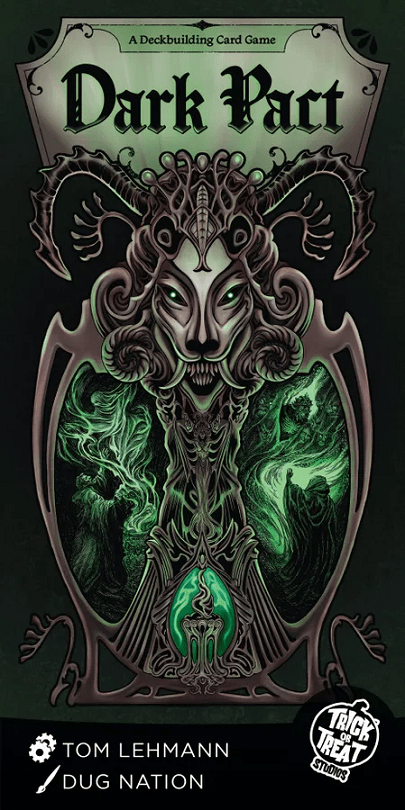
While I’ve commented on the game’s modest size, this trait is actually multidimensional. Dark Pact is packaged in a small oblong box that resembles a diminutive coffin. It looks fit to house a demon. Or perhaps a ritual dagger. There’s a mystery surrounding its unique physique that blends with the overall occult aesthetic in a pleasant way.
I didn’t lead with the setting because it’s particularly faint. About as material as that of Dominion. If you’d rather grip cards with skeletal warriors and raging spirits than calm valleys and forlorn homesteads, you will find its countenance attractive. The facade is sort of irrelevant, but it sort of isn’t. As I said, there is a sense of veiled weirdness. The kind that pervades titles like Cave Evil and Cryptic Explorers. It’s not those games and does not bear the same emphasis of setting, but it does boast the same palette and mood.
The weirdness in contrast with its familiarity is the real pull. Not just the visage, but also the brazen multiplier cards and the eye-popping pacts. I do find it slightly disappointing that the ritual is muted with a group, but with a vile partner, this game provides something esoteric and thrilling. Is it more effective than two-player advanced Race for the Galaxy? No, but that’s a reasonable measuring stick. What’s important is that it’s potent and distinct.
A copy of the game was provided by the publisher for review.
If you enjoy what I’m doing and want to support my work, please consider dropping off a tip at my Ko-Fi or supporting me on Patreon. No revenue is collected from this site, and I refuse to serve advertisements.
 Player Elimination
Interesting that this review emphasizes the variability of the central supply and doesn’t mention the Grimoire… which is a crucial part of the design.
The grimoire is a private reserve of up to three cards that initially has a silver, a 2x multiplier, and Inscription, a chainer that lets you take a card from the supply and place it in your grimoire, reserving it for a future buy.
What should you buy first? A silver to increase your initial payload? Inscription to increase your strategic flexibility? Or, something from the supply? Any cheap card that provides two actions means you don’t need to multiply a chainer to play a terminal and keep going. Banishing Spirit lets you sweep and replenish the supply on your turn, greatly improving your access to the cards you want to buy. A dark pact will give you direction…
Multipliers loom large when playing the “first game setup”, where everyone starts with a dark pact that requires them (to both give them a clear direction and teach them about multipliers). But, in the real game, where players need to find a dark pact on the fly and tailor their deck to it, there are quite a few Dark Pacts (6 out of 13) that don’t require multipliers to fulfill.
Testing showed that having two multipliers in your deck was generally needed to be competitive. Players start with one 2x in their starting deck, with a second 2x guaranteed via the grimoire, even if your rivals are exiling and/or buying all the ones in the supply ahead of you.
There’s a lot of emergent gameplay that comes from interacting with a constantly changing supply, other player’s goals (as defined by their dark pacts), and your deck design. “Retrieve” (from discard to hand) and “Gain” (when cards gained go directly to your hand) become just as important as “Action” and “Draw” as deck-building verbs.
Do you play attacks without multipliers (to hurt your rivals while providing you a small benefit) or with them (to magnify the benefits they provide at the cost of usually nullifying their effect on your rivals)?
More players increases the cut and thrust between different strategies and, with generally increased exiling of cards from the supply for denial, can lead the game towards Deck End strategies. There’s a cost in downtime, of course, but brisk, experienced players who plot their next turn while other players take their turns generally find the game moves fast enough. Enjoy!
LikeLiked by 2 people
Appreciate you taking the time to reply Tom – and all of your work in the hobby, you’ve made some of my favorite games.
I do not include every detail or mechanism when reviewing games. My approach is to deliver some sharp, hopefully unique, observations as well as capture the spirit of the game and what it’s trying to convey.
I was considering mentioning the Grimoire, but refrained from doing so for brevity’s sake. I’ve done a lot of writing for professional outlets like Polygon, IGN Geek & Sundry, etc. and editors have hammered into my head how important a restrained word count is. People won’t read long reviews and end up skimming them.
I understand if you think the Grimoire is important enough that it should have been mentioned. Totally fair.
I’ve used the Grimoire in some interesting ways. I’ve reserved cards I’d like to acquire, but also hate drafted cards into it aggressively with some success.
While I completely trust play testing over my own intuition and experience, I think the more multiplier cards you have has to lead to an advantage over fewer. I will concede that perhaps two multipliers is enough to win, but I can’t believe you have the same odds as someone with another x2 and x3. Even with the dark pacts that do not utilize them, they are invaluable to grabbing the cards that you do need.
In my plays at higher counts, I frequently saw people acquire cards allowing them to sweep the market. This means that multipliers rarely made it past one player’s turn, and almost never made it past two player’s turns.
Also, concerning your point about multipliers being much more important when playing with the starting configuration, that may be so, but you would likely be surprised to hear that I have never played with a dark pact starting in your deck. I’ve always played and taught this with the standard game.
LikeLiked by 1 person
An Ascension-style supply tends to increase the tactical nature of a game, which the Grimoire counteracts. Glad to see you using it in interesting ways.
Sure, having more multipliers is generally a good thing (unless you are trying to win via the Diverse Learning pact with its no duplicates clause), but A) that’s true only to a point — we kept records and the player with the most multipliers didn’t regularly win; they often fell victim to a player with a more focused deck and fewer multipliers — and B) aggressive exiling in higher count games tends to breed more aggressive exiling (a player seeing no multipliers at the start of their turn will often exile 6-9 cards from the supply to turn one up), which often leads to either a very strong Spirit Lord — a card that cannot be exiled or hate-drafted into a grimoire — or pushes the game towards a Deck End situation, both of which change the dynamics of the game.
FYI, one test group adopted the meta-group-approach of aggressively exiling cards to get to 3-5 multipliers each (including their 2 private ones) and then would stop doing so about half-way through the supply deck (given there are ~6 multipliers per player) to counter these effects.
At that point, the game became less about multipliers and more about tailoring your deck to effectively use them. Is this where the game eventually goes for most experienced groups? Dunno. That’s something we’ll find out as the player base expands and more experience occurs. But, it was certainly suggestive and reduced my fear about multipliers being too dominant (along with seeing some wins with just one’s two starting multipliers). As always, your mileage may vary. Enjoy!
LikeLiked by 2 people
Great write up, thanks! Res Arcana is one of my favourites, and I have had a lot of fun with Chu Han, so I feel this is a safe bet.
Good to see Tom’s response in the comments, also thanks! I’ve played some games of Res that have been awful, but appreciate it’s about making the best of what you’re dealt. There’s a subtlety there that’s worth exploring.
I also appreciate the concision and brevity of your reviews, Charlie. It’s something that seems to be getting lost as people self-publish and do y have editors. Writing and reviewing in this way is definitely a skill.
LikeLiked by 2 people
Thanks, Greg!
Have any thoughts on the Res Arcana expansion? Wondering if I should try and track that down some day.
LikeLike
I got the second expansion (the Pearl one) after maybe 50 plays of Res. I’ve had maybe 6 plays with the expansion. I like it, it provides a bit more stuff and a couple of different strategies, but I think there is more to discover in the base game.
So at this point it’s worthwhile but not essential.
I do like how the theme of the expansion weaves through all the components though, very much a thing of itself rather than just “some bits we thought we’d add on”.
I think they’re pretty easy to get hold of, at least in the UK.
LikeLiked by 1 person
(No idea why that user name has come up. WordPress having a fit…)
LikeLiked by 1 person
Thanks for your thoughts. It’s been a long time since I’ve played Res Arcana, need to get it back out.
LikeLiked by 1 person
I’m looking forward to trying Dark Pact, I’m a sucker for a Lehmann card game. As mentioned above perlae imperii the second expansion for res arcana is amazing, I like both expansions but the second one seems (for me at least) to synergise with the base cards the best.
I ended up back to your website after hearing you on So Very Won’t About Games, I do miss hearing audio Charlie. Maybe one day we’ll get you on another regular podcast. You should see what Rapha is up to 😉
Great content as always, I’ll make sure to pop post the site more often
LikeLiked by 1 person
Thanks, Greg! I do miss podcasting and would enjoy doing it more often. I have no desire for all of the extra work involved, however (editing, running a separate site, etc.). Thanks for listening to my guest appearance on So Very Wrong About Games and for reading my work here. I appreciate it.
LikeLike