
Fantasy Flight Games launched the Living Card Game (LCG) format in 2008 with A Game of Thrones: The Card Game. It soon extended to a variety of lines, including Call of Cthulhu, Android: Netrunner, and Lord of the Rings: The Card Game. The promise of this exciting new format was an end to chasing rares, steady support, and an affordable product space. A crucial aspect was an equal opportunity for players to acquire content, as all sets were known and non-randomized. You could head to the store, pick up the new expansion, and know exactly what you were getting. Sharks wouldn’t possess an advantage, and these games would not be geared towards those with the most economic power.
As Bob Dylan said, “seems sick an’ it’s hungry, it’s tired an’ it’s torn/it looks like it’s a-dyin’ an’ it’s hardly been born.”
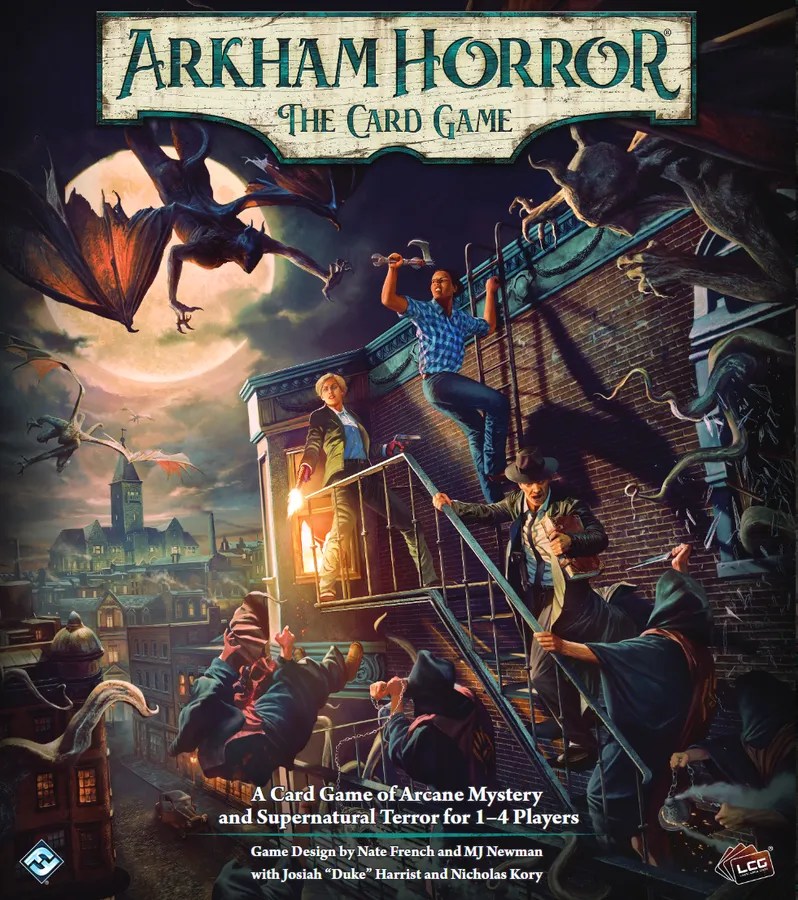
That’s a little uncharitable. This format has endured for nearly two decades, and is still finding success with Marvel Champions, Lord of the Rings, and yes, Arkham Horror: The Card Game. But man, the potential of this structure has been nearly equaled by its unexpected nags.
What was hard to initially see, but quickly materialized, is how difficult it would be to keep up with or catch up on this never-ending serialized product line. The release schedule has catered to addicts. New hits have been pumped out monthly in small manageable blister packs that can be tossed into a larger game order or quietly eaten as a subscription. You hardly notice an extra $15 on the Visa statement, not until you bump your Netrunner shelf and nearly perish under a barrage of data packs. Most people eventually tail off, tapping out due to content oversaturation.
Arkham Horror was somewhat impervious to this blight. Being a cooperative narrative-driven adventure game, the content is very much the core of the product. New scenarios and boxed campaigns are easy enough to plow through when a large contingent of the player base are solitaire gamers, and another chunk are playing this excellent game with a partner or roommate.
But there’s still a problem. Let’s talk about Kenny.
Kenny discovered Arkham Horror: The Card Game in 2023, digging deeper into the hobby after a COVID-fostered solitaire gaming affinity. Kenny buys a core set and falls in love with the game. Now what?
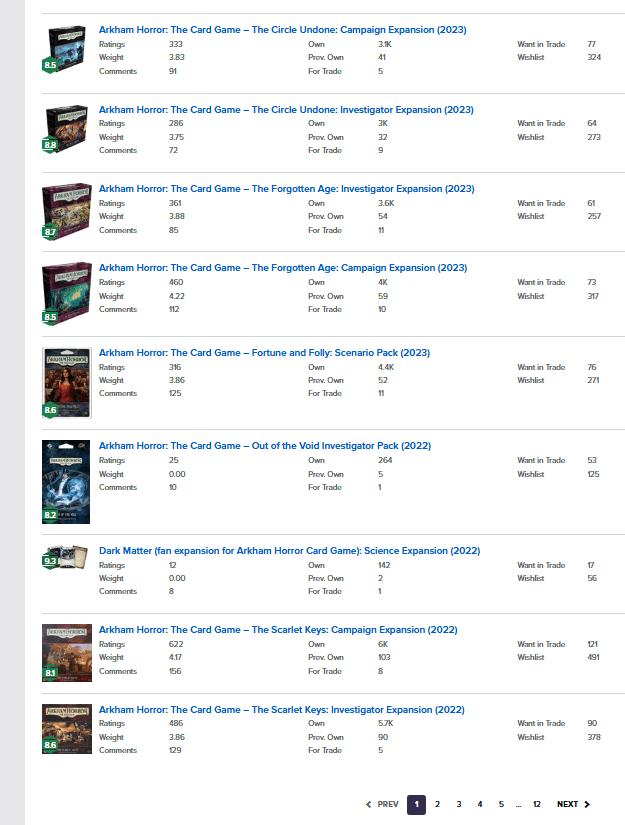
Literally hundreds of products. Navigating this quagmire seems an impossible task. Furthermore, with many of the expansions being out of print, the core promise is broken. The whole egalitarian structure of no blind buys crumbles if you’re still chasing difficult to find cards in the secondary market. Good luck, Kenny. Dude just wants to go to the store and exchange currency for cardboard. He doesn’t want to have to spend hours researching scenarios and campaigns and investigators. He doesn’t want to dig through dozens of online stores and reselling sites trying to find that one crucial set everyone raves about. This one game becomes its own domain of study.
Collectible card games attempt to deal with this problem of the indefinite library by cycling out sets. Fantasy Flight attempted such a competitive format, with mixed results. Once these techniques and patches start creeping in, the benefits of this proprietary LCG approach diminish.
Of course, cycling out sets doesn’t really work in a non-competitive adventure game. At least not in a satisfactory way.
This brings us to Arkham Horror: The Card Game, unofficial subtitle: Chapter Two.
It was clearly deemed that the existing product line was unwieldy. It was no longer serving its purpose by alienating FNGs and likely resulting in stagnant sales numbers. They needed a fresh start. A clean break.
Chapter Two is the beginning of a new Arkham Horror: The Card Game. An evergreen launchpad for newcomers to get into the game and hop aboard while the train is just moseying out of the station. FFG is also smart enough to know that a portion of veterans will also grab a ticket. Completionists, sure, but also those who are curious and want to play the new three-scenario campaign. Or maybe they want the new investigator or encounter cards. You will need this box if you want to pick up future content.
But other than those shallow areas of interest, there’s not a whole lot here for those long in the tooth. The short campaign is entertaining, but it mimics some of the same beats of that in the original core set. You can carry old content forward, but you will have to make some adjustments like not mixing certain cards with the same name or only utilizing the new encounter cards. It’s a little bit of an organization headache and many will likely keep the two chapters wholly separate. The appearance is that the necessary steps were taken to not cut off the existing community, but no special attention was given to that core segment.
The ultimate goal of this new introductory box is to service the Arkham Horror virgin. And for this group of innocents, this is a very solid foundation.
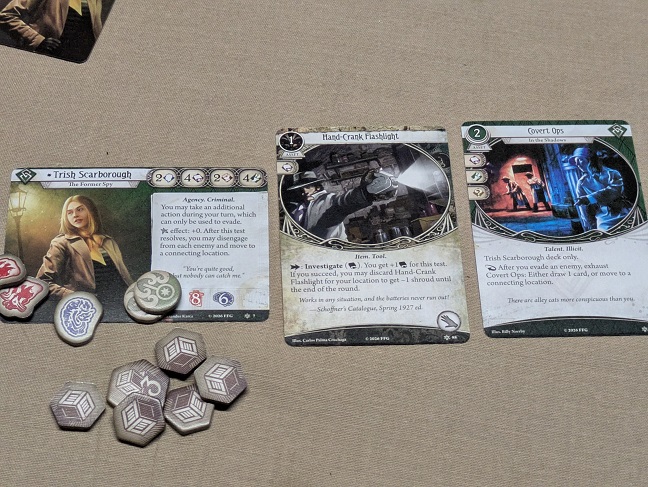
Notwithstanding the insert, the rest of the components are thoughtful. Beyond all the standard expected tokens, there are very useful connector pieces to place between locations. This was a popular aftermarket purchase that was never officially supported. Also included is a draw bag for the skill tokens, a crucial element that was originally absent from the game. The rulebook is excellent and the campaign guide clear. Investigator and scenario decks are organized to be opened and utilized without any fuss. The preconfigured investigators are built in a way to show off the card pool rather than achieve efficacy, which I’m not sure is a wise design tradeoff, but importantly, you can get right to playing without having to build decks or sort cards. That’s ultimately what this box is about, getting you into the game without any burdens.
And once you get in you will realize that the game is (still) excellent. It combines narrative thrills with a standard Mansions of Madness or Arkham Horror template of hopping between areas, juggling adversaries, and managing your resources. You will discover cursed artifacts, develop a tableau of assets, and navigate a changing world that adapts to your decisions.
The scenarios unfold over multiple stages, usually with two separate pathways moving simultaneously forward. One encompasses the investigators’ goal, such as rescuing a friend or deciphering a secret message. The other centers the unending progress of doom and devastation. This is effectively a timer, a device to set the tempo.
I am of mixed opinion on the chaos bag. This is the primary mechanism of resolution for everything from fighting a Deep One to translating a forbidden text. You add up your character’s ability in a particular skill, play cards out of your hand to modify the test, and then draw a random token which adds or subtracts from the total. The neat aspect is that some tokens are not numerical values, but instead are symbols. When drawn, they trigger special effects that are scenario dependent. Additionally, this token pool is modified game to game and supports difficulty adjustment.
As a system, it allows for some nuance and clever tricks, but it lacks the drama of a die roll. The standup climactic moments hit harder with kinetic resolution that everyone can huddle around. Adventure games also tend to run more smoothly with dice-based systems due to the speed and familiarity of play. I’m not totally against the deviation here, but I don’t find it particularly strong or noteworthy.
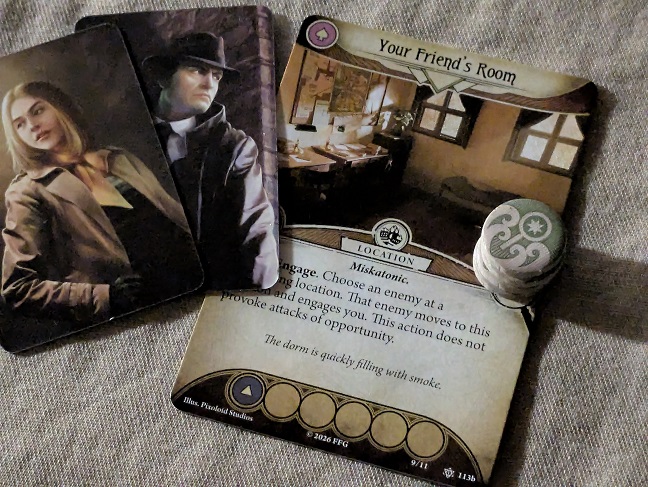
One of the strongest assets of the design is in how it builds attachment to your character. This is most evident when constructing your own decks, as you gain a familiarity and investment through the character building. It’s akin to statting up and equipping your protagonist in an RPG. This contrasts with Mansions of Madness and Eldritch Horror which feature more shallow character definition. The reality is that you have more skin in the game when your agency is embedded in the deck you wield.
The character development and ownership are elevated with the campaign format. Depending on the decisions you make and the overall narrative outcome, future scenarios will be impacted in various ways. This establishes a sense of authenticity to the storytelling, but it also enhances the stakes and provides a minimum semblance of replayability. There are promises for a richer experience in future content regarding this branching format, and I hope to see it materialize.
The scenario writing across the entire line of expansions is regarded as extraordinarily strong for the most part, with designers finding new ways to surprise players. This is really the crux of Arkham Horror: The Card Game, as the flexibility of uses for cards as locations, items, threats, and events really supports a creative and fertile ground for experimentation. It’s the proper argument for why this game should exist over Eldritch Horror or Mansions of Madness. It truly is unfortunate that the core campaign is somewhat modest in ambition, as players are not necessarily offered a good sense of the imagination typically expressed.
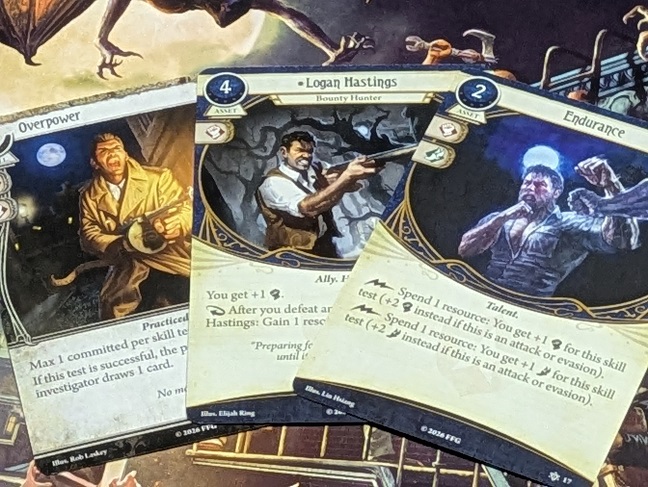
Another oddity is that this new evergreen box is launching without much in the way of scenario support. Additional investigator decks are arriving soon, but we are months away from a second campaign via expansion. Normally I would praise this interval of content release as the constant pressure of new products is a large downside for casual LCG players, but here it seems a misjudgment, as the starting campaign is so short and easily completed. This sets an awkward expectation too, unless of course they are distancing themselves from treating this as a lifestyle or primary game in a collection. Regardless, the fuel of this design is content, and it will need much more to lift off the ground and convince those skeptical of adopting the new edition.
One thing that wasn’t glossed over is peripheral support. There are new player mats, storage boxes, and token upgrades courtesy of Gamegenic. Despite my proclivities for gluttonous overproduced thematic games, I’m not the type of person to pursue optional component upgrades. I usually skip metal coins or neoprene aftermarket board replacements. But these deluxe Arkham Horror upgrades are enchanting. The investigator playmat is such a simple thing, clearly unnecessary, but the organization and segregation of areas is an appreciable bonus. The specialized deck boxes (“deck tomes”) are fantastic as well.
I find it difficult to predict the future of this line. There is a context to this game that is alluring, one which extends beyond all the fuss of content focus and new editions. As with many others, when I think of Fantasy Flight Games I think of Arkham Horror 2nd Edition, the Launius and Wilson banger that really set the tone for this company’s brilliant work in the aughts. While that Arkham Horror shares many qualities with this Arkham Horror, the most obvious is the position as a core identity of FFG. This game carries the spirit of adventure, mystery, and cosmic horror forward. It serves as a constant in the hobby and is an iconic successor that is more modern in its focus on content and serialization. The only thing it could do further to bridge the gap between then and now would be to utilize crowdfunding and pack in the miniatures. Let’s praise the ghost of Christian Petersen that this is not the case.
A copy of the game was provided by the publisher for review.
If you enjoy what I’m doing and want to support my work, please consider dropping off a tip at my Ko-Fi or supporting me on Patreon. No revenue is collected from this site, and I refuse to serve advertisements.
 Player Elimination
I’m fathoms deep in the Arkham LCG space, so I have a dozen responses, but overall this was a solid review of the game and the format! As great as Fantasy Flight is, they have an unfortunate tendency to abandon their product line, even when there’s still demand, so I worry about that for the LCGs. But mostly I’d like to refute your review of the token bag. I don’t object to your “comparative physical drama” evaluation, although my group loves to grab a token and slap it on the table with our palm on top until it’s time for the dramatic reveal. More it’s that the token bag is the mechanic most responsible for making the game design as strong as it is. It allows for randomness controlled within a range which essentially eliminates swing (mostly) and means that players can always decide to turn a die roll into a decision if they’re willing to pay the scaling cost. It really gives the best of both worlds – uncertainty through randomness and Euro style calculated resource management.
LikeLiked by 1 person
Fair points, Randy. I knew some (many?) would disagree with my opinion on the Chaos bag. I have to admit, I also prefer dice to Gloomhaven’s card system, and preferred dice than the card draw in Oathsworn (it allowed you to use either).
I’m not completely anti-card/token resolution, and I’m going to be reviewing LA-1 soon which uses a card based skill test, but I do greatly enjoy the activity of rolling dice.
LikeLiked by 1 person
We’re all Kenny… (I wanted to get into LotR TLCG but the bewildering array of expansions put me off.)
I borrowed the first edition from a pal in lockdown and thought it was okay, although he’d already set up the decks. Glad this new version streamlines _that_ process.
I only played the first scenario. I recall No Pun Included remarking the third scenario in the base box was hard as nails. Is that still the case?
I liked the bag draw mechanic, more interesting and versatile. I don’t mind dice (although I properly fell out with them playing Legends of Andor).
LikeLiked by 1 person
I think ALL of the scenarios in this new set are hard as nails. Some of that is because the prebuilt decks are not strong, but also partly because the game steers towards challenging.
LikeLike
I had a conflicted experience with the game. On the one hand, I’m an inveterate Lovecraft/Cthulhu gamer from both the competitive and cooperative standpoints. OTOH, I am not a solo gamer. At all. With that in mind, I found that the cooperative experience was less than I had experienced with things like Arkham Horror. I’ve played co-op deckbuilders, but those have a dynamism inherent to new cards becoming available during gameplay, which is more exciting (to me, at least) than building a complete deck beforehand and hoping that it functions properly during play. In other deck CONSTRUCTION games (e.g. MTG, et al), that would be sorted out in the course of many games before you reached the crux moment (a tournament), which may be where I find this system lacking. In short, I lack the interest to perform the steps of construction without having a more varied opponent than any solo/co-op system will be able to provide; not least one that that’s an intro campaign as is the case with this new release.
A wonderfully comprehensive review, as always, and I lack the answers to the problem that they confronted in terms of the pile of content being neither feasible to keep in print nor accessible to everyone getting into the game in more recent times. I like the LCG model for the reasons you cite (no rare chasing, etc.) but it did somehow seem to temper the life the of the games involved, in that every card being accessible meant that there was a set of decks that became more predictable, for lack of a better term and the audience became reliant on FFG to deliver a set of functional decks, which is more stress on the design team and, again, tends to put the game on rails in terms of expectations. Dunno.
LikeLiked by 1 person
That’s interesting regarding your first points. I see where you’re coming from, but I’ve had a good time collaborating on deck building and working it out as a group. I also view this not entirely through the lens of the deck construction, but more like Mansions of Madness supported with a neat central card driven engine.
LikeLike