
Y’all know the difference between a bilge rat and a man-eater? I’m talking ’bout the bad fish. One that will swallow you whole. Roll you ’round in its jaws and squeeze the life out a ya. This cutter, in the year of our lord 2019, was a fierce gnawer. Still is! She’s among the best Prospero shook up. A wiley jig of sneakin’ and chompin’, they call it hidden movement. It’s a hell of a thing. I’ll play ye game. I’ll play the shark. I’ll stare you dead in the face with those glass eyes and I’ll eat your head and your body and your legs. And I’ll eat your soul. The whole damn thing. And then, that sliver of what’s left of ya will be asking for more.

Prospero Hall’s 2019 board game adaptation of Spielberg’s classic film is fantastic. Not for a game based on a film. Not for a mainstream release that sold at Target. Just plain ol’ fantastic.
It’s a hidden movement design that’s a cousin to Fury of Dracula and Letters From Whitechapel. It measures up to those games, despite taking only about half their time and occupying half their space. My soul to the ocean and it may swallow me whole if not the truth. This is a magnificent game.
One player takes on the role of the Great White. This is the big bastard who is out to devour as many citizens of Amity as possible. Each turn, this aggressor plots a series of movements on a hidden sheet of paper, darting about the island and targeting beaches with oblivious swimmers. These people can’t help themselves. Each turn, an event card puts more of them out into the churn. They don’t care about the big feller. They don’t know better. The rest of the players are the trio of protagonists in the film: Brody the Police Chief, Hooper from the institute, and Quint the sharker. These fellers know better. They’re out to save the people and tag the shark with three barrels to slow it down. That’s the setup. The magic of this game is in how it intersects and plays off the strengths of the film.
Jaws is a cinematic triumph that combines the suspenseful wizardry of Steven Spielberg with the emotional pounding of John Williams’ score. Despite a simple plot, it combines many different elements to create an enrapturing picture that stretches far beyond its creature-based horror contours. The characters are iconic, well-realized, and eternally interesting. There is nuance to the subject matter which explores the greed of capitalism as well as overcoming one’s deeply rooted fears. Finally, the cinematography is astounding and offers the first indication that Spielberg would settle among the best in his craft.
Jaws the board game, likewise, served as an indication for what was to come. Prior to this title, the Prospero Hall design studio released Suspicion, Bob Ross: Art of Chill, Choose Your Own Adventure: House of Danger, and many other unheralded games. While all of these titles are satisfactory mass market shelf fare, none of them are particularly interesting or worthy of exaltation. Some will object and offer Villainous, which has proven extremely popular. But even that game suffered from repetition, overly restrictive play, and a general lack of drama. No, Jaws was Prospero Hall’s first real banger and hinted at the group’s true potential.
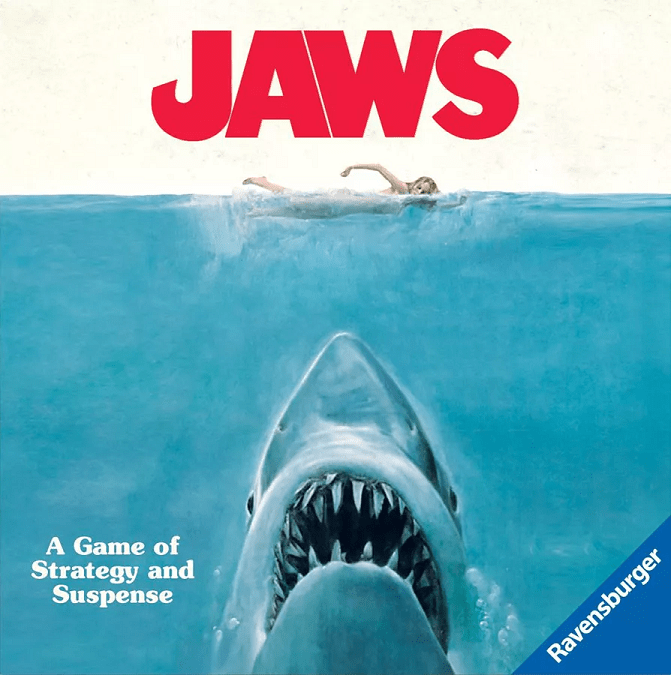
One of the central conceits of the film was a fortuitous calamity. During production, the mechanical shark suffered many malfunctions. This relegated the beast to a background role with the score and Spielberg’s command of the camera doing much of the heavy lifting through suggestion and suspense. The movie is much better for it.
While not accidental, the board game follows a similar path of relying on imagination to instill terror. The idea to utilize hidden movement in this fashion is superb, leaning into a direct sense of paranoia by obfuscating the threat. The protagonists frantically trawl the waters following traces of movement. Infrequent sightings, via motion sensors and beach attacks, direct attention. Conversation erupts as the group debates where the shark could be due to limited movement and temporal considerations. Sometimes you are close and the action comes swiftly after a buildup of intense pressure, just like the brutal beach scenes in the film. Other times you are completely off the trail and waiting for that glint of fin, mimicking Quint’s leisurely pose at the bow of the Orca.
The way the shark appears and then disappears is perfect. These moments are where tension redlines and everything collapses setting off an explosion. Often the shark will slip from your grasp before you can attach a barrel, leaving you cussing the seas and spitting in the wind. The emotional turmoil instills a similar topsy-turvy feeling as the famous dolly-zoom shot. It’s great.
This first portion of the game also captures the antagonistic element encapsulated in the mayor of Amity. He’s the primary advocate for the town’s economic interests and a major thorn in the film. While the mayor is not directly present in the game, there is a general sense of the town’s hubris and recklessness as the game fights your efforts at every turn. Swimmers regularly pop up at the island’s various beaches, their hindrance acting like a tide battering you about. You have to constantly bail this water, balancing it with shark hunting in order to achieve progress. Brody can close beaches to aid in this task, but these actions are momentary as the mayor and public demand peril.
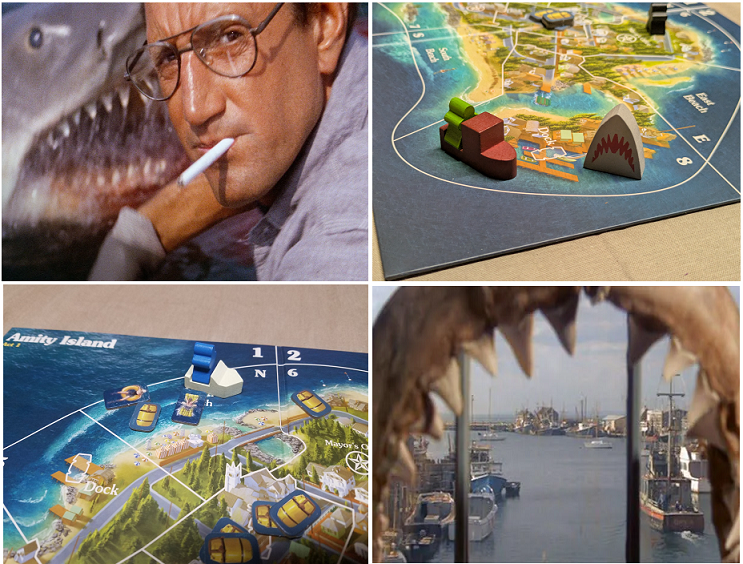
A foundational and generally under-appreciated source of brilliance in Jaws is the attention to detail and all of the little strokes courtesy of Spielberg. It could have been a pedestrian picture in the hands of a lesser filmmaker. Continually, we are gifted exceptional camera work with great cinematography. There is a wealth of brief shots where the camera lingers for just a second from a particular angle or with particular blocking. These form the everlasting spirit of the movie, the soul that extends beyond the viewing.
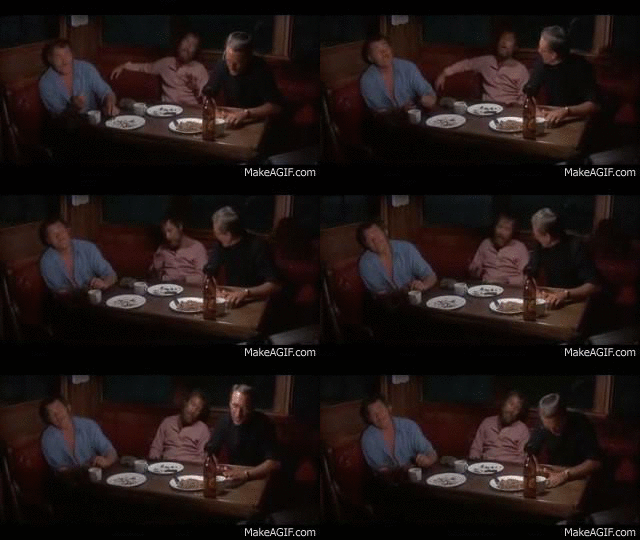
The small details are what make the board game as well. Touches like Brody’s son Michael appearing courtesy of an event, mimicking the terror of the estuary attack in the film. And the flow of action broken up with discussion as players try to outwit the shark and deduce its location – which directly parallels the action scenes bookended with extended character beats such as Quint’s unwavering speeches or Brody’s dinner with Hooper. Or the very structure of the game, a detail I’ve held in the analysis chamber waiting to fire. Time to fire.
A non-trivial portion of my affinity for this design is in its two-act structure. Not only does this seamlessly fit the bisected segments of the movie where the first portion focuses on convincing the mayor the threat is real while the second narrows in on the elongated hunt out at sea, but it also presents an enormous tempo change that turns the game inside out. I am fond of games that drastically change, presenting an end game or phase that escalates and presents a novel climax. Games like Arkham Horror, Middle Earth Quest, and Spartacus which all feature whole separate phases of intense action within their own structure.
In Jaws, the second half of play has you flipping over the board to reveal the Orca, Quint’s ragged vessel. Now, instead of the monster hunting swimmers on the shores of Amity, the shark is attempting to tear apart the boat and devour the three main characters. The whole game flips from a hidden movement structure to a quirky skirmish encounter. It’s incredible and very well executed.
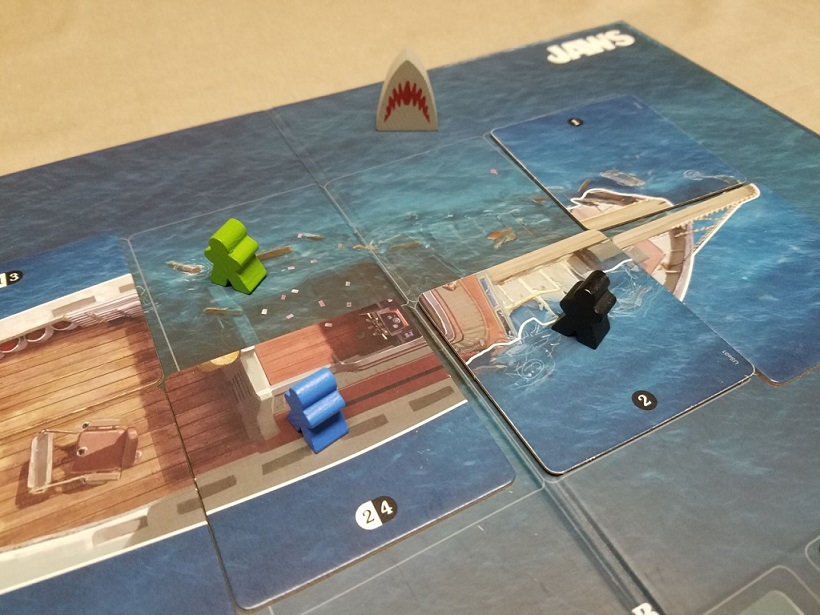
Of importance is the retained restriction. In the first portion, there are faint guardrails due to the limitations on movement distance and the necessity to attack swimmers. There is room for creativity, but you are incentivized to attack certain spaces which leads to a more predictable game state. In the final battle, the game takes a heavier hand, literally limiting the shark’s attack to three possible spaces on a board which totals eight locations. This retains an element of trying to outthink the shark, as the three hunters need to predict where the villain will attack.
This is an odd process. Three cards are flipped to denote the shark’s options. The shark writes their choice down in secret, locking it in. The three main characters then discuss their plans and move their characters about the Orca, placing their individual target markers on certain spaces. Then the shark reveals their position and the outcome is determined.
The best aspect of this system is that it points to a great line Quint mutters in the latter half of the film: “I don’t know, Chief, if he’s very smart or very dumb. He is a smart, big fish.” The restricted options really allude to a shark that is limited in tactical approach. Its action is telegraphed to a degree, and it puts that carrot out in front of the players, allowing you to outsmart the dumb beast and land a fierce blow with machete or pistol. But sometimes he’s a smart, big fish. Sometimes he bites where you least expect, tearing out a big chunk of boat or flesh.

This climax is pure cinema. It feels tethered strongly enough to the first portion of the game as it still retains an element of outwitting your foe as well as directly rewarding each side based on how well they performed in the first act. But it extends the emotional beats by placing the characters in direct peril, redirecting the action to the players as opposed to innocent bystanders. The violence is quick and brutal, with only a couple of solid blows taking out a protagonist. In my last play, Quint was the first to go, being devoured as the section of boat he was standing in collapsed and dumped him into the sea. It was almost beautiful in how it served as a nod towards the height of the film.
None of this is to ignore the legitimate complaints associated with this bifurcation of play. It presents additional rules players must internalize, and despite linking to the outcome of the first portion, it does present a common criticism of rendering the earlier half less relevant. This is also the primary culprit in the game’s length extending beyond an hour, which some may view as too bloated.
But damn, this ending sequence is tense and dramatic for both sides of the table. It’s the better half of the game and much more novel than the hidden movement portion. It’s the kind of thing that when it’s all said and done – as limbs, bits of shark, and gnawed timber float on the table – you have to lean back and sit in silence with the air still. Maybe you light up a cigarette or down a shot of whiskey. Maybe you smile, blood dripping from your lips, and start humming.
Show me the way to go home
I’m tired and I want to go to bed
I had a little drink about an hour ago
And it went right to my head
Wherever I may roam
On land or sea or foam
You can always hear me singing this song
Show me the way to go home
If you enjoy what I’m doing and want to support my work, please consider dropping off a tip at my Ko-Fi or supporting me on Patreon. No revenue is collected from this site, and I refuse to serve advertisements.


This is the one game I regret selling and not bringing with us across the pond. I don’t really have room for another game, but this one seemed good enough to keep. But the reality is, with all of the other options, this one almost never came off the shelf in recent years. I think it has something to do with that divergence between the two halves of the game, in that we always found the first half to be too light and the second half to be too one-sided (it was either a walk for the humans or the fish.) But I totally agree about the film points. Jaws remains a modern classic, especially if you ignore the effective MacGuffin that is the giant fish, as it’s mostly about the three main characters (fully-realized as you say) and their relationship with nature: fear (Brody), wonder (Hoo-pah! in Robert Shaw’s elevated growl) and something to be conquered (Quint.) It’s a great film and an almost-great game. My fave from PH is still Pan Am, though.
LikeLiked by 1 person
Pan Am is a very solid game, but I’d personally place Jaws, Rear Window, and Texas Chainsaw Massacre over it.
LikeLike