
Dungeons & Dragons, yo. We all have an opinion about it. It’s re-asserted itself in the zeitgeist. Stranger Things kicked off a full-blown renaissance, but subsequent works such as the acclaimed film Honor Among Thieves and the universally lauded Balder’s Gate 3 have created a cultural phenomenon. But there’s reason for concern. One D&D was a massive failure before it even began, and the indie tabletop scene continues to siphon off blood. Additionally, there is new controversy regarding the use of AI art in a recent sourcebook, as well as a groundswell of criticism aimed at the game’s antiquated systems by Baldur’s Gate enthusiasts. The brand appears a ragged mess.
That mess has seeped into another property. The long hand has gripped Plaid Hat Game’s Forgotten Waters, wringing out each drop of salty sea and replacing the fiery pirate spirit with…something else.
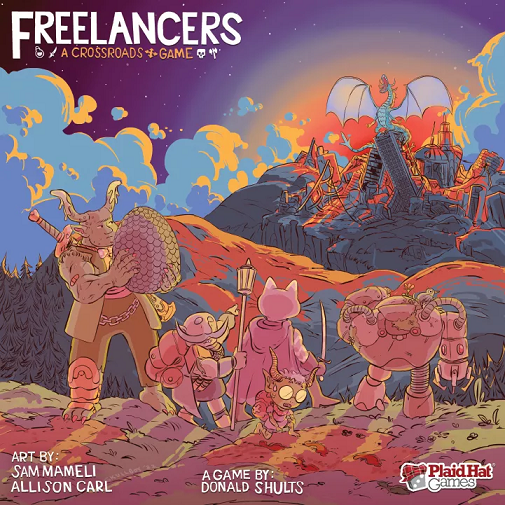
Freelancers is a rickety golem. It’s an offshoot of Forgotten Waters, sharing many of the same systems and a similar sense of silliness. It includes elements of Mad Libs, Choose Your Own Adventure, and improvisational roleplaying. There’s worker placement, lengthy story sequences, and lewd humor. It has dice-rolling for tests, sophisticated narrative combat, and a robust web application that is the heart of it all.
It’s mess to the horizon.
And every bit of it works.
Despite its amalgamation of systems, it’s really a rather smooth contraption. Play never feels choppy or forced. From beginning to end, amid a throng of interludes and distractions, this story game is a Frankenstein’s monster that is best described as beautiful and enveloping.
I selected Forgotten Waters as the top release of 2020. Freelancers is better.
The real achievement is in how it forms an experience that transcends its medium. We often layer plaudits on various board games and describe them as capturing the sensation of playing tabletop RPGs. This has happened with titles such as Gloomhaven, Folklore: The Affliction, Descent, et cetera. “Dungeons & Dragons in a box” is a popular description for all of these works.
That’s not really true. Not in any meaningful sense. We usually attribute this RPG-like quality to surface-level mechanical features. Primarily, character development through experience and treasure. A story is also a pre-requisite, but the actual merits or focus of that element is inconsequential. No one plays Gloomhaven for its story.
This really highlights that board games struggle to escape their format. Our expectations are appropriately low, and hacks like me continue to parrot this faux classification.
Designer Donald Shults has pushed beyond this boundary with Freelancers. It’s something new, taken a step beyond the novel experience of Forgotten Waters. Playing this game is the closest we may ever get to playing a traditional RPG session. Whereas I compared Cole Wehrle’s Oath to a post-Forge indie RPG, Freelancers is more obliquely inveigled by Dungeons & Dragons.
It bucks the board game jacket right from the start. You don’t have to setup a board or fiddle with various story decks or enemy miniatures. Instead, each player grabs a species and job sheet then begins drumming away with their pencil. You write down a character name, pick descriptive words, and fill in detail prompts. Then, everyone reads their class-specific backstory aloud, telling the group how Stumpy Pete became a clamdigger or steel-eyed Martha gave up her dung farmer life. It’s all ludicrous and nonsensical and totally coherent in its absurdity. The game is immediately declaring its focus.
You have a narrative background and you’re given starting weapons and a universal goal of attaining experience points to level up and secure a more favorable ending for ol’ Stumpy Pete. And you’re part of an adventuring party, a group of freelancers who are down on their luck and desperate for coin. It’s a mix of Gary Gygax and Adventure Time in terms of vision.
This beginning process is parroting RPG character creation. Players are given agency over the experience and begin altering the shared fiction. It’s a session 0, planted right at the forefront of play.

That pen & paper roleplaying influence is carried throughout. Nearly all of the changes between Freelancers and its predecessor Forgotten Waters are alterations that lean into the Dungeons & Dragons motif. Gear is now slotted with an emphasis on weapons, armor, and followers. The clever constellation system is swapped wholesale for a more direct pursuit of XP. The sandbox ocean exploration is gone, replaced with a stylish map containing semi-linear paths. The group’s cartographer will mark up and alter this sheet like a mad artist. There is an entirely new dungeon delving encounter format where the group pushes through a series of challenges and confronts monstrous denizens. Best of all, there is a renewed focus on immersion through exceptional voice acting, superb writing, and the delightful prompts for player improvisational roleplay.
That element of in-character performance is the most naked smuggling of tabletop RPG sensibilities into the game. Moments in the story arise where it asks a specific participant to make an inspirational speech or a persuasive argument to a non-player character. These can be skipped if the group is not up for it, but they are the most poignant moments in the adventure. They feel loose and inviting due to the general tone of absurdist humor. This atmosphere lends a broad feel to the spectrum of possible roleplay, and somehow, the goofy gesticulations of an unprepared board gamer melds with the existing nonsense to heighten the overall thematic resonance.
This is Freelancers most brilliant stroke. By adopting a kitchen-sink style of humor, nearly anything goes and everything fits. You can’t screw it up because the narrative is not sacred. It’s easy to riff on and to laugh at. And there will be laughing. I can’t recall another tabletop experience that has elicited such outward guffawing. I’m smiling as I write these words, thinking of recent experiences.

One of the more unusual aspects of this design is that it has this vibrant post-apocalyptic fantasy world but there’s absolutely no lore. Players aren’t expected to read missives beforehand or suffer an excessive setting dump. Instead, the weirdness emerges through play with some of the most crucial elements influenced or supplied by the players. It’s fascinating.
The overall structure of the game feels every bit a D&D module. “Wizards and Wyrms” is absolutely another “Keep on the Borderlands”. The story is mostly prescribed, and the big parts are somewhat railroaded, but the characters at the table are incorporated. This occurs in Freelancers with the Crossroads mechanism. These are narrative encounters based on character details, such as an old co-worker from your dung farming days tracking you down, or an absolutely hilarious dating profile survey for the divorcee. They are big moments, not small ones, and they color the adventure for all involved. It’s the same vibe as an old-school GM incorporating your character details into their pre-written story, doing their best to allow agency and influence on the shared narrative. You’re not going to change the outcome or send the train off the rails, but you can nudge it and leave a mark.
This limited agency is an overriding trait of Freelancers. I could see some taking issue with it, and confirming their suspicions that a board game can never capture the experience of an RPG. Focusing on the limited narrative agency is looking at it all wrong. The moments players can influence and alter, even if seemingly minor in comparison to the plot, are the strongest scenes of the evening. They are the memories we’ll keep and the magic exuded by the cooperative story experience.
That magic is manufactured almost exclusively by the exceptional web application. It performs the function of games master, and it does a surprisingly wonderful job. Many will speak of the best-in-class voice acting, which certainly deserves recognition, but the smooth branching of storylines, tracking of player decisions, and randomizing of events occurs in a way that a deck of cards and story booklet couldn’t effectively manage. It would be a horrendous amount of work and leak spirit from the game. I know people have asked for this solution, but they should just give it up and look to another title if this is a deal-breaker.
It also is an improvement on the previous electronic implementation in Forgotten Waters. The voice acting is elevated, the writing is stronger, and it seems as though there are more branching decisions and interesting encounters. Quality of life improvements include automatically listing common entries native to a page – saving time from punching three-digit numbers – and an enhanced save system allowing you to continue play across devices. The scenarios are exceptional as well, feeling more astutely edited and sharper. They clock in at a two- or three-hour time limit, alleviating one of Forgotten Waters‘ largest issues.
Another ache in that previous design is cleverly soothed. It is much easier to achieve a positive ending for your character, requiring only a modicum of effort on XP acquisition. Previously, you would really need to work in order to receive enough bennies to fill out your constellation. Since it’s easier here, this results in more latitude during the worker placement adventure book phase as you don’t need to focus on certain skills or actions in service to character advancement. This means you can interact with the story and choose more interesting activities. It’s such a great subtle but natural evolution.
This leaves the obvious question of whether Forgotten Waters is still relevant and worth engaging. Perhaps not if you’re only aiming to dedicate time to one of these releases, but I think there’s a more interesting way to look at these games. Since scenarios diminish over multiple plays due to a lack of exploration and surprise, I think we should view this new title as a standalone expansion to the previous entry. The scope of both games allows for a wide range of scenarios and tweaked playstyle, affording a large amount of content for players to experience.
However you look at it, Freelancers is a marvelous artifact. I believe it’s a direct result of intermedium game design, assimilating various tabletop properties to produce something which is quirky and spectacular. Freelancers may be a mess, but it’s a glorious mess.
A review copy of the game was provided by the publisher.
If you enjoy what I’m doing and want to support my efforts, please consider dropping off a tip at my Ko-Fi or supporting me on Patreon.
 Player Elimination
This is timely, as I just played this for the first time this week. I quite enjoyed it and the story telling was fantastic, provided you’re into that sort of depraved humor that thankfully we’re all well into. Most poignant was one of my friends (who had not played Forgotten Waters) who looked at me and said “this game gets me.” The writing and acting was superb (caveat, only played the first scenario), and everyone had a good time.
Now in comparing it to Forgotten Waters, I feel like this a lighter and slightly less satisfying version of that game. You’re right, we all easily reached the top level without too much difficulty, which as not the case with FW. I felt the “game” part was less satisfying as a result with no real threat of failing. The game felt easier, but we were playing “normal” on the intro scenario, so who knows, maybe that will change with repeat plays. Honestly the most disappointing part was the MadLibs bit. Because they were split across the profession and species pages, the coherency was a lot worse. And quite frankly, they just didn’t use it much at all, unlike Forgotten Waters which had multiple points where it came into play, and generally more text. I felt like “why bother” with it at all, it added very little. And the profession seemed to have much more interaction with the app than species, but I guess we’ll see how that goes with repeat plays.
But 100% the best part about this game is the length. There way no way in hell you could play Forgotten Waters at a game night (well, without saving at the midpoint and picking it up again later), whereas this easily fits into that time frame. As such I see this game being much easier to bring to the table. I look forward to having the right group to play it again…
LikeLiked by 1 person
Yeah the Mad Libs point is a good one. We find them pretty satisfying though. I half miss not returning to the entries mid game, but I also would often forget the strung together narrative in Forgotten Waters. So it felt a little incongruent.
Also, the scenarios are rated on difficulty and do get slightly harder. I’d suggest setting it to hard though if you feel that way. A lower difficulty, while something I don’t prefer in a cooperative game, fits this type of game better IMO. Allowing you to adjust it is the perfect compromise.
LikeLiked by 1 person
Wonderful blog post! This word puzzle has recently become my obsession, and I can’t get enough of it.
5 letter words containing these letters
LikeLike