
Long Range Reconnaissance Patrols (LRRPs) were a fixture of U.S. military doctrine during the Vietnam War. They consisted of small teams of well-trained soldiers with a versatile armament and skillset. These units traveled deep into enemy-held territory to perform a variety of tasks. They are also the titular subject matter of Mike Lambo’s 17th solitaire wargame.
Yes, as of this writing, he’s now self-published 18 such games. This lone man, in the span of a couple of years, has churned out small format solo titles covering topics ranging from Battles of Medieval Britain to Lone AstroTank: A Solitaire Sci-Fi Wargame. It’s almost absurd and I was understandably skeptical when I began my journey with LRRP. Now I’m cranking CCR and smoking dope out a shotgun.
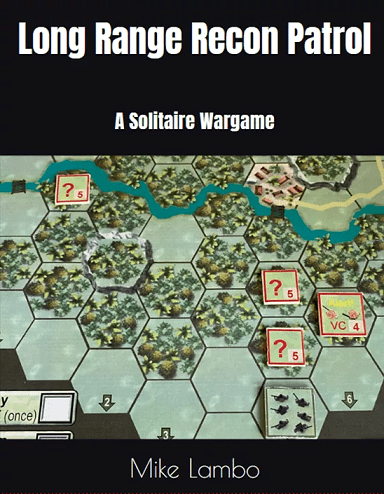
The entirety of Lambo’s catalog is available either in PDF format from Wargame Vault, or as a physical softcover book from Amazon. Long Range Recon Patrol is just as it looks, a no-frills basic production that is discernibly indie. In spirit, it’s most similar to the magazine wargames that are prevalent in the genre, although it’s more robust in content than typical of that format. It comes across as plucking one of those games from the pages of a zine, acknowledging that it’s effective and evocative enough to warrant recognition, and then giving it the treatment of a dedicated release.
This ruleset is approaching the DMZ between light and medium weight. It’s not complex and allows you to setup and push through a scenario in as little as 30-minutes, but it’s also a procedural game with a fair amount of referencing. This activity, combined with the necessity to print and cut out your own chits, pushes it slightly beyond introductory.
LRRP’s overall structure is a clever dice-based action system. You toss six standard dice and then spend each result to perform actions. A one or two can be expended to run two spaces. A pair of the same value allows you to move cautiously and avoid rolling on the dangerous jungle table. Twos or fours are used to perform recon actions and spot nearby foes, and threes or fives let you open up with your M16s, grenades, and M79s. You can also take cover, call in gunships and air strikes, even lay claymores in an adjacent hex. For how small the physical experience of play is – the book, a printed map, and some dice – there is an expansive list of actions here.
This dice system constricts choice and forces a constrained tactical decision space. If you’ve stumbled across a nearby North Vietnamese Army unit, you will likely want to hightail it out of there and put some distance between you. But without any ones or twos you may be stuck withdrawing at the pace of a wounded turtle. In very rare instances, you can’t move at all. The ethos behind this action system mimics that of titles such as Combat Commander or Tank Duel. You’re not free to do whatever you’d like, instead you’re given an assortment of options and then must devise a tactical approach in how to best utilize them. It can be a frustrating constraint to those wanting more freedom or finding this unrealistic. I’m actually quite enamored with this philosophy as it works well to simulate deficiencies in communication, as well as the vagaries of morale and exhaustion. At this level of abstraction, it feels appropriate while forcing creative play and also establishing an element of tension that is devilish.
Enhancing that tension is the outright menacing nature of the environment. Moving quickly through the jungle can harm your squad. Same with crossing a river unless you navigate to a bridge. There are event rolls at the end of each round which can turn everything upside down and lead to unexpected ambushes. Even the foes you confront are terrifying. While VC squads can be destroyed with relative ease, your conventional weaponry can’t outright vanquish NVA elements. The best you can hope for is to pin them or, if lucky, call in an airstrike and erase the threat. When you do receive damage, you must randomly determine which member of your six-person squad is wounded. This nullifies that team-member’s special ability, lowers your strength and overall effectiveness, and brings you closer to defeat.
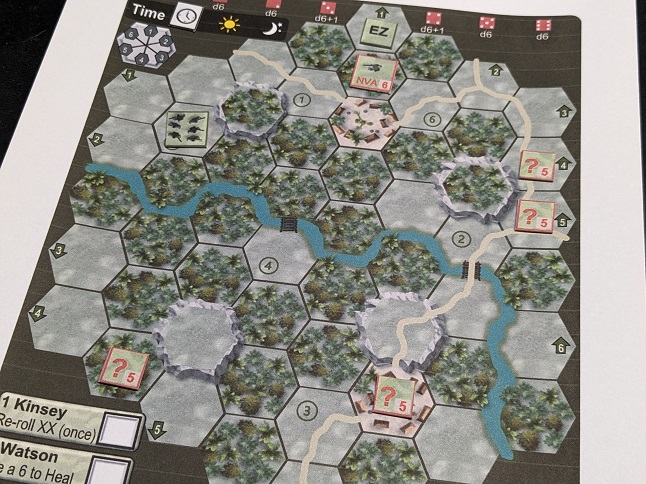
This inherent unpredictability is the heart of Lambo’s solitaire system. You’re utilizing a dice pool to perform actions, many of which you have to roll tests to accomplish, and either skirting or engaging unknown tokens, which may turn out to be an enemy unit or nothing at all. These tokens function as points of interest that randomly wander and often tie into the scenario’s objectives. They may spot you and reveal themselves during the enemy portion of the turn, but you are highly incentivized to aggressively recon and spot them first. In this case, they are more likely to be nothing when rolling to reveal their true nature.
The game grounds itself against this core concept of reconnaissance and captures its setting quite well. Due to the mission considerations, the dwindling of resources such as water and meds, and the sturdiness of NVA forces, you often are best served remaining mobile and avoiding contact. Getting bogged down can be death, as time is working against you and even a single casualty in your squad means failure. It can be a harrowing game at times, although variance occasionally shakes out highly in your favor resulting in a stark difficulty swing the opposite way. As I said earlier, above all else, it’s unpredictable.
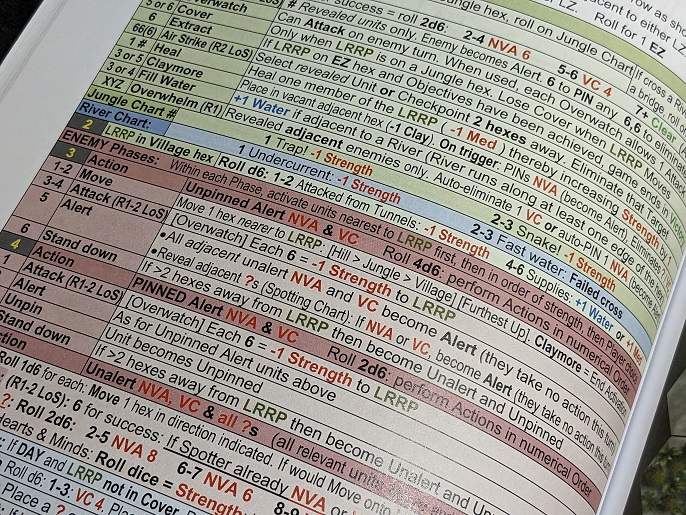
Despite the modest scope, LRRP manages a charitable amount of content. There are 10 scenarios, each distinct with various quirks. More importantly, each mission is a separate map. Paired with the map are all the necessary charts and the sequence of play. Most of this reference information is standard and doesn’t vary, but a couple of details such as the event chart offers new options to discover with each scenario.
This format of presenting the rules processes on one page and the scenario map flanking it, forms the focus of play. Your attention bounces between rolling dice while referencing system flow and the map holding the various chits and details. Some may find this unsatisfying, as you can find yourself heads down in resolution as opposed to always centered on the board and the tactical situation. It can vaguely feel like the modern crop of app-assisted games, such as Descent and Destinies, where your attention floats between two bearings. I found this quirk immaterial, however, as my overriding attention was framed around the game’s wonderful emergent narrative and chaotic battlefield. The rules detail was light enough that many actions were quickly internalized, and the game loop is logical and intuitive.
The strong qualities of manifesting story from seemingly nothing really carry the experience. Because of this quality, missions stand up to multiple plays as each session tumbles forward in unexpected ways. I’ve played the straightforward first scenario and everything has remained peaceful with only minor complications focused around gathering water and remaining hidden. I’ve also had grim encounters stumbling clumsily into NVA divisions that have pursued me deep within the jungle, ultimately surrounding my LRRP team and cutting us apart.
There are only so many moving parts in this restricted format and I don’t think many would continue to be astonished after a couple dozen plays, but it’s unequivocally impressive just how much juice Lambo has squeezed from this thing. Long Range Recon Patrol is the abounding zine game I unknowingly craved, and I hope to continue the tour for the foreseeable future, even if my streak of disastrous leadership doesn’t let up.
A review copy of the game was provided by the publisher.
If you enjoy what I’m doing and want to support my efforts, please consider dropping off a tip at my Ko-Fi or supporting me on Patreon.
 Player Elimination
Thanks for the great review. Much appreciated. Mike
LikeLiked by 1 person
Thank, Mike!
LikeLike
Reminds me of Victory Point Games in their good ol’ polybag days.
How is the enemy AI to run?
LikeLiked by 1 person
The enemy AI is simple. Alert VC/NVA activate on their turn by rolling four dice. Each 1-3 moves them one space towards you (ignore terrain), mid numbers attack, some numbers have them alert nearby units. If they’re far enough away they may go back a non-alerted status.
Non-alerted enemies and question marks wander around randomly.
Very quick to resolve and the game does not get bogged down here.
It’s mostly sneaking or being chased by NVA, with an occasional standing firefight.
LikeLiked by 1 person