
Bloodstones is the antithesis of modern production. Instead of heaps of miniatures, it has stacks of oblong tiles. Rather than thick mounted boards, it has silky cloth maps. Instead of vacuformed inserts and trays, it has soft bags emblazoned with faction symbols. Instead of an air of disposability, this Martin Wallace creation feels like an heirloom, something intended to exist outside of time and trend. It appeals to a classic ideal.
The gameplay follows suit. This is a fantasy area control game, but it’s not one which is expressly dynamic or energetic. It’s a methodical experience, one prefaced on spreading forces and control under the guise of logistics. Defenders withdrawing and cancelling a battle occurs nearly as often as actual bloodshed. It’s a weird game, one that is subtle.
This understated sensation draws me towards the game. Beyond the tasteful aesthetic, the setting itself is faint and almost formless. There is a description of the situation and factions in the beginning of the manual, but most will never read this excerpt. Most commonly, this design is engaged as a nearly abstract endeavor. The line art depictions of swordsmen, lizardmen, and dragons betrays an ethos similar to the portrayal of knights, bishops, and kings in Chess.
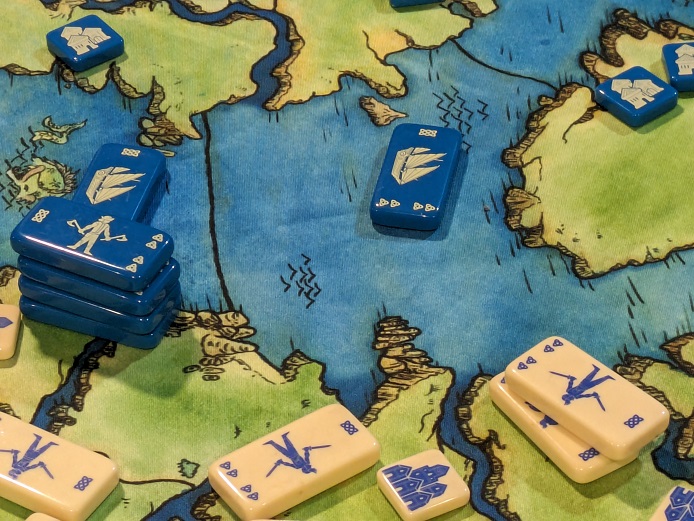
The asymmetry is also an extension of this philosophy. It’s real and effectual, but it’s not structurally radical. This is no Root when it comes to faction identity. Rather, factions typically have a meaningful distinction through units. The Hill Folk have a couple of formidable giants. The Dragon Riders have two dragons. The Necromancers can raise undead, although sparingly. The more significant impact is often less overt. The Corsairs, for instance, have more blank tiles than every other faction. These are powerful tiles which cannot be deployed to the board as units, but they can be substituted in as combat results conferring a huge bonus. The Horse Lords have two leader units and a hand of seven tiles instead of six. This allows them great flexibility, particularly in mobility.
This is the illusive experience Bloodstones is after. The first play may be rough, as one is still trying to tease out the implications of certain rules, much less the significance of smaller faction details. It’s entirely different than a CMON or Matagot troops on a map affair. It’s more plodding at times, certainly more difficult. But I’ve found it exceptionally rewarding.
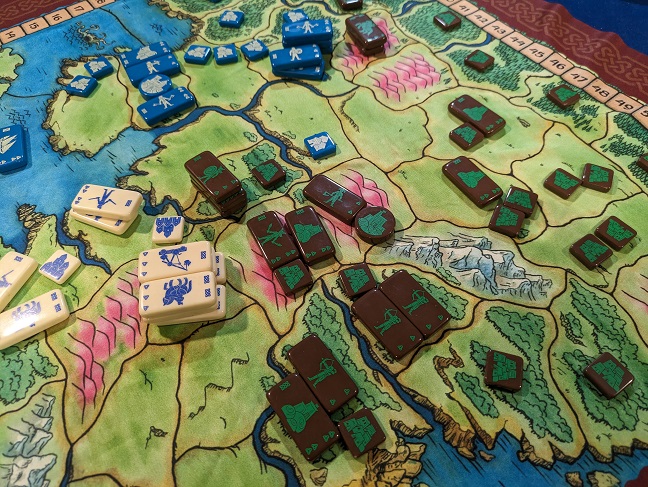
The backbone of Bloodstones is math. Like other Wallace designs, logistics is a primary focus as you must be thoughtful how you spread your forces and interact with the map. But it’s also sophisticated in its economic system. You don’t have various types of resources such as gold or coal. Instead, everything is parsed through the draw of tiles. They function similarly to multi-use cards. You deploy them to the map as units and pay their cost by discarding other tiles. You expend them to move around and reposition. They’re also spent to put down villages which are a major source of victory points.
How you think about and utilize these tiles is the foundation of play. You have a myriad of options, and every turn you can burn through and refill your entire hand. All costs are opportunity costs in this sense. This gives way to an analytical undertone that is based entirely on intuition. There’s no resource conversion or stockpiling a certain currency for a big spend later. It’s all turn by turn, in the moment, influenced by a confluence of board state, strategy, and instinct. I find this type of mathematical logic enthralling.
For one, it’s not a system where math begets math. There are no multi-step computations. Everything is direct, yet subtle in implication.
Combat exemplifies this. Each player draws three tiles from a bag, four if you have more units than the opponent. You then select your best three, with the option to substitute one of your personal tiles into the result set. The average draw has a value of 10, but you add your unit strength in the area being fought over to the total. This is all simple arithmetic that you can gently nudge, but there are hidden costs. One piece of fallout is that if the defender substitutes a tile, they will be one tile down on their next turn. This is because you refill your hand at the end of your turn, not an opponent’s. This is a cost that is obvious when scrutinized but the actual effect hard to completely assess.
The point scoring follows in lockstep, again presenting a simple mathematical structure that is subtle. Half of the game is scored through villages. Each of these square hamlets you’ve deployed to the map earns a single point. They are scored when your draw bag is empty, which occurs exactly twice per game. If you destroy opposing villages, you gain a single point as well, but only at game’s end.
The understated incentive here is that aggression is favored relatively early in the game. By denying your opponent a cycle of scoring, that village you’ve just raised has an increased point delta. This isn’t a huge swing, but it’s important.
Equally significant is the battle system. The victor in battle earns points equal to the number of units in the opposing army. This can be a large amount, particularly if players form large armies. But there’s a whole tactical system of unit flow here that easily evades newcomers. The defender can withdraw before battle if they possess more cavalry units than their opponent. Strong play results in the defender withdrawing with every single opportunity. It’s how you negate the strength of factions such as the Corsairs, and it’s an enormous element of point negation. There is also a hefty benefit in withdrawing in that it lets you reposition into terrain that would normally cost you many movement points. This system of attacking, withdrawing, and retreating at battle’s conclusion plays out like a dance of sorts. It’s the most dynamic aspect of play and spurs great consideration in positioning.
This whole effort can sound frustrating. When you engage it purposely, I find the system intellectually stimulating. It forces a different thought process than its peers, and furthermore deepens the identity of Bloodstones.
Despite my naked praise, I have strong reservations. This is a prickly affair. It’s rough on its players, not pushing participants into strong play nor providing obvious guidance. The mathematical foundation, while simple, is not something that’s immediately easy to interpret due to all of the odd rule flourishes.
I also am bothered by the most obtrusive faction in the game, the Chaos Horde. This warband of marauders changes the game significantly. They are more mobile and devastating than any other faction. They subvert the normal turn structure by destroying villages without the defending player having a turn to respond. They feel awful to play against.
It’s actually quite neat to have a faction that alters typical strategy so severely. However, the way the Chaos Horde influences play is unfortunate. They totally handicap a major scoring vector and halt the organic growth of the logistical expansion inherent to the design. More worrisome is that they often lead to a situation where their wrath is focused upon a single opposing nation, forcing that particular player to deal with a cancer in their empire while the rest of the table is free to engage the more enjoyable elements of the system. This is just awful in practice and is a real turnoff. It results in a poor dynamic that cannot easily be assuaged. The outcome is an entire faction that will likely not see future play at my table.
Another shortcoming is that the game is unbearable at higher player counts. Its worst qualities are accentuated, with play becoming sluggish and momentum all but dying. Three skilled participants can run the game to a satisfying conclusion in about 75 minutes. Adding even one more faction to the table can push that number up an additional hour. At five or six, Bloodstones is a non-starter. I can’t imagine anyone finding satisfaction with a full count, as the Chaos Horde further slows play due to altering the decision space so radically.
All of these quirks put this game in an uncomfortable position. I find it a brilliant design at its heart, and one I cherish with each play. But it’s an experience which is unreliable and difficult to speak of. I’ve seen it absolutely careen off a cliff like a flaming wagon ready to explode into a million splinters. You can’t blame the players in this instance, as the game does not manage to facilitate its best persona if you engage it with a large group or under the shadow of its malignant faction.
What’s stunning is that despite these large inefficiencies, I’m held captive by this work. There’s a coherence in this design that I find undeniably appealing. From form to strategy, it’s a unified creation that is refined. It operates under the same precepts as Wallace’s other area control efforts, namely A Few Acres of Snow and Mythotopia, without parroting their mechanisms. It also entirely avoids those game’s glaring problems.
There’s a sharp contrast with the excess of modern crowdfunded games. It’s a vibe that is relatively uncommon, at least in this style of design. The austere identity feels fresh and inventive. That heirloom quality I pointed out earlier is so pleasant and agreeable. I’d love to see more of this in the industry.
I am quick to point out that I do not write buyer’s guides, recommendations, or with the intent to influence consumption. I write about games to evaluate them as artistic achievements, and to analyze their influence on both hobby and culture. Bloodstones is a primary example of this approach, as I believe this game to offer a powerful experience, but I also am well-aware that it risks disaster as a purchase.
A review copy of the game was provided by the publisher.
If you enjoy what I’m doing and want to support my efforts, please consider dropping off a tip at my Ko-Fi or supporting me on Patreon.
 Player Elimination
Fantastic review Charlie. I wish I had space on my shelf to justify just having art, because it sounds like this game would fit wonderfully. As it is I’ll appreciate it vicariously through your artistic review!
LikeLiked by 1 person
Thanks!
That sounds like a smart move. I would never recommend buying a game just to have it, as they take up far too much space and this one is quite expensive.
LikeLike
Love the review. Agree with almost everything, especially the player count. We’ve found it great at 2P, and I’d recommend it at 3 and 4, but anything with 5+ probably doesn’t work unless you’re ready for a long night. I have not played with the Chaos Horde but have no desire to do so.
Once you factor in the setup, mechanics, and high quality of the components (including the cloth maps), this is one of the best games I’ve played in a long time.
LikeLiked by 1 person
i didn’t even mention how wonderfully simple the setup is. Great point.
LikeLike