
Arcs is vicious. That was the subject of part one in my ongoing discussion of Cole Wehrle’s latest work. This space oddity’s jagged edge extends beyond the base experience and into the thorny recesses of the campaign. Here, mechanical additions emerge from their stasis with alacrity, the particles of grand stories shed from their animation in brilliant waves that collide in spectacle. This big box expansion is dizzying as a concept, reminiscent in ambition to Kubrick and Homer. And by god, it manages something special. It manages something fundamental.
Part 2 – Arcs is an Epic
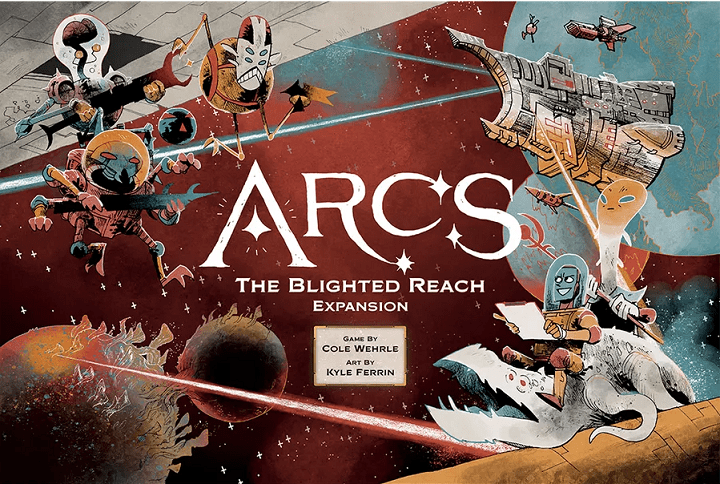
Arcs is The Blighted Reach Expansion. It’s the greater achievement that the mechanisms are in service to. It’s the divinity of the game, the experience that extends beyond play and exists as a happening on its own. It’s why I’ve spent more time thinking about this game than any other of the past few years.
Arcs, then, is about the creation of myth.
Let’s look at where it begins. First, there’s that enormous box. The contents initially are alien in nature. Many will have heard whispers that portend to what lies ahead, but much of it exists as potential. After a session or two the innards are only more luminous and alluring once you understand the possibility of their ambition. There is an intense curiosity surrounding what lunacy Wehrle has crafted and how the game will be upended when including a new Fate.
I believe this tease, the physical content locked away and waiting to be discovered, is often overlooked in analysis of the common campaign format of board games. There is a lack of concrete mystery when a game is constructed ad-hoc, such as generating a dungeon with random cards. When content is actually crafted and lives in a hard state, there exists a desire to uncover it. It’s the central magic of legacy games. A sheet of tokens or deck of cards is much more seductive when it’s sealed in something opaque and can only be opened when the game permits.
This is important in the case of Arcs because the relationship between player and game begins with that of wonder. It ignites a deep curiosity and fosters engagement with its audience. This is paramount for its storytelling approach.
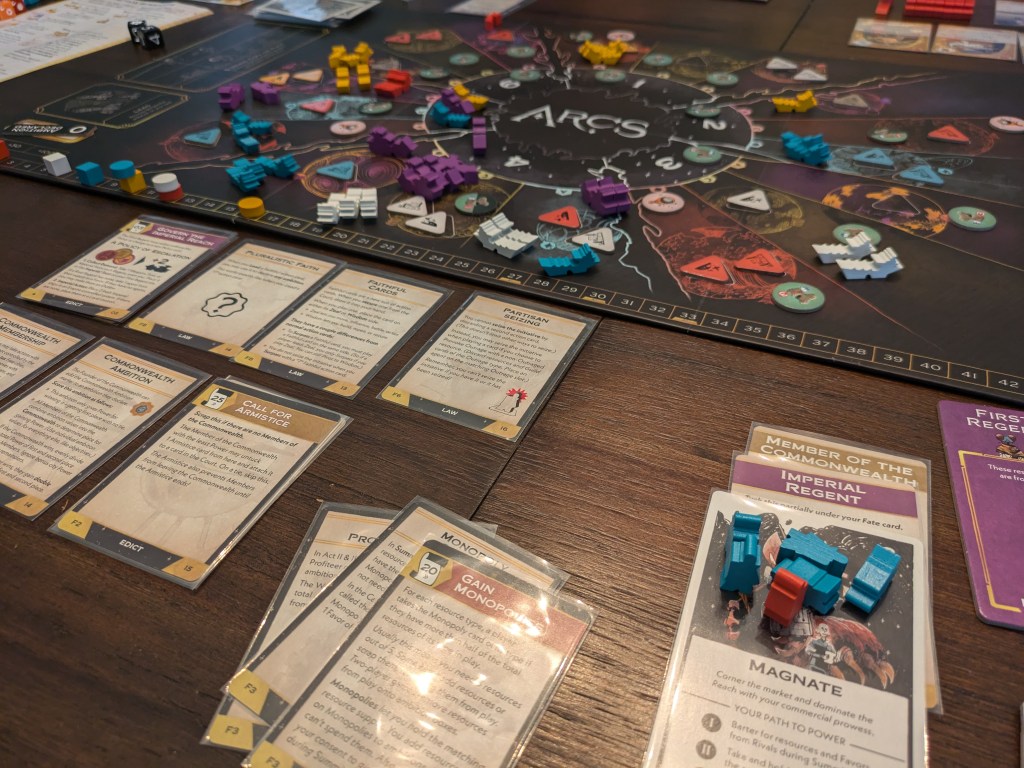
While the contents’ mysterious existence defines potential and helps to conceive amazement, the next step creates focus and narrows scope. Distinct roles, called Fates, are given to players who then advocate for them. These are prescribed mechanical and narrative instruments that frame the experience of play. This is true for the individual, but it’s also true for the group in that the assortment of selected Fates smash together in a beautiful and ugly mess to craft a unique game shape. How each individual session of The Blighted Reach forms and subsequently shakes out can be studied and ruminated on. There is a weight to this thing that is undeniable.
This, also, is where Arcs muddies the waters.
On the surface, this is a very mechanical experience. Many confess they don’t feel there is a strong or persistent narrative in play. This is because the game presents its concepts system-first, dumping large chunks of rules on participants, often just as the group has become comfortable with how things used to work. It’s also a consequence of the not-trick-taking action system. If Arcs were an RPG, it would be described as crunchy and mechanistic, not at all story-focused or narrative in approach.
Wehrle has already shown us the opposite side of the coin: Oath. That game is story-first as the reward cycle pushes narrativistic play. There is room for the story to emerge as the most stellar and dramatic moments arise during play. Arcs, for better or for worse, often hits you with the most compelling moments between sessions, when you’re grappling with how your Fate will change the fundamentals of play and reshape the game state.
That’s not to say there aren’t moments of grandeur in the midst of Arcs. The narrative can be outright astonishing. But it exists a layer below the systems, with the player’s engagement and thoughts often residing in that top layer as they try to figure out just what the hell is going on and how they can accomplish their myriad goals.
It would have benefitted greatly from a mechanism similar to Oath’s journal. When I really examine what happened in a session of Arcs post-play, the storylines emerge with just a touch of effort. It’s easy to pick out the implications of the Empire, how this or that Fate interacted with the Blight, and what the outcome of all of this means for the people of the Reach. There’s quite a bit going on there storywise, not just in what the game dictates in setup, but also in player decisions to vanquish worlds, eradicate disease, and scatter each other’s ashes into the void. A system to collect these thoughts into a formal retelling would have highlighted them in a way the game fails to. As an experiment, I tried this after our final session of our Blighted Reach campaign, and it was just as enlightening as I hoped. Try it yourself, you may be surprised.
I’ve been thinking a lot about Wehrle’s design philosophy. My perspective has partially changed due to the exceptional book Games: Agency as Art by C. Thi Nguyen. This was recommended to me by a reader, and I’ve found it fascinating, particularly in how it has reformed some of my thoughts and affected my outlook.
Arcs, really all of Wehrle’s games, demand a high degree of fluidity in agency. It wants players to temporarily adopt striving play, that is playing with an interest in winning for the sake of the struggle, while also desiring players assume a narrative agency, with the intent for participants to bounce between these two modes of play.
This was seen in Oath, and much of that game’s unique philosophy seems to have influenced Arcs. Arcs, however, has a more solid and formalized competitive base, which is why striving play is in fact necessary. Without the pursuit of competitive play, many of the game’s most interesting systems lose their meaning. The tension in declaring ambitions, finessing the action system, and seizing initiative all exist as a means of striving play.
The creation of fiction emerges as a result of those mechanisms. It only formulates as a narrative agency downstream of the striving play. It’s more difficult and much less meaningful to play Arcs as a narrative-forward design, unlike Oath, a game which virtually requires it to unlock its deeper secrets.
I think a greater satisfaction can emerge within the game’s narrative agency, however, as the most transformative and lasting facets of play exist as the story that emerges through a combination of design cues with player action. A valid criticism could be levied that these two philosophies are sometimes incoherent, one damaging or undercutting the other. It’s an issue the base game on its own does not display.
Arcs as a mechanical pursuit is exhilarating, but the looser framework of the campaign and its execution threatens that enjoyment. One symptom is that there are odd combinations and lopsided conflicts as a result of the Fates intermixing. This is why, I posit, that the real essence of Arcs is in the creation of myth.
The output of play is a crystallization of a societal narrative flush with phenomenon and prophecy. In a certain light, Arcs feels evolved as a storytelling device. There’s a definite artistic intention of sculpting the contours of the experience around this co-mingling of striving and narrative play. It combines the format of board game – a structured set of challenges to be overcome – with that of unstructured oral tradition. Oath did this first, but Oath feels raw and immature in comparison, as its reward system and incentives for striving play are much less substantial. You can see this in what Wehrle is offering in the upcoming Oath expansion. Many of the new elements seek to undergird and strengthen the evolving narrative with mechanical elements. Arcs doesn’t need this. Arcs already has it. Its only sin is that the narrative is obscured by the mechanical wizardry firing on the surface.
Storytelling is the foundation of human communication. It’s something Wehrle continues to express in a unique way, capturing this element of our nature through gameplay. As a work of art, Arcs is perhaps Cole’s most human design yet, offering a mature and elevated process of communicating myth. It can serve as a tool to better understand humanity and its inner workings. There is a sense of historical exploration as we dive into various archetypes that echo throughout eternity. The result, if you look for it, is an epic that rivals the great stories of deceased civilizations.
I’ve heard art described as a connector of the spiritual to the physical. This flits along at the forefront of my thought as I’m pushing dreadnaughts, casting dice, and running my finger along the edge of cards. I am absorbed in the aesthetic and engrossed in the many textures that collide to produce something recognizable yet personal.
That is what Arcs means to me. It’s what Cole Wehrle has delivered.
A review copy of the game was provided by the publisher.
If you enjoy what I’m doing and want to support my work, please consider dropping off a tip at my Ko-Fi or supporting me on Patreon.
 Player Elimination
So well put. This is now how I will describe Cole’s designs to others.
LikeLiked by 1 person