
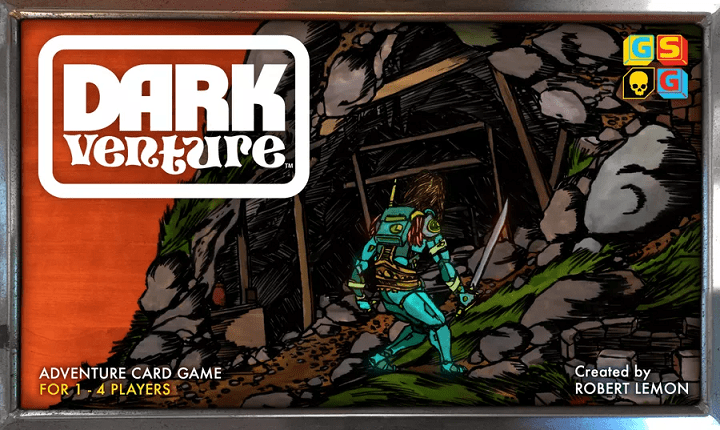
Dark Venture is a radical adventure game born of hallucination from one-man-band Rob Lemon. I prodded this quirky design in 2019, writing about it in my monthly Independent Shelf series in Tabletop Gaming Magazine. I found this artifact so becoming that I even included it on my 2019 games of the year list. Well, this little reprobate is back with a second edition accompanied by a wave of small expansions intended to broaden the game’s scope. I’m now going to pick at these, and I’m also going to reflect on this title and drop some lyrics regarding its extended existence.
If you’re unfamiliar with this thing, it’s a weird one. An indie adventure game loosely born of titles such as Runebound, Arkham Horror, and Talisman, it’s notable for its card-based board that unfurls and contorts as players place locations to the table and expand the map. It’s not just the board though – everything is found on cards. The player’s heroes, their foes, and the items wielded and worn by both. It’s fully competitive, with these oddball apocalyptic sci-fi loons pursuing personal objectives (more cards) while trying to scrap together equipment and supplies to endure the hell they wander through. It has this grungy yet inspiring relationship with choose-your-own-adventure novels as it provides a small booklet of narrative encounters for players to interact with when both deploying and entering locations.
The physical composition is enthralling, with Lemon’s illustrations raising the hairs that hide in the vulnerable places of the body. The experience is predicated on mostly mood. The systems function as a funnel with the detritus of die rolls and card draws shoveled into the maw that spits out the ground meat of emergent narrative. It’s wild, and it has to be as the resolution systems and processes found in the design would be labeled vexatious without the ambrosial output.
Let’s play this top-down and hit the new content first. Then, once we’ve worked our way through this gutter of sediment, I’ll fuse bone and mud and stone to compose a view of the composite.
Cue the waves of sonic horror.
The most petite of additions are The Alderkang and Beasts & Monsters. These are both accurately labeled “mini-expansion” and consist of two dozen cards and a couple of small punchboards with character standees and tokens. It’s easy to dismiss such content given its restrained scope, but I actually find both of these boxes to be excellent additions to the Dark Venture world.
The Alderkang is the most vibrant of the two, adding a boss-like foe as well as a cohort of minions. He presents an amplified challenge while lumbering about the map and recruiting goons to his entourage. One enticing element of this extension is that it folds in setting details from the sequel title, Dark Venture: Battle of the Ancients. That follow-up skirmish game is where the Alderkang first appeared and won players over. He’s a foul bastard who’s fallen from grace and seeks to reclaim his throne. When he does appear, it can significantly alter the tone by shifting priorities and causing players to skirt his presence. That type of impact is appreciated and a key draw of the expansion.
Beasts & Minions feels more astutely like a “more stuff” box. It adds new characters, some nifty items, and one of my favorite quests allowing you to play as a character beset with lycanthropy. That’s one of the strongest qualities uniting all of the Dark Venture expansion material – each set offers quests that are themed with their block of content and focus the game in various ways. Everything here is appropriately beast themed, and it allows for a neat addition that requires no creep in terms of rules overhead or strain.
Well, that’s mostly true. One quality in both of these boxes that is somewhat coarse is the new location content. The additional cards added to the location deck are interesting in their own right, and there’s absolutely no drop off in terms of writing and artistry. There is, however, an integration issue. The locations in the Dark Venture base game have you reference a story book found in the box. Vile Invaders, the first expansion launched alongside the game’s release, added new locations paired with its own narrative booklet. It’s just a tad cumbersome flipping between books and occasionally someone not spotting the iconography that points you towards the correct material. These new mini-expansions are even more awkward. Since the number of locations is very small, producing a booklet for each diminutive box doesn’t make sense. Instead, these sets come with cards that contain the narrative prompts and branching outcomes.
This is a bit of a hairy wart. You just keep the little stack of cards near the play area and might have to reference them once or twice per game. The experience feeds on variety and the new material cooks. However, I did find myself wondering whether siloing this content off into separate small boxes was the proper direction. I’m unconvinced there’s a non-zero number of Dark Venture fans who purchased one mini-expansion but not the other. It may have made more sense combining them into one larger set, possibly integrating the other material from this wave and collecting it all into another narrative book. At some point, too many booklets do become a problem. The cards are advantageous from the perspective of minimizing the footprint and storage. It just feels a little tacked on, like a new digit sewn gawkily askew onto your crusty palm.

The other expansions are larger. They’re still small of course from our current warped standards, but they drastically alter the core experience of Dark Venture, thus making sense why they’re isolated into individual boxes.
Khrag Pit Arena sounds totally bonkers but it’s the less warped of the two. This box adds a new arena location, a set of gladiatorial themed characters, and plenty of weaponry to draw each other’s alien blood. Of course there’s more quests framed around gladiatorial bouts and gathering pit fighting sundry to stimulate your sessions.
What’s most quirky here is that this expansion offers two ways to engage it. The first is a standalone gladiatorial gauntlet. You need components from the Dark Venture core box, but you don’t play the standard adventure game format. Instead, you battle your way through a conga line of foes with the ultimate goal of seizing the championship belt. It’s very kooky but only a little intriguing. I’ve found it somewhat flat as a holistic experience, continually craving the full Dark Venture mode of play in its absence.
There are some neat aspects to these pit fights, particularly around triggering encounter tokens as you navigate the arena. This is similar to one of the alternate modes of play in Dark Venture: Battle of the Ancients. The top-notch writing in these narrative snippets does much of the heavy lifting to make the arena experience worthwhile as even a distraction. Unfortunately, the combat system is a little too sleight and not dynamic enough to sustain an entire session, abbreviated as it is in this new mode.
I do find this content to be salvageable as a DLC-like insertion into the main Dark Venture game. The Khrag Pit can be added to the main deck and appear during play, just as any other location. Those who move to the arena then enter this mini gauntlet in the midst of the adventure. It’s oddly compelling to have one player zoom in on this micro-arena fight which is juxtaposed with the wider lens of external world exploration. As the would-be-gladiator is cracking eggmen and snapping the jaws of vile beasts, everyone else is pursuing their own goofy epics assembling artifacts or tossing peculiar arcana into portals.
Splendidly, it functions as a highlight when it appears, something to be noticed and reckoned with. Just as DLC commonly adds new areas to explore in games like Elden Ring or Borderlands, venturing forth into something new and mysterious is a special kind of fun. It’s also a pleasure to be the first one to slap it down on the table and then demand that others call you Maximus Decimus Meridius.

CRAWL! is the more absurd of the two larger expansions. I imagine most players will integrate this in its most simple format – by adding all of the new cards to their corresponding decks. You get new characters, items, locations, and quests. Boom, done.
The more maniacal – and perhaps masochistic – will utilize the crawl mode of play. Functionally, this is intended to mimic a dungeon crawl of sorts where you’re pushing into areas, battling creatures that appear, and ultimately facing off against a boss. This, again, draws inspiration from Battle of the Ancient’s adventure mode, placing encounter tokens down on location cards. The whole map begins revealed, built randomly from the deck at the beginning of play. Each location card them receives a random encounter token which dictates what enemies are drawn and what loot may be gained. These tokens are face-down, however, so you can’t be sure of what you will run into when crawling onward.
Here’s the word on my street: this format is not the best Dark Venture has to offer. It does culminate in a neat battle with The Ancient of Death Dhoreget Kelt, but to get there you need to wade through a legion of jank. Setup is quite onerous as you must separate components, remove cards, remember that some items no longer have their special ability, and implement several new rules. It’s a lot of pain for a playstyle that’s not any stronger than the standard experience. I tried this once, and as expected, it’s a novelty.
Full world exploration mode is even more ludicrous. This mashes crawl together with standard play and sets the goal as encountering every single location in the game. There are new rules for camping and a methodology for saving the game state in the midst of this extended session. It’s best thought of as epic Dark Venture, and it’s something maybe one percent of all players would have an interest in. Designer Rob Lemon indulging this sick fantasy is splendid on one hand and totally in line with the game’s punk credo, but it’s more of a test of will than a truly desirable commitment. It’s something that can be done more than should be done.
The far-flung methods of play in these boxes bring to mind the Dungeon Degenerates‘ expansion Grime & Gold at the Ghost Gate. This, similarly, created a zoomed-in fresh way to play the existing adventure game, but in doing so, it required players adapt imprecise new rules, component modifications, and an entirely new philosophy. That expansion didn’t work at all and was a real dud. Khrag Pit Arena and CRAWL! do work and provide some of the tendrils of vindication Dark Venture proper exhibits, but they’re just a little too far out there and require a great deal of buy-in. They stretch the game not only out of its comfort zone, but also out of its area of expertise.
Look, all of this material is strong when employed as content additions to the already varied base. That is where the majority of users will find satisfaction and how I will be using them. For the minority of sickos that get off on maladaptive gaming, have at it I suppose.
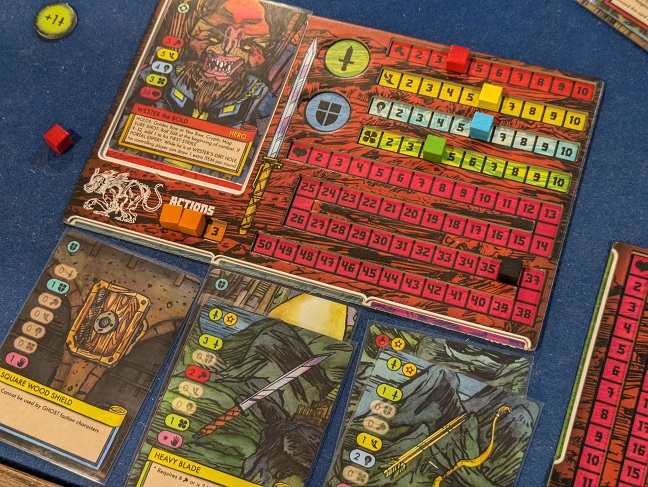
One of the benefits of this product dropping was the opportunity to return to this evocative game. Not only for players such as myself, but for Lemon as well. I have to admit, I do wish he went one step farther with the changes to the design.
While many little items were touched up or clarified, the most noticeable alterations speed up play. This is a proficient solitaire or low player count game, but the interactions and map development at three or four participants bring about a more dynamic experience, and it’s a little wilder for it. The second edition reduces the action points allotted each turn from three to two in these larger games, but it counteracts this by making item interactions free. This means you can change out your equipment or scoop up dropped loot without giving up momentum. Combine this with quicker atomized turns and the game moves at a stronger tempo. If you found Dark Venture sluggish it likely won’t change your opinion, but it is a meaningful bump that provides for a smoother round-to-round transition.
Everything else is mostly the same. This includes the game’s largest pain point: setting up new characters. This is the most clunky aspect of the game, as players can deploy new characters to the board during their turn. These function as obstacles or perhaps opportunities to interact with. They’re a strong way to elicit player interaction by indirectly authoring the game’s content and manipulating the environment. There are also dozens and dozens of really badass creatures and aliens, and you want to see them out and about doing their thing.
Every time you deploy a creature you have to pickup the equipment deck and find the starting items listed on the card. Then, after fishing out the items, you have to shuffle it and make sure it’s sufficiently randomized. This sucks. It’s an anchor that drags behind the speeding war rig and deadens velocity.
This second edition could have taken the opportunity to bake in weapon stats on character cards, perhaps retaining the old method for heroes or possibly removing them from the deck altogether. To maintain the flow of loot a number of item cards could have been drawn randomly as recompense for slaughtering your target.
I expect Lemon did not make this change for two reasons. The first is that it would have required a drastic redesign of nearly the entire character deck. That’s a ridiculous amount of effort for an already established game with a niche audience. The second reason is that having characters wield actual items creates a neat situation where the stronger the loot the more dangerous the foe. This is clever and it adds to the narrative and immersion, but I don’t think it’s a good enough reason in its own right. The combination of the two does make for a tough obstacle.
Beyond that one appreciable change and one overlooked opportunity, there’s not much else to pivot on. My opinion of this design has not wavered in the past five years. Dark Venture is still a clunky indie cut that requires a high degree of administration, but it also approaches the adventure game genre from a peculiar perspective. It’s a host to artistic vision, and playing this wild thing is a delightful experience of authoring bizarre narrative. It belongs in the counter-culture catalog alongside Cave Evil, Shadows of Malice, and Cryptic Explorers. The game design here isn’t impeccable or paradigm shifting, but it’s idealistic and freethinking. While I may give more leeway in a radical design such as this, the mechanisms on offer are interesting and compelling. Combat is clearly the weakest link as it’s a rote attritional exercise, but all of the card work and world authorship are top-notch, besting more mainstream designs in creativity and distinctiveness.
I do find myself appreciating the sequel Dark Venture: Battle of the Ancients more than this original release, and by a margin of at least one standard deviation. I find the follow-up even more imaginative in how it flirts with adventure-game elements in the framework of a multi-player skirmish endeavor. That sister-title is also less sprawling in terms of rules and components, making for a less cumbersome play. But they are different enough to warrant engaging both. This second edition of Dark Venture made a strong case for its continued existence, and the totality of additional content widens the narrative scope and unpredictability in a suitable way.
Dark Venture is a game full of charisma. It’s wild and excessive and a bit of a mess. Yet, it’s the type of mess that I want to belly-flop into, scattering rubbish far afield in protest to everything rigid and sober. It’s comforting to know that jumble of mayhem is sitting there, eagerly awaiting the next adventure.
A review copy of the game was provided by the publisher.
If you enjoy what I’m doing and want to support my work, please consider dropping off a tip at my Ko-Fi or supporting me on Patreon.
 Player Elimination
Well this is right up my street. Indie designer, crazy cool setting, everything card based (small box, small footprint). Ended up ordering it off the back of this review (just hope the fiddliness doesn’t grate so much it remains on the shelf). Thanks for the review Charlie.
LikeLiked by 1 person
Thanks for reading Greg. I hope you enjoy it and don’t regret buying it.
LikeLike
Totally agree with this review. It’s a hot mess of a game, but what a wonderful and unforgettable hot mess indeed!
LikeLiked by 1 person
Thanks for reading/commenting, Ken!
LikeLike