
Tidal Blades 2: Rise of the Unfolders is a grand campaign adventure game with the same genealogy as Kinfire Chronicles, Oathsworn, and Descent: Legends of the Dark. This type of game has really taken off in the crowdfunding space and we owe much of it to the success of Gloomhaven. New titles spring into existence like mogwai popping from the back of that enormous box. It’s past midnight you say? No worries. Cram down a salisbury steak, baby; a new campaign is firing up on the platforms.
Primal: The Awakening, pop. Tales from the Red Dragon Inn, pop. Roll Player Adventures and The Isofarian Guard. Pop pop.
It’s nearly impossible to really distinguish yourself in this environment.
Yet, Tidal Blades 2 is a smooth-as-can-be design that is crafted exceptionally well. In a less crowded field, this game would be crushing it. Instead, it’s fighting tooth and nail for an inch of spotlight.
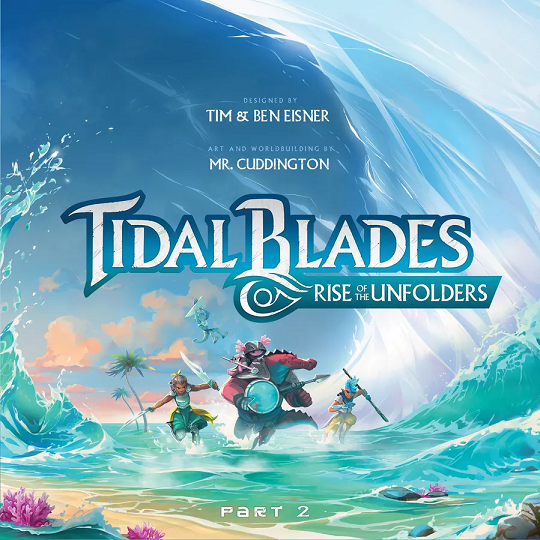
Tidal Blades 2 is something different than Tidal Blades. That original design was a competitive worker placement game that did some funky stuff with dice. Rise of the Unfolders is a cooperative adventure game with a nearly-20 session campaign. It’s scenario based, with each mission emerging from a character-focused grand narrative. The actual framework of play lives in the gray area between skirmish and dungeon crawler, presenting challenging conflicts with many twists and turns.
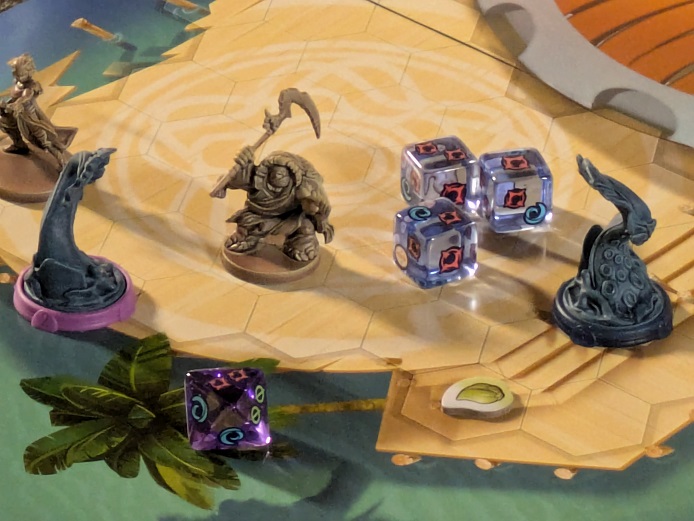
The primary draw of this sequel is the setting. Originally established in Tidal Blades: Heroes of the Reef, the world is bright and vivid. It looks like a Pixar film has jumped from the screen and onto the tabletop. This is evident in the cover and graphic design across the nearly overwhelming sprawl of components and tokens, but it’s most strongly displayed in the game’s multiple spiral-bound map books. Yes, multiple. The game’s most intriguing quality is that it doesn’t use a foldout booklet for each scenario, but that it uses two or three set adjacent to each other.
This is incredibly neat. It allows for designers Tim and Ben Eisner to compose odd environments with unique contours. One of the three booklets is smaller in size than the others, which farther supports this creativity with unique shapes and structure. Even better, as each scenario progresses, the map often changes. This can be due to entering a new portion of the board or triggering an unexpected event. It feels somewhat responsive, with the shifting landscape being a focal point for the story itself. I’ve seen similar games load content without revealing it or wait to procedurally generate the details of a room, but this design actually has you flip to new pages in one of the map books mid-game, which radically changes the board with entirely new artwork and mechanical details. It feels evolved and unrestrained in scope.
Look, usually I build up a review and lay a foundation before navigating through various aspects and weaving together a coherent essay that represents my thoughts and key observations. Typically, I try to structure such a thing with a climax where I pull together all the pieces and hit hard on what the game is and what it’s about. I’m just cutting right to it with this one: Tidal Blades 2: Rise of the Unfolders is about its world. The unusual utilization of environment and board is the special quality, one which extends from the setting and places it centralized before you. At its best moments, it’s magnificent.
While I would argue the map and scenario writing is stellar, the prescribed narrative surrounding it is best described as solid. It’s certainly worth reading aloud to the group to set the tone and develop characters, but it’s second chair to much of everything else going on and more in line with the broader movement of story-driven campaign board games. You typically won’t remember the words between the action, but you will remember that time when you flipped the book to a new page mid-mission and that big thing happened. The power isn’t in the scratches or scribbles on the page, but in the characters and foes dancing across the colorful world and lighting it afire.
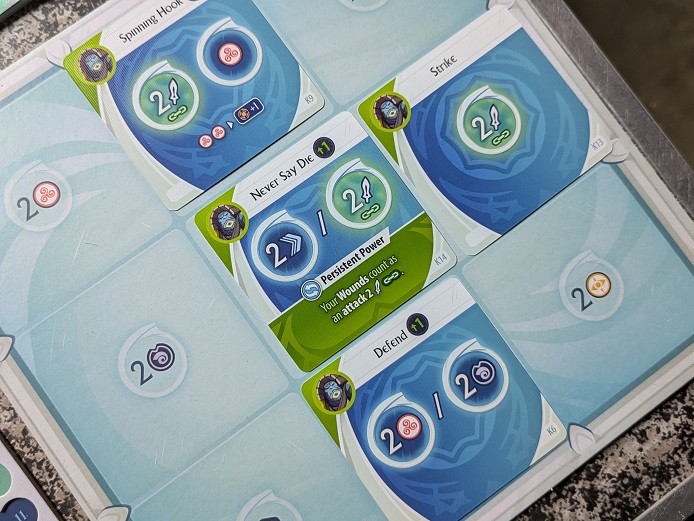
The core mechanical engine is an action card chaining system. It’s grid-based, where each player selects a card from their hand for the round, and then later places it onto their personal nexus. Once placed, you can then perform every action listed on the card, as well as every other action in either the row or column it was placed. This is similar to the central mechanism of Monumental, a clumsy game that was ultimately unimpressive. I was pleased to see the one enticing aspect of that design utilized here, particularly in a more successful manner.
What’s promising about this system is that it harnesses the momentum of engine-building Euro-games to fuel action on the table. Character potential grows with each successive card and the impact of each turn builds upon the last. Eventually you fill a row or column and the contents are discarded in a flurry of activity. This creates a cyclical feeling of powering up to unleash fury, an emotional and physical outburst reminiscent of fighting games and the super bar.
The best quality of this mechanism is the escalating tempo. You’re afforded a great deal of agency in sculpting your ability and setting yourself up for impactful turns. There’s a timing element here that works well, allowing you to slow-roll activity until the board state aligns and you can unleash the full scale of your authority. This fits harmoniously with the subject matter and supplements the action in a vibrant way.
However, I am somewhat wavering on how strongly affecting this system is. The synergy and action interleaving is slick and finely tuned. But, oddly, the payout from the engine is not altogether stunning. Most of this is due to the cards themselves. These are the inputs that fuel the combat maneuvering. The action library is almost entirely just movement and attack action points, with a healthy support of resource attainment. Only occasionally does a card have text and rarely legitimately wild considerations. It feels purposely restrained, as if the design duo was concerned things could become unhinged and go off the rails.
This is in contrast to a game like Fateforge. That dice-based title utilizes the core engine of Gordon Calleja’s Vengeance as the propellant for a cooperative fantasy adventure game similar in scope to Rise of the Unfolders. Fateforge does start off somewhat reticent with its dice recipes used to perform special maneuvers, but it slowly builds up the player’s repertoire of abilities and leads to a strong payout in terms of cinematic dynamism. Later in the campaign you have many options, some extremely strong and unique.
Tidal Blades 2 does offer character growth with new abilities and cards – and it’s a gratifying system in a number of ways – but even with a large amount of experience and improvement, the card system never approaches a feeling of daring or unbridled impulse. There is a streamlined nature that can be appreciated from a certain perspective, and it consequently frames the experience around the world, the map, and the evolving narrative. The card system is simply a shade too monochrome to really provoke a strong affection.
As I said, the card system – even if it’s not as dramatic as I’d prefer – is well calibrated. In fact, this game as a whole is finely tuned. It’s a worthy follow-up title to Druid City Games’ excellent Wonderland‘s War, one of my top titles of 2022. In that review, I commented on how it felt intensely modern. It’s a game that’s very aware of the design craft, modern trends, and where current expectations lie. Tidal Blades 2 builds upon this wisdom and takes it all a step farther.
This is such a multi-faceted, consumer friendly work. It allows for solitaire play, not just multi-handed but with a bespoke system. There is difficulty scaling by both choice and in response to scenario outcomes. Sessions are full and epic while not taking more than an hour or two of your time. Subsystems are introduced over the course of the campaign to ease players in. The structured narrative can be read from the book, or you can grab the foreteller files and crank up the audio narration. The game presents itself as world-first, but there is a great deal of respect for system throughout the game, including the thoughtful nexus grid, meaningful and rapid character development, and an interesting resource system where block tokens shift to energy you can spend on abilities. Asymmetry is high, yet everything is fluid and clear on your character sheets. The absolutely beautiful miniatures set is optional, allowing for a lower buy-in for those fine with standees. It keeps going. The game ticks every box in the current market, with each of these vectors fully fleshed out and not merely tacked on. As soon you raise your voice to object on a specific detail, the Eisners speak up and head off your objection.
There is just a great deal of effort here. I can zoom in and analyze any specific aspect of the game and there is plenty to talk about – such as the branching development options with your character and how the Gloomhaven-esque micro-goals fuel interesting meta-decisions. Or how about the sophisticated town phase and how it weaves together world building with important interspace character enhancement.
With that being said, this is a game with a lot going on. The setting itself may belie the fact that this is not a streamlined or straightforward affair. There are multiple tracks on a player sheet, the card system requires some consideration, enemies have individual decks of cards and require the tracking of their health on a separate component. There are a ton of tokens and bits and various things to organize. It’s certainly not as heavy as the largest hitters in the genre, but it’s not a family weight title.

The legacy of Tidal Blades 2: Rise of the Unfolders will be that it has established Druid City Games as the equivalent of a AAA studio. That’s one of the main thoughts that’s stuck with me throughout my journey with this game. Minor quibbles with the lack of a native insert aside, this game is a behemoth of a concept from top to bottom. This publisher has established that their games have the next gen graphics, they have the attention to detail, and they have the big narrative swings to leave an emotional impact. Everything feels very tightly coordinated and carefully placed. Despite the fact that this is not a large company, they are absolutely in the business of making large games in terms of scope and impact.
To be clear, I would not say that this is my favorite campaign game, not in a world that has titans such as Maladum and Battlestations. But I would say that this is a defining title that reiterates the success of Wonderland’s War and highlights how this team has a deep understanding of the industry. Tidal Blades 2: Rise of the Unfolders is a lovely game. And it’s one that will persist, if not with widespread acclaim, then with a fervent cult following.
A review copy of the game was provided by the publisher.
If you enjoy what I’m doing and want to support my work, please consider dropping off a tip at my Ko-Fi or supporting me on Patreon.
 Player Elimination
2 comments for “Steadfast Vibrancy – A Tidal Blades 2: Rise of the Unfolders Review”