
“And deep down in your heart, you know we never should’ve left the island.” – John Locke
I have a difficult time recalling 2012. With particles floating through the air and crumbling upon close inspection, it all feels like an out of focus dream. What I do remember is that this was one of the finest years in tabletop gaming. Android: Netrunner, X-Wing, Spartacus, Pax Porfiriana, Wiz-War 8th Edition, and so many more. Including Ignacy Trzewiczek’s finest effort, Robinson Crusoe: Adventures on the Cursed Island.
I remember the excitement of pre-ordering this game and its eventual arrival. The box seemed enormous at the time. Word of mouth was intense with a tremendous amount of jubilance on the back of convention season. I also remember dedicating myself wholly to the game. It wasn’t a choice. If you wanted to understand and actually play it, you were required to consult various online forums and FAQs. That original rulebook is infamous for being one of the worst. This reputation is earned and fair. The fact that Robinson Crusoe endured and made it all the way to a 2024 collector’s edition is testament to the treasure buried beneath the loam of byzantine phrasing and incomprehensible language.

Robinson Crusoe is influential for being among the first wave of hybrid board games. It helped naturalize the melding of Euro and Ameritrash design principles to elevate and support the various systems woven throughout the game. It’s an experience that expressly utilizes resource management, risk optimization, and action efficiency as a driving foundation for narrative storytelling. The setting is rich and actualized. So are the mechanisms. Neither sphere of the experience is subservient to the other. They work in unison.
I was eager to return to this design as I made the grave mistake of trading it away many years ago. Despite the cryptic original rules, I was surprised to find that I retained many of the game’s finer details. I suppose the rapture of the island is something that can’t be easily untethered.
Regardless of this revelation, falling back into Robinson Crusoe was elementary. This is due primarily to the Collector’s Edition being a marvelous composition. The rulebook is wonderful. It’s clear, not overly verbose, and laid out extremely well. It’s almost potent enough to erase the nightmares of our youth and the struggle that was RC 2012. And if the text doesn’t jive with your brain, there’s an all-new tutorial that runs players through an abbreviated learning game. This process is a significant addition. It includes a dedicated booklet and pre-organized selection of cards to facilitate a first date. I found this unnecessary for my own requirements, but I did work through the guide to gain familiarity and understand the benefit of its existence.
I think both of these qualities – an enhanced rulebook and bespoke tutorial – speak to the completeness of this new edition. They lay the groundwork for a strong first impression and form the spine for the rest of the material to branch off of. The scenarios are cleaned up and include a couple of previous promo entries. The components are nifty with shaped resource tokens and optional miniatures to replace the character discs. Unfortunately, the figures do border on being a usability problem. A core mechanism requires stacking action discs to denote who is the primary actor and who is supporting, but base rings are supplied as a fiddly solution to this dilemma. It’s not ideal but it’s workable. The miniatures do look rather nice in play.
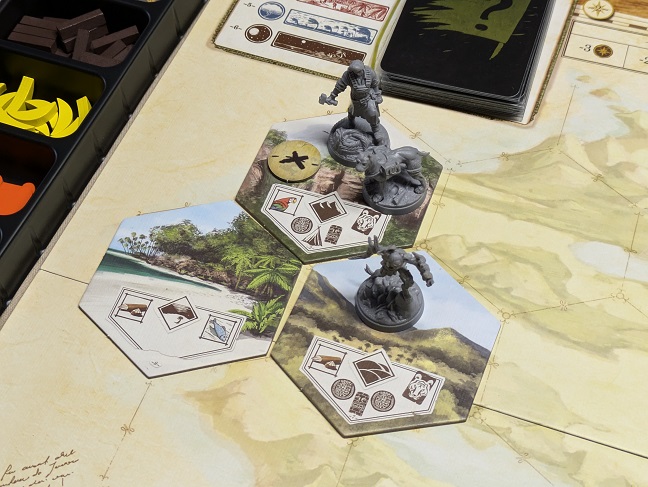
The quality of product is met by the superlative gameplay. Robinson Crusoe is a banger, even in 2025. The worker placement inspired action point system is a clever way to physically orient cooperative planning. The survival mechanisms – including granularity of shelter, invention of tools, and the bleakness of weather – all work in concert to fuel an experience that reflects brutality with moments of inspiration. It blends many fundamental elements of endurance with unique scenarios that really push the system in interesting directions. This is where the creativity of the game is most evident, and these scenarios often come to life with climactic finales and fantastic twists.
The action point system is surprisingly natural. You place your two pawns on various spaces of the board to explore the island, gather resources like food or wood, or build elements of your shelter. You can craft inventions like fire, rope, and a knife. You can hunt wild beasts for their meat and fur. There are so many options, and you want to do them all. The clock is ticking, as you have a set number of turns to complete the scenario. Additional pressure is constant due to the terrible effects of weather and starvation and morale.
There’s an enormous amount of goodness here. Yet, the most admirable quality is how it handles consequence. There are three decks of adventure cards that map to specific actions in the game. You occasionally have to draw these and resolve them. They’re pretty bog standard in terms of event cards that cause complications, pain, and occasionally glimpses of magic. That last bit is where we need to focus.
A portion of the cards offer a tempting choice. Maybe you find some shady looking fruit growing on a mutated tree. You could eat it to stave off your hunger, but it might later cause internal bleeding. Or perhaps you can jury rig a roof onto your structure with that load of wood that just washed ashore. Unfortunately, it’s heavily rotted and is likely to collapse when the next snowstorm hits.
These cards offer an immediate boon, but as a cost they are shuffled into a central event deck that is drawn from each round. This means they’re bombs ticking away; the destruction of your internal organs or makeshift hovel quickly approaches. It’s a fateful decision with the ensuing consequence expressed through a focused mechanism. While easy to overlook in the grand scheme of the game, these are some of the most defining narrative moments. They’re also the most cogent articulation of theme.
Theme, not setting, typically has two parts. There is an answer and an outcome. One of my favorite films is Sam Peckinpah’s The Wild Bunch. I’m hesitant to partially spoil a 56-year-old movie, but one of its themes could be identified as choosing to die alongside your friends in an act of defiance is the highest form of loyalty. There are of course other themes in the film as this is just one poignant distillation among several motifs.
The adventure cards and their decision-and-consequence transparency are fiery igniters for such statements of theme. They provide moments of storytelling that often parallel and comment upon the greater happenings within a scenario, highlighting hubris and the immediacy of life and death decision making. And what they most brilliantly do is cause reflection upon agency and how the narrative emerges from player action. These micro decisions happen across the field of many such games. Yet infrequently do we have the clarity of relationship between agency and consequence as presented here.
I also find myself attracted to the parallel here between this potent mechanism and the Adam and Eve creation myth. There are emotional beats here drowned in the games subject of temptation and consequence that speak to my religious upbringing. This sensation is likewise reflected in the biblical barbarism found in the game. There is a wave of constant suffering and impossible decision after impossible decision. This Old Testament ruthlessness consequently infuses success with meaning. It’s the equal and opposite reaction of the challenges faced.

While I mentioned that the new rulebook is a measurable improvement over the original text, there’s something more to this. Robinson Crusoe was a heavy and complex game in 2012. One of the most arduous. That’s not the case in 2025. Mark Bigney of the So Very Wrong About Games podcast first commented upon this phenomenon when discussing Race for the Galaxy in a recent episode. Over time, the accepted standard of complexity has markedly increased. Robinson Crusoe was perceived as demanding and incredibly dense. With the passing of time and the collective hobby’s advancement, it’s merely a mechanically loaded mid-weight title. It’s a two-to-three-hour game that now boasts dozens and dozens of peers. There is no ludic equivalent to the Overton Window, but if there was, it certainly has shifted over the past decade.
This shift in acceptable game weight clearly has a benefit, but there is also a notable downside. I’m speaking of the risk in alienating newcomers to the hobby. More than once I have made the mistake of stating a game or ruleset as “straightforward”. That may indeed be the case when operating in the circle of experienced players, it’s not at all true when approaching gamers whose preferences are more mainstream. Look, Wingspan is not a suitable game for people that are used to Uno or Taboo. We must all be careful in not becoming too comfortable with this apparent shift in standards and be fully aware of the context we operate within.
All of this is fascinating, particularly when reflecting on 2012 and how Robinson Crusoe landed. It has me considering whether other such casualties of the time exist. Part of the trouble with this specific game is that it was perhaps the first heavy cooperative design. This elicits a certain playstyle and approach; one the wider gaming public may not have been fully ready for. Hell, I’m not sure Ignacy and whoever authored that first rules text was ready for it.
That’s completely changed. This new edition is sharpened, honed, and impervious. The only quibble I have with this product is that it’s seemingly incomplete. That’s not to say that the game is insufficient or missing a necessity for play, but it feels just a touch light in terms of presenting itself as a definitive Collector’s Edition. What I’m saying is that the new Book of Adventures feels less an expansion, and more a piece of this new set that’s been pulled out and presented as a separate product. Admittedly, that feeling of incompleteness is something that really only materializes once you’ve seen this expansion and realized how much it adds to the life of the game.

This is one of the best expansions ever crafted. Over the past few years I’ve grown cynical when it comes to aftermarket extensions, especially in the era of crowdfunding. The majority do not really improve the core experience, instead bolting on cruft such as new sideboards or decks which increase administration but do not increase enjoyment. I mentioned in my review of Cosmic Frog’s Find Muck expansion that often, the most significant benefit of producing a new addition to a game is bringing it back into the spotlight. Expansions serve to reignite passion in a time where hobbyists have a plethora of competing titles on their shelf.
But the Book of Adventures offers true utility. It’s simply a spiral bound book full of scenarios. It collects many fan-made creations, such as those found in the Treasure Chest expansion, alongside a bevy of content that was previously only available through promos and special one-off acquisitions. This trait of scattered content and promo hunting has been a frustration, but that’s no longer the case.
In addition to collecting all of these scenarios in one usable booklet, it also presents many altered setups of existing content. The goal is to allow for you to tweak the difficulty level of the game by tackling either a more challenging or easier configuration. This is useful, albeit in a somewhat limited nature. While I doubt this was a conscious tradeoff, skeptics may protest that this duplication of content takes up precious space that could have been dedicated to additional scenario options. There is some credence here, particularly when you consider that the game already boasted a solid number of difficulty adjustment options. Frankly, it’s now one of the best in class in allowing players to manipulate the challenge of play.
One unfortunate aspect of this expansion booklet is that it’s not as refined as the Collector’s Edition box. Robinson Crusoe has stood the test of time and has benefitted from hindsight, post-release development, and a loving dedication. As a more recent release, the Book of Adventures is less mature and holds some quirks which may bring players back to the early days of this game. A couple of the scenarios have typos or misprints, and language can occasionally be unclear. While this is unfortunate, it doesn’t undercut the overall strength of this expansion and its success.
Robinson Crusoe is undoubtedly a classic. It’s one of the best cooperative adventure games in existence, and it succeeds in transforming player agency into nuanced thematic storytelling. The Collector’s Edition combines with the Book of Adventures to form an expansive release that properly elevates the design and ushers it into a modern era. I will not make the same mistake twice, as I do not see this game leaving my collection ever again.
A review copy of the game was provided by the publisher.
If you enjoy what I’m doing and want to support my work, please consider dropping off a tip at my Ko-Fi or supporting me on Patreon.
 Player Elimination
Great analysis and observations, as always. I owned a copy of this for a few years (received it from our own Nate Owens, in fact) and I agree with much of what you say: It was daunting in presentation. The rulebook was questionable. The difficulty level was considerable… and it’s that last point that proved the death knell in our household. I was playing with my then-new girlfriend who was an experienced gamer and she lost interest, not because it was THAT complicated, but because the complication on top of the fact that we regularly failed without even making what seemed to be decent progress simply gave it the most horrible label of any game: Not fun. Who wants to set up this sprawling game in which you’re dead or seem to have little hope of making progress, five turns in? And in which the rulebook that you’d think would have some paths toward that hope presenting nothing at all?
Like you, I ended up trading it away and really have no regrets about having done so. Co-ops have to meet a high bar around here, anyway, and those that are more puzzle-solvers like Crusoe have an even steeper climb. While I appreciate that there are difficulty adjustments now, your suggestion that the Book of Adventures is largely comprised of those adjustments or variations isn’t enticing to me. I recently tried a crowdfunding product in the form of Peacemakers: Horrors of War. It took all of three plays for me to put it on the trade block because not only was the gameplay wholly mechanical (optimize your conditions and then play cards to solve it) and unthematic, but once you’d played through the eight scenarios, the only replay possibility was ramping up the difficulty (“Win the scenario with zero casualties!”) Again, that kind of puzzle-solving is appealing to many. Just not me. I’m afraid that Crusoe would fall into a similar personal divot, despite you mentioning that the Book of Adventures presents more actual content, aside from simply ramping up the toughness of the puzzle.
LikeLiked by 1 person
Yeah, I wouldn’t recommend you give this another shot if you didn’t find the combination of narrative and puzzle solving to be compelling.
I do think the difficulty aspect is wholly solved though. I introduced two new players just this past week and we did a scenario on the easiest difficulty, allowing for us to win somewhat handily. There were a couple of moments where I wasn’t sure if we would make it, but we pulled through without too much trouble.
Personally, I want my coops very difficult (30-40% win rate), so I prefer this one on its standard difficulty level, but I really appreciate the ways to configure it.
LikeLike
Awesome article as always. Thanks, Charlie!
I got back into Robinson Crusoe last year, mostly as a solo experience. I really enjoyed it (again) for a while and definitely encourage people check it out. I hear that designer Ignacy Trzewiczek comes from TTRPGs, which shows: not only is the theme unique and gorgeously expressed, this game is masterful at creating a “procedural GM” that tells an engaging story while creating problems to solve. It’s a compelling world to return to, one of my favorite board games, and if it can be played at easy difficulty, I bet it’s an excellent gateway for newer gamers.
My enthusiasm ran out eventually due to:
Again – if you’re on the fence, definitely try this game out! It’s both a great game experience and an interesting design artifact.
LikeLiked by 1 person
Interesting observations, appreciate the insight Randy. I do agree that it’s very swingy, certain events or weather rolls can really throw things awry. This hasn’t bothered me, however, as these elements can often really enhance the storytelling, even in a worst case when it results in your defeat.
The samey-ness hasn’t hit me yet, at least not more so than any other coop. I’ve played it only seven times over the past month and a half (a couple of times solo and a few multiplayer). I can totally understand someone feeling this way, however.
I haven’t played the Livingston scenario yet. I think Ignacy has said it’s his favorite and I’m determined to play it soon.
LikeLike
I also bought the original game back in 2013, and found it very complex, although enjoyable. When I re-bought it a couple years ago, it felt like a medium-weight and quite fast game, both for me and for less experienced players. This growth of board gaming “literacy” is fascinating indeed.
Design-wise, the only thing that bugs me is that in the choice “get reward now, suffer consequences later”, rejecting the reward has more utility _in the long term_, but also is more boring and severs players from the procedural narrative ameritrash part. Thus players are mechanically incentivized to make the game more boring for them. I would prefer if players would have to accept immediate or delayed negative consequences for long-term growth that would pay off in the future.
LikeLiked by 1 person
I sometimes play where I don’t look at the consequences, instead just assessing the benefit with an unknown risk. I actually really like to play this way, although the bulk of my sessions do not utilize this house rule as most players dislike this element of risk and the increased difficulty.
LikeLike
I often take the risky approach. The way the “bad consequence” cards pack the Event deck means that there’s a decent chance they don’t ever come back around, or (like in the example Charlie shows), you can mitigate it by (for example) making sure you have medicine before you draw it.
LikeLike