
Cyclades‘ release in 2009 was a watershed moment. Alongside Chaos in the Old World, it was responsible for the conception of the hybrid design, blending together elements of Ameritrash and classic Euro principles. The hybrid movement is one of the most important developments in modern board gaming. It irrefutably influenced the hobby, resulting in contemporary design conventions that have virtually eliminated the boundaries between the classic Euro and Ameritrash genres. Categorically, there are no hybrids anymore. Practically, everything is a hybrid.
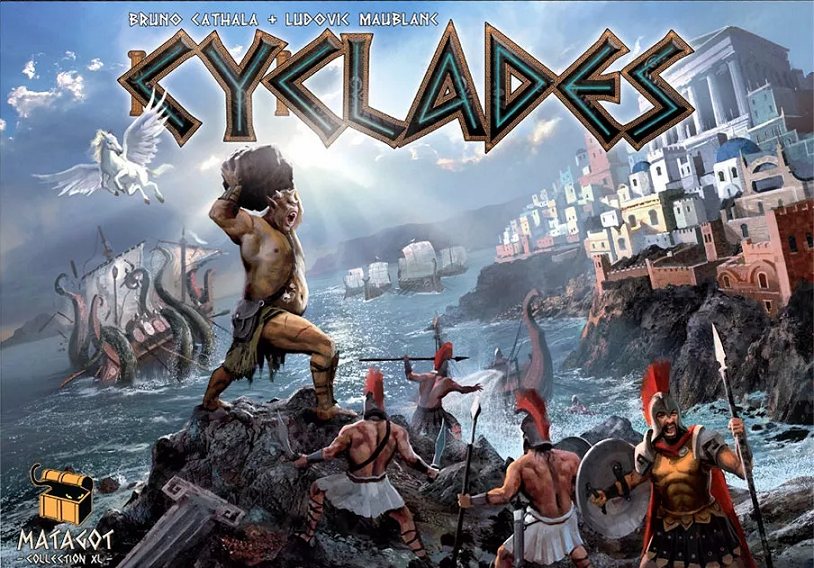
It’s difficult to overstate how important this title was. There is no reason it should be out of print, and if any elder design deserves a refresh, Cyclades is certainly it.
But a re-working of this scope is surprisingly bold. I should have expected it. The developments in this new edition parallel the philosophy of this game’s prior evolution.
Cyclades‘ identity as a hybrid design is found in the coupling of an auction mechanism to a high conflict area control attraction. In broad and terribly imprecise terms, it’s Ra meets Risk. Cathala and Maublanc were cooking with gas. This concept, and its ensuing implementation, is terrific.
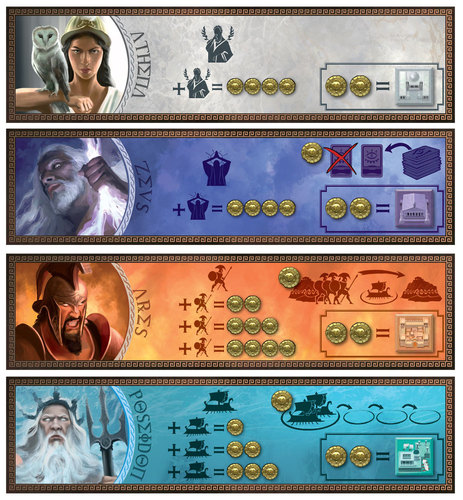
Each round players take turns bidding on the blessings of a god. Ares is an investment in war. Poseidon allows you to expand across and control the seas. Athena bestows knowledge and Zeus grants, well, membership cards which provide discounts on future purchases. Those who are slumming it with little to no gold – or perhaps who wish to bide their time until the right moment – can effectively pass during the action round by seeking Apollo’s counsel and receiving a monetary gift.
Each god was precisely balanced within a particular niche. The only way to gain more troops and move across land is to outbid everyone else on Ares. If you don’t win Poseidon, you will never get more boats or form a necessary bridge to link isles. Athena offers an alternate path to victory through culture, and Zeus is useful in stretching your money farther when vying for the other gods. You can’t really bypass a god to achieve a like outcome. Cyclades in this way is about winning bids at the right moment and leveraging the auction mechanisms so that the lords of Olympus will shower you with good fortune.
It felt like the design duo was never really comfortable with their creation.
Pegasus was an early tell, a release valve for the pressures of the bid cycle. This mythical creature, like its peers, can be purchased from a public offer. A small selection of the monster deck is available and cycles each turn to reveal new options. Most creatures provide a powerful boon such as stealing another player’s gold, destroying boats, or protecting one of your islands from invasion. Pegasus outright busts the game, allowing a player to move from one island to any other on the board. It means nowhere is safe, and it creates such an unequaled benefit that players often take actions to mill the deck or prepare an invasion force in case Pegasus turns up. The game, for worse, almost revolved around this potential legal exploit.
This is because it’s the only way to get around the very deliberate tempo of needing to first win Poseidon and set up logistics, then later win the services of Ares in order to actually invade an opponent. There’s a two-step process, at minimum, to invasion in Cyclades which creates a more strategic long game that is rife with as much conflict in the auction phase as that on the map. Because any such offensive maneuvers are signaled in advance, participants often call out when someone is poised for a powerful move. It’s obvious due to the necessary action sequencing, which means opponents can band together to try and stop it via the auction.
There is a quality here that many find problematic. It’s one inherent in the other mythic titles of Kemet and Inis as well, where the table can vacillate in whack a mole style, always subverting the player who is about to win. This often leads to an extended third act with experienced players, one that is tense but also exhausting. As a consequence, the significant focus of play is on the auction itself, and less so upon the dudes on a map area control element.

That initial pointer of Pegasus turned into the multi-faceted Hades expansion. Modular expansions were popular at the time, and this sought to capture that model by presenting several new options. The titular segment was the inclusion of a new god, Hades. Gaining the god of the Underworld’s favor yielded the ability to command an undead army. This was a fascinating addition that allowed players to raise a temporary legion, one that crumbled in short notice as the souls returned to the abyss. But crucially, it was another way to move armies without the command of Ares.
The subversion of the gods’ roles was only further torn open with the second expansion, Titans. This is a banging extension, one that makes the game more dynamic and wilder. It allows players to recruit massive titans to their ground forces. Oddly, these giants do not provide a serious boost in combat strength or power, instead, they afford players the opportunity to move every single turn by paying gold. Even more significantly, the board was totally redeveloped to include larger masses of land, leaning into the titans’ benefit and obviating the necessity to curry Poseidon’s favor almost entirely. It’s a weird mixture when examined with any serious level of scrutiny, pushing the game farther away from its core tenet.
Clearly, the design team was never satisfied with the restrictive nature of the action system in their original design. They sought to alleviate this regulation with each additional effort. It’s uncanny how thoroughly they acted to restructure the identity of the game, lessening the tension of the auction and opening the game up for more swingy outcomes.
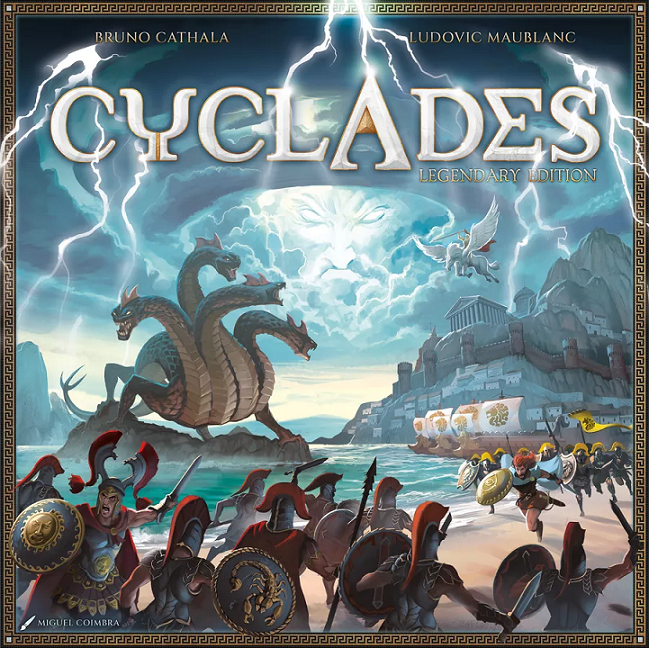
That sore never quite healed. Cyclades: Legendary Edition is the latest effort to re-write history and correct the wrongs of their original design. It’s billed as a director’s cut, containing the best material from each of the expansions and unifying the additions into the central skeleton of the game. This is indeed the case, but it’s also a George Lucas-like Special Edition, as there’s no longer a way to separate this philosophical shift that occurred across the release cycle of this game. For better and for worse.
Unfortunately, Cyclades: Legendary Edition is not modular. You have to use it all.
The titans and their bonus movement have been merged with heroes, an interesting component of the Hades expansion that offered a new pool of characters to recruit to your side. Heroes grant the titan bonus movement, but they also possess special abilities to twist the game. Additionally, Hera is a new god busking for tips, offering recompense in the form of mercenaries. These serve a similar role to Hades’ undead soldiers, but they stick around indefinitely allowing for stronger military presence. They’re also much weaker from the perspective of setting and not nearly as interesting.
Just like the original release’s expansions, these tweaks create a sense of dynamism by allowing more opportunity for aggression. Nearly every nip and tuck further this goal.
In the original release, winning an auction for a god afforded the opportunity to construct a building. The goal was to amass four separate buildings; each paired to a different god. When this occurred, the buildings were discarded and the player was awarded a metropolis. You won Cyclades by building or seizing two metropolises.
Now, buildings are constructed for free. Don’t need no drachma for this party. Furthermore, Hera even allows you to construct any of the four buildings belonging to the other gods.
This is all about momentum. The game is in continual motion, always moving forward toward inevitable conclusion.
Gold is also free flowing. It’s more abundant on the map, you begin the game with juiced coffers, and you’re able to bid zero gold on a god and win their services if no one contests you.
That last bit is the methodology of the Legendary Edition in microcosm. The OG required players always pay at least one coin, regardless of discounts. This restriction is another that has been lifted. In addition to a zero space being added to the bid track of each god, discounts are now cracked wide open and you’re allowed to reduce your cost to nothing. What’s bananas is that this also applies to the benefit of Zeus’ temple, a building that reduces the cost of monsters. Multiple temples stack. The consequence is that players can effectively buy several monsters every single turn late in the game. It slows play down and results in the purchasing of creatures as a denial tactic without the intent of using them. This is awful. While its significance is relatively minor in the overall balance of play, it is definitely the most egregious change.
Another tweak for momentum is an escalation in costs on the bidding tracks. Previously, each additional space to place your pawn and lock in a bid incremented by a single digit. Now, spaces near the back half of the track jump by several coins. The outcome is that it’s easier to carve out a space and select a bid that is difficult for opponents to overcome. This, combined with the flexibility of hero movement and Hera’s blessings, results in a significantly tamer auction phase. It was common to see players outbid each other several times in the original game, now, sequences of multiple bids being upended are rare. There is far less jockeying for position and the overall auction is resolved expeditiously, with little fuss. The drama of the game has been completely rebalanced, with the dynamism of the map overtaking that of the god offering.

To the design team’s credit, it feels as though they’ve achieved what they have always wanted. I’m sure they consider the previous release as antiquated and have no desire to look back.
The sense of perpetual motion is much more in line with modern design. There’s a familiar feel here to games like Blood Rage, Wonderland’s War, and Lords of Hellas. Progress comes cheap, the board state churns in unpredictable ways, and the climax draws ever near. Many will embrace this new demeanor and praise it for its modernity. I, admittedly, quite enjoy the post-Lang hybrid area control framework. However, I can’t help but feel that something was lost.
With less grappling in the auction phase, a large source of tension has been gutted from the design. There is also a sacrifice of depth and nuance. For instance, a clever ploy in the previous edition would consist of bidding low on a god you did not want to win but which you knew would be contested. Like going a single gold for Poseidon. This would allow you to delay making your primary move, allowing you to perhaps seize a desired god for less gold, or pivot towards a useful vector based on others’ activity. Such gambits are mostly absent from the Legendary Edition entirely due to the flexibility in actions.
My most critical claim is that with the trade for the more contemporary design philosophy, Cyclades sense of distinction has diminished. It now feels more familiar and comfortable. As its unique identity fades, I wonder if this new edition will struggle to stand out in what has become a very crowded genre.

I’m aware that this review has been dominated by an undercurrent of criticism. I do think that something important has been lost with this release, and I believe it’s the worthiest point of discussion. Yet, I know that many will find the Legendary Edition an exemplary re-working. Beyond tilting the experience towards a more volatile style of area control, there are a couple of very solid improvements here.
The modular map is great. I’m a person that is all for ditching the general obsession with modularity and going back to the creative approach of HeroQuest. Foldout boards are underrated, as they typically cut down on setup time and simplify the rules burden. But the randomized island configuration can significantly alter the feel of play. It’s likely the setup will have focal points that incentivize players to butt heads. Often, there’s a general sense of inequality generated by the random layout, and this can create interesting environments that fuel conflict and temporary alliances. Unfortunately, it’s also integrated with new setup rules that put the last player in turn order at a glaring disadvantage. This can thankfully be fixed with a minor house rule.
Many of the expansion elements that are now standard feel more tightly integrated. Heroes don’t appear bolted on to the design, rather, they’re an organic element of the whole. The ditching of large land masses from Titans and reorienting towards island hopping is a great change. Hera and her mercenaries march in unison with everything else.
This is also a smooth entry for newcomers. The style of play is more familiar, and the re-worked auction format is much less likely to lead to stalled turns and stale game states. It’s a less aggravating experience, as long as you’re prepared for large unexpected swings on the board. Less experienced players will also appreciate the abilities of the creatures and heroes presented as text instead of icons on the cards. This is quite an enhancement as it reduces confusion and eliminates time spent referencing help sheets.
Additionally, I have to say that Miguel Coimbra’s artwork is a treat. The board, while busy, is vibrant and fun. This isn’t a drab game, rather, it’s something worthy of eyeballs. The component choices in the retail addition are also sensible. Some may lament the loss of plastic, but I find the meeples and standees more than adequate. The only real misstep is the meager allotment of monsters. The creature assortment is noticeably light, with the deck needing to be reshuffled long before the game concludes. This quality pairs poorly with the change of four creatures being available for purchase each round instead of three, as well as the ability to churn cards late game. There is a nagging feeling that the game was put together with crowdfunding backers in mind, and the retail release sort of being an afterthought. That may not be true, but this glaring deficiency in content is problematic.

With the spotlight transferred from auction to area control, I can’t help but feel as though Cyclades: Legendary Edition has veered off in the wrong direction, destined for a turbulent journey that would rival the path of Odysseus. The bulk of the changes are sensible and certainly understandable in the current climate, but they’re also in service to homogenizing this fantastic experience.
It is gratifying to see the designers revisit their creation and sculpt it into their desired form. Most are never given that opportunity, and it’s grand to see their vision fully realized, regardless of preferences. I am curious about future work on this game and whether any new expansions are planned. That, combined with my affection for the modular board, means that the actual result of this remastering is that Cyclades has effectively doubled in size on the shelf.
A review copy of the game was provided by the publisher.
If you enjoy what I’m doing and want to support my work, please consider dropping off a tip at my Ko-Fi or supporting me on Patreon.
 Player Elimination
Such a great review, thanks Charlie! Those masterful insights into how mechanics blossom into dynamics is one of the things I’m here for.
LikeLiked by 1 person
Thanks so much, Randy. And thank you for becoming a Patron. I appreciate it!
LikeLike
Interesting perspective. Haven’t played it yet, but a friend has it. I’ve always felt more drawn to Blood Rage and Kemet, so we’ll see how this goes.
LikeLiked by 1 person
While I prefer Cyclades to Kemet, Blood Rage is one of my favorite games and a tier above.
I hope you enjoy Cyclades when you get a chance to play it.
LikeLike
I’ll admit I never played the new release, but I did play the old game a fair number of times (around 10) and I had some issues with it. From what I’ve seen the new version does make a lot of improvements.
The idea that you need multiple gods to get something done, and you have to show your hand as you need to go multiple turns sounds like good game design on paper, but it creates a quagmire. Let’s say someone had a boat line towards an island, he needs ares to seal the deal. There are so many ways he can get blocked
In a 5P game you have 4 players that can try and stop him. The chance of none of them being able to make ares prohibitorily expensive, or get any of the gods/monsters that can stop ares, are almost nil. As you said, the pegasus was added to break this gridlock, and it is a very ugly solution. Hades and titans also broke the move boats/armies in two different turns rule to try and fix this. Hera with her mercenaries is their latest attempt at fixing the issue.
No one wants to build academy, you just paint a target on your back. This is the same, to a lesser extend, with the other buildings. Giving everyone a free building prevents the situation in which everyone is just hoarding gold and armies waiting for someone else to make the mistake of building a building. Same with philosophers, just go apollo if you have 3 so you don’t become the focal point of everyone else. If you have a metropolis you are on match point, everyone of course wants to stop you, and if they do, they are on match point.
For instance, a clever ploy in the previous edition would consist of bidding low on a god you did not want to win but which you knew would be contested. Like going a single gold for Poseidon.
And then someone else would bid 2 gold on poseidon to delay their primary choice.
The new system forces everyone to bid what they think a god is worth, rather than just bidding as low as possible, and then bidding +1 until the god reached its natural price point. With an amon-re like system you’re encouraged to actually take the position you feel it is worth immediately. If you try to cheap out others will take the best price, and you either have to pay too much or take the left-over god.
For our group, cyclades was quite fun for its time. But one titanic 5 hour game made us hesitant to play it more often. Every time someone suggested it, the others would often say they didn’t want to get trapped in a long, drawn out game. If the game isn’t finished quickly by someone getting a lucky break, you end up in a gridlock of multiple people with massive gold reserves, armies, or a stack of priests. Letting them block the winning move. In the end we only played it twice more. Hades helped because it either let someone land the winning move, or there wasnt enough money to make a blocking move.
The changes look very promising and most of it can be backported to the original game, and I am excited to try that (free building, better bidding track). I was thinking of getting the new edition, but wasn’t sure if it was worth putting money in a game I had mixed feelings about, and I am quite content with kemet.
I agree with you the original Cyclades feels more philosophically pure. A game in which you bid for what part of the game you could interact with. And you needed to move pieces into position over multiple turns with multiple different gods to make it happen (or just pegasus). The expansions and rerelease broke that by letting you cheat a bit. The new cyclades folded those cheats into the base game, and with that stained the vision. I am sorry I am a bit critical, especially since I didn’t play this new edition, but I think it would have been a mistake to stick with the old system, knowing the issues it had.
LikeLiked by 1 person
No need to apologize. I think the majority of people will agree with you, which is why I think most reviews of it are very positive. I tried to explain my reasoning so that people like you could understand what the new version does and how it may improve the experience for you.
I hope you give the changes a shot and enjoy it.
LikeLike
I really appreciate it when someone is willing to go against the grain and give their true opinion on a game, rather than take the easy route and just give it a thumbs up. Leaving a comment that is mostly negative does not feel very nice to the person that is willing to be honest.
Apart from your opinion on the game giving up part of its multi turn purity, would you also say the original is still a better game to play for you? If offered to play either, would you prefer to play the original?
LikeLiked by 1 person
I would be happy to play both. I think the bidding system is slightly handicapped beyond the multi-turn aspect, particularly with the zero cost monster buying and lack of general conflict in bids due to the new god flexibility and stepped bid increments.
But I do like the map, both in modularity and in how it reasserts the island over large land mass play.
Even with my criticisms, I don’t view the new game as poor. So I would be happy to play it.
LikeLike