
“Now my doom is upon me. Let me not then die ingloriously without a struggle, but in the working of some great deed to be told among men hereafter.”
Reiner Knizia’s latest – a truly new release and not one brought back from the dead – depicts the ferocious battle between Achilles and Hector as illustrated in the climax of Homer’s greatest work (suck it, Odysseus). This iconic conflict is animated as a back-and-forth positional abstract. It’s the kind of simple yet evolving activity that the doctor has built a legacy upon, the kind of game that grows in significance with each re-telling of its story. Call me Thersites, for I am willing to speak out of turn and declare this the most remarkable original Knizia design that I’ve played in many years.
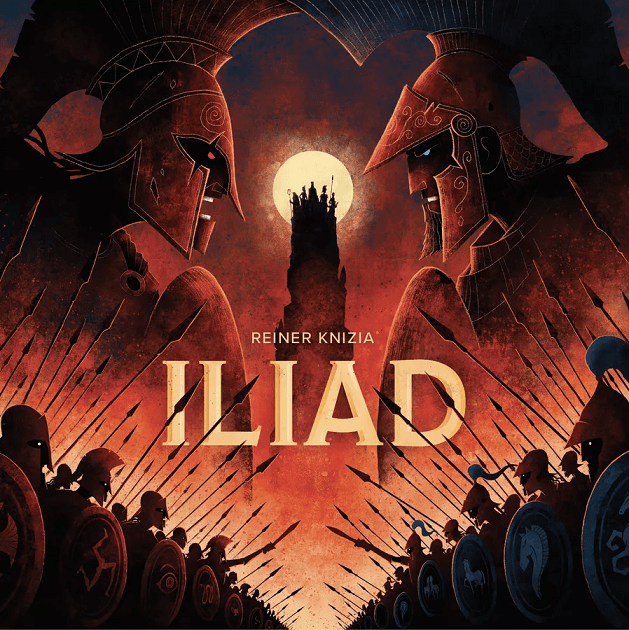
This is not simply a contest of wits, nor thrust of spear and sword. Achilles and Hector, as envisioned through the actions of the two players, vie for the favor of the gods themselves. As each tile is placed a plea sounds. Deities, both fickle and earnest, stoke the souls of these warriors as they usher in doomed fate.
The metaphysical leaning is a clever mechanism, for it allows a degree of deception. The themes at the heart of the design are less tethered with the divorcing of motif from the material world. This blends with the concept of an abstract tile layer rather well, riding upon a gossamer robe of emotion. No one would say Iliad accurately simulates the physical combat of these two champions, but if viewed from the sensation of violent competition with the strong current of its central push-and-pull system, this design does elicit a high-stakes tension in the appeal to empyreal patronage. This is primarily realized in the success tokens.
Iliad is played on a simple 6×6 grid. A randomized success token is placed at both ends of each row and column. These chits are the bounty of the gods. They’re the divine influence bestowed upon mortal subject. Competition is fierce for these are what bless you with victory in the aftermath.
The perplexing nature of the blessings is that they range in point values, creating an obvious division in quality and desire. Furthermore, they are paired with various colors, a trait which establishes a fluid hierarchy amongst them. If a player finishes the battle with a token in each color and their opponent has not, then that champion is exalted and has bested their foe. Only if both or neither have done so do the values of the success pieces matter, in which case the sum of the greatest achievements in each color is compared. This secondary state of completion is more common, and the climax of the fight is often a grueling struggle over these last few invocations. This is also where the most extreme produce their nectar, for a subset of awards sit outside the five-color objective. Instead, these gold and red gifts offer either a strictly positive or negative value, thus only affecting the outcome if the secondary tier of victory is triggered.
Scoring then is nuanced. The heroes must vie for primary colors but must also pay close attention to the points offered as well. As priorities shift and the conflict evolves, the dynamic to and fro places each in a difficult position, often forcing cataclysmic maneuvers that slice at the strings of fate and threaten to unravel the destiny of those locked in unending battle.

Striking in tandem with the volatility of scoring is the actual placement of battle tiles at the center of the board. Achilles and Hector take turns, each playing one of two options from their hand. You only ever have two tiles, which places immense pressure on each maneuver. Both warriors possess symmetric draw piles, and strong play requires being aware of which options remain.
The board possesses spaces with prescribed color restrictions, meaning Achilles can only place in the red squares and Hector only in blue. Thus, Iliad isn’t a race to overwhelm positions, but rather, a tight clash where you must decide how to best utilize each tile as they become available.
The primary attribute on each conflict tile is the number. When a row or column is filled, whichever warrior has the highest total sum with their tiles in that line succeeds. They choose one of the scoring tokens at either end, and their opponent receives the other. While this sharp conflict is interesting, the special power on each tile creates volatility and chaos. It feels as though the gods have descended from Mount Olympus and are manipulating the duel in real-time. This is where everything opens up.
Two of the abilities reposition tiles already on the board. One allows you to move your own piece and another allows you to reconfigure an enemy’s. You cannot perform this action on tiles that are completely surrounded on all of their edges, adding a further incentive to quickly throw up a shield wall and play defensively around your key positions.
Perhaps the most powerful effect is the option to swap one of your success tokens with a public offer at the side of the board. This is crucial, as it affords an opportunity to either modify your assortment of colors – again, aiming to collect all five for victory – or manipulate your point values by swapping a low scoring tile for another. This is a fundamental technique to shed off the negative tokens, which creates this paralyzing anguish of wanting to hold these tiles in your hand in order to time their usage. But with a hand size of two, you severely handicap your ability to pivot or respond in meaningful ways.
How you address this limitation and fully utilize your tactical acumen, weighing both the value of your placement as well as its ability, is a large determinant of success. Since every space will be covered on the board, where you hide your low values is just as important as where you choose to fight with utmost fury. The delta between scoring tokens awarded is also of great significance. Combine all of this with the chase for certain colors and placement is considerably textured.

The allure of this contest is the duality of tight constriction with explosive activity. Your hand size, a limited use of abilities, and a narrowing board state all contribute to the former. The latter is comprised of large swings in scoring as the delta between two tokens can be wider than the gulf between mortal and deity. The timing of when a line is completed and tokens are awarded is also very important, as it has knock-on effects concerning the value of certain board positions and the ability to swap tokens. Since each player has an effect which can move an opponent’s piece, they can force a line to tip over the edge and finish early, perhaps with a low value conflict tile.
There is a well-defined arc to play that may act as a wedge between those who sing the game’s praises and those who hang their heads. The early portion of battle is a buildup. Scoring may not trigger for quite a few breaths, as each warrior feels out the other, perhaps testing them with a well-timed faint or minor blow. The second half of the bout is more rapid and brutal, like iron biting flesh. Turns are often contemplative as you must continually do the simple arithmetic of adding up each line in an effort to determine your best maneuver. Those who do not enjoy this tactical play and who cannot revel in the tension, well, they will find the task a drudgery of menial labor. There’s a thin line between enrapture and disgust, and this exercise may test your mettle.
Iliad’s ruleset is simple, but the implication of certain actions works as a driving force of continual upheaval. Agency is more limited than most positional abstracts, hewing closer to titles such as Santorini or Hypergrid. It’s not a game purely of wits as the variance of tile draw, as well as the randomized setup of scoring tokens, makes for a somewhat wild experience that is non-traditional.
This divine catastrophe is what appeals to me most. It’s an exciting game, one that can get away from you as the comforting touch of Hera glides through your fingers, her presence scattering like dirt in the wind. It’s as tense as it is maddening when it turns, leaving you absent in your moment of need.
Few entries in this genre allow an escape from shouldering the burden of defeat or bestowing commemoration upon your foe. The variance has a striking effect here, with the way the tiles come out granting and denying favor in a temperamental way. While this conflict may be impure, it is glorious and capricious, with both serpents intertwined and striking at each other’s throat. Cry out oh sons of Peleus and Priam.
“No man or woman born, coward or brave, can shun his destiny.”
A review copy of the game was provided by the publisher.
If you enjoy what I’m doing and want to support my work, please consider dropping off a tip at my Ko-Fi or supporting me on Patreon.


Enjoying my early plays! It’s a 6×6 grid by the way 🙂
LikeLiked by 1 person
Whoops, thanks for the correction.
LikeLike