

Five months have passed since my original review of The Old King’s Crown. While the outside has grown colder and darker with winter, the inside is a different story. My appreciation for Pablo Clark’s ambitious game of throne-seeking has ignited. It’s stuck with me, claiming a seat in my top 10 of the year and inspiring a deeper exploration of its more feral contents. This includes a lengthy foray into the far reaches of the design. I’m talking about The Wild Kingdom, the game’s sole expansion which was available during its crowdfunding campaign, and which will be widely available in the future.
The contents fit the name. We’re offered seven modules of varying complexity that radically twist the game like a contortionist shoved into a crevice. These are not small nudges, but rather large shifts in dynamics that undermine expectations and occasionally balance. They are strictly for experienced players, ones who have adopted this title as a lifestyle game of sorts. The vast majority of players don’t need, and likely will not even benefit from such experimentation.
Let’s tackle the easy stuff first. There are two additions I will always use. The first isn’t even a module. Bundled with this new content are metal coins to replace the influence tokens in the base game. I’m not the type of person that springs for optional deluxe components such as this. With that being said, they’re hefty and beautiful and certainly an upgrade. The Old King’s Crown is a design that is wholly synthesized with its aesthetics, and this small component upgrade is befitting of that quality.
The other auto-include are the new Kingdom cards. These are the special powers that are bid on at the top of each round and constitute the tableau building portion of the game. 15 killer cuts are featured. The ruleset assumes a stance of wanting to highlight this content if you’re including it. It suggests cutting down the existing Kingdom deck and then shuffling these new cards into a smaller subset for your session. I find this method to be additional work with no purposeful gain. I just shuffle them into the main deck and if they avail themselves during play, well, then we consider them like every other card.
I want to urge caution. There’s a consideration of taste here, as these new options will not appeal to everyone. These cards, like the rest of the expansion, are gonzo. They significantly alter the play space. My favorite is The Binding Stone which allows you to purchase another faction’s personal upgrade cards from their Site of Power. Yes, you get to place your grubby fingers on one of their unique cards and claim it as your own. It’s no longer available to them. Ho-ly, this is cruel. If a player was accruing lore and about to nab a centerpiece card for their deck, you can slide right into their personal space and gank it out from under them. This is the type of hedonistic tomfoolery The Wild Kingdom beckons.
There are other crazy options. The Blood Seeking Box materializes lore and influence every time a card is eliminated. Odd Arrivals at Court lets you re-arrange all of the cards and tokens in the court. You can just totally shove all of a player’s cards into one undesirable court location and completely hose their plans.
What I find alluring about these cards is that they take that extra step into the absurd. They certainly risk tipping the game into an untenable state, but they force the adoption and evolution of new tactics. Some Kingdom cards and situations will require aggressive counterplay, perhaps even multiple players teaming up ad-hoc. The way this influences dynamics folds into the game’s structure relatively seamlessly. No onerous new rules or systems need to be internalized, just shuffle these cards in and let ‘er rip. If you find the base game already too unpredictable at times, then step off. Really, if that’s the case – and this is an important point – you should never have acquired this expansion as its sole purpose is to spark insanity.
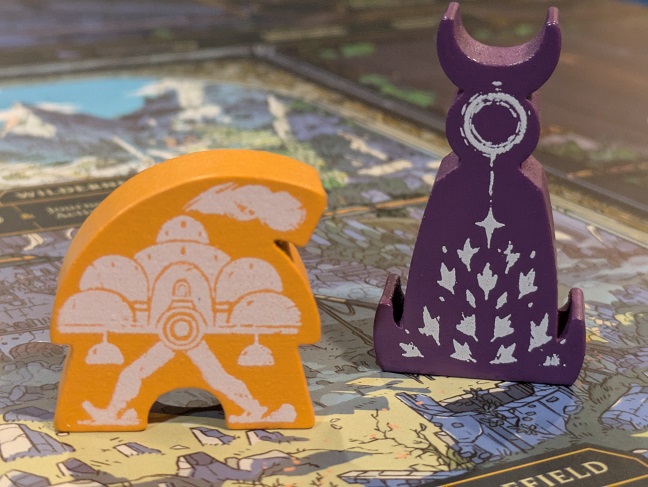
A second module I’m likely to integrate relatively frequently is The Travelling Town. This leggy hamlet is a piece that begins in a random location and then moves to a new area at the end of each round. If you secure the location reward during the clash phase, you can instead activate the town. Doing so allows you to acquire one of the cards on the King’s Road outside the bidding phase. Additionally, it does not take up one of your two slots on your personal board, instead the Kingdom card slots into one of two positions on the Travelling Town overlay.
Conceptually, this isn’t difficult to grasp. Fight for the town and you get to add another entry into your tableau of powers without occupying one of your precious spaces. It’s powerful and seductive. What’s particularly interesting is that there are only two slots on the Travelling Town board. When it is triggered a third time, and of course each time after that, the player selecting a Kingdom card boots out one of the existing options. This is the only way to extricate these cards from their sanctuary, as the guilders of the restless metropolis protect your purchased assets – they cannot be stolen during the regular Kingdom card phase.
This expands the combination of powers and abilities factions can acquire. It’s potentially powerful, but most importantly, it changes up the texture of the area control component. This is evident in its secondary feature: it places influence tokens at locations it visits. The implication is that it creates hotspots which offer greater rewards. This injects a level of dynamism to the regions that is absent during standard play. One of my criticisms of The Old King’s Crown was that the board was too static. The only reason to fight over a particular region is the effect, with a secondary consideration being another player’s herald as you may wish to steal influence. This absolutely soothes that ill.
One quirk this alters which may not be readily apparent concerns the bottom two locations. These two spots stave off attrition by manipulating your deck. They’re often neglected in the short length format. This is because attrition is a lesser concern the fewer rounds you play. The Travelling Town can inject some interest in these otherwise overlooked areas, shifting the standard incentives into a more even layout. All of these reasons establish The Travelling Town as my favorite module of The Wild Kingdom expansion.
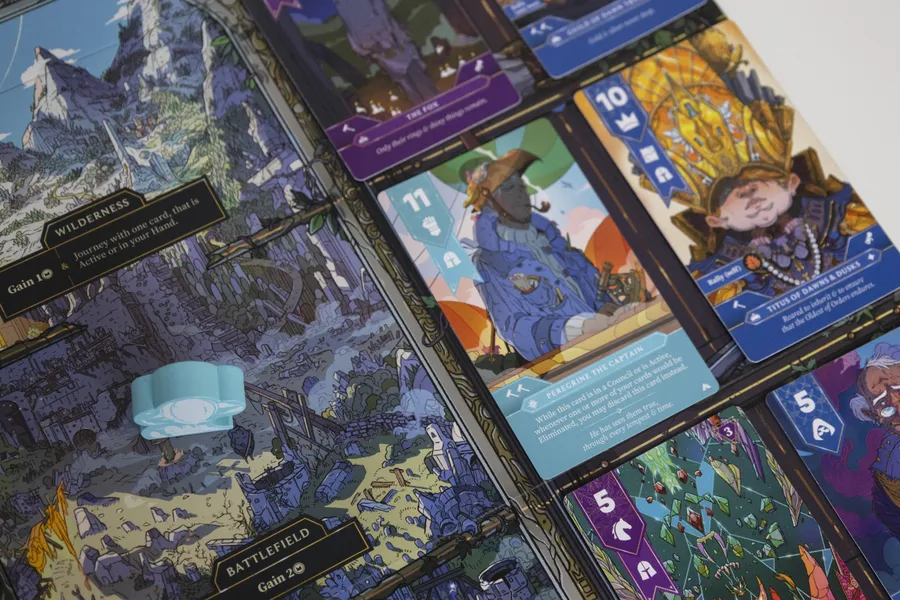
Another incredibly interesting module is Aeronauts. This extension allows players to visit the Near & Far, the Aeronaut sky ship that sails across the board in similar fashion to The Travelling Town. When visiting the ship, players may claim one of the neutral Aeronaut cards and add it to their hand. These expand the scope of abilities and afford new tactics to wield. Describing these effects as crazy or powerful is expected at this point. They can do things like assassinate cards outside the current clash or protect another of your cards that’s killed.
Much like Kingdom cards, these allow you to introduce new synergies to a faction’s existing suite of abilities. The right card at the right time allows you to unleash a fresh maneuver or power play that can produce staggering results. Each Aeronaut card can be countered in various ways, however, so there is a requirement for thoughtful recruitment and nuanced strategy.
The most intriguing aspect of Aeronauts is the Near & Far. This ship is not only a piece that interacts with the locations on the board – it can also be pressed into service as special Supporter piece deployable to clashes. This is, frankly, unhinged. It’s a three strength Supporter that returns to your board each round. This makes it one of the strongest weapons in the game.
Smartly, this WMD is reigned in via clever design. To recruit this special unit, you need to visit its location after all of the neutral Aeronaut cards have been claimed. This is unlikely to occur until round four or five, which results in the Near & Far unleashing its force exclusively in the final act. This is a perfect crescendo that synthesizes with the natural arc of play, enhancing the general tension that occurs in the final rounds.
While the Aeronaut module is a neat wrinkle, I find it less universally appreciated than The Travelling Town. It tends to provide an element of focus for one or two players, while the rest of the table ignores the airship.
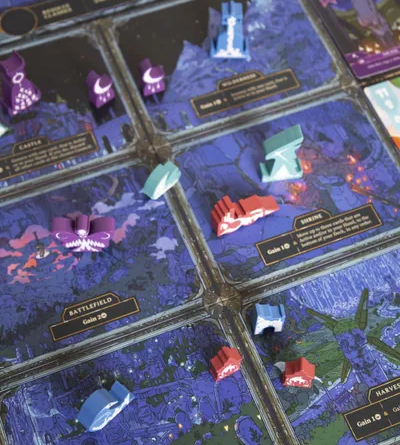
The least impactful addition is the night tiles. These consist of the six locations on the board but presented in a modular tile format. You shuffle these up and then place them randomly over the existing areas. Simply, it decouples locations from their previous pairing.
For those with only modest experience playing The Old King’s Crown, this is an absolutely nothing adjunct. It’s a vestigial expansion element at best. Don’t bother.
There are some subtle implications that may avail themselves over time, however. For one, it allows you to possibly trigger two deck manipulation effects in the same round. Or it could let you take advantage of both Journeying to gain lore as well as placing a card in the Councils. The altered combinations of loot shift the mutually exclusive framework around, offering a minor jolt to the strategic landscape. This is a small expansion element. I’m not particularly fond of it, as I’d prefer to spike other variables instead. I also think there’s a more naturalistic downside, in that this module weakens the aesthetic. The night tiles, while attractive in their own right, are less striking and rich than their counterparts. It was likely far outside the scope of the design, but I would much rather have seen tiles with new effects that could be utilized on the board more flexibly.
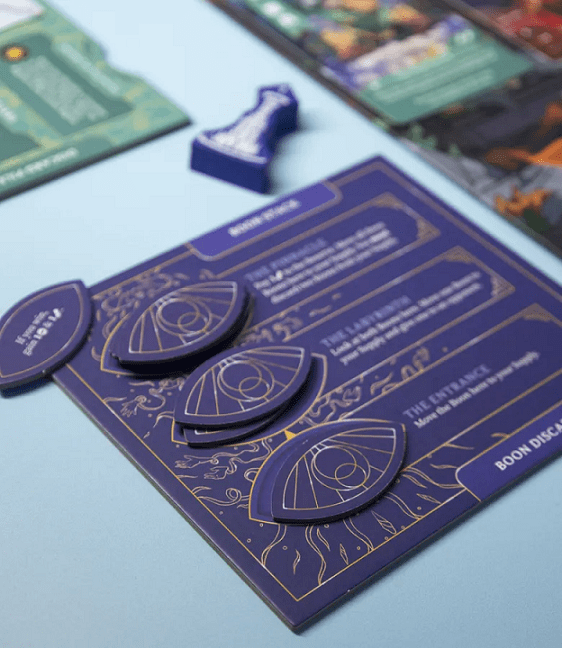
Back to the best of the stuff. The Whispering Tower is a beaut. This ominous piece is placed at a random location at the beginning of play, and it effectively blocks the reward. The player who triggers the location of The Whispering Tower must visit the spire. This is already distinct from the other location pieces added in The Wild Kingdom, but it only gets more peculiar from here on out.
When visiting the tower, you must ascend the edifice from the bottom. This allows you to trigger three sub-location effects. Effectively, you’re doing this to gain boon tokens.
These are sharp little bastards that are kept in your area face-down. They are then placed on your cards as a Spring action to enhance their effectiveness or to make a wager of sorts. The former type provides bonuses such as +5 strength or adding the Flank ability. One ludicrous boon adds 10 strength but you have to burn the card afterwards. Watch people stand up in disgust and shock the first time this axe gets thrown.
The second type are just as interesting. They trigger only if you win the clash. One awards influence and lore. Another allows you to make an impromptu visit to The Whispering Tower. All of these tokens, regardless of type, are a single use. Afterwards they’re discarded and make their way back through the tower’s boon pool.
While this doesn’t displace The Travelling Town as my favored module, The Whispering Tower is glorious. It shuts down a location, which causes a ripple through the incentive framework, and it provides for more secrecy and drama. Furthermore, I dig the way it intensifies the setting of the game. This functional piece establishes some cursed location your army is campaigning through, and you actively work your way through the tower, possibly abandoning the adventure mid-way. It’s a gnarly little detail that works to augment the atmosphere and environment, two areas that stand to benefit from such.
I don’t plan on venturing to The Whispering Tower very often. It’s better leaned on as a special occasion, something to alter play dramatically for the right crowd. Those who dislike the design’s chaotic substrate will scoff at this additional havoc and certainly dislike how it may serve to really break the game apart in overt ways. Ultimately, this expansion element is the inverse of the night tiles, largely dictating a session and its overtones.
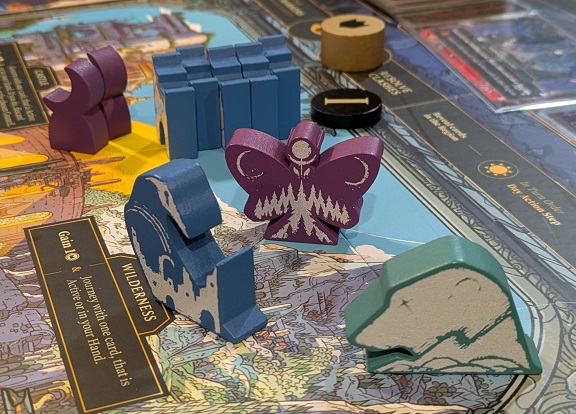
While the majority of modules are excellent additions that I’d not hesitate to include given the mood, the final two additions I’m more reluctant to extol.
Legendary Creatures is one of the simplest options of the entire box. It adds a new faction specific monstrous piece such as a giant moth or bear. This unit acts as a second herald each player can place on the board. It follows all associated rules such as point stealing in clashes and returning to your board in the Winter season. If an effect allows you to move or manipulate a herald, you must choose one of the two faction pieces and cannot affect both. Additionally, your beast and herald may never occupy the same location. The final quirk is that if you lose a battle where your legendary creature is present, you may claim a special faction card and add it to your hand. This is a 13-strength card which also awards lore and influence if played into a clash where your creature is present and you subsequently win the battle.
This sounds like a neat option. In reality, it’s one of the more clunky modules. Certain effects which target heralds become messier, the card is a little obtuse in how it’s added to your deck and then returned to the supply, and it makes the board itself cluttered. At four players, there are just far too many pieces being placed on the map. While the chaos inherent in this game can be intriguing, this leans so far into that aspect of the design that it becomes intractable. There’s a general slipshod feeling to the affair, and it’s less congruent than the bulk of The Wild Kingdom’s content. You can tell Pablo Clark was cognizant of this dilemma, as the Legendary Creatures all possess the exact same ability. It’s as if the module brushed too close to disarray, and there was an attempt to reel it in by foregoing asymmetry.
Now, there is an instance where I find this addition useful. It’s uniquely appealing at a low player count. One of the deficiencies is that there is too little interaction at two-players in terms of point stealing. Since there is so much open map space, the chance that both heralds are on the same location is slim. The Legendary Creatures, however, double the herald presence in a two-player game and provide a wealth of opportunities for increased point deltas. This works well, and I find the module a worthwhile inclusion in the box simply for that reason. In all other formats, however, I’d much rather go to The Travelling Town or Whispering Tower or Aeronauts. Legendary Creatures just don’t provide the oomph and texture of those other extensions.
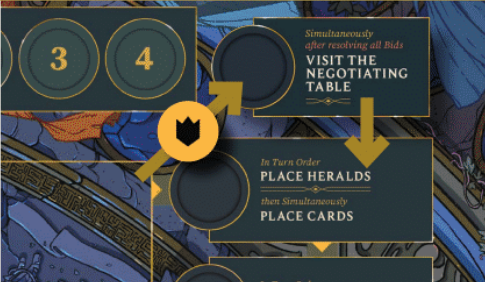
I’ve saved the most mind-bending and difficult to grasp piece for last. This is another one I’m not exactly keen on. It’s the Negotiating Table.
First off, this is only usable in games consisting of three or four players. It also requires a few additional components, including an overlay on the main board and player specific trade agreement/alliance cards. These are used with a new phase that occurs every round, as players “Visit the Negotiation Table” at the beginning of Spring right after the Great Road is resolved.
The negotiation phase consists of three steps. The initial stage allows players to trade resources such as the expected influence, lore, and Kingdom cards, but also more exotic options like faction cards, supporters, and even tactic tiles. This is where things get interesting, as significant deal-making can occur which shakes up balance and threatens to have a massive influence on play. This is the reason to use this module, simply to see the mischief capable. Over-the-top moments like someone tossing all of their supporters to The Clans. Or someone handing off their assassin in exchange for a leader card.
It gets even more ludicrous. The next step allows for complex binding and non-binding trade agreements. Players swap specific cards and the rules framework enforces these conditions. This allows for a wide latitude of creativity, which is limited mostly by the ingenuity of the players embarking on this pact. This can be almost anything, like allowing someone else to pick the clash order, or play specific cards into a fight.
The final option is the most grotesque. Players can enter into formal alliances. This requires several new rules and clarifications, such as any negative effects on cards or abilities not harming your ally. Ready for this one? Your strength is added together in clashes, but the two of you must decide who receives the award from winning. This is difficult to grapple with. Insane would be an appropriate word.
In a sense, it turns The Old King’s Crown into a four-player game of Dune. That is nuts. I don’t know how many more adjectives I can conjure to describe this. You can also get into frantic situations where two players bully the rest of the table – imagine this in a three-player game. I can’t quite work out if I even enjoy this module, but I suppose that’s a great deal of the charm. It’s perplexing.
I’m going to fess up here. I’ve only used this particular addition twice. I don’t feel nearly experienced enough to opine on all the implications and ripples this creates in play. People were reluctant to form alliances, and we mostly performed a few minor trades. The more robust aspects of this module almost feel forbidden. I’m not talking about cutting the tags off your mattress or foregoing an oil change. This is a substantial modification to the game, and it bears an illicit tone. Are you even playing The Old King’s Crown if you’re embarking on a team affair where winnings must be carefully discussed?
What I can weigh in on is how this module alters pace. It absolutely slows things down. The round is obviously elongated, but this phase can also terribly drag. Deals can get complex, players may be reluctant to come to terms, and voices may rise. Look, the groups I play with can turn anything into a negotiation game. We often cajole, threaten, and browbeat each other into targeting the lead player. Discussion is organic and often arises at regular intervals. Even so, this module felt a bridge too far. Perhaps designer Pablo Clark should have stopped at Nijmegen.
Maybe not though. This is the piece of this expansion that I’ve thought about the most. It’s one I will continue to contemplate. It’s uncomfortable and weird. But there’s something here which makes me want to keep poking it.
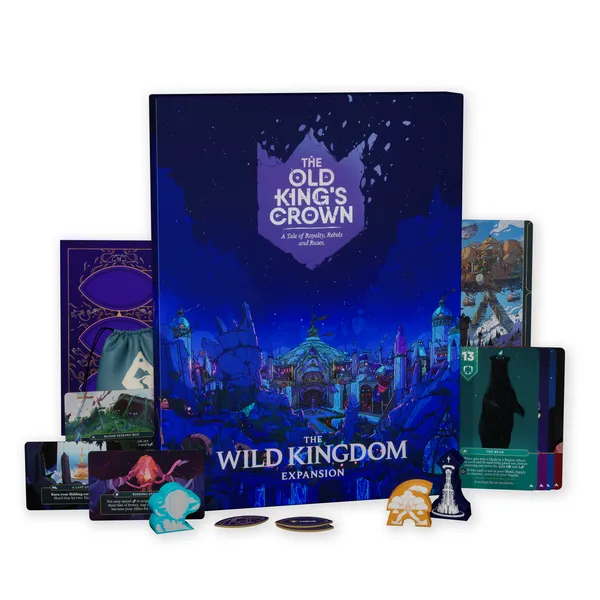
I believe I’ve stated this in the past, but many modular expansions create a framework that mimics the function of scenarios. A session where you throw in The Travelling Town feels like you’re adopting a specific scenario that alters the standard ruleset. It tailors the game towards a certain direction and upsets ingrained heuristics. This is what scenarios do in skirmish and wargames. These options are robust in The Wild Kingdom, and this is a substantial box.
What it comes down to is that this is for all the sickos. It has an experimental feel to it, loosening the game’s boundaries and testing its elasticity. There are times when it feels as though it’s about to burst apart, particularly when more than one module is included. Those instances can be majestic, but they can also be fragile.
Above all, this is a creative box that lives up to its billing. I imagine its allure will fade somewhat once new factions are introduced, as that type of content has broader appeal. The Wild Kingdom is a niche offering. It will retain its bizarre pull, as the jesters who don’t think The Old King’s Crown is wild enough will find this offering hypnotic.
A copy of the game was provided by the publisher for review.
If you enjoy what I’m doing and want to support my work, please consider dropping off a tip at my Ko-Fi or supporting me on Patreon. No revenue is collected from this site, and I refuse to serve advertisements.
 Player Elimination