
Whenever people liberally throw around words like “innovative” or “unique” with recently published games, I can’t help but clench my jaw. It’s a difficult pothole to avoid, as the promises spat by titles in the crowdfunding era are necessarily braggadocios. We’re all guilty of this from time to time. It’s natural to pile on superlatives in an overly charitable manner when discussing games that spark fire in the gut.
But the modern field is downright old-fashioned when compared to the hobby’s infancy, particularly in the wargame scene. Avalon Hill’s 1961 release Gettysburg introduced the hex grid. The beloved Squad Leader was one of the first lifestyle board games and standardized the expansion model. Ambush was a pathfinder of narrative gaming that laid the groundwork for modern storytelling.
And Alfred Leonardi’s Ace of Aces series pioneered the first-person concept in tabletop gaming. It predates first-person shooters Wolfenstein and Doom by over a decade.
That’s quite shocking. In fact, “shocking” is an adjective I’d ascribe to much of this game. The brilliance and simplicity of the core system. The rousing immersion. The sheer creativity. It’s all a wonder.
This previously difficult to find game is now available once again thanks to a remastered edition courtesy of Mr. B Games.
The concept is simple because that’s all it needs to be. Two biplanes square off in the skies above France during World War I. If you want more deets, you got American Eddie Rickenbacker strumming in a SPAD XIII opposite Georg von Hantelmann’s Fokker DVII. These late war aircraft are among the finest machines of their era, You and another player will hop in the seat, grip the stick, and fight like hell to bury the other bastard.
There are plenty of World War I air combat games. Ones like Blue Max and Wings of Glory depict multiple planes from a top-down or even three-dimensional view. They are somewhat detached, maintaining a neutral perspective from above the battlefield while attempting to transpose your experience into a more personal one through dramatic action and cinematic detail. There is a general feeling of control as you command pieces and move them around a map like toys in a fantastical warzone. Your planes are an extension of you. They’re not you. It’s like the difference between poking something with a stick or prodding it with your finger.
Ace of Aces isn’t like that. Players don’t manipulate pieces or even interact with a board. There is no board.
“The best board games don’t have boards.” – Charlie Theel. Don’t quote me.
All of the action is presented as first-person illustrations. This is beautiful work highlighting wonderful shots from the cockpit with exceptional detail and artistry. Each player has their own book configured to their aircraft. You hold it, flip to an appropriate page, and see what your pilot sees. Or rather you see what you see. After an initial orientation to get comfortable with the format, you become the pilot. That character is never depicted, rather, they materialize as they sit in your chair.
With each of you holding your own book – and this physical activity is nearly the entirety of play – the fiction arises organically from siloed positions. Your decisions intertwine creating emergent drama and cinematic thrills. All of this is sort of obvious, though, as the benefits of the first-person perspective are familiar. What’s less obvious is that part of Ace of Aces‘ awe is not just the uniquely immersive viewpoint, but also the mechanisms at work and their simple yet befuddling nature. I have to give you a rundown.
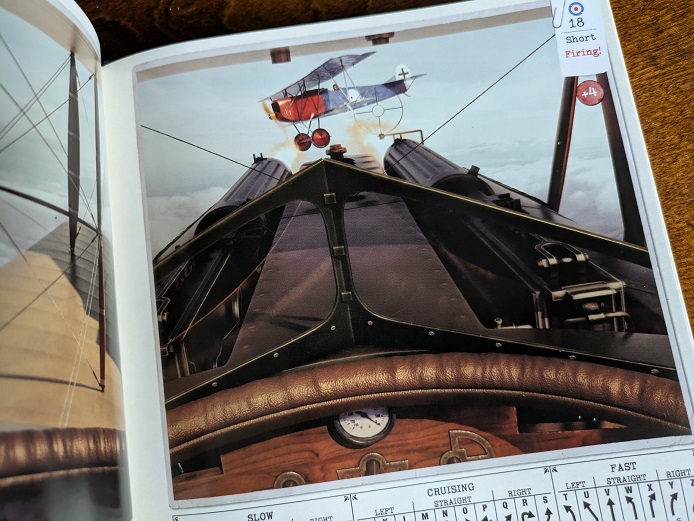
You both start on a specific page. This presents the two aircraft meeting in a head-on orientation, spotting each other and closing distance. At the bottom of every page is a maneuver chart. Options consist of straight pushes forward, soft turns, sharp turns, barrel rolls, even the famous Immelmann maneuver where you loop and perform a 180. Each player secretly selects one of the options and then feeds the associated number to their opponent. When given your adversary’s number, you flip to that page, lookup the maneuver you chose at the bottom of this new page and then head to yet a second destination based on the number below your chosen action.
So, check it. I’m banking hard to the left, which has the number 24 below it. I don’t know what my opponent is doing, but she hits me with “73” and I respond with “24”. I flip to page 73 and find my left bank, which now shows number 92. Then, I head to page 92 which is my landing spot and represents the new positioning of both our aircraft. Meanwhile, my target was doing the same thing, albeit with different numbers.
Say while I banked left, she also turned sharply in that direction. Maybe she was expecting me to climb and try to whip around her flank, but she guessed wrong. On our landing spot, my viewpoint would be tailing her plane, while she would be looking over the shoulder to spot me in pursuit. She’s about to get lit up.
This is some sort of arcane wizardry. Seriously. I can usually mentally model systems, strategies, game states, and so on. While I’m not particularly adept at strategy games, I can usually understand them and provide some semblance of meaningful analysis. This system, despite its relative ease, eludes me. The trick is obviously the intermediate page, and I understand the way the branching legwork needs to mathematically extrapolate various end conditions through a resolution matrix of some sort. But Leonardi mapping all of this without the aid of modern technology just seems insane. Perhaps even innovative.
I can’t see this system emerging from the current scene. It’s very much a product of its time, before algorithms and coding and app-assistance. These books and their intertwined nature are a strange piece of technology that feels alien. That’s really what you’re buying with this ticket. It’s not altogether different from the puzzling allure of a game like Turing Machine. The quirky nature is something with a timeless appeal.
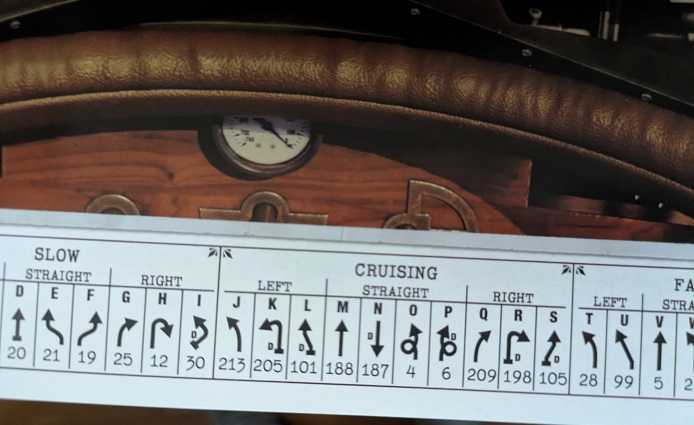
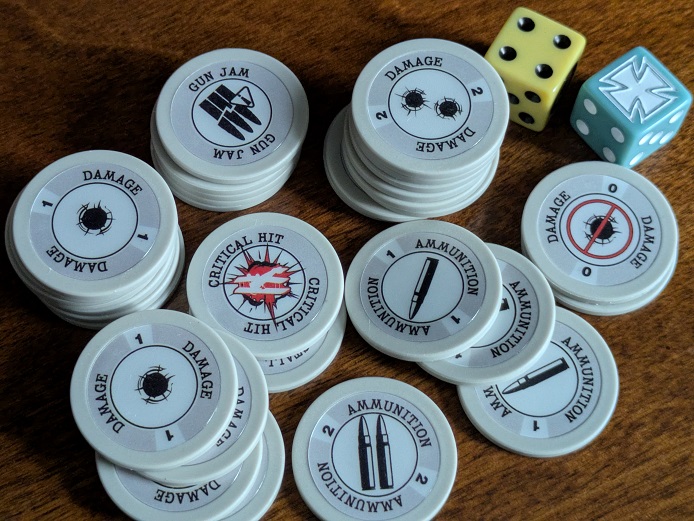
Depending on the end result and the orientation of each aircraft, one or both players may be able to fire at the other. Standard rules assign a set number of damage, with your plane seizing up and tumbling out of the sky after eating a few bursts. It’s simple but does the job. There are also rules for tailing and limitations on difficult maneuvers. A modest section of advanced rules adds-in a couple options for more sophisticated damage systems, including rolling dice, tracking ammo, and suffering jams. And for the grognards or perhaps the deranged, there is even a large section of rules text devoted to the game’s original ruleset that goes even deeper with simulative elements.
While I’m sure some would disagree, Ace of Aces flies high due to its straightforward concept and straightforward execution. Massaging the tone by tracking ammo, accomplished via deluxe poker chips, doesn’t tip the scales into lunacy. But when you start considering various stats based on alternate aircraft types, I think you’ve been flying too high and your brain’s screaming for O2. My personal calibrated sweet spot is using the bag draw method, which broadly mimics the uncertain damage system of Wings of Glory. But I wouldn’t hesitate to raw dog it and do away with the dice and chips and just go for the smoothest method.
Look, the game is not these details and various damage models. Ace of Aces’ essence is in the rushed flipping of pages, the breathless anticipation of your final relative positions, and the associated sensation of brittle planes screeching by each other to arrive at this orientation. There’s this funny thing that happens where my brain tries to reconcile what just occurred. Sometimes we talk about it, “oh no, I went hard left” and “what the hell, how did you get behind me?” Usually my imagination is given a jolt and an image of the action appears in my consciousness. Much of this is the design’s naked appearance, despite the clever bits being obfuscated. It begs you to formalize the proceedings as the pages act as single frames taken from a continuous strip of film. Your imagination naturally fills in the missing cellulose.
It helps that the new edition of the game is just lovely. The books are fantastic and a pleasure to interact with. The chips are chunky and add substance to an otherwise airy experience. It’s all stored in a slipcase that wastes no space, perhaps even to its detriment as the few bits are stashed in a tight drawer. It’s hard to imagine playing this game in its original format with black and white line art. This truly feels like a remastered design that doesn’t lose the soul of the original work. Although, admittedly, this is just my intuition as I have not played the original version.
It’s weird how Ace of Aces lands on some of the exact same vibes in games like Wings of Glory. There is tactical anticipation, clever positioning, and various aspects of risk-taking. The process of guessing what your opponent will do is very similar. And yet, while there is that identical core, all the rest feels so different. It’s difficult to explain, despite the fact that it should be obvious due to the varied spaces these designs occupy. The overlap and dissonances clash in astounding ways.
One of those conflicts is the extremely light frame. I’ve alluded to its beautiful simplicity of play, and it’s wonderful to sit down with someone and have them flying a fixed-wing coffin in just a couple of minutes. But just as carefree and exhilarating as this experience is due to its direct nature, it’s similarly unappealing as an extended campaign. Ace of Aces is best encountered as a quick patrol. You’re never planning a session around this game. It’s a weird filler unlike anything else the hobby has to offer. It’s your grandfather’s Purple Heart or weathered flight jacket. Something you lovingly pull out to show off. If you do this too often, it loses some oomph and the novelty fades. There’s just not a lot of game here. If you have 20-minutes and it’s been a couple months since you last shot down a Fokker? Hell yeah, spin up that propeller. But the high will be a short burst, like a meaty squeeze on the trigger of your linked Vickers machine guns.
A copy of the game was provided by the publisher for review.
If you enjoy what I’m doing and want to support my work, please consider dropping off a tip at my Ko-Fi or supporting me on Patreon. No revenue is collected from this site, and I refuse to serve advertisements.


I remember reading about this one in GAMES magazine in the 80’s and even as a kid not being able to believe in this simultaneous turn-to-page magic trick underlying the system. I think I’d have to sit with the design for a week to reverse engneer it. I half convinced myself it was probably just a shallow trick. Amazing to hear it holds up!
LikeLiked by 1 person
Yes, I’m certain you could sit with it and deconstruct it, similar to someone studying a magician and picking apart an illusion. But ultimately, it’s an impressive feat of cleverness.
LikeLiked by 1 person
Intriguing. I went off to find pictures of the original line drawings, which are evocative. Love that this system is getting a re-release. (There are also pictures on BGG of people using model planes to help visualise each other’s location.)
Your second paragraph is really interesting too. Innovation now seems to be refining systems, which to be clear is a good thing. But I wonder what the last big leap was in game design?
LikeLiked by 1 person
Concerning the last big leap in game design, my gut instinct is Dominion. I can’t think of a game actually creating a new genre after that.
LikeLike
Reminds me of the Combat Heroes book/game series. It’s also a first person multiplayer game where you’re hunting your opponent through a maze in a generic fantasy setting. It had a fairly complex combat system and even a campaign where you could upgrade your characters.
LikeLiked by 1 person
Oh that sounds interesting. Going to check that out
LikeLike
A good review. It captures the fun I remember we had playing Ace od Aces when it first came out. A small correction, however. Both Tactics (1954) and Tactics II (1958) used a grid of squares. I believe that the earliest hex map was either the second edition of Gettysburg or Chancellorsville, both published by Avalon Hill in 1961. Gettysburg’s third edition (1964) reverted to the first editions squares; clearly, hexes were never a good idea.
LikeLiked by 1 person
Ah, good correction Andy. My research was innacurrate. I will correct this.
LikeLike
Our game shop had a store copy of this in the early 1980’s that we used to play between games of Micro Armour and Cosmic Encounter. Always a fun time and we were fascinated by the mechanics of it. First person perspective video games like Red Baron and Battlezone were just geting popular, so this fit with the times. Always wanted to try the Dragonriders of Pern implementation of it.
Nice to see it back in print.
LikeLiked by 1 person
Hopefully this proves popular enough to get some of the other Ace of Aces games and those other versions back into print. There’s just nothing like this now.
LikeLike
Geoff Engelstein did a deep dive on his blog a few years back that went into the “algorithm” of this game. I’m an engineer by profession that has designed algorithms, and it’s still pretty amazing how it works. It’s actually why I backed this game: https://gametek.substack.com/p/all-about-that-ace
LikeLiked by 1 person
Thanks, Chris! I was not aware of this before writing the review, awesome stuff.
LikeLike