
Geoff Engelstein was influential in bringing Takashi Ishida’s Magical Athlete to the United States in 2003. It’s unsurprising that Geoff, alongside his children Brian and Sydney, have tapped into the spirit of that phenomenal race game, pairing its traditional roll and move structure with several new flourishes. In fact, there is so much of that previous games’ DNA within DC Breakout, that its timing could only be described as tragic. While this new Engelstein joint is a solid game with its own vibrant tone, following CMYK’s 2025 edition of Magical Athlete is a tough challenge.

A “what if?” scenario has been jammed in my craw. I can’t help but ponder how this game would be received if Magical Athlete only existed as that chintzy Z-Man Games edition, the one with the MS Paint board and flimsy print and play quality standees. In that timeline, DC Breakout: Arkham Asylum is killer and fresh. In that timeline it fights its way on to my top 10 of the year list.
It’s unfortunate that’s not the case and we are in the only timeline we know to exist.
I didn’t expect the presence of Magical Athlete to have such a glaring effect on this new Wizkids title, but it’s nearly impossible to separate the two. They both share the exact same central mechanism: roll a six-sided die and move along a track. And they both subvert this old-fashioned approach by delivering over-the-top nonsense via character powers. These are ridiculous abilities that are delightful to watch unravel. Often, they cascade and interweave, one player’s boon colliding with another’s bane. Sparks fly and hijinks ensue. Untangling the claptrap and interpretating these collisions is the essence of both designs.
It’s more interesting to talk about where these two games differ. On paper, it seems like a substantial divide.
First is the overall structure. Instead of Magical Athlete’s four-race point tallying, DC Breakout offers a more direct format of two matches with the first-place finisher of the second sprint taking the W. This represents a shorter competitive bout as the inmates of Arkham Asylum race to be the first to fly the coop. Some will prefer this change. It’s more logical and less fussy. You don’t need point tokens to keep track of ongoing scores, and this seems to follow a purer spirit of racing. Once the second race begins, whoever wins, wins. Magical Athlete can be anticlimactic in that someone could find themselves too far out of it, leaving them fighting only for bragging rights in the final footrace. This is a problem with multi-linked racing games in general, and something which I’ve seen deflate excitement in the final race of a Heat: Pedal to the Metal Championship.
One element lost, however, is the ability to manipulate points creatively. Magical Athlete integrates several new effects – present on both racers and tracks – that earn points outside of the standard first or second place finish. This is compelling, allowing for additional vectors of character abilities. It also opens the space for non-traditional paths to victory. I do find myself lamenting the loss of these powers, as they’re distinct and unusual. Unsurprisingly, the philosophy of character design is a large fork in the road.
If there was one thing we could point to as both of these game’s special sauce, it’s their lineup of racers. These competitors deliver the effects that instill chaos and unpredictability. They’re the identity of the design and the primary conduit of agency. They’re nearly everything. And while both games share some similarities, this is one of the areas where they diverge in pronounced ways.
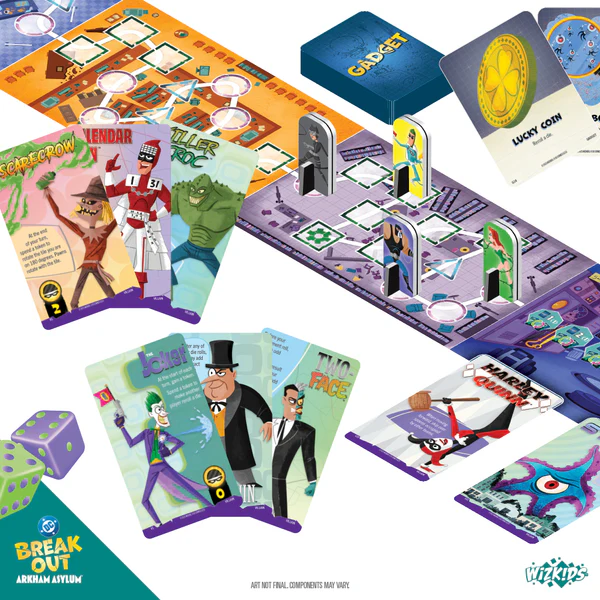
DC Breakout has a generous cast. There is a jailhouse of iconic Batman villains here, including the expected Joker, Catwoman, and Poison Ivy. But there are also deep cuts like Condiment King, Red Tool, and Kite Man. It’s a strange lot, but there’s no complaining as each of these heels boasts a unique power. Yeah, I don’t know who this loser strapped to a kite is either, but he allows you to fly to the space of another character on the same tile, which is smooth as hell. But let’s talk about the track, as a majority of these criminals provide effects that interact with the unique layout.
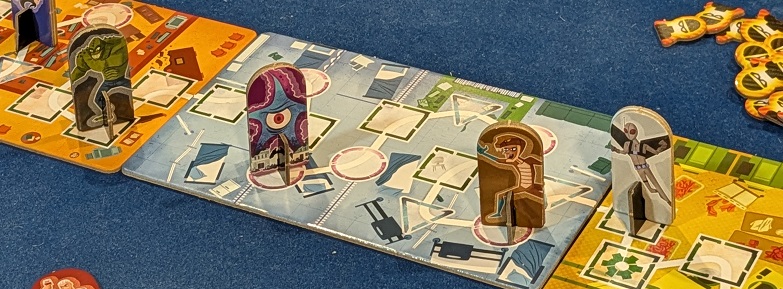
Instead of a full board, we have multiple square tiles that are randomly assembled. The quirky design consists of spaces of various shapes. While the visual result is a bit of a mess, this feeds into a philosophy of rewarding racers for landing on particular spots. Egghead – another B-side nutjob – has you predicting whether you will land on a square, circle, or triangle each turn. Red Tool offers a bonus movement if you start your turn on a circle, and a bump of three if you begin on a rarer triangle space. This is fairly typical and you will be throttling powers based on possible destination spaces.
Look, some people think Magical Athlete suffers from having zero agency. Many of us zealots see this not as a problem, but a feature. My friend Aaron has described it as a windup toy you let loose, which is a perfect analogy. DC Breakout allows you to be a little more active behind the wheel. It does this by leaning into limited use powers. This is a huge push away from its influence.
Many of the characters begin the race with a set of tokens. Every time you use their power, you discard one of these charges. Run out and you’re a regular joe in stripes. This creates a decision structure that is significant in terms of manipulating the game state, particularly when you consider that multiple players possess such abilities which creates overlapping forked possibilities. Outcomes become less predictable and this more active player state creates a degree of focus.
This is the touchiest part of the design. By utilizing limited uses, the range of powers develop in interesting ways. Unfortunately, it also fosters for more directed aggression. The Joker is the best example of this. Each turn the Joker gains a token, and he may spend that token to make another player re-roll their movement die. Now, even though he has a constant drip of tokens he still needs to be a little choosy on how to use them, especially if you’re playing with a big group. The niggle here is that this power is not only somewhat boring, but it also feels bad. As in, directly bad since someone is explicitly targeted by choice. You stop a player mid-celebration as they’re coming off a hot “6” and tell them “nah, loser”. Deadshot similarly spends a charge to negate someone’s ability. Poison Ivy burns a token to make racers move backwards. Deathstroke makes another player lose a turn.
While this may be over-dramatizing, I think these abilities fundamentally change the experience. What really works in the low stakes tone of Magical Athlete is the frivolity, the embracement of mirth and playful nonsense. It’s defanged and silly. When I’m Big Baby or the Banana, it’s not my fault I stonewall you or make you faceplant. It’s just part of the gag. We can all laugh at our own misfortune as well and join in the fun. But when people are deciding to use precious resources to jam up another player, the game gains a bit of a competitive edge. It’s no longer scatty and instead is stern. People in groups that tend to be more vocal may start negotiating and pleading their case. Protests such as, “why would you make me skip my turn when I’m not winning?” begin to materialize. This can slow the game down, but more importantly, it positions the design in a contentious stance. It’s materially less goofy and instead a smidge malignant. Now, this does perhaps fit the theme permeating the evil cast, but it’s a slightly subversive approach that causes friction. The tone isn’t as becoming to a flighty roll and move game.
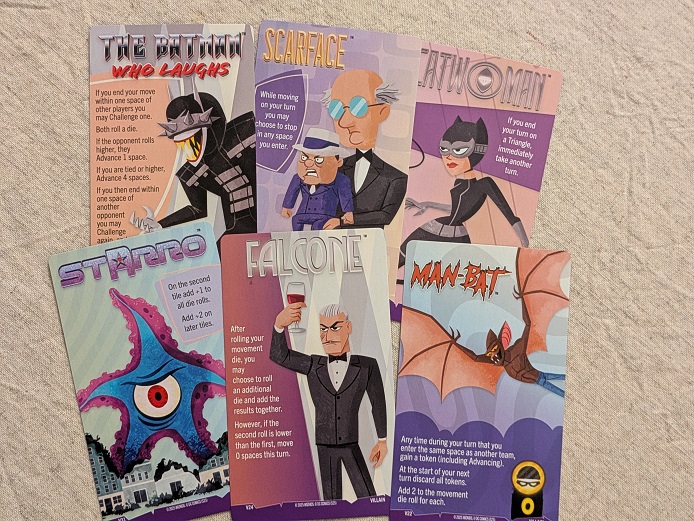
While I find this methodology less than ideal, there is a design element here that is quite gratifying. Instead of selecting a single villain for each race, you’re actually pairing two characters and benefitting from both of their abilities. This is clever and implemented superbly. It allows you to craft combinations of powers that amplify each other and produce layers of synthesis. This deepens player agency, again addressing that common complaint with Magical Athlete, and establishes increased investment. Since there’s a greater degree of personal responsibility, it dovetails thoughtfully with that heightened sense of competitiveness to produce a slightly more cerebral experience than expected. The huge stable of characters also is integral to this system, as it allows for enormous diversity and strategic experimentation.
There is a great deal of possible discussion with these characters. As I said, they’re the spirit of the game and the main reason to engage DC Breakout. With that being said, the final point I want to analyze is their nature. The philosophy is somewhat different than the design’s forefather and it’s worth digging into. I’m not talking about the targeting abilities, but rather that there’s a penchant to lean into probabilistic faculties.
Let me explain.
In Magical Athlete we have weirder and more conspicuous character powers. Stuff like M.O.U.T.H. eating opponents and Flip Flop letting you swap positions repeatedly no matter the distance to the target. They’re a little more vulgar and lead to broken or near broken game states more often. This is mostly true at the extremes, as there’s a middle ground of roll manipulation and other similar effects which strongly overlap between both games.
DC Breakout feels more refined. It’s more nuanced and, as I said, probability oriented. This is because a large number of the powers have you concentrating on which shapes you land upon, using odds-based tactical decision making. In addition to many abilities centered on the board layout, you also have to weigh the potency and timing of using your charge tokens. Finally, a new flourish, Gadgets, adds one more single-use effect to consider.
Gadgets are neat. They’re cards you draw when landing on certain spaces. You also gain a number of them depending on your finish in the first of the two races. It’s really the main benefit of doing well in the initial scurry as your finishing position otherwise doesn’t have a large effect on the game’s overall outcome. These Gadget cards can be very powerful, however, and broadly follow the same framework as character abilities. Examples include the Pogo Stick which adds to your movement roll, Vorpal Grease which shifts all other teams back a space, and Fickle Fingers of Fate which have you autoroll a five for your turn. It’s satisfying to pull these out of nowhere and leverage an effect no one saw coming. The mystery adds a nice touch to enhance tension, and the majority of effects lead to a dynamic game state. And like the character selection, there are a charitable number of Gadgets included.
But this highlights how there’s a homogeneous identity found across the powers in this game. A lot of the differences between effects are realized through shaping the calculation behind the experience, which is subtle at times. This is echoed with the board design. None of the map tiles feel distinct. They all have different orientations of circles, squares, and triangles, but there is no personality. I would be flabbergasted if someone said they had a favorite map tile. It’s just not discernible as all of the variance is down in the math and not at all evident on the macro scale. The variety seems included for managing outcomes and creating uncertainty, not for meaningfully altering the identity.
All of this is fine, but DC Breakout is at its best when it punches through the finer details. This is when a player crafts a combo of powers that stretch the mechanisms and risk sending the game off the rails. Occasionally this results in a blowout where someone forms a supercharged aerial tag team of Man-Bat and Firefly, rolls a six, and moves 36 spaces for an easy win. In my experience, these unhinged synchronizations are relatively uncommon, and the majority of races came down to a very close finish. But honestly, the explosive moments have been the most unforgettable. There’s a tension there, primarily caused by the suite of character effects mostly promising wackadoodle carnage and only rarely delivering it.
Now, let’s talk about the most important division between DC Breakout and Magical Athlete. I’ve alluded to it throughout this text, but we must address it head-on. From my experience, the setting and character of each of these games is something which seems insignificant on paper but is the most singularly important trait when it comes to the actual experience of play. A lot of the hard work is being done in the margins, tweaking abilities and developing a huge swathe of effects, but ultimately, those details don’t necessarily move the needle when it comes to how people receive these two titles.
Magical Athlete is all in on its absurdity. The School House Rock aesthetic is so damn good. The colors are vibrant and the tone is perfect. Everything is working in unison to deliver a specific vision. DC Breakout is no slouch. Ryan Goldsberry’s illustrations are front and center, and this game possesses a strong atmosphere. It unfortunately lacks the small touches, such as the chunky wooden meeples, the outlandish instruction manual, and the bonkers tone. There’s this sense of energy emanating from Magical Athlete’s absurd facade that fosters an energy and buy-in which isn’t present in DC Breakout. It’s the enchantment also seen in the recent hit Hot Streak, and it’s a quality difficult to formalize. That attribute is hindered with the Batman setting and median physical production. To some degree, it’s unfair to judge DC Breakout relative to the genre’s best in class title, but I think this act is illuminating in pointing out its strengths and weaknesses. It’s also present on the mind due to the proximity in release timing.
One interesting thing I’ve noticed is that the most ardent fans of Magical Athlete struggle to find DC Breakout: Arkham Asylum as fulfilling. For these people, this newer design has a difficult time getting out of the shadow of that classic. The comparison acts as a thief of joy. Yet, those who are not as enamored with Ishida’s work have found something more resonant and robust in this Engelstein offering. Those unimpressed with the windup toy approach appreciate the increase in agency and the more active stance. I completely understand why someone would dearly appreciate DC Breakout. This is a fine design that does many things well, and it’s clearly been crafted with a deep love for its influence.
A copy of the game was provided by the publisher for review.
If you enjoy what I’m doing and want to support my work, please consider dropping off a tip at my Ko-Fi or supporting me on Patreon. No revenue is collected from this site, and I refuse to serve advertisements.

