
War is morally questionable, at best a compromise between inaction and horrific aggression. The societal and human costs are often extreme. There are benefits, however. Achieving independence. Ending tyranny. Freeing an enslaved population. Often, violence is the only remaining option.
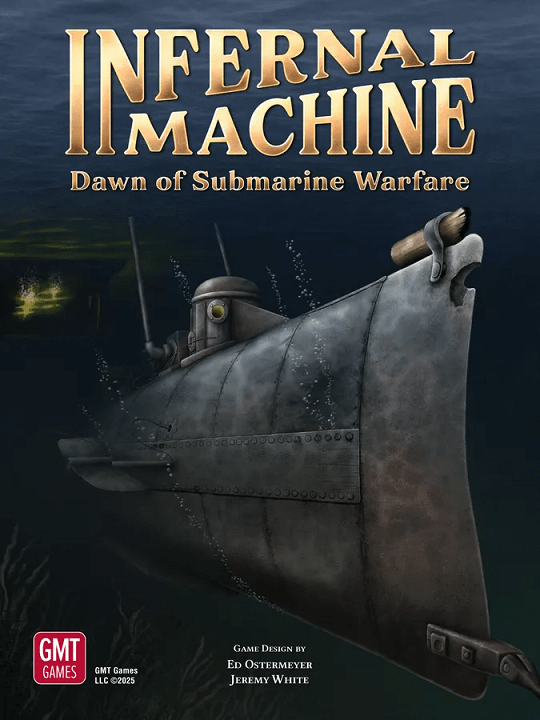
Rapid technological advancement is another benefit. One typically overlooked due to its insignificance in contrast to the costs of conflict. We’ve seen this throughout history where industrialization and innovation have flourished under the fertile soil of war. Infernal Machine: Dawn of Submarine Warfare is about just that. It sits at the uncomfortable crossroads of capitalism and bloodshed. This is an ethical quagmire of a game, one that attempts to handle its premise with maturity and care. Regardless, innovation struggles to get out from the pallid shadow of death.
You’ve been down too long in the midnight sea
Oh, what’s becoming of me?
This is a game about contrasts. It features multiple mechanical frameworks butting up with one another, just as its themes uncomfortably intersect to produce a wider and more effective picture. Explicitly, Infernal Machine is about the designing, developing, and operating of the world’s first submersibles, called fishboats. The impetus is wealth and the marvels of engineering. The backdrop is the American Civil War.
While this is a game with wide scope, it features a rather narrow beginning. This is because it’s exclusively a solitaire endeavor. Over the course of several hours, you will spend time engaging a loop of developing a fishboat, manning it with some of the bravest – or perhaps insane – individuals, and embarking upon dangerous missions where your creation will be tested on the front lines of the conflict. This is a wild endeavor, one more akin to space exploration in the midst of combat. In this way, it feels as though you’re researching and developing new technology, pressing human and machine to their limit for legacy. This underlying curiosity does a great deal to instill fascination and wonder as guiding principles that compete with the sense of horror and futility. These traits function as the guiding light of the design.
From a high level, Infernal Machine is reminiscent of another solitaire game. Procedurally, it has a similar identity to Avalon Hill’s 1981 hit B-17: Queen of the Skies. That design has players manning a B-17 Flying Fortress on bombing runs over Europe. Both are all about the process of determining randomized outcomes based on a proliferation of modifiers which adjust die rolls that determine results on a table. There are lots of tables. And die rolls. And modifiers.
Imagine a situation where your scrappy fishboat manned by eight brave souls has snuck through the enemy blockade of Charleston. You’ve located your prey, the U.S.S. Housatonic and plan your approach. To begin the assault proper, you roll a 10-sided die to determine your starting vector. Make sure to add three for your experienced crew. After rolling, you set your crew’s crank intensity. Yeah, they’re hand-cranking this creaky bastard to power it. You decide to give it all she’s got and set the crank intensity to strain for a further +3 modifier. This then adds two fatigue tokens to the cranker and a red cube to the fate pool.
The fate pool is neat. It’s a bag building mechanism of black and red cubes, with the former denoting success and the latter indicating catastrophe. It functions as a secondary resolution system used more sparingly than the die rolling and is the culmination of several decisions made along the way.
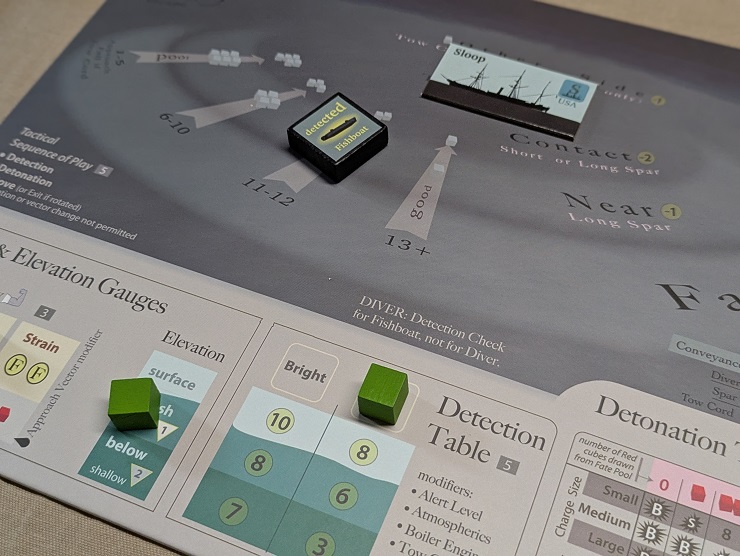
So, you’ve added a red cube. That’s not good but it’s a tomorrow problem. You have your approach vector and can place your fishboat counter on the tactical board. Now, we can start an actual round which begins with a detection roll – modified by the enemy’s alert level – to see if you’ve been spotted. If you’re spotted your submersible token is flipped to detected. Blow the roll again and you start getting shot at. That’s another consolidated process of rolling, setting crank intensity, and evaluating a chart. Possibly taking damage which can result in malfunction and even the death of crew members.
After the detection phase, you may target the enemy ship and attempt to set off your charge by ramming them with the spar at the nose of your boat. But you’re currently too distant from the Housatonic so you need to spend the turn closing. That’s the round. You repeat this, eventually getting close enough to detonate your payload while hopefully avoiding enemy fire. There are more charts and modifiers based on things like visibility, weather, and your fishboat’s depth. The concussion of your own blast may severely cripple or outright destroy your ship. This is dangerous business and your fishboats often never make it home.
You can see his stripes but you know he’s clean
Oh, don’t you see what I mean?
This is the Tactical portion of play. It’s only one third of the game. This is a snappy joust where you make an attack run and escape, everything wrapping up neatly (or messily) in maybe 15-minutes. The other phases scale aggressively in complexity and intention.
Let’s work backwards, slowly zooming out. This is exactly how the rulebook teaches the game, applying rules from an inside-out approach. The technique is well-executed, with guiding scenarios teaching as you go. I applaud this effort as Infernal Machine’s complexity is high and dumping everything on the player without proper pauses would have been awful.
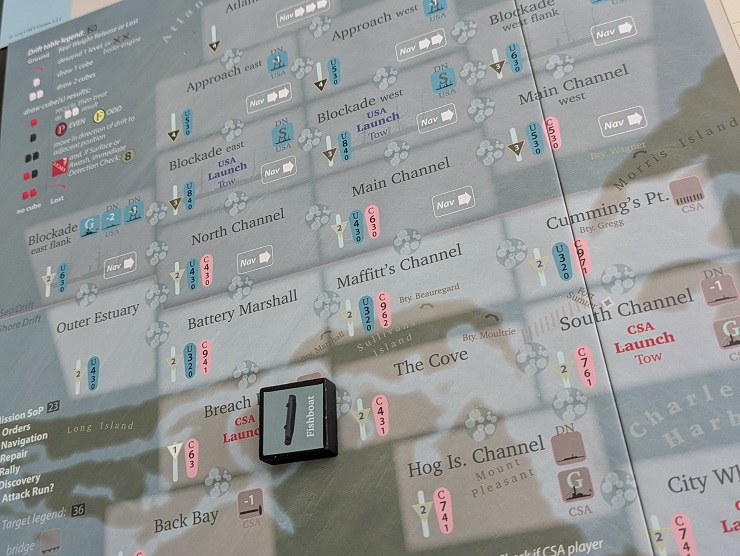
Panning out, we now have the Mission phase. This is a high-level view of an area of operations, such as Charleston or Richmond. You now need to navigate across sea zones with various enemy threats as you attempt to avoid detection and maneuver around obstructions. You have to consider new details, such as target checks to locate your prey, navigation cards which dictate your fishboat’s drift, and crew morale which can scupper your mission. The additional layer here is enormous, as illustrated by the Mission board which is much larger than the Tactical and Fishboat displays.
The process of navigating the battlefield is laborious. It follows the ongoing trend of referencing multiple other components and charts, requiring its own set of player aids with heavy instruction. As complexity begins to pile atop complexity, it’s easy to accidentally miss a die-roll modifier or forget a sub-step. Most of the time this doesn’t really ruin anything, it just creates this eternal asterisk hovering about the session.
But what’s wonderful about this portion of the game is that it effectively conveys the breadth of the mission. You’re not just clumsily pointing a large can at a warship and slamming into it like a narwhal with dynamite on its horn; you’re navigating treacherous waters and trying to pierce an enemy blockade in a fragile piece of machinery that is nearly untested. This whole business is psychotic, a perfect display of hubris as humans are crammed into a shoddy coffin and descend willingly into what is likely a watery grave. By pulling back and showing the context of the nearby environment, a sense of scale is achieved that only heightens the tension and near-futility of the endeavor. This in turn amplifies the emotions associated with success, as you shrug off crew death and endless malfunctions to achieve glory. What we have here is the type of drama you read about.
You’re the one who’s clean
Holy diver, holy diver
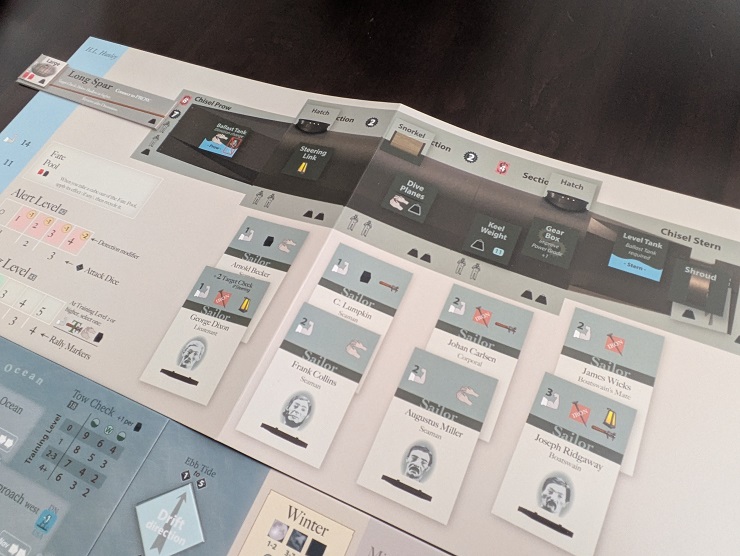
Zooming out once again, the final frame is the Campaign game. This is the hardware fastening the various components together, the long view which adds purpose and integrity to the experience. You have investors, funds, a stable of crew members, training, campaign level events, and all kinds of new tables, aids, and modifiers. It’s a lot. But it’s also worth the trouble.
I find this the most compelling portion of the design, which is surprising due to the increasing abstraction. The constraints add to the intensity of your missions, and the focus on a longer term elicits various tradeoffs that are difficult yet satisfying to contend with. It’s sort of like running NASA while then taking time out to run the nuts and bolts of the actual missions. While the nation is at war. This contrast in perspective and scope is fantastic, providing a complete picture to what would otherwise be a limited simulation.
What’s particularly great here is that you’re forced to live with your choices. You can’t push the buck off on another. The decision to place your expert mechanic on that risky mission in a cheaply built submersible turned out very poor. You have to live with it. The loss endures. Deaths resonate. The destruction of a fishboat you poured hours of labor, engineering, and money into is incredibly harrowing. The loss endures.
The two separate concerns of life and money intermingle in an uncomfortable way. That’s the beauty and horror of it. While peering over the board, nudging little counters and contemplating on how to improve your design, those losses hang over you like shadows evading the light. Infernal Machine places you into the role of businessman, engineer, and captain. It flirts with divine empowerment but ultimately claws back that control and leaves you powerless at times.
Coming after you, holy diver
Oh, holy diver, yeah, alright
Let’s return to that earlier comparison of B-17: Queen of the Skies. The designers of both titles strongly captured the fragility of their centerpieces. Every time you push out from port, you can feel the pressure fighting to cave in your skull. Every blast, every malfunction, it’s an absolute terror.
Much of this unfurls through rolling to see what happens, with a lot of busywork in between process and outcome. It’s the type of busywork many detest, the people citing lack of agency as an affront to gaming. But it’s more than that. There are nuanced and meaningful choices woven throughout. Often, they’re subtle, with the importance of any one decision rippling throughout the experience. When you decide to crank at a high intensity and add a red cube to the bag, that may be the reason you never make it home, your fishboat eventually succumbing to catastrophic malfunction and being ripped apart by the current.
This percolating agency is where it leaves formation and departs from B-17. It offers a broader sandbox experience where you shape much of what happens at all levels. Being in charge of the contours of play, primarily through the management at the Campaign tier, places this game in its own unique category.
This is a very dense design. There are many player aids covering the various phases and systems. You will get things wrong, probably multiple things. It’s undeniable that a lot of your time will be spent on following instructions and parsing out the little details. You’re not only the businessman, engineer, and captain, but also the physics engine keeping it all in motion. It asks a lot of the player, returning it in rich simulation, extraordinary history, and gripping narrative. Playing a full campaign takes seven or eight hours, but by the end, you feel like you’ve been through an epic historical drama.
I find it interesting how this game manages to detach from its context at times. Some of the weight of its subject matter is kept at a distance due to the barriers at the Campaign level. Mental weight often orbits around engineering as opposed to bloodshed. There’s a buffer between loss of life on the opposing side and your own culpability due to the detached and impersonal notation of the target. Losing your own is far more terrible, as they have names and personalities and fleshed out skill profiles. Their loss isn’t only emotional, but it’s also mechanical. There’s an intimacy there that is extricated from the terrible profession of war.
I also am delighted by how the game’s overall design so perfectly mimics the foibles and challenges of its subject matter. Navigating this vast ruleset is creaky at times. It can feel as if the game is going to fall apart as you cross-reference rules and charts and die rolls. You miss a modifier here or realize you misinterpreted something there. These are little leaks. Malfunctions. Coming out the other side is glorious, but it can often feel as though you never will. There’s a certain sense of lunacy here that parallels the feat of fishboatin’.
Like many GMT products, the details are strong. There is supplemental background material, a wealth of components, and a great deal of content. It smartly allows you to play either side of the conflict, running a Union or Confederate aligned enterprise. I would argue it’s less about that context of the war, and more about the internecine conflict of human, machine, and environment. You do big things in this game because you engage in extraordinary risks. The sense of satisfaction accompanying the entire process from design to execution is immense, rivaling the contentment of any game. The question is whether you’re cut out for all the work to get there. Infernal Machine requires a level of dedication that’s akin to studying for coursework or prepping for a major test. It’s a lifestyle game for one, something which you can’t only sample from time to time. This will be devoured by some; others will bail out and get lost in the drink.
A copy of the game was provided by the publisher for review.
If you enjoy what I’m doing and want to support my work, please consider dropping off a tip at my Ko-Fi or supporting me on Patreon. No revenue is collected from this site, and I refuse to serve advertisements.
 Player Elimination
Very nice review – I am playing this game too and really like various zoom in and zoom out levels!
LikeLiked by 1 person
I’ve seen some of your social media posts and thought you were enjoying it. It’s a unique system that offers a lot to explore and dedicate yourself to.
LikeLike
I agree with the comments about B17, but I would also suggest Enemy Coast Ahead Doolittle Raid as another GMT offering that starts out with the bombers at the target area to, when the game is in full flower, the player is picking crew members and determining how the bombers will be configured. This could also be exemplifies with older games such as Tobruk by Avalon Hill
LikeLiked by 1 person
Sounds interesting, I will look into it. Thanks, Jeff.
LikeLike