
Tag Team was a noteworthy competitor in 2025. Its combination of smooth card play with the unpredictable drama of auto-battling forms a compelling build. So compelling in fact, that it seized my affection previously allocated to games like Unmatched and Dice Throne.
Anyone with eyes could see this new Scorpion Masqué title was not a one-off. This game was clearly destined for a lengthy commercial lineage. Arthur’s Legacy is the first such offspring, a new standalone set that offers a glimpse into how this system will mature. There’s no real surprise or heel turn here. As expected, this new offering piles more iron, scales, and blood upon the hardy bones of its ancestor.
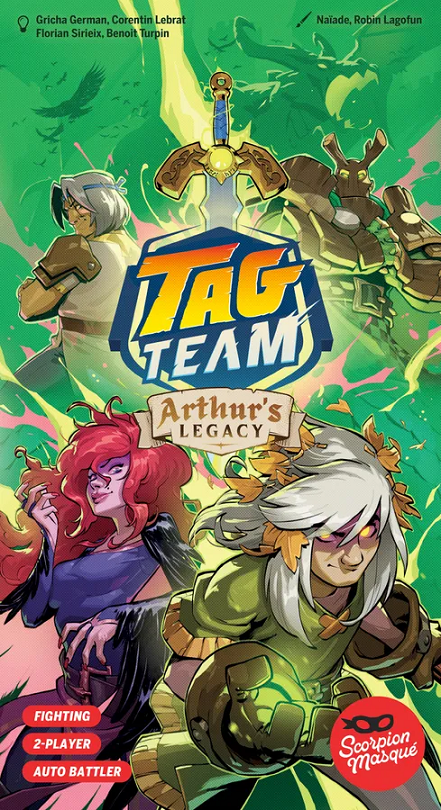
Tag Team’s anachronistic backdrop is a safe approach. The original set was no holds barred, including cowboys, mythic shapeshifters, and golems. This type of setting is fun and certainly appeals to wider geekdom. It has the pitfall, however, of possibly slipping into generic mélange. When you throw everything at the wall, the wall tends to look like everything. Which is to say it looks like nothing.
Unmatched solved this problem. Tag Team is swiping the idea.
By releasing themed sets, clusters of character arrive with a sense of coherence. It appears less random or slapdash and instead ordered or tailored. The focus of Arthurian setting, albeit with anime stylized artistic liberty, establishes an identity to frame the experience around. In the future, it will be easier to distinguish this set when discussing its characters, as well as chart the game’s trajectory over the long-haul.
This is why Unmatched’s Cobble & Fog is so much more effective than Battle of Legends, Volume Two. Despite it being year’s since my last play, I immediately know the former hosts villains such as the Invisible Man and Dracula. But who the hell is volume two?
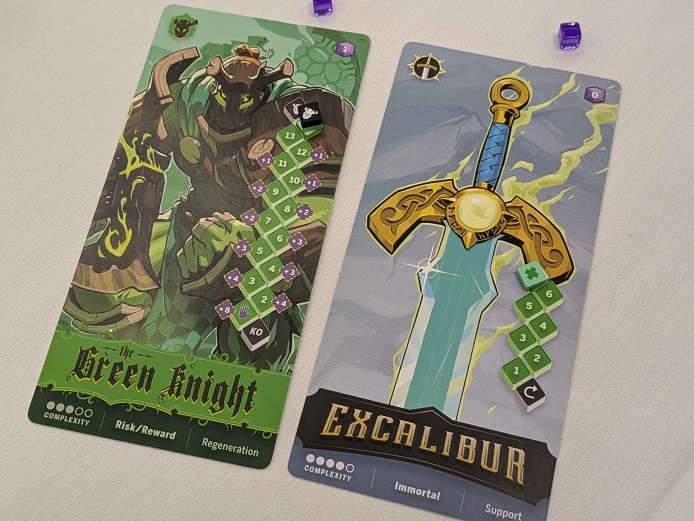
Arthur’s Legacy is a strong cast of six characters. Well, five characters and a sword. Don’t fret, Excalibur is a badass and maybe my favorite fighter in the box. It’s impervious but often doles out aggression at a high cost. This allows for some really potent combos such as pairing the blade with the enigmatic Green Knight who can heal himself from the decay inflicted by this wondrous artifact. Each of the new characters is distinct in such a way. The design team displays a strong understanding of the game’s strengths and manipulate them in interesting ways.
One legitimate criticism pertains to the meagerness of this lineup Six total options feels substantially fewer than the 12 of the original set. This is a bummer, especially because you could effectively play two simultaneous bouts out of one box previously. Now that’s impossible due to the reduced roster. This smaller cast functions strongest as an addition to an existing Tag Team collection. It’s worth sticking to just the Arthurian combatants for a few skirmishes, but sooner rather than later, you will want to throw Merlin out there to fight alongside Shango. Or see what it’s like to tag team a dragon with the man-bear Bödvar. I imagine a couple of years from now, we will see all kinds of loopy teams. I’m personally hoping to beat the hell out of the Savannah Bananas and Dungeon Crawler Carl with the iconic duo of Jareth the Goblin King and Omar Little. Sure, it probably won’t get that weird, but a person can hope.
This new set is very familiar for fans of the original game. While each of the new fighters avoids derivation, there’s nothing altogether crazy here. There are no new modes or modules. No new rules tweaks or functional changes. This is purely a content expansion. More of the same.
That’s of course, fine. The format of combining two fighters to make a team means that additional fighters enhance the existing spectrum of combos. These characters overall are not more complex or sophisticated than the base game, so I wouldn’t urge a newcomer to avoid Arthur’s Legacy either. It’s just a steady, workmanlike production whose notes land exactly where expected.
Workmanlike is an interesting word, as it betrays the hesitancy I broached in my initial review. Tag Team is a high-quality design, one that lands smoothly and pleases. But this two-player quick dueling category just can’t quite get over the hump. I find that it falls into a similar space occupied by Roll & Writes, and to a lesser extent the new wave of Trick Takers: functionally empty calorie gaming.
This is something I’ve thought about a lot. This has perturbed me as I’ve cracked back into Tag Team and ruminated on my abandonment of Unmatched. These games that deliver a quick jab – able to be set up, taught, and played in a half hour at most – lack the necessary power for permanence. They don’t have the immersive experience and tactile delight of a miniatures skirmish game. They don’t have the rich and layered constitution of a more complex card game. And particularly for duelers like Tag Team and Unmatched, they don’t even have the larger shared experience of a multiplayer game.
For me, these games tend to be played because they fit into a time slot. They’re not the reason I get together for play. If I have a night of head to head gaming on the schedule, Tag Team will only be lifted off the shelf as a commercial break. An intermission to catch a breather.
What else would there be?
I recognize this isn’t the case for everyone. Tag Team is a well-crafted title. It harnesses the auto-battler format to produce a similar windup toy effect to Magical Athlete, one where you take your team, build their deck, and loose them in the wild just to see what happens. People dig this game. I dig this game. But it feels like a product of its time. One which returns to basics, in this case the classic game of War, to produce something fresh and simple. Something which we can fit into our busy schedules and squeeze out more plays. Something which we can purchase cheaply and wring life out of. It’s the opposite of the bloated big boxes that take and don’t give.
Perhaps more accurately, Tag Team is the equivalent of an app game on the tabletop. I do not mean that pejoratively. It’s vibrant, easy to start up, and provides enough strategic consideration to produce satisfaction. There is continual feedback integrated into the card resolution which results in a steady dopamine release. It has even opened the spigot of DLC with a promise of endless content. This product is a bruiser, one that will have enduring success. It’s also a testament to Scorpion Masqué’s unique penchant of coupling creative product development with unusual game design. They continually manage to produce titles with mass appeal that smuggle in peculiar ideas.
A copy of the game was provided by the publisher for review.
If you enjoy what I’m doing and want to support my work, please consider dropping off a tip at my Ko-Fi or supporting me on Patreon. No revenue is collected from this site, and I refuse to serve advertisements.


dang, I‘d pay a premium to see Omar Little in Tag Team. Or in Unmatched, actually.
We have started a domestic run of Tag Team games, but it has much fewer calories than Unmatched for us. I agree, that‘s not a bad thing, but I do wonder if Tag Team will stand the test of time as Unmatched has.
Which, Sir, I‘ll have you know, has a great co-op mode and workable competitive multiplayer modes. Good day to you, Sir!
LikeLiked by 1 person
Omar coming around the block!
I never enjoyed the Unmatched competitive multiplayer. It always seemed to pale to the two-player mode for me.
I do actually like the cooperative play. I reviewed the original Unmatched Adventures set and, at the time, really enjoyed it. Over time, I’ve just not felt the strong pull to go to it very often. Other titles have hit much harder in the miniatures game category in my opinion.
LikeLike
I like Tag Team and was seriously considering getting this.
But the cost at my game store was almost as much as the original set, and there are far fewer fighters in it!
I know as reviewers, we don’t talk about cost, but it’s too bad that what could be a really nice set isn’t getting purchased because of that.
I might feel differently if I played the game more?
But anyway, nice review as always!
LikeLiked by 1 person
Yeah the price is high for the content, or at least it’s high compared to the standard set by the original set. I believe it’s only $5 cheaper MSRP with half the content.
I don’t have any interest in defending a publisher, especially their pricing model, but I do wonder if the print run is smaller as they expect this to be less popular. However, it could be the case the print run is even larger than the initial Tag Team release due to riding on the game’s success and expected sales of new content.
LikeLiked by 1 person
I got this at Gen Con because I really liked the original, but I haven’t been inspired to break it out yet. I like King Arthur and all, but I think 6 characters from this same genre/era really throws off the wild variety of the first set. I would rather have seen them follow Smash Up’s path of releasing varied sets with some vague connection to keep the silliness going.
LikeLiked by 1 person
That’s understandable. I think over time, a combination of lots of themed sets will accomplish that.
LikeLike