
After a decade of work, Jenna Felli continues to evolve and shirk a single design style. One continuing trait that has stuck around since her origin is an embracement of the bizarre. But even that is possibly on the chopping block. From Shadows of Malice to Zimby Mojo to Cosmic Frog, I’d dare to say, her games have gotten less weird. The Mirroring of Mary King was an unusual and compelling design, but Murray the A**hole Frog was a twisted take on set collection with a stroke of spite. Even the aforementioned Cosmic Frog was a resource gathering game that wasn’t too odd if you looked past the setting.
The WItches of Willowspur is the continuation of this soothing of the strange, another step towards wider appeal and a more welcoming veneer. Death and destruction are nowhere to be found, instead replaced with comfort and companionship. The very goal is an act of empathy as you seek to break an evil curse and free Murray from his toadness (yes, the same Murray). Most prominently, this also bucks the trend of Felli’s cutthroat approach as it’s the first cooperative design in her oeuvre since Shadows of Malice. That alone is worth exploring.
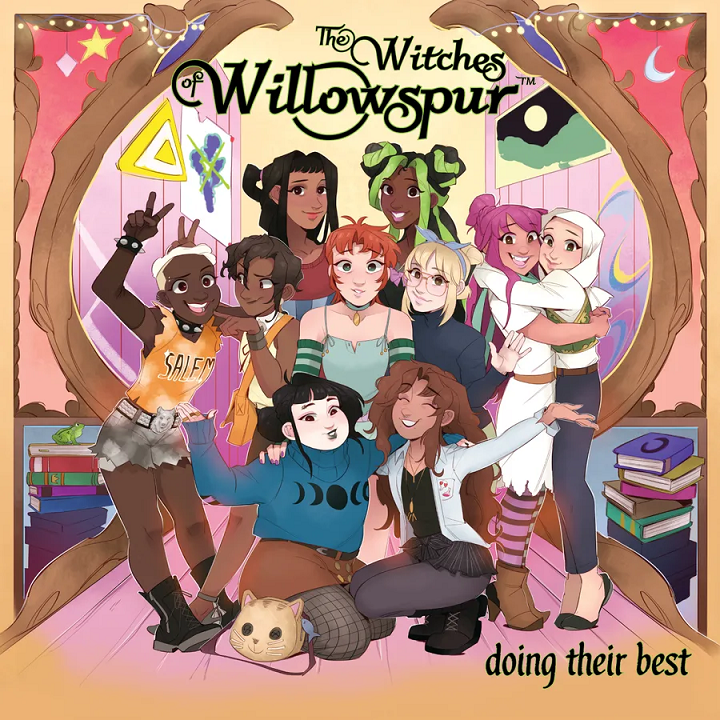
Look, it’s still a little weird. The cover is the first hint. It presents a welcoming and joyful tone. Maybe even that dreaded word “cozy”. But it ain’t that. This is a medium-weight Euro-style game of efficiently gathering supplies, crafting potions, and coordinating group actions. There is a strong theme of partnership and support, but it’s one that rides shotgun to the bevy of action options and myriad system considerations. Make no mistake, Willowspur is every bit as chunky as Cosmic Frog, offering a two-hour hop of counter-mischief.
The second indication of unusualness is the introductory narrative. There is a full-page preamble of what’s going on in the story, why you’re here, and what your objective is. The pitch is that you’re trying to undo a curse your evil witch mothers enacted. They’re the baddies that turned Murray into a frog. There are multiple princes in the storyline, a king and two queens, intra-dimensional regions, and so on. It’s a lot for a plot that could be a Disney Descendents film.
Another place where this is classic Felli is in its structure. Turns are pretty simple. You do one thing. One action. But to get to this one action you have to decide on a location you’re visiting first. Each location has a sub-menu of possible activities. This is all handled pretty tightly with a trio of cards. You place the card of the location you want to visit in front of you, and this card doubles as a reference for the possible actions there. But if you look at the elaborate player aid that offers a more analytical framework to the sequence of play, the process comes across as obtuse. It’s certainly complete and a useful reference, but it also belies the simplicity of the game’s loop. There’s actually a lot such obfuscation going on.
The whole location compartmentalization is only minorly useful. Witches need to be at the same location to cooperate, as well as to affect each other with spells or their unique character powers. More importantly, what this reveals is Felli’s penchant for narrative contextualization. This is a game like Android: Netrunner, where keywords are provided not just for mechanical reasons, but also to reinforce setting.
How about an example. Part of the risk of actions in this game is gaining suspicion. Suspicion is measured by an individual track on each player’s board. As teenage witches, you are evading the watchful gaze of your evil mothers and trying to keep a low profile as you undermine their efforts. High suspicion means you’re struggling to remain hidden and will likely suffer when your mother occasionally visits with you.
When this visitation occurs, you reference your current level with results on a suspicion chart. Just one suspicion? Then you’re questioned. Two or three? Lectured. Four and five is scolded and so on. These terms are highlighted but don’t indicate their own mechanical outcome. Instead, the chart provides an outcome, and these bolded terms are provided for setting purposes. Or possibly to give the associated outcome a reference title, but that proves inconsequential as these terms are never mentioned anywhere else.
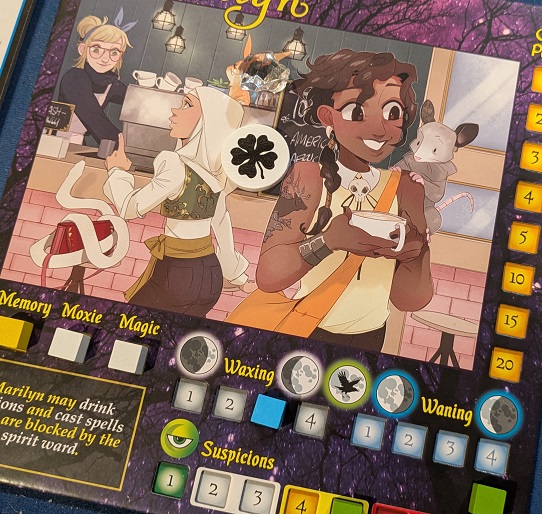
I welcome this smuggling of setting and narrative context into the game. I delight in using terms like ICE and Grip in Netrunner, and I delight in referencing Moxie or Bound in The Witches of Willowspur. But this points to the general complexity of the design and re-affirms that this is not as light as the tone seems to indicate.
This mention of suspicion brings us to the dice. They’re a little wonky. Most of the actions in the game – such as visiting the wilds and drawing cards to gather ingredients or bewitching the townsfolk to accrue crystals – requires you roll a pool of dice and check for successes. Dice pools have an RPG flair where they’re boosted by a relevant personal stat as well as the number of characters participating in the action. This is the game’s primary conduit for cooperation and an enormous element of the system.
So, coordinating which witch performs which action is key. Those with strong stats for the relevant activity will want to be the ringleader, while those with lesser competency will want to support. This works well as a coordinated structure. There is a lot of discussion up front at the beginning of the round as the group forms a plan. The action system facilitates this. But the oddity here are the dice.
The dice are nice beefy eight-siders, but get this, the majority of sides are blank. Two faces have successes and one has a suspicion result. The other five are as black as the cover of Smell the Glove. Generally, more successes mean more resources gathered. Suspicion results increase your suspicion of course.
This system feels like a transmission stuck in first gear. The probability of success remains low enough that even large pools of dice often result in little impact. This establishes a bit of a malaise when it comes to the randomizers, with drama that is miserly at best. I understand the purpose as this game feels thoughtfully designed in terms of its mathematical core, but the dice are robbed of their primary benefit. There’s no real excitement in this resolution system and it has a downstream impact of commonly resulting in limp turns. Frankly, many will simply find this too parsimonious.
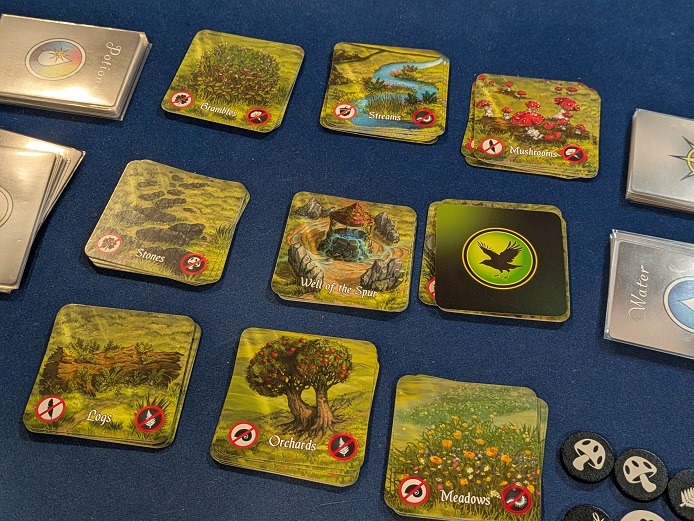
With the dice and resolution taking a back seat, the real oomph of the experience then emerges from the social coordination. This is the bright spot the of the game, taking the core recipe fulfillment and harnessing this in a cooperative format with layered considerations.
Besides the obvious teamwork of combining actions, there is also a deliberate effect of limiting spellcasting and potion-usage in the framework of a puzzle. There are four types of spirits that function as suits effectively. Each potion and spell in the game is powered by one of these spirits – which gives the card a suit. You can only use one of these spirit-powered effects if the particular suit is not currently warded. And whenever a potion or spell is utilized, its suit becomes the new warded spirit until a different one is used.
This is a nice touch as it represents your evil mothers working to counter your efforts and block your progression. But more importantly, it forces players to work out ahead of time which spells and potions they will use. Imagine this, I want to cast a serpent spell that will boost the number of dice I roll when gathering resources from the spring. But Ben wants to down a serpent potion which will allow him to look at the top of the spring deck and possibly bury a card before I forage through it. For these actions to sequence properly, we need another player to cast a spell or gulp a potion of a different spirit in between our turns. This way the ward will move off of serpent before I cast my spell, allowing me to enhance my action and gather more resources.
These sequences of planning are the meat of the game. They’re what The WItches of Willowspur is all about and the most fulfilling aspect of the experience. If you don’t enjoy strategy discussion – or find your group susceptible to quarterbacking – then you won’t find much fulfilling here. It’s also worth recognizing that this is the main culprit in extending the length of play. At five or six participants it is very long and will clock in at around three hours. The game settles more comfortably with three or so players where rounds are quick and sharp.
There is another oddity at the higher player counts that emerges from the system. Turn-to-turn you are really focused on two main tasks. You are primarily gathering resources such as shells, centipedes, and water to either craft potions or permanently increase your basic stats. Both are useful and both increase your group’s final game scoring. Stat boosting, however, is weighted more heavily in that formula, and it also provides better long-term boosts. It’s more difficult and takes more time, of course, but usually it’s worth the trouble.
The problem with larger player counts is that the incentives skew even more heavily towards statistic modification. This is because each player has an elixir formula they need to concoct in order to boost their trait. Potions have similar formulas but they’re simpler. In a low player count game, you will often gain resources that are not useful in the elixir recipes spread among the few players at the table. In larger games, nearly every resource can be utilized due to the volume of elixir formulas in play. Since boosting a stat is a better return, the group will save these resources and trade them between players to craft elixirs. Why spend the acorn on a single-use potion when you can combine it with a mushroom and jack up your Memory stat? It’s worth more points later and you get a bonus when rolling for actions that utilize Memory.
This seems like an unavoidable system quirk, something that you have to live with in order to make it all hang together. But it feels better to have a more varied slate of actions which is what occurs with fewer participants at the table. I’ve played in a session at the upper limit where the majority of witches never brewed a single potion. And we won. It’s a bummer primarily because the process – which remember is much lengthier at higher counts – becomes repetitive. Perhaps we should be thankful that it works at that upper count at all. It can be difficult to find a strategy game that even functions at five or six, much less one that still feels balanced in terms of difficulty. Ultimately, it may appeal to some groups that are less picky about optimal parameters.
I’ve talked about scoring a bit. This is another area where Felli’s quirkiness prevails. You total the score of all of your witches at the end of three rounds. This is done via formula, one which is more cumbersome than most. Then you see the game controlled foe’s scoring algorithm and you can’t help but blush.
Let’s look at your mothers’ score. It’s (10 x N x R) + [3 x N x (B + W)] + (N x U) + (C + 1) x S.
Really.
Truthfully, it’s not overly difficult to calculate this. There is an easy reference for each letter and none of it requires extensive thought or consternation. What this does, however, is muddy up the game state and hide final scoring. You have to actually look at the formula and consciously break it down in order to get a feel for how a particular scoring vector applies and what its weight actually is. It’s, well, odd.
I don’t mind this. The system functions, if not fluidly. But what I find less compelling is the process by which the enemy pursues their goal. In the typical cooperative design, there is an overlap in game-controlled antagonist and player-controlled protagonist progress. In Pandemic for instance, you and the diseases interact by affecting a shared environment. There is a dynamic approach where you influence each other in a game of whack-a-mole. That is a standard approach to cooperative game design.
Willowspur is…different.
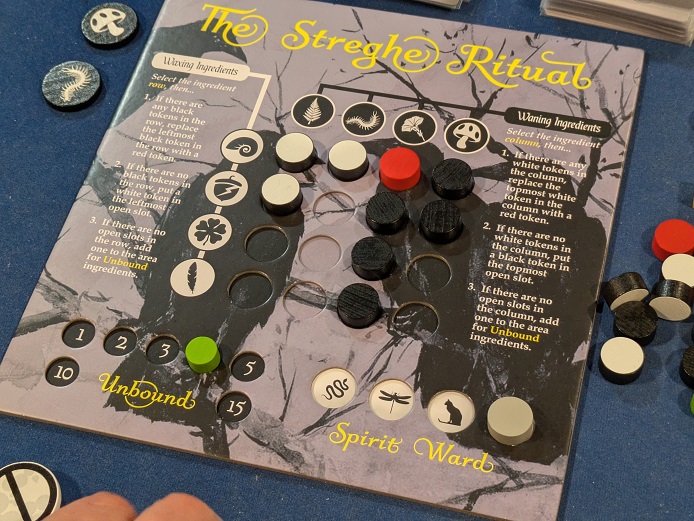
Here, your mothers’ progress occurs on a sideboard. One you cannot touch or interfere with. It’s almost entirely driven by random card draws that occur at regular intervals in the game. These draws place chits down on a matrix, with results in the same column and row exploding off each other for higher end game pointage. You can’t stymie this or prevent it. It’s beyond your reach, like a cloud approaching on the horizon. Effectively, it’s another algorithm, but one distilled to random busywork. Is it any different than a deck that spits out a random number within the bounds of the formula?
I do enjoy how it interacts with the clever dark and light status of the game’s ingredients. This is reflected when players gather resources during the game, only able to collect light resources during the first half of the round during waxing moon and dark resources during the latter waning moon half. While this has a mechanistic purpose, it’s another sly element of setting infusion. This is important as I find these setting details to be a significant boon for the experience, and I do appreciate that there’s this illusion of an evil ritual occurring just beyond the young witches’ sight.
This scoring system strongly represents the overall bewilderment of this work. For all the quirks and unusualness that I’ve stepped through here, the core game is really a straightforward Euro-style design that is familiar enough. The weirdness is less camoflauging than in Cosmic Frog and less ingrained than in Zimby Mojo. Willowspur’s primary weapon is the cooperative format, as the discussion and theme of leaning on each other pushes it beyond the staid nature of an efficiency game. If this was a heads-down competitive experience, it would suffer greatly and prove far less compelling.
I don’t know what this says about Jenna Felli’s continued work as a designer. Refusing to be pigeon-holed, perhaps this is just another experiment that bears little resemblance to her next game. I certainly see a renewed sense of joy emanating from her work, as this title shows an expression of youthful exuberance. But that ruthless undercurrent can still be teased out of the process, emanating from the dice like radiation. That conflict in tone is ultimately what gives the game it’s defining characteristics, presenting a design that manages to be unique, traditional, brutal, and compassionate all at once.
A copy of the game was provided by the publisher for review.
If you enjoy what I’m doing and want to support my work, please consider dropping off a tip at my Ko-Fi or supporting me on Patreon. No revenue is collected from this site, and I refuse to serve advertisements.

