
This review is based on a pre-production copy of the game that is expected to be nearly identical to the final product.
I love MOBA games. My time playing League of Legends and DOTA are well in the rearview, but many of these games’ concepts work extraordinarily well on the table. Team play. Miniatures skirmish-like combat. Character development. This is all intriguing stuff. It’s also all present in Trials of Maya, a new tabletop MOBA design from the trans-media studio Department of Lore. This Indian design team has produced a lavish and rich production that boasts sophisticated gameplay and a wholly unusual setting. This game, in both spirit and stature, is mountainous.
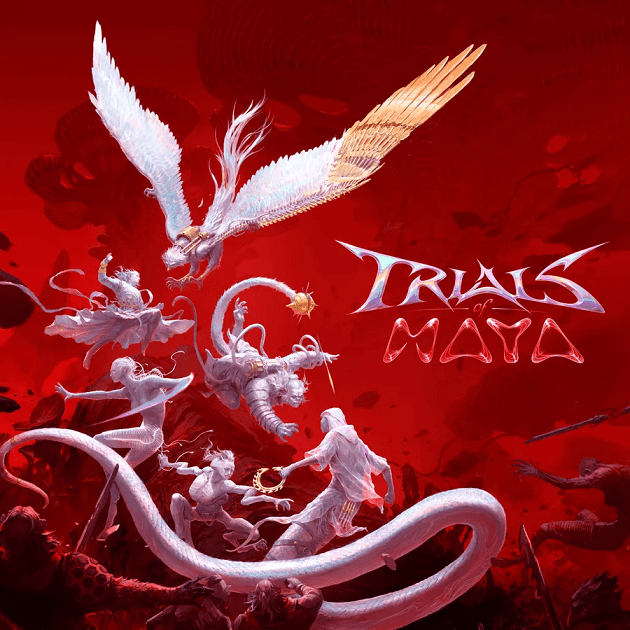
This is a true MOBA experience. I often describe games like Worldspanner Factions and D&D: Trials of Tempus as MOBA-like due to their adjacent stylings, but Trials of Maya has towers and bases and minions and lanes. Some of these ideas are abstracted or adapted in various ways, but this feels like you’re playing a MOBA with similar goals and tactical considerations.
If you have no idea what I’m talking about, don’t fret. The MOBA genre is a popular video game format where two teams of powerful characters square off, each trying to attack and destroy the other’s base. It’s part skirmish combat game and part arena sport. There are RPG elements such as leveling up and acquiring new skills. It’s a neat, highly competitive type of game that exploded in popularity a decade ago.
Back to Maya. Two teams square off fighting their way across the board with the goal of making it into their opponent’s area and destroying their fortress. On your turn, you will move, strike foes, and gain experience. A small selection of rotating public objectives provide incentive for specific behavior, such as moving seven spaces in a turn or inflicting several attacks. These add a nice touch of variety as you need to navigate the action system in congruence with your round objectives while keeping the overall goal in sight. All of these things interlock to form a coherent engine that hums along to produce dramatic conflict and a dynamic tactical puzzle. This is a cerebral game, one that is thoughtful and nuanced.
One of the most interesting methods is the implementation of minions. In MOBA games, minions are often called “creep”, as they steadily march out of your base and towards the opponent’s. They’re chaff, typically cut down by heroes and ground into the dirt. But they’re endless.
Not here.
In Trials of Maya, minions possess a bespoke lifecycle that intermingles with player agency.
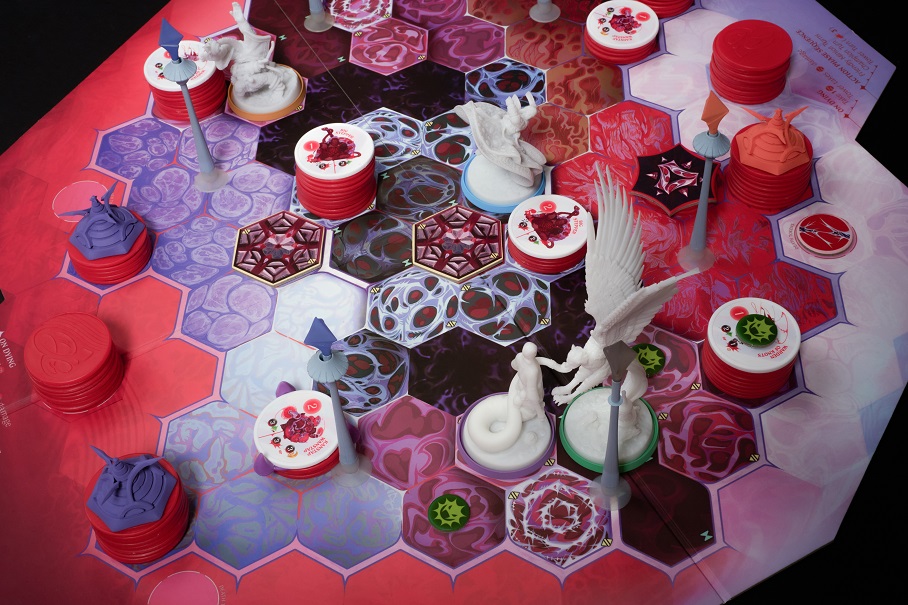
In this game, they function more like neutral enemies that stand in your way. You can farm them, chipping away at their health. When you aggro them in this way, they target you and hit back. In this sense, they function like dynamic terrain in a similar fashion to the mindless combatants in D&D: Trials of Tempus or even Core Space. That’s fine and interesting, but it’s taken a step farther. Each health chip you remove from a minion is banked by your team. If you deliver the killing blow, you gain the top chip, which is called the head. Now the minion is yours and you can redeploy it to the battlefield to fight for your side.
This is such an impressive concept. It incentivizes slicing chunks out of minions and racing to combat them before the opposing team, as each point of health directly contributes to your own grunts. There are also tradeoffs in deploying a captured minion immediately, versus holding on to them a bit longer to accrue more health. When you choose to spawn them, you populate their health from your banked chips. The more you beef them up the longer they’ll last, but it also means any other minions you want to deploy won’t be quite as formidable. Do you deploy multiple weak troops or fewer hulks? Each minion type also has their own stats and abilities, adding substantial nuance. Finally, health chips removed from the opposing team’s minions continue to flow to your bank in a closed economy of back-and-forth destruction. This is just a gnarly way to recycle the battlefield into an ecosystem of conflict.
The only concern with this clever system is that it can occasionally result in a grind. Minions can clog lanes and it can be difficult at times to safely encroach on the enemy’s backfield due to the constant reciprocal churn of spawning speed bumps. I’ve seen things occasionally devolve into attritional combat where the game is decided by hero kills more often than tower destruction. This is more of a problem in the one-versus-one format as opposed to the standard four-character bout, but it can appear in the larger game as well. This isn’t a crucial issue, but I find it less satisfying to grind the opponent down as opposed to cutting through their line for a dramatic finish.
How Trials of Maya models the MOBA structure is intriguing, but the real vehicle behind the game isn’t wed to that popular video game style at all – I’m talking about the card-driven action system. This mechanism could be entirely divorced from the MOBA mode, which is what occurs in the alternate death match free-for-all variant, and it would groove along just fine.
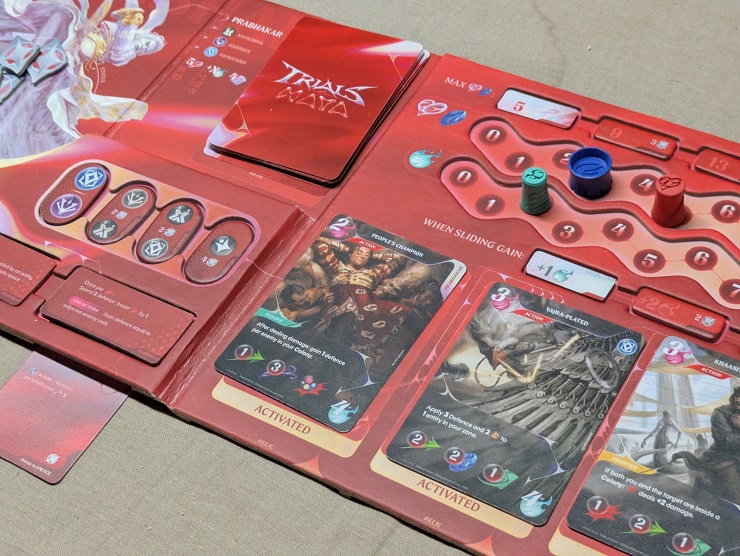
This is where the mechanical budget is almost entirely allocated. Each character has a player mat that holds three cards. At the beginning of the round, the card in the far-right position falls off the mat and returns to a personal discard pile. The other two slide over, and then each participant places a card from their hand facedown into the now open far left slot. The facedown cards are revealed and the action phase begins.
This is an intricate system. Each card provides an initiative value which is used the round it enters play. It also costs energy to activate the card and execute the actions upon it. Finally, it has an energy boost which is gained when it falls off the mat.
There’s a lot going on here. Card choice, which comes from your asymmetrical deck, must stand up to many different considerations. Perhaps this round you want to strike first and eliminate a character that is in your face. In this instance, you need to play a card with a low initiative value. But you also need to consider the energy cost on the card, the suite of actions available, and what energy the card will provide three turns from now. You need to balance short term versus long term needs, as well as evaluate how this new selection fits into the existing cards in your river of actions.
So, you’ve chosen your card, initiative has been set, and it’s your turn to act. Here’s the whiz-bang of the system. You now may activate any of the three cards on your mat. You pay the energy, then perform any special text-based actions on the card, as well as the standard icons of movement, attack, defense, and card draw. Once you’ve completed the card, you may then activate another and so on. Charging all three cards will take quite a bit of energy, which puts you in a continual dilemma of taking smaller turns with fewer actions, versus saving up for more momentous activations. This push and pull quality is excellent, as the decision space is thorny and complex. It can also make predicting your enemy’s behavior difficult, particularly if they have a lot of power banked.
It gets richer. As you’re accomplishing objectives and accruing experience, you may begin to upgrade your champion. Unsurprisingly, this system is heady with several options. You can increase your health ceiling, gain permanent energy income, unlock character specific abilities, and activate icons which increase the oomph of your cards. Many values accompanying your actions correlate to the number of a matching icon spread across your active cards. This is added texture for the card play, but it also opens up this upgrade path of simply adding baseline icons to your character board. This results in a growing power curve to the game that feeds a delightful arc of prowess. Put simply, late game is nuts.
This character development aspect is woven into the card play in such a way that produces a very satisfying overall experience. This is a long game, one that may stretch two or even three hours. It does flirt with the danger of becoming monotonous but mostly avoids that hurdle by doling out a constant stream of progression. There is ample breathing room to experience this growth and wield it. The game doesn’t cut off too early just as you’re becoming powerful.
While I’ve laid out the primary details that make this release compelling, the question hanging in the air is how this design measures up to the genre’s standard bearer at the moment. Yes, I’m speaking of Guards of Atlantis II from Wolff Designa; a cracking MOBA-style game that does so much right.
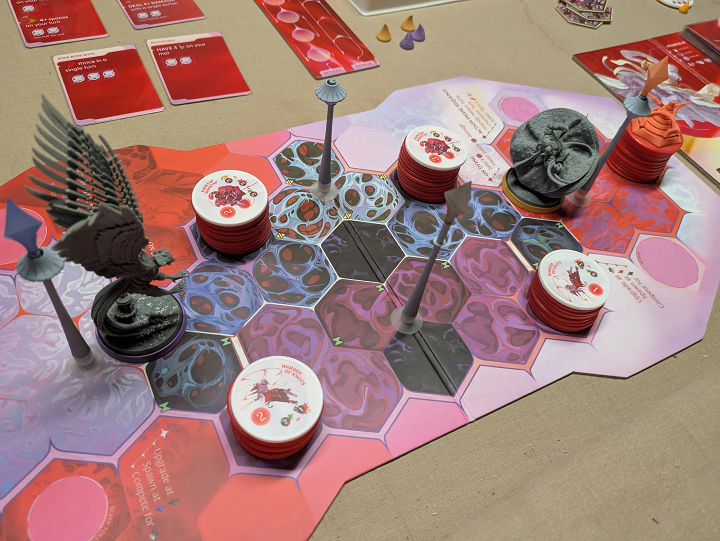
These titles have chosen distinctly different paths of adaptation. Most obviously, Trials of Maya supports two or four players while Guards of Atlantis stretches to twice as many. Maya most comfortably plays in its two-on-two team format, which is a relatively substantial upper mid-weight skirmish that feels full and compelling. In fact, I would wager it’s stronger than the four-player option in Guards. I’d typically pass over Guards of Atlantis with four, opting for something else such as Worldspanner Factions or even Company of Heroes. And now, Trials of Maya. The two-player mode here is also not filler. It has some minor issues with lane clogging and pacing, but it’s a full experience that allows you to experiment with various characters and sample the overall system.
How each game handles minions is quite different. Guards captures the element of pushing lanes and the brittle aspect of continual minion churn. Maya instead places a more strategic focus on acquiring minions and building up a warband of combatants. The latter is more complex, strategically as well as mechanically. This is really the philosophical divide between the games.
Guards of Atlantis prides itself on its refined sense of restraint. It’s not an overly complex game from a systems perspective. The complexity arises in above table play and character interactions. It’s an incredibly dense game tactically, but it’s easy enough to learn and to refresh yourself upon the rules. This agility is also how it expertly handles six or even eight players.
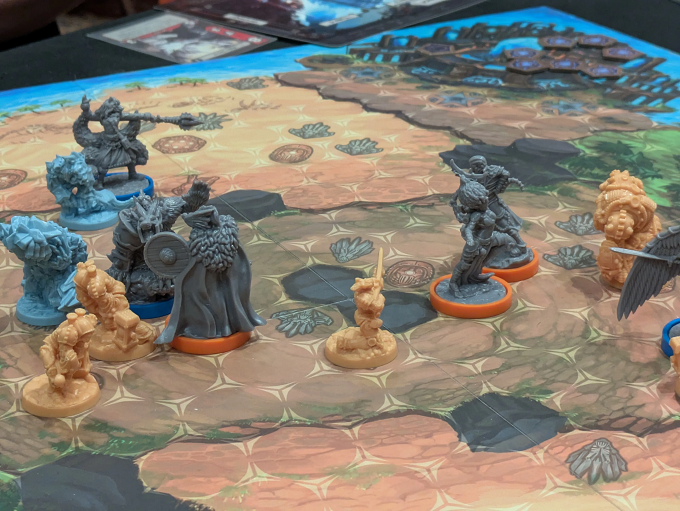
While Trials of Maya boasts a much smaller lineup of characters, you are expected to court them more intimately. Each has many different upgrade paths and a heap of detail. This complexity is how the game functions well at lower player counts, filling the air with weighty decisions.
The wealth of detail in Maya reverberates with the physical production. While some specifics may change, the pre-production copy of the game is an enormous thing. It’s a large square cake-box design like we’ve seen in Descent: Legends of the Dark and Kingdoms Forlorn. Each character has their bespoke components stored in a small container, including their large miniature. It all feels very deluxe and overstuffed with content. The only criticism I’d raise here is the incredibly small font on many of the items. Those lacking youthful eyes will struggle to read many of their character’s upgrade cards and ability tokens. Even those with perfect vision will be unable to identify an opponent’s ability from across the table, although that sort of thing is somewhat expected in these types of complex games. It does seem as if usability was sacrificed in this regard.
Launching off this largess of content is a commitment to extension. While this is an enormous and full box that will rival the largest crowdfunded offerings, there is clearly a vision here of building upon this core set. While characters come with pre-built decks allowing you to jump right into the fight, there is a full system of customization. The game mimics Warhammer Underworlds in that it provides a set of neutral cards characters can begin to insert right away. There is a wide range of latitude here where players construct decks using the icon system I’ve previously mentioned. It’s relatively liberal in restriction and you are afforded solid latitude in composing your fighter. Each character does bring some unique cards to their build, but the majority of the deck can be wholly assembled.
The methodology going forward is that of a Living Card Game, the format Fantasy Flight Games popularized with hit titles like The Arkham Horror Card Game and Android: Netrunner. Future releases will contain non-randomized card sets that can be integrated into character builds immediately. This is ambitious. Instead of producing an ever-growing pool of characters, the design team has opted to expand the depth of customization in the existing roster. I’m sure new combatants will arrive, but there’s no need to switch from your favorite hero. Instead, you can indefinitely tweak them and craft various builds to suit your desires. It’s kind of wild if you can conceptualize the boundaries of this content and how it will fork off in a multitude of directions.
This is the final and perhaps most defining attribute that splits Guards of Atlantis II from Trials of Maya. The latter is very much nestling into lifestyle game vibes. It comes across as the type of experience that wants a dedicated player base, one that will continue to explore and master this endeavor, matching the product’s growth with their own.
Maya is a heavy game. It will require more effort to learn and the road to competency is extended. Many Guards of Atlantis fans will likely not find the additional effort and playtime worth the results. This is where the games will sharply split, likely creating strong responses from players.
In the end, there is an extraordinary amount of promise here. Beyond the mechanical reach of this game, the Maya universe looks legitimate. This launches alongside a companion novel, which is surprisingly decent, and boasts that trans-media tag hinting at an ambitious future. I’m enthralled with the setting as the high-fantasy universe incorporates a culture and heritage which is anything but generic.
Maya is an organic sentient network that is attempting to predict fate. It runs endless simulations incorporating various individuals in order to predict the future. This is expressed by the Trials themselves, the arena conflicts showcased in this board game. This changing environment of refinement and iteration is captured in the game’s evolving battlefield, including the lifecycle of minions and the progression of heroes. It provides commentary on human agency and self-determination. I find this philosophical bent endearing, and much more interesting than that of its peers.
Will Maya reach its potential? I don’t know. I’m writing this prior to the game’s launch, and I cannot speak for the character or business acumen of any of its creators. I can speak to this design, and it has left me impressed. It may not be the best MOBA game around, but it is an intriguing entry that will likely establish a diehard cohort. Those desiring a more complex MOBA entry will find their effort and enthusiasm met in kind by the game’s ingenuity.
A near final copy of the game was provided by the publisher for review.
If you enjoy what I’m doing and want to support my work, please consider dropping off a tip at my Ko-Fi or supporting me on Patreon.


Onward is an excellent 1v1 MOBA that deserves a mention. Best of the bunch in my opininon 🙂
I thought the card play in Maya looked a bit clunky in a playthrough on youtube, but I’ll hopefully get a chance to check it out myself.
LikeLiked by 2 people
The card play definitely isn’t as smooth as some of its peers, primarily due to its complexity. I don’t know if I would call it clunky, but I also wouldn’t argue aggressively against that descriptor.
I have heard of Onward but haven’t played it. Will have to look closer.
LikeLiked by 1 person