
You’re stuck in a foreign place. It’s a prison of walls and darkness and fear manifest. Do you trust the unknown formless hand? Do you expose your vulnerability for a glimpse of truth? Do you recoil or do you meet The Presence?
Can you scare me up a little bit of love?
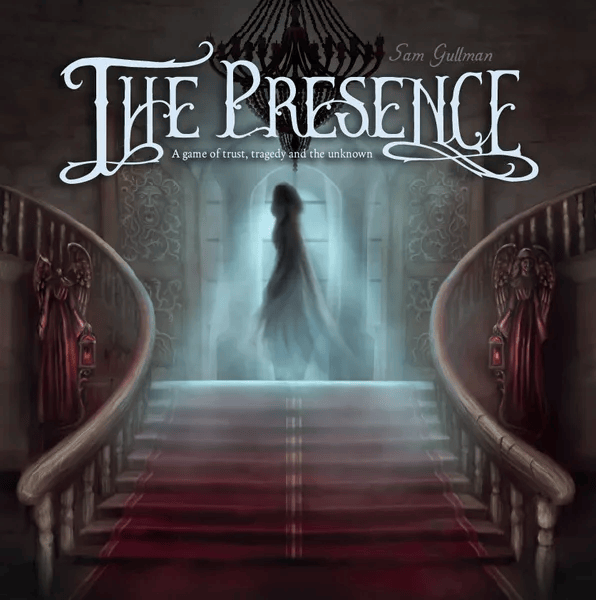
The Presence is a ghost story. It’s an indie work that draws obvious comparisons to Betrayal at House on the Hill and Mansions of Madness. But that’s just the apparition’s shape. Its true nature is more obtuse. More confounding. Just as you think you’ve figured it out, its terrified form slips through your grasp.
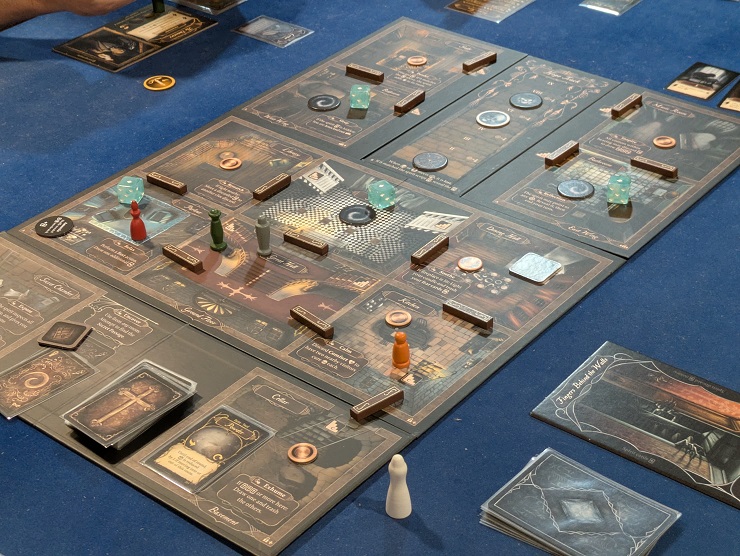
The Victorian-era setting sees a collection of visitors unwittingly transported to a seemingly vacated mansion. This is a right collection of misfits; a detective, a professor, an orphan. A ghastly resident haunts the ground flittering between rooms, disturbing the stillness, and reliving horrors. This role is portrayed by another player, and their goal is either to guide the trespassers to the truth or lead them to their doom. The source of the game’s mystery – in both meta structure and internal fiction – is that the participants do not know whether they are playing a fully cooperative or one-versus-many game. This uncertainty is exquisite.
The only other game I’ve seen adopt this approach is the underrated Rear Window. There is a small chance in that game that the clue-giver is partially at odds with the rest of the group, and it serves the design by fostering tension and uncertainty, which mimics the film it’s based on. A similar degree of suspense manifests in The Presence. As players move about the mansion, they must navigate areas where the spirit is active and capable of interference. But there is an allure to giving yourself over, to placing your trust in that frightening being. This is because they are uniquely capable of helping you succeed.
And it’s not yet time to meet the Lord above
In order to win the game, the visitors must collect clue tokens scattered around the dwelling. These reward players with cards that provide strong abilities, supplementing each character’s hand of existing actions. When the clue cards are later spent, they are not discarded to the player board. Instead, they are discarded to a shared tableau underneath one of four secrets. As I said, The Presence is confounding. Its mysteries are often conspicuous and lingering at vision’s edge.
Secret cards indicate one of four suits. These suits are also displayed on the clue cards with symbols such as a mirror or beating heart. These home in on the game’s underlying theme, representing tragedy, suffering, betrayal, and death. They abstractly indicate the circumstances surrounding the spirit’s origin.
Players are trying to match the suit on the discarded clue card to the proper facedown Secret card in the tableau. The clues are placed below the Secret card in a column. Eventually several build up, and player’s flip the Secret to determine if their deduction was accurate. Once all four Secret cards are flipped, the visitors win. Easy peasy.
Must have looked like I was dancing with the wall
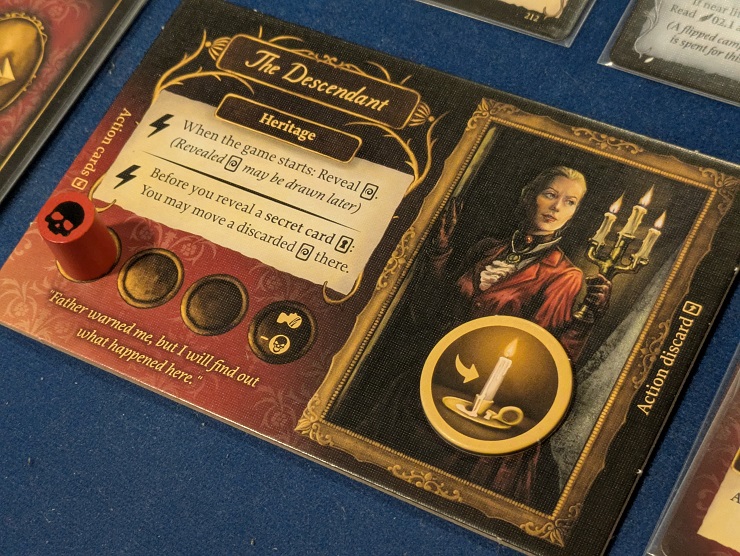
There’s a clever flow within the game loop. Each character has their own set of action cards with some noticeable asymmetry. You use these in a similar function to the card-driven mechanism of Nemesis, spending cards each turn to move, search, and collect clue tokens. Some are multi-use and they’re solidly neat while somewhat restrained. You can gain stronger cards by collecting those clues, at which point they become a single-use resource which you spend for board advantage, as well as to progress your overall goal of deducing the spirit’s Secrets. So, the mystery itself is woven throughout the action system and a driving force to momentum.
Deriving the suits of each Secret card is a lighter endeavor than one may expect. This is not a deduction game along the lines of Mystery of the Abbey or The Search for Planet X. It’s not the note-taking heady format originating with Clue. It’s a little more surface level, the light deduction mixing with some risk taking in order to progress the game.
The first layer is suit prevalence amongst the clue cards. A certain number of cards are removed from this deck before the game begins. The suit corresponding to the Secret card in the first slot only has a single card removed, while the second has three and so on. What this means is that if the group has a large number of mask clue cards spread amongst their hands, they can be fairly confident it’s in the first or second slot, as there are far more of those cards in the deck than ones belonging to the third or fourth Secret’s suit.
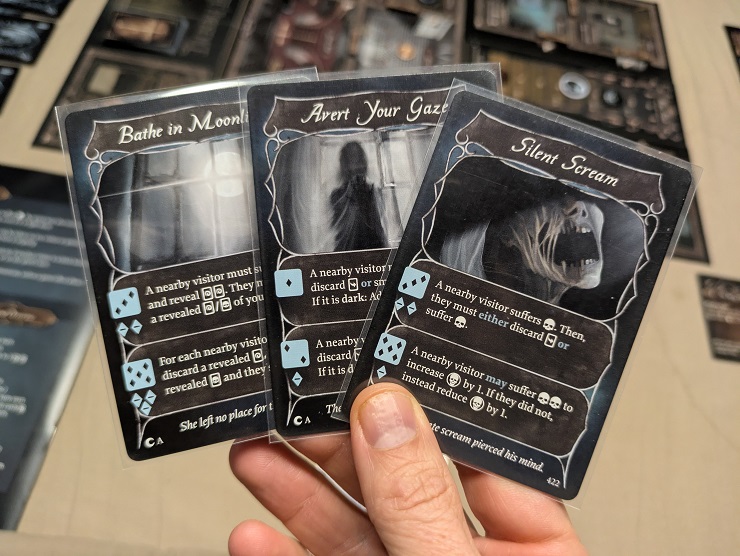
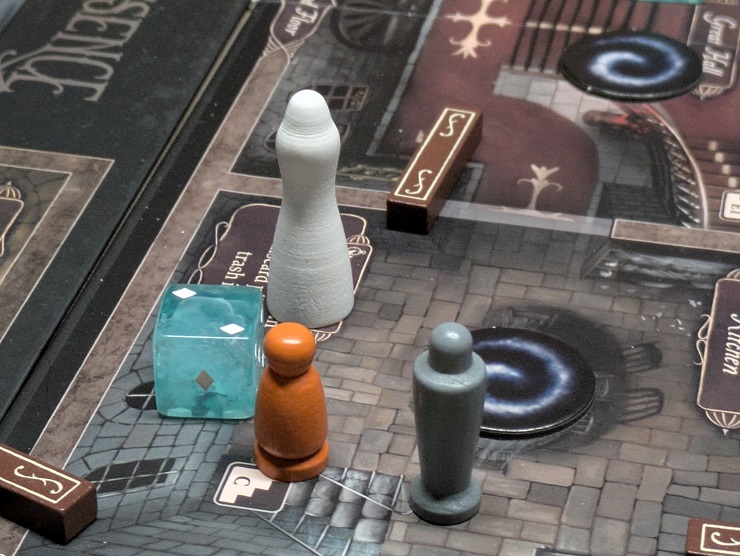
Items and abilities can do things such as peek at a card. The ghost player’s turn consists of playing cards from their own personal deck, which are fueled by dice representing the apparition’s presence on the board. Some cards allow a ghost to indicate various things, often subtle. Occasionally the ghost will be able to whisper a single word to a nearby player on the board or even move them to an adjacent room. All of this can help indicate the nature of the Secret cards. This kind of loose yet creative stuff is enjoyable. It also reinforces the setting, roles, and major themes.
This is the most obvious representation of the game’s motif. Players must decide how cautious to approach their pathing in the mansion. They need to consider whether to take the shortest path to a clue, versus a longer route which will avoid presence dice. This bears agonizing tradeoffs. If you leave yourself vulnerable and the ghost is working against you, they may inflict terror or seal you off from your colleagues. On the other hand, a spirit whose goals align with the group’s can provide a significant boost. The tension here is excellent.
The fallout from this uncertain relationship is that the role of spirit is more interesting. Visitor play is relatively straightforward. The core deduction puzzle remains identical game-to-game. What changes, primarily, is the particular spirit and their deck of abilities. The position of power allows you to be coy, terrifying, or somewhere in between. This latitude is the fuel for a dynamic and entertaining experience.
But because of my condition
I fell in love with a little ghost, and that was all
My claim that visitor play is somewhat repetitive is grounded in the deduction mechanism. Part of why the detective work is facile, however, is that this a surprisingly brief experience. There is a timer driving the game forward, and both spirit and visitors must accomplish their goal quickly. This keeps the outing to roughly an hour, although that is distorted slightly around player count. I’ve actually found the experience quite strong with as few as three participants and as many as five. It’s flexible enough and the tempo is rapid with experienced players. The end result is not as dramatic as a session of Betrayal at House on the Hill, but it’s just as quick and more satisfying from a systems perspective. It’s also far more reliable.
One of the impressive small touches that connects with player count is the rule on communication. Players are not allowed to discuss strategy unless their pawns are within ear shot of each other on the board. And no one is allowed to talk strategy if the current player is “alone”. This is manipulated by opening and closing doors, maintaining a tight formation, and forming a flexible strategy. Due to the nature of the game’s deduction coupled with the pressures of time, this discussion is crucial. It’s also a tool for a malevolent ghost to manipulate.
This is an excellent detail. The most discernible shortcoming of this design is that the legwork is relatively abstract. Gathering clues, discarding cards, even deducing Secrets are all tasks buoyed by mechanisms and symbols, not by story or pizzazz. Now, they do follow along and elucidate the foundational subject matter, but only in a broad connotation that requires players to fill in the details. Otherwise, you’re hitting a pinata and nothing sweet is coming out. The more vibrant particulars, such as limited communication and uncertain motives, are significant in connecting the game to the setting and allowing players a footing to find the larger themes.
But they pale in magnitude to the campaign.
The Presence was originally designed as a straightforward single-session game. It included multiple ghosts that each behaved differently with their own decks of action cards and playstyles. During the development cycle, things changed. The campaign emerged.
Instead of throwing all of the content at the players and having them select a setup, it presents a starting point with an initial spirit and associated scenario. Through play, the scenario is modified and new content is released. It’s somewhat of a drip feed of piecemeal additions – such as adding a new card to the item deck and a new clue token to the bag – but these small gains serve to continually provide dopamine via material reward.
What’s very well done here is how the content is delivered. Most of it is tied to narrative passages and direct story. These provide small interludes with choices afforded to players, and they occur mid-game. This establishes an incentive to interact with certain campaign devices, such as the event cards which are effectively side quests. The story surrounding these elements is linked to the background of the ghosts. This is fantastic, for it centers the game’s reward cycle around uncovering the game’s mystery, providing intellectual benefits as well as formalized content additions.
Since each play is singular and not linked to a linear narrative, players can hop in and out and there’s no real need for continuity. In this way, it reminds me more of a roguelike setup, mimicking the wonderful approach of the Dead Cells board game. I adore this methodology. It harnesses the benefits of campaign play without the costs. It adapts to modern needs, unconcerned with maintaining a consistent group of players. Of course, those jumping in for a single session or two will not receive the totality of information presented, such as what the nature is of each ghost, but it’s still a worthwhile one-shot for curious gamers.
There is danger here. It is entirely possible to play The Presence and not progress in the campaign. In fact, players may not even realize this is happening. There is little guidance on what will occur and how things are unlocked. This is of course by design to keep the mysteries sealed up. But since forward progress is reliant on player action, there is a real chance of getting stuck and having to replay a scenario many times.
My experience is that a new scenario is revealed after roughly three sessions. That feels appropriate, perhaps even perfect. A spirit and the accompanying scenario are not single-serving experiences. They’re intended to be explored, for playstyles to have room to develop, and for the background of the ghost to be investigated. Three sessions, with the ability to return down the line and pursue more, is just about perfect. But there’s no guarantee that three will be your number. My players have aggressively pursued the campaign elements, even at the risk of losing the current scenario. The allure of story snippets and narrative progress appeals strongly to our proclivities.
Can you scare me up a little bit of love?
I’m the only one that sees you, and I can’t do much to please you
And it’s not yet time to meet the Lord above
I would urge you to decide relatively quickly whether you want to pursue the campaign. If you feel confident the answer is no, you are strongly encouraged to just unlock all of the content immediately. Sorting through and understanding what you are doing will be a challenge, and it would be best to play a game or two with the initial ghost simply to understand how the components are organized and utilized.
This content is such a large driver of the experience. If The Presence was simply the initial Veiled in Moonlight scenario, it would not be particularly gripping. Play would still be solid and worthwhile, but I couldn’t see myself returning to the game or celebrating a lengthy honeymoon. It would be a lark at best. The campaign allows the game to sprout legs. It allows the game to hold back pieces of itself, centralizing the greater themes through its very structure. All of the narrative is likewise sequestered in the extended format, leaving the basic experience feeling even more abstract and detached from its setting.
Much of this wouldn’t work if the new content wasn’t compelling. Fortunately, the new material is continually interesting as the wider picture develops and we become more familiar with the antagonists haunting the mansion. I do find myself occasionally wishing the structure would evolve more. The building’s static layout could have been readily experimented with, but what is offered instead does cross the necessary threshold and mostly meets expectations.
With all of that being said, I do not view The Presence as a game desiring dedication. I wouldn’t enjoy it to the same degree if it was a weekly task where we were determined to dig up its graves and pilfer its inhabitants as quickly as possible. It serves well as an hour-long ghost story that we can come back to as our desires wax. In this way, some of the repetition and the mildly lengthy setup time never rankle. And the thin narrative is wallpapered over with interesting text interludes and cut scenes. In this way, the game speaks to me and offers something I haven’t found elsewhere.
The Presence was published more than a year ago. It’s been difficult to find due to a lack of North American distribution. The game’s return is imminent with a crowdfunding campaign intended to beckon a new printing as well as a fresh expansion. May the séance bring good spirits.
A copy of the game was provided by the publisher for review.
If you enjoy what I’m doing and want to support my work, please consider dropping off a tip at my Ko-Fi or supporting me on Patreon. No revenue is collected from this site, and I refuse to serve advertisements.


Any insight into the reprint? Is it a significantly different edition, or a straight reprint?
LikeLiked by 1 person
From what I understand, it’s mostly a straight reprint with a cleaned up rulebook and significantly altered learn to play mode. This edition has a learn to play book/scenario that attempts to walk you through the game, but they told me up front they were going to completely rework this for the new edition, so I didn’t bother to utilize it or comment on it.
LikeLike