
Wavelength is an elite party game. It features energetic team play, interesting discussion, and a monolithic plastic dial that generates a random position along a spectrum. All of these contribute to its success. I was intrigued when I heard that publisher CMYK was issuing a diminutive card-based version of this game. I wondered how it would compete with recent darling ito in this small box category and how effective it could be in translating that larger experience into a more portable dimension. I was surprised to find that in minimizing the footprint of the design, the charm largely vanished.
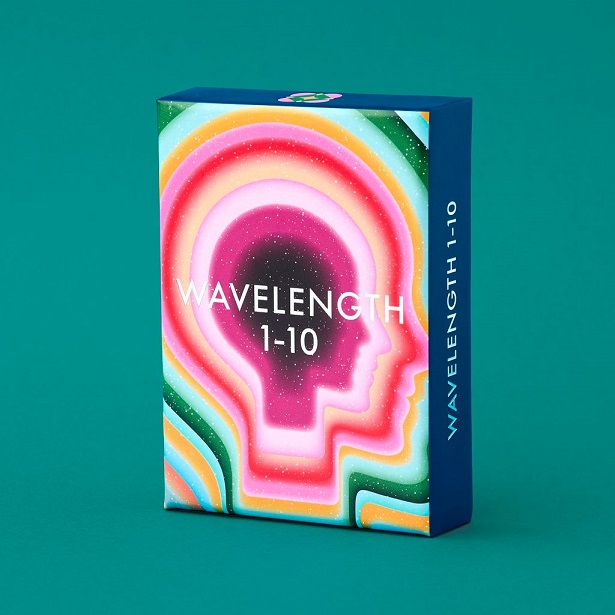
It seems like the heart of Wavelength is still present. Players select a category card that broadly translates to the topics in the original game. Restaurant or Mythical Creature for instance. The clue giver then draws a random card numbered one through 10 (hence the title). This number is the distillation of the large spectrum device in the original game, similarly, pointing to either the worst or best end of the category.
Let’s say I have the topic of Mythical Creature and drew a “2”. I need to give a clue that indicates a rather poor, unappealing, or just downright sad, fabled beast. But not the most hideous or pathetic, as that would be a “1”. A nine or 10 would be easy. Medusa, the phoenix, maybe even a dragon. But a two?
I offer a wolpertinger. You know, the German rabbit with wings and antlers that falls into a coma when it sees a woman. It has “2” stapled to its forehead.
If you’re familiar with Wavelength this all sounds familiar. That bigger version of this game relies on a more granular and imprecise point on the scale, but it’s all roughly the same. Provide a clue to lead the group into selecting the right point in the range. People talk it over and debate a little. Consensus is reached and the correct value is revealed.
It’s not the same.
The trouble with 1-10 is that the game loses much of its charisma. It’s altered in several ways that undercut the experience and leave it pallid.
I didn’t imagine losing the plastic centerpiece would be so detrimental. It’s a gnarly contraption that people love to play with, sure, but I was still surprised at how this large gadget focuses energy and acts as a lightning rod for enthusiasm. There’s an overt joy in fiddling with the thing and there’s drama in snapping open the window and seeing just how close to the answer slice you came. It’s just not the same when flipping over the number card. It’s the difference between a kazoo and a roman candle.
I think the component’s edifice-like nature also acts as a conduit for the CMYK brand and aesthetic. I associate this publisher with a stylish vibrant fashion, and such a vibe requires a delivery mechanism. Imagine a minified version of Magical Athlete where Big Baby was a flat chit. The energy would be entirely altered. The spartan approach to Wavelength 1-10 provides no room for the publisher’s trademark artistry. This is a minor problem the Magenta line faces, a card game series put out by CMYK, but it was partially solved with the bold approach to packaging and unique visual presence in games like Fruit Fight and Figment.
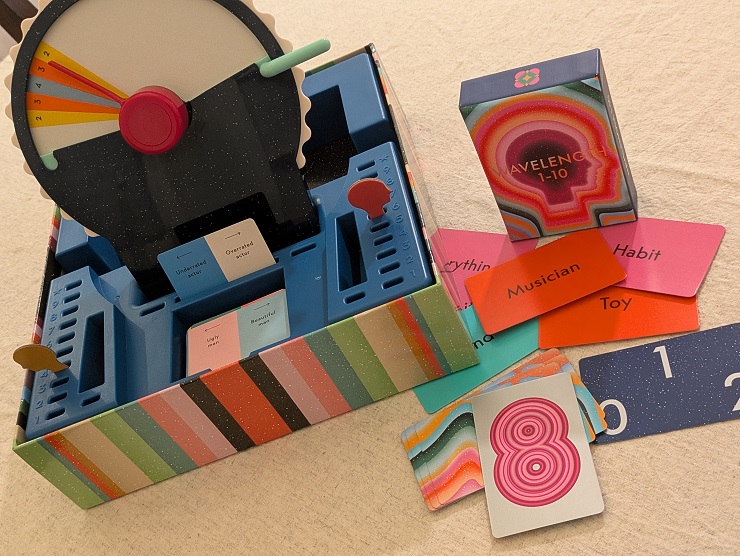
Another irk are the topic cards. These come across as much flatter than their precursor. This is because there is more room for creativity in the original, as the structure doesn’t restrain the game to a best to worst gradient. There are very interesting cards such as Dictatorship-Democracy, Unbelievable-Believable, Book was Better-Movie was Better. These more intriguing topics also lead to more creative clues which in turn begets more engaging discussion. This pocket edition can’t approach this cleverness and loses at each step of the way.
The team format of the previous design is also worth grieving. It provides a camaraderie that develops through the challenge of competition. The ability to steal the other team’s clue injects a new dynamic into the game, one which breaks up the format with variety as well as promoting an alternative headspace. There are more situations and diversions in that structure, as opposed to the fully cooperative nature of 1-10.
This cooperative structure in the new game abets an ideology of lower stakes. This game feels less consequential, more a filler of time as opposed to a sought-after experience. But this is also what works for the game.
By adopting lower stakes, lesser barriers, and an overall intentionality of casual appeal, this shrunken box finds an altogether new target audience. I do think ito fulfills this role more sharply, but Wavelength 1-10 is easier to understand than both that competitor as well as its predecessor.
That’s not nothing.
I’ve tried teaching the biggie Wavelength to a group of adults that are used to straightforward party games. And as people that did not have a strong desire in learning something new, their lack of interest resulted in a struggle with understanding the large wheel and how the clue process intersected. There’s a small leap needed to grok the transposition of a clue to the indicated point on the spectrum and how the device weaves this together. I just couldn’t get through nor make it work.
I run into this often. Smart people capable of great things, completely lacking the desire to put in the effort to learn something new. It can be difficult to understand for hobbyists, as we encounter new games weekly.

Wavelength 1-10 is easier to understand. It shifts the headspace towards a numerical ranking of things, almost like an organization of tiers, as opposed to a fuzzier gamut. There are less rules overall and the group can work together. I find cooperative games, while initially foreign to traditional players, can disarm people and allow you to lead them slowly into an experience.
There’s also a clear advantage here in footprint. This means you can literally slip the game into your pocket and take it on a camping trip, a flight, or a cruise. While the previous Wavelength box is not enormous, it is relatively large for a lighter affair. The dial and box combine to form the play space, taking up quite a bit more room than 1-10.
It’s important to understand that I’m not criticizing this iteration because it’s not as capable as its predecessor. I’m criticizing it because what’s left is uninspiring and average. Those are two descriptors I do not associate with this publisher’s oeuvre.
I think there is an audience that will find this title appealing. The idea, unfortunately, is more enticing than the actual outcome. The desire for reduction doesn’t change that in compacting this design, much of the juice has been squeezed from the object. What’s left veers more towards husk.
A copy of the game was provided by the publisher for review.
If you enjoy what I’m doing and want to support my work, please consider dropping off a tip at my Ko-Fi or supporting me on Patreon. No revenue is collected from this site, and I refuse to serve advertisements.

