
Abroad gives off a vibe. It presents as a pleasant little outing, maybe something akin to Parks or Trekking the World. This is deceiving. It is not a cozy travel game. It’s a stout mid-weight fella that’s more robust than it appears. In fact, it wanders in the region of burgeoning modern tableau builders like Terraforming Mars and Ark Nova. But this is also misleading, as it’s not nearly as baroque as those works. This design exists in an interstitial space that maintains a cognitively engaging mechanical framework while also allowing for a more relaxed approach. And it kind of owns that ground.
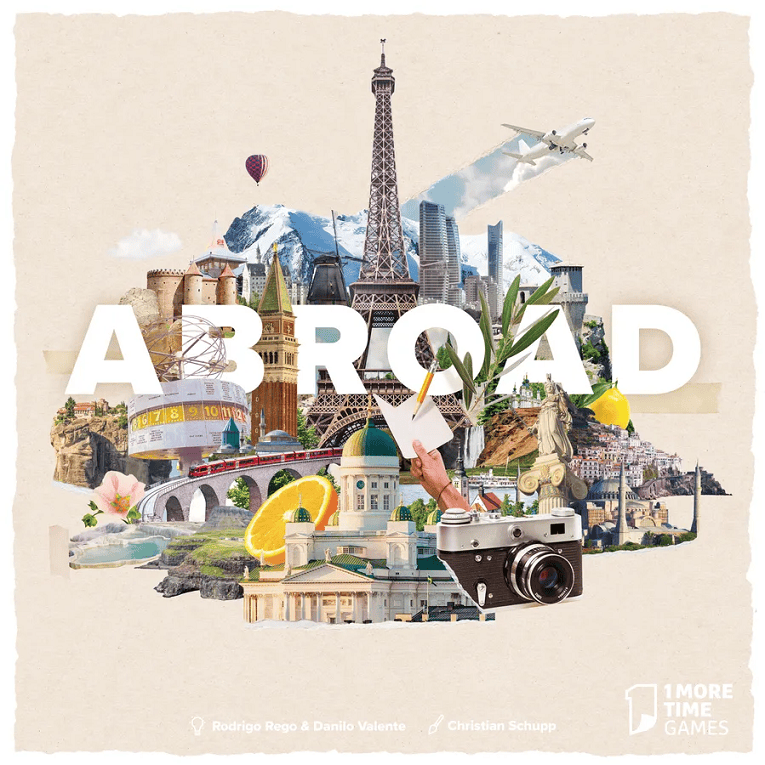
Travelling is such a simple and pleasurable setting. Seeing this activity branch out beyond lighter mainstream fare is encouraging. It fulfills the oft-requested desire of diversification in board game themes. More importantly, it highlights its subject matter within the boundaries of a solid system.
The gameplay loop showcases the core identity. This isn’t a subtle design. Players take turns placing a card from their hand onto their player mat and then executing the action to gain any benefits. This is tableau building where your tableau is housed on a calendar and the cards represent European destinations you visit. You’re effectively charting out and executing a trip, traveling across the continent and sightseeing in various areas of cultural significance.
The powerful motif is the interconnection of destination with movement. You first travel on your turn, either hoofing it across the land or paying resources to catch a flight or train ride. Then you place a destination card on your calendar, with each unique locale taking up a varying number of days to visit and experience. This cost in days is a nifty action point system of sorts. One of the strategic elements is managing your calendar and threading the cards into a proper slot to allow the right intersection of location properties with combinatorial benefits. Do you go for a larger number of brief sites, or fewer more elongated visits? Likely something in between depending on what regions and tags you’re seeking.
There are several interesting considerations here. The first is the weekly structure. Each round of play you only have seven days of sightseeing. You need to optimize around this artificial calendar constraint, which creates a puzzle to navigate. This also produces an interesting player-driven tempo. Some travelers will take fewer actions during the week by visiting more sizable destinations that eat up their time. Some will obviously take less and receive more actual turns each week because of this. There is heady strategy here in how you pace yourself, how you respond to other players, and how you effectuate your goals.
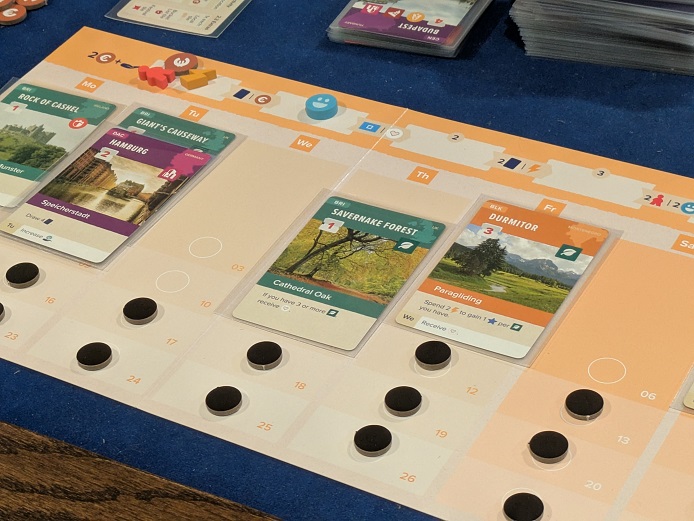
The locations are the other notable detail. These are the Ark Nova-esque cards full of tags, bennies, and bonuses if visited on a specific weekday. There is certainly a combinatorial aspect here with some cards cascading off others, as well as external benefits in other areas of the game that provide you with resources for playing specific colors or tags. For instance, each player has at least one Postcard, a hidden personal objective, which will often intersect with the details of the locations you visit throughout the game.
It doesn’t lean heavily towards engine building. Escalations in benefits and synergies are shallow compared to something like Race for the Galaxy. This is very much a 2nd generation tableau builder in the vein of Terraforming Mars. The common criticism associated with this popular genre is evident here, however. This is the system of drawing from a huge deck where you’re completely beholden to the whims of chance. It can be frustrating if you need a specific tag yet fail to draw it no matter how much you focus on top-decking. Unfortunately, drawing the right cards is a factor in strategic execution and can influence the outcome of the session in various ways. This is most commonly evident in region scoring.
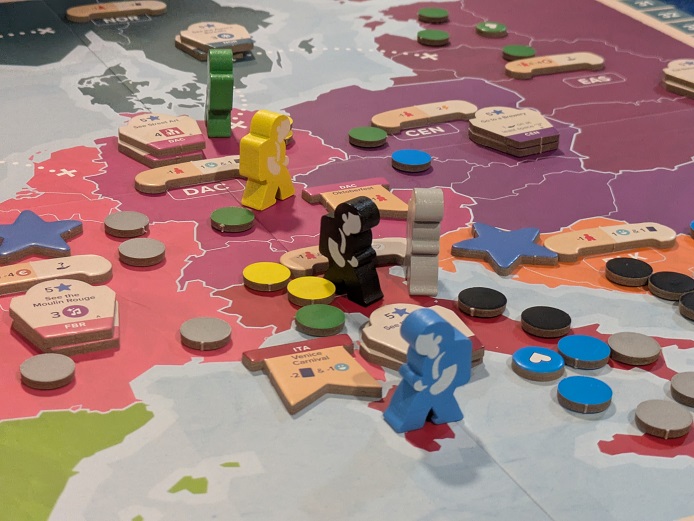
One of the neat traits of this design is that it’s fundamentally an area control affair. Every location you visit allows you to deposit discs from your calendar onto the region, with a traditional method of first and second-place majorities receiving scoring at the end of each week. Scoring is repeated at the conclusion of each of the four weeks across play, so early investment can pay off significantly.
Because there is not direct conflict, and perhaps because there are a few other avenues to collect points, the area majority mechanism does not feel brutal or demoralizing. It walks a fine line of adding some underlying pressure without creating too sharp an edge. Interestingly, Abroad doesn’t feel like El Grande or Samurai. It’s not suffocating – and subsequently not as thrilling. The game is more strongly positioned as this personal journey where you discover an old country inhabited with historic sites. It skillfully balances activity on individual player mats with a shared geographic board to create interactions and focus the overall experience on a central venture. This is less heads-down than Ark Nova, as you’re tinkering in mostly the same space and competing for those regions or rushing special bucket list locations for bonuses.
A quirk of this game is that it’s often detached from specifics. Your traveler is not well defined nor characterized. The locals you meet are abstracted to simple benefits. The impetus for your journey is simple capitalism – competing for a full-time position writing for a travel guide publisher. There’s not a lot of detail here to hang your hat on and this is not a design that’s strong with narrative.
But this is because the focus of the game is not you. It’s not the legs of your journey nor the people you meet along the way. It’s the country, the buildings, the culture. As you grapple with the constraints of the huge location deck, it feels as though you’re continually embarking upon an expedition of discovery. You come across unexpected finds, wander into new encounters, and come across views that turn the corners of your mouth upward. That deck establishes the breadth of the world. Filtering it encapsulates delay and exhaustion, fulfillment and wonder.
I think the conventional scoring is this game’s weakest point. This is because these systems function merely to provide consequences and incentives for the card selection. Your travel plans are restricted in order to establish proper board game structure, and it can distract from the legitimately sharp elements in this design. The brightest spark is undoubtedly the intersection of locations, travel, and time. When those three elements collide, they form a bridge between your personal calendar log and the geographic map. They also act as a connection between your and the game’s soul. As you thoughtfully set Edinburgh on your mat, your mind wanders to Scotland and the year 2024. When you place Canterbury, your eyes light up and you look to your partner sitting across from you. These locations ignite memories and allow you to reminisce and inject those personal details into the otherwise broad design.
These locations also function as dreams.
I grew up without the opportunity to travel. As a kid, I never journeyed more than 200 miles from my home. I didn’t fly in a plane until my 20s. I never left the United States until my 30s. I still haven’t ventured farther than neighboring countries. For me, and perhaps for some of you, there is a hopeful optimism within the confines of this box that is far-reaching. I believe we have a duty to expand and develop our worldview, to seek out what is beyond the edge of our vision. We can do that through real-life experiences, but we can also do it through art, literature, film. And games. This title doesn’t offer deep cultural commentary or knowledge, but it can inspire. It can mobilize ambition and thought.
My connection to games is frequently aspirational in nature. I’ve written about my search for masculinity in Rocky Mountain Man, my contemplations on bravery in Purple Haze. My affinity to Abroad is likewise rooted in an element of humanism and longing. A craving for meaning. Getting away from the math and to these places and desires, that’s where Abroad discovers meaning.
A copy of the game was provided by the publisher for review.
If you enjoy what I’m doing and want to support my work, please consider dropping off a tip at my Ko-Fi or supporting me on Patreon. No revenue is collected from this site, and I refuse to serve advertisements.

