
I spend a lot of time playing games whose existence is attributable to a trend. Certain titles like The Crew and Ganz Schön Clever created cracks in the pavement for others to sprout from and flourish. Robo Run is the latest germination, a seedling fighting for some of the light established by the Spiel des Jahres winner Sky Team.
Robo Run similarly features a strict no communication policy within the framework of a light two-player experience. It boasts completely different mechanisms, setting, and themes, but it occupies the same category and surely is targeting the same audience. The most glaring difference is that Robo Run’s appeal is narrower and more specific.
This really does have similar contours to Sky Team. Two players sit opposite each other, mouths shut and eyes twitching. One carefully takes a turn, hoping they’re finding tendrils of teamwork in the murky environment and sequencing actions correctly. Then the other responds, facing the same challenge. Tension arises from needing to do all the things but only able to do some of the things. Agency is restricted and occasionally the least ugly option must be chosen. There’s an ebb and flow with occasional humor in folly.
Ostensibly, this is a cooperative spatial puzzle where you are restricted from communicating. While it eases you into the experience, this can be a cerebral activity that requires focus and thoughtful play. The heady nature clashes slightly with expectations set by the whimsical Pixar-like tone. Regardless, the setting is endearing.
You each take on the role of a sentient robot attempting to escape a factory. Other mindless clunkers, defensive systems, and industrial hazards stand in your way. You can’t just walk out, for security would identify your awakened state and thwart you. You must move erratically, something akin to a mechanical version of the Fremen sand walk. An outside observer would note your bots seem glitchy and aimless. That’s the idea.
This isn’t a programming game, instead, it’s an action sequencing game. You alternate turns with your companion, selecting a card from either the stand in front of you or the stand in front of them. Each card is double-sided and each side is unique. Selecting a card triggers the actions only on the side that is facing you. This is clever. It’s kind of Hanabi-ish in that you have limited information, can’t openly communicate, and must take occasional gut-wrenching risks in order to succeed.
These cards move both of your pieces, but also the antagonists, along the gridded board. Each action card is comprised of explicit tradeoffs. It’s a tricky problem to navigate as you’re trying to get your bots to their respective exits while avoiding foes. Just a single instance of an enemy moving into the space of one of your bots and that’s it, you’re as got as Lucas Jackson.
As you can imagine, it’s occasionally nerve-wracking. Executed cards are unavailable until next round. You’re stuck with what you have until they’re all gone. This means your options dwindle, with tension escalating as fewer and fewer cards remain. Sometimes you’re just nailed, the last remaining choice triggering shutdown. It usually feels like you did this to yourselves.
There are several tools at your disposal – such as one player being allowed to pass their turn each round – and these abilities intermingle with card selection to provide agency. When the game ends and the gag order is rescinded, there’s a convention of reflection where you work through decisions and try to ascertain what could have gone differently. A lot of “if only” language gets thrown around.
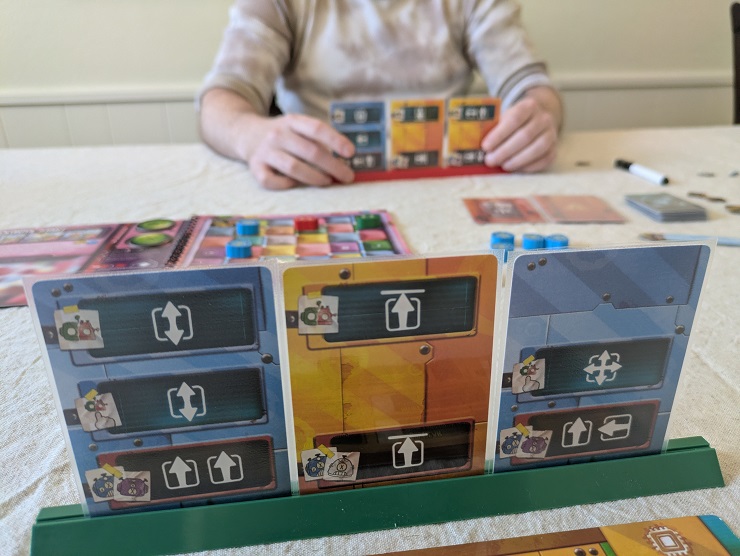
What’s funny about Robo Run is that in terms of feel, the closest analog is Frogger. Yeah, Frogger.
You’re weaving robots through a dynamic environment, doing everything you can to arrive at the destination without touching an obstacle. However, it’s more puzzle-y than twitch reaction. You have to similarly think ahead and forecast vectors, but Robo Run is less frenetic and more analyzing cause and effect. It’s a cooperative spatial puzzle as opposed to a test of hand-eye coordination. So, perhaps, a thinking person’s turn-based Frogger.
While this formula works and presents an inventive system, it does suffer from an overall intonation of detachment. You never embody your robot as your actions move multiple pieces on the board and don’t encapsulate ownership. Instead of identifying as a protagonist, it conveys a sensation of controller or engineer. This abstract nature is dolled up with the story-based scenario framework.
When you play Robo Run you select one of five included campaigns to play. Each is comprised of a booklet of scenarios with flavor text, setup instructions, and bespoke rules tweaks. These booklets also include scenario specific boards in the spiral-bound pages. It’s an overall similar structure to games like Mandalorian Adventures and Stuffed Fables. Fortunately, this is not a demanding affair, as working through each campaign is roughly 90-minutes or so.
This content encapsulation is a neat development in modern design. There is a generous variety of missions that introduce custom rules and challenges, allowing all of this overhead to be off-loaded to the playing area. While this is mechanically fluid, it struggles to find the same grace from a narrative dimension. The story is exceedingly faint, with text being bare bones and facilitating the briefest of beats. This is of course fine, but it doesn’t assuage the overall abstract constitution of the game. I would hesitate to describe this as story-driven or thematically rich.
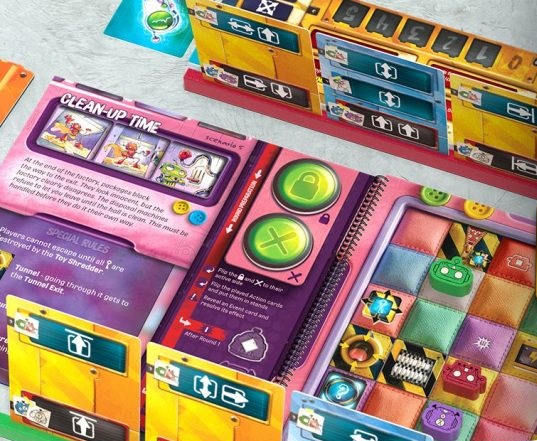
Robo Run works as a cooperative logic-puzzle for a couple to ponder over. I find it less engaging, however, than Sky Team. This Eryk Nowak design is more distant from its setting. While Sky Team is not focused on simulation, it’s oriented as a first-person experience that fosters creative mental imagery. It provides the necessary context to construct a solid picture of sitting in a cockpit and fumbling with controls as you struggle to perform as an aviator. There’s a thematic weight to it.
Robo Run isn’t like that. It’s carefully shuffling pieces around in a thicket of thorns, trying to weave between the brambles and make an escape. It’s less about feeling and more about thinking. In that way, it’s harder to embrace.
There is additionally a quality to its tension that I find bothersome. More dynamic cooperative games tend to feature calamity from random events or a sequence of cascading shocks that emerge after a buildup of pressure. Robo Run is odd, in that failure is often due to a dwindling of options that ultimately leaves you in a pickle where your only remaining choice loses you the game. Sometimes this occurs because you didn’t see an action on a card or you didn’t process the consequences of downstream knock-on effects. When these moments of failure happen, it’s often apparent how you could have avoided the problem one turn prior if you would have put just a little more thought into it. This is frustrating, as there’s a natural inclination to want to unwind the mistake and not make the poor choice.
The tension between wanting to play well and moving excruciatingly slow is off-putting. I don’t want to blow this out of proportion as it’s not a huge problem in the game, but it’s a small issue that speaks to the nature of failure and how Robo Run frames it. Misplays are very important. There can be a tendency in charitable groups to allow players to take back actions when the game state hasn’t meaningfully deviated in the time since. This type of thing doesn’t mesh well with Robo Run and highlights the fragile nature of its decision process.
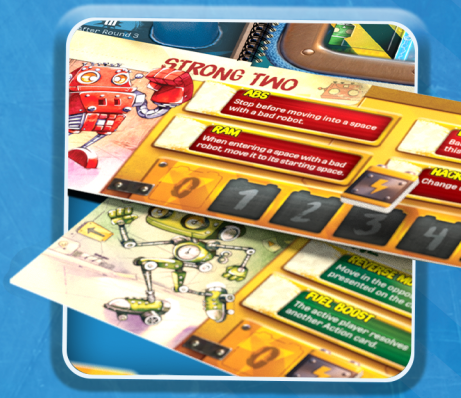
I have to say, Robo Run does admirably fight for attention. Later campaigns introduce some wacky obstacles. New rules emerge in a campaign style. The difficulty can spike unexpectedly, although it also is occasionally trivial when cards and game state wondrously align. Finally, I’m pleased with the overall compact silhouette and its incredibly reasonable cost. It takes after Sky Team, again, in that regard.
The most interesting aspect is unequivocally the game’s thematic heart. It forces players to shut down their natural characteristic of speech and adopt a robotic demeanor. But through action and quiet cooperation, rays of consciousness and humanity emerge like light finding its way through a cracked surface. The motif of partnership is comfortable in this design, as the restriction on communication is not as artificial as it is in Sky Team. While the setting of Robo Run is unrealized, its subject matter is certainly handled effectively.
I wish that was enough to carry the experience. This design centers itself around logic puzzles that lack dramatic expression. It’s a very quiet game, which means it lacks impactful moments. There’s an internal struggle as it can’t quite escape blandness in its puzzle accoutrements. The lunatics that enjoy Turing Machine and Ricochet Robots may find this mental space exciting, but I’m unfortunately a different kind of mad.
A copy of the game was provided by the publisher for review.
If you enjoy what I’m doing and want to support my work, please consider dropping off a tip at my Ko-Fi or supporting me on Patreon. No revenue is collected from this site, and I refuse to serve advertisements.

