
There are two ways an adventure game can go. Those like Dungeon Degenerates and Xia trod in haphazardry, random details slamming together like hydrogen isotopes in a thermonuclear reaction. Memory crystalizes around narrative beats as the story arc emerges and takes shape. Games like Unsettled and Legends of Andor take a different route, embracing puzzle solving, efficiency, and resource management. They bolt engines powered by modern Euro sensibilities to the chassis of a colorful setting, smuggling more rigorous system design into a genre that can be occasionally sloppy and unsophisticated. The first category desires players to manipulate story and the second wants participants to manipulate systems. This is more of a spectrum than a binary, with titles like Western Legends and Robinson Crusoe running the gap.
Rock Manor Games’ StarDriven: Gateway is a child of the latter gene pool. It’s focused on efficiently squeezing performance out of an engine with players ruthlessly pursuing fame by accruing victory points. These points can be wrung from every corner of the galaxy; through exploring uncharted stars, gaining reputation with the council worlds, even promoting your crew as they improve in skill. It’s not so much about telling a story or creating memorable scenes, but on maximizing turns by responding to the strongest blips as they pop up in your display.
If you’re familiar with my proclivities, you may view this characterization of the game as a disappointment. That’s not really the case, as this Todd Walsh design brings enough insight and provocation to fire up the combustion chamber. It’s a surprisingly solid endeavor.
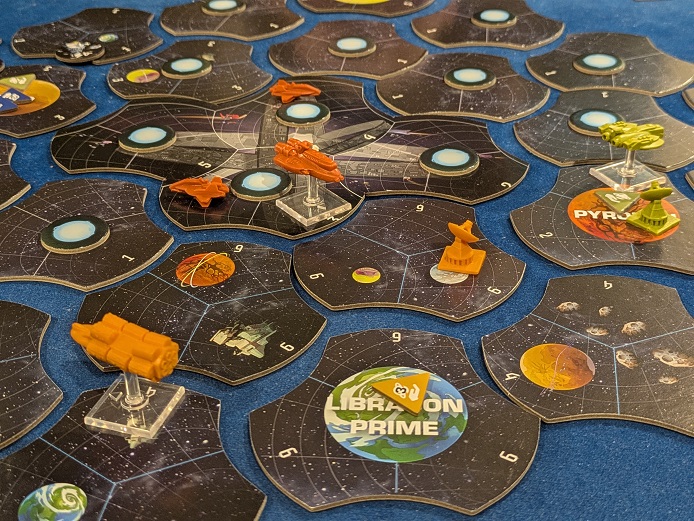
At a high level, this is standard adventure game fare. Each player controls a single piece, in this case a starship. You travel around the board, interacting with points of interest while pursuing various objectives. All of this is in service to points. The overall tempo is set through the competition, as a race element forms the foundation of this design. On the micro scale, players are competing to complete faceup mission cards in a public display. On the macro, the overall expedition is a sprint to a specific points threshold. This is a pretty standard global end game trigger, as it’s seen in Xia, Merchants & Marauders, The Witcher: Old World, and many other titles.
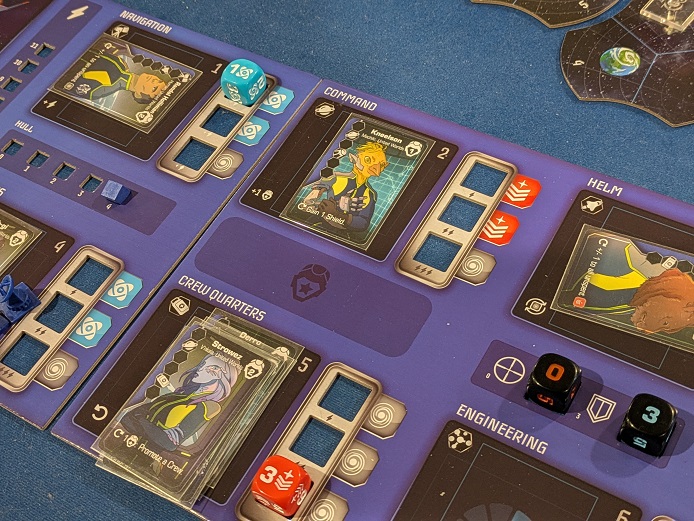
Where StarDriven: Gateway veers off into isolated space is in its action system. Players roll a pool of dice that are separated by three colors. These dice are assigned to stations on their personal ship mat each turn in order to perform certain actions. Helm utilizes green dice and facilitates moving between space sectors. Sensors uses blue to reveal adjacent tiles and exploration tokens. Green six-siders are placed in Engineering to ready weapons and red in Command to unleashes them. The higher the die-value the more potent the action. This is pretty straightforward, such as three pips allowing you to fly three spaces across the board or inflict three dice of damage.
This approach feels vaguely like Thunder Road: Vendetta’s dice activation system, threaded with some worker placement characteristics. Your turn-by-turn actions depend on deciphering a decision-matrix based on efficiently utilizing your dice to pursue varying goals. While the game presents the environment as a sandbox, you cannot wander around aimlessly and hope to secure victory. You need to analyze the available public missions, consider how they intersect with your private objectives, and then deftly chart out a path to navigate your options.
This process is also not just about spending your dice wisely, but about timing your loop effectively. Similar to worker placement games like Cryo or Manhattan Project, you need to eventually decide when to take your dice back and re-roll them, giving up your current ability to act in order to reload your stations and prepare for the future. This inherent tension flies well alongside the game’s high BPM tempo with players wanting to thrust forward as quickly as possible. Deciding when to pit stop is a conundrum.
The term “sandbox” has bothered me for some time. In modern board game design, this gets thrown around in the broad spirit of Skyrim, hinting at players possessing the agency to do whatever they’d like. Often, this is an illusion, for the structural incentives necessarily require you to pursue specific tasks or goals. Some games allow more or less slack than others. The most explicit example is Western Legends, where approaching it like Red Dead Redemption will lead you bleeding out in the desert. Players are forced to ruthlessly ambush miners or pursue bank robbers in order to police the game state and reign in scoring engines. You can’t sit down to a game of Western Legends and do whatever you’d like. Not if you plan on having a shot at victory.
The game doesn’t want you to do whatever you’d like. This is because designers feel constrained to express their works in the format of a zero-sum competition. It’s what we are accustomed to in this hobby, and games which typically operate outside that norm unfortunately function as a lightning rod for criticism. Designers place incentives in front of players, and players respond in kind. StarDriven: Gateway, thus, is not a sandbox. It doesn’t falsely embrace this moniker, but I’ve seen it expressed by other reviewers. The open world vibe is a facade for a competitive victory point race.
The setting also doesn’t fully obfuscate the systems-focused nature. There’s not much narrative here, prescribed or emergent. There is a basic background setting for the game, but there are no story events, narrative snippets, or unexpected scenes occurring. A faceless game-controlled enemy sends fighters and dreadnaughts after your ships and outposts, but most will not have a formal understanding of why or what’s occurring. The most exciting story moments are uncovering anomalies when exploring, as you draw these exciting calamities from a larger deck and they inject color and context into the action. But this is a smaller part of the game and not something you can pursue ruthlessly and hope to succeed.
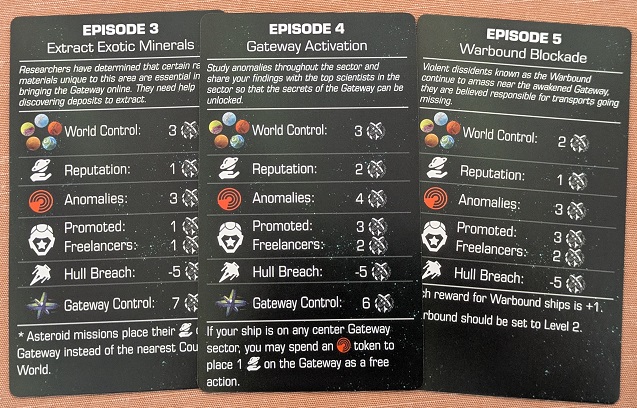
I enjoy the episode structure. This is the design’s unique way of scribing scenarios. Each episode weights actions differently, awarding a unique quantity of victory points for the various accomplishments. Mimicking the work’s overall philosophy, these scenarios are not constructed in order to convey narrative. There is a thematic difference between each episode, but the overall context is light. This approach is superior to just a single mode of play as it alters the feel of a session by pushing you towards different goals. It’s a neat and simple way to achieve strategic variety. I do lament the missed opportunity of leaning hard into more radical structure or rules changes for each scenario, as this seems like a primary vector to inject more excitement into the experience.
The one area where a sense of story and context make a strong appearance is, perhaps unsurprisingly, the dice activation system. As this is the primary conduit for the game’s novelty, it’s apt that this mechanism also conveys the strongest sense of character.
How this materializes is through crew. Each player has their own set of personality cards that are stored on their board in the crew quarters. You draw specialists from this deck and then spend actions to assign them to the various stations on your player mat. A station must be manned in order to have a dice assigned to it. But in addition to meeting this minimum requirement, crew members offer special abilities which allow you to perform exciting bonus actions or receive additional resources. Furthermore, you can promote these crew members during play, flipping them over and enhancing their effectiveness. This is one of the more satisfying aspects of the design, intuitively because it overtly improves your ability to execute big and dramatic turns.
Your ship console is an intersection of worker placement spaces and personal tableau. Assigning crew to various stations and upgrading them is a camouflaged process of tableau building. The most satisfying turns have you activating stations and tapping multiple specialists in order to break out of the two-action structure with explosive propellant. This doesn’t happen often as you must work to refresh expended crew, but when it does, it feels like you’re kicking on the afterburners and increasing thrust.
Crucially, crew must also be utilized in order to accomplish missions in the public market. It’s another consideration when filling out your ship and trying to connect which goals to pursue in the near term. The more people you can cram into chairs on deck, the more objectives you will be able pursue. This, in combination with the dice activation system, highlights how the core gameplay flows through your ship and its operators.
Finally, the whole crew system adds personality to a game that can be somewhat monotone. It’s easy to gloss over this, but your cast of characters all possess shiny names as well as a defined species and traits. There are some gnarly aliens whose mugs betray just how fun they likely are at parties. In its best moments, StarDriven: Gateway captures the tone of assembling an ensemble cast of hooligans operating in tandem to blast across the galaxy and explore mysterious systems.
Another appreciable aspect of this game is its pace. With experienced players, it fires along with a strong focus. The constraints on progress are less environmental and instead centered around systems activation. One of the best features is that the Navigation station on your ship allows you to teleport across the board. You simply have to place a die that matches a gravity value on the tile you’re jumping to. This is fantastic, as it cuts out the doldrums of mindless travel, allowing for more flexible and impactful turns. Consequently, it feeds the late game ability to accomplish missions rapidly.
Like many adventure titles, three participants seems to be the ideal configuration. Two-players is fine, but you run the risk of a relatively solitaire affair feeling even more solitaire. A table of four isn’t terrible, it just slows the pace of a game which benefits from increased tempo. All of this right in line with genre standards.
Beyond racing to complete objectives, the only interaction occurs with conflict. The combat system is interesting enough, with damage landing on random systems of the ship board and constraining future actions. But player-on-player combat – depending on the episode – is often disincentivized and usually only performed when convenient. It’s not a game where you hunt each other down, rather, one where a rare drive-by may prove beneficial. This element of tension, however, is appreciated as it makes sharing spaces uncomfortable.
The area where StarDriven: Gateway deserves the strongest criticism is in its user interface. It embraces iconography, which is often difficult to ascertain, contradictory, and lacking uniformity. This is most grievous on the ship mats, where symbols in the corner of each station point to a bonus micro-action. However, sometimes they don’t. Sometimes these icons are just reminders.
For instance, the Command station has an icon in the corner which indicates you receive an experience point. This isn’t the primary purpose of activating this position, it’s a bonus. Navigation also has a similar icon with a “+” in the corner. Although in this instance, it’s not in addition to the effect provided by the main action. Instead, it’s a reminder that the main action grants you energy. None of this is Blood Rage: Valhalla levels of confusion, but it makes learning the game more difficult. The player aid cards are also missing some details in the action section, which only compounds the issue.
In some ways, I can’t help but feel as though StarDriven: Gateway is more of a platform than a wholesale epic showpiece. That’s not to say the offering presented is shallow, but it does occasionally lack the overall wonder at the far end of potential. This thought is also somewhat colored by the separate Invasion expansion, a box that turns this game into a full-fledged cooperative ordeal. I will be writing about that in more detail in a future review, but it showcases more nuanced setting development while not downplaying any of the core mechanisms which support its infrastructure.
As is, StarDriven: Gateway has a large scope. It offers a cohesive system that touches on combat, exploration, character development, asymmetric abilities, hidden and global objectives, varying scenario goals, and even a functioning automa opponent for solitaire play. While its competitive framework is lean and the central focus, there are small areas where vibrancy emanates. The top-notch dice activation system carries much of the experience, elevating the large swathe of conventional tools. There is a joy to be had in fiddling with dice, placing them into slots, and watching your crew whip into action.
A copy of the game was provided by the publisher for review.
If you enjoy what I’m doing and want to support my work, please consider dropping off a tip at my Ko-Fi or supporting me on Patreon. No revenue is collected from this site, and I refuse to serve advertisements.

