
Hilt just doesn’t sound right. Condottiere has been Condottiere for nearly 30 years. It’s featured a board with a map of Italy, artwork depicting a fairly traditional historical setting, and cards that are impossible to read from across the table. Publisher CMYK says, no it doesn’t. Condottiere is now Hilt.
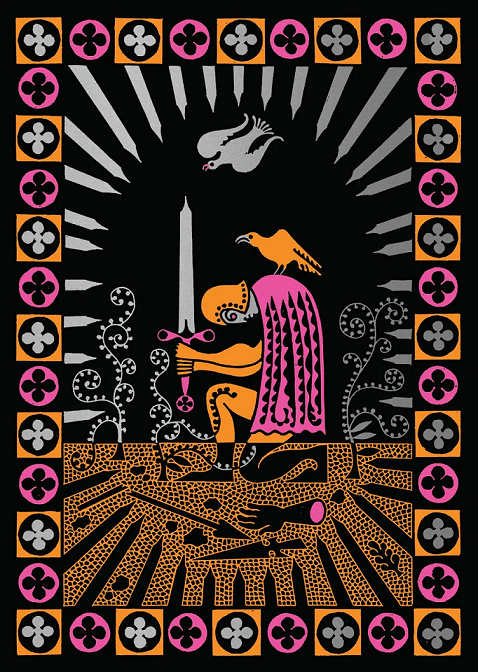
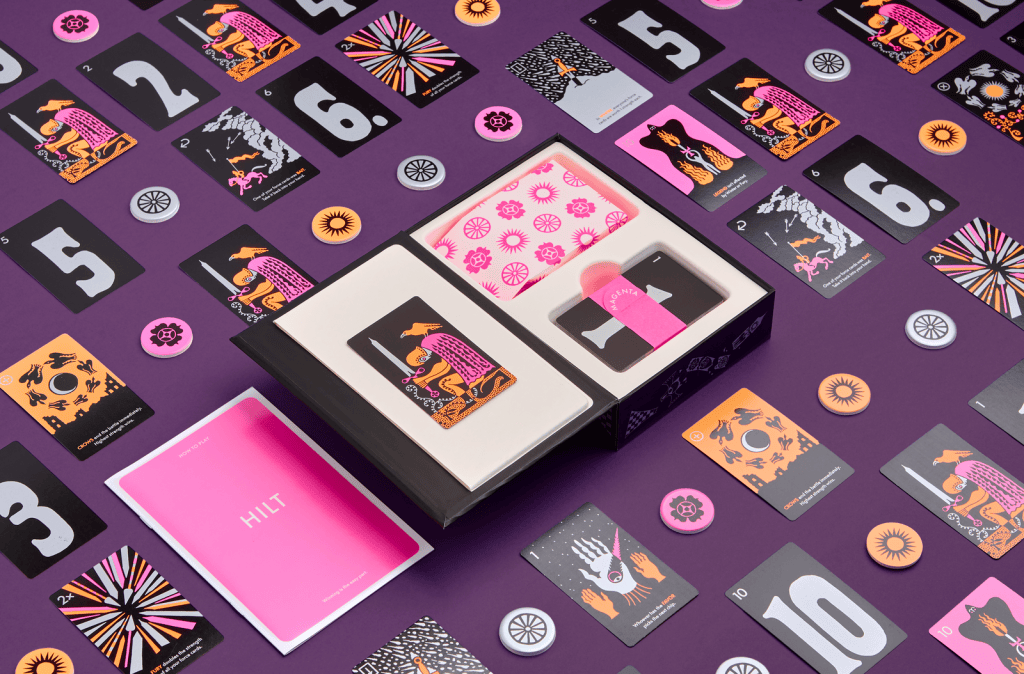
Like a neon sign ushering you into a fight for your life, Hilt dons the Magenta threads with utter conviction. It looks absolutely incredible. I’m sure some will lament the loss of the subdued common uniform of older editions, but much like CMYK’s reenvisioning of Magical Athlete, this game feels absolutely comfortable in its new aesthetic. I have played Condottiere dozens and dozens of times across multiple versions. Without a doubt, it has never looked this handsome.
If you’re unfamiliar, oh do I have a treat for you. Condottiere Hilt is one of the best card games. Ever. Each participant is dealt a large hand of cards that consist primarily of numbers. There are plenty of 1s, 2s, and so on. The deck consists of all single digits save for a few 10s. Players take turns placing one of these number cards from their hand to a personal tableau. With the wargame framing, these values can be thought of as strength in the battle.
Imagine the situation of the first player throwing out a 3, the next a 1, the third player slaps down a 4, and the fourth reveals a 3 as well. We then go back to the first player and the process continues, around and around. It may be helpful to think of this as a bid. You’re gunning for the highest total sum of played cards. A player can pass instead of revealing another card from their hand, but then they cannot jump back into the round. What they’ve played up until that point stands and can still win the conflict, but they are restricted from playing any more cards.
Truthfully, this is a game about enduring pain. Each card you lay is a cost. If you win the battle, it’s likely worth it. If you lose? Well, that’s a hell of a bite to chew on.
The brutality manifests in that this is a game almost entirely of ruthless hand management. You do not draw new cards until only a single player with cards in hand remains. As you can surmise, this means pushing hard for a battle is a big gamble. It means your participation in future contests will be stunted at best and completely nullified at worst. You fight tooth and nail in the first skirmish you best win, otherwise you’re lying in the mud with your entrails hanging out your body. No one’s offering a hand. They’re going to keep fighting around you.
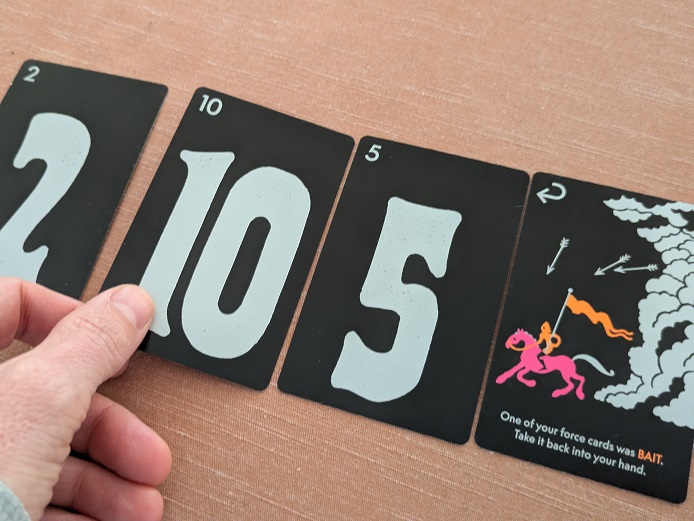
This all sounds rather basic. Nothing more than a Knizia-ish bidding game where you have to be careful with your resources, you say? That’s why there are special cards.
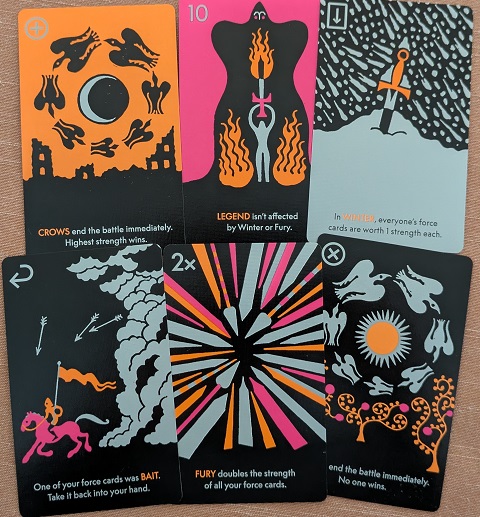
Bait lets you pull one of your played cards back to your hand. Don’t like how the battle is going? Collect your 10 and retreat. Fury doubles your total. Throw that bastard down and watch players recoil. When Winter comes all number cards are reduced to a 1. Doves is a kick in the groin. No one wins, the battle ends immediately and all cards in play are lost. Ho-ly. All pale in comparison to Crows. This sucker ends the battle immediately, but whoever has the current highest strength total wins.
With just a few wild additions, this game explodes in possibility. All of these cards create ripples of uncertainty and strategy and tension. Play assumes multiple layers, mostly existing in the headspace above the table.
Imagine you’re playing out a strong hand against a single foe. Everyone else has passed for the round. You each have several cards in play, including a few high valued strikes. Then you decide to get a little tricksy. You reveal a Bait and pick up your highest card. Your opponent grins, thinking they have it. They don’t want to pass yet as the battle isn’t over and they don’t want to cede their offensive. So, they trickle out a 1 hoping to delay.
You play another Bait and pull back a 6 this time. The derelict across from you plays their own Bait, since they have committed more than enough power and can reserve some for a later battle. Now, that 6 you withdrew? You play it back out there. Oh. Now your opponent is caught in the dance. Do they recommit? Who will roll over first?
A well-timed Doves can completely trash a round, ruining plans. The existence of Crows means that it’s risky to allow a player to hold the highest strength value. If play cycles around and it gets back to them while still in the lead, they can just outright win the fight if they’re holding those black birds. If Jill plays her 10 right off the bat, do you throw out a 10 just in case she’s holding Crows? Since all the cards are not dealt out each round, you never know what your opponents are holding. Every faint. Every play of a high value. It all feels dangerous and tense.
Someone wanting to study sunk cost fallacy should observe Hilt. Players are ready to carve out their own flesh and sacrifice every drop of blood for a single victory. Often, they’re just digging their own grave.
This game is full of thoughtful drama. Of mind games. Of occasional negotiation and scheming. Of enduring pain better than the cretin on your left and right.
The primary knock against Condottiere is that there is no way around a poor hand. Since cards are dealt out randomly, you may just get stuck with a bunch of 1s and Bait cards. If this occurs, you will very likely need to weather the round and hope for the best. There’s absolutely nothing you can do about it.
Hilt doesn’t fix that. Hilt fixes other things.
First off, let’s recognize that this edition does away with all of the new cards and rules tweaks that came in later printings. I swear by Condottiere’s original ruleset. No Spring cards, no Spies or any of that faff. It’s nice to know that original designer Dominique Ehrhard agrees, for he was the driving force behind this re-imagining of the game.
I wouldn’t actually consider restoring the card pool to its original incarnation a change. It’s a smart decision but it’s not radical. All of Hilt’s actual changes are focused on executing a philosophy that’s at the core of this edition: make the game leaner and more focused. This results in each battle having higher stakes and the overall length of play noticeably reduced. It’s a tighter design in scope, without losing the looseness in battle resolution and brinksmanship. I think these changes present as a minor streamlining, but make no mistake, they are actually fairly significant and affect several of the more nuanced aspects of this design.
All of this flows through the decision to scrap Condottiere’s board. Italy is vanquished. Instead we have tokens.
Previously, the active player selected an area on the map to battle over. Card play would commence, and the winner of the struggle would place one of their cubes in the region. Then they would control where the next battle was fought, and so on. Condottiere’s objective was to win control of three contiguous regions, or simply five total anywhere on the board.
Hilt’s objective is to win three of the same color tokens, or one of each of the three colors. Firenze, Spoleto, and Bologna are out. Orange, silver, and pink are in.
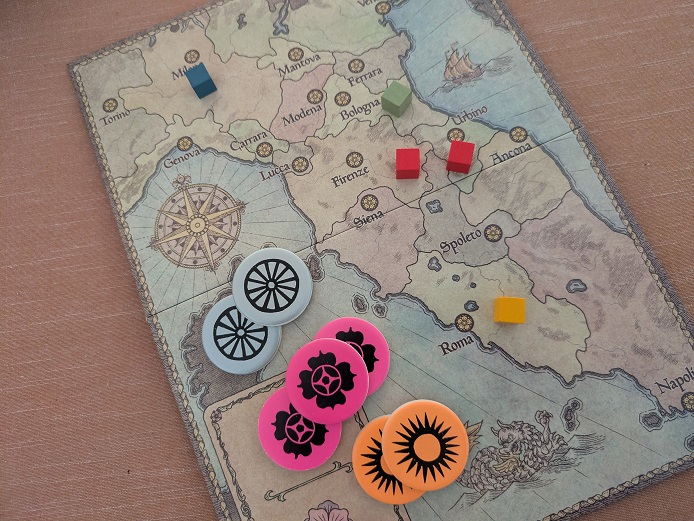
It’s evident how this new system is derived from the old. Three of the same color represents a contiguous plot of land. One of each of the three mimics the total of five needed prior. Incentives are somewhat similar. Somewhat.
First of all, this cuts out 10 or so minutes from a typical session. It’s just faster. On average, a token is more valuable than a region on the old map. This means that nearly every single chit is worth fighting for, which in turn incentivizes expending resources to try and win it, thus causing the game state to progress faster and rounds to end quicker. In Condo, many battles are fought in corners of the map or far-flung regions that are not adjacent to area you control. Burning your hand of cards on those areas is a fool’s errand. Cards are too precious.
Every area matters in Hilt.
Think about it this way. You’ve won one battle, an orange token. No matter which color is presented as spoils next, they’re all worth the same to you. Another orange puts you one away from victory. As does a silver. And a pink. After winning a single battle, every subsequent fight either wins you the game or puts you one away from victory. It’s like the map in Condo if every area was adjacent to all others. This means the large bulk of play is around consequential conflict. And of course, this means players achieve victory faster.
Most will view this as a boon. There are tradeoffs with this change. On the positive scale, there are far fewer instances of just two players fighting. This would happen often in Condottiere, where the majority of participants would pass and commit no cards, instead, allowing a duo to duel for a region. This is because the valuation of areas was asymmetric. I may not care about Firenze at all, but it’s adjacent to Jim and Sherry’s fiefdoms. Now, less players are sitting idly by twiddling their thumbs and watching other people war.
But it’s not that simple.
There is such tension in this game that observing others is often entertaining. It’s common for outsiders to egg people on, wanting to convince an opponent to go all in and burn their hand of cards. These outcomes have a direct effect on later battles, so they deservedly draw attention. Of course, this type of social manipulation is not always seen, and it’s perfectly possible to play this game in quiet solitude. I’d argue you’re doing it wrong, but fair enough if that’s how you roll.
Another second order effect of this change is that because every battle is significant, you have to participate. I would suggest that the default stance in Hilt is to fight, whereas the default position in Condottiere was to pass. There are moments in Condottiere where someone has an opportunity to win the game. They’ve selected a region next to their provinces which will complete their trio. This means the table needs to mount a proper defense. Now, you obviously don’t want to be the one to cede your hand of cards in order to win a battle you don’t actually care about winning, so maybe you pass. This is especially common if you’re immediately clockwise from the aggressor and there are more players downstream. Force them to mount the defense.
Those sweet moments of Machiavellian poise are gone. Very quickly, nearly everyone is within striking distance of winning. Sitting out is not an option. There are far fewer instances of pure defense. Hilt is all-out offense. This is also reverberated in battle selection. You can no longer choose a location to fight over that’s unimportant. Unimportant doesn’t exist. There’s a great deal of strategy in Condo when selecting regions, which influences how you then play out your cards. If your hand is light and you just won a huge contest, you can then select a less important area that no one cares about for the follow-up fight. There are no safe spaces now. Everything is up for grabs and worth pillaging.
This removes a lot of the slow play. It removes a lot of the macro-level fainting and subterfuge. It also pares down the hand management portion, seemingly limiting the skill ceiling. Admittedly, I’m not totally confident of this last point yet.
Beyond the more nuanced strategic landscape, Hilt’s streamlined objective also eradicates the outlier extended sessions. Every so often, a play of Condottiere could go the extra mile. The 45-minute Fourth Crusade would turn into the 90-minute Albigensian Crusade. I’m sure many of you scoff at this possibility. Who wants to play Condottiere for 90-minutes?
I do. Occasionally.
These big sessions were something else. They’re solidified memories that form some of my best gaming moments. We’ve had plays where the entire board was filled without anyone achieving the organic victory condition. Had to look that one up to figure out who won. These were epic tales. Now, they’re just memories. Those uncommon extended features seem extremely unlikely to occur in Hilt. The math just doesn’t permit it.
Paradoxically, while the overall session feels less momentous, each individual battle has higher stakes. The game short-circuits some of the various alternate paths, instead forcing everyone into a meat grinder of confrontation. What I do particularly enjoy about this change is that it seemingly opens up opportunity for collusion in a novel way. Because every single late game fight is a chance for multiple people to win the game, it requires much more concerted effort to maintain status quo and stalemate the gamestate. By that, I mean you need to be careful that half the table doesn’t burn through their cards, leaving just two players to bash each other’s heads in for their final token.
This is a much more common threat in Hilt than it was in Condottiere. It’s resulted in some really gnarly social maneuvers. I’ve orchestrated a multi-player agreement to shed our entire hands and end the round early, as everyone agreed none would be able to defend against the player who had punted on the battle and committed no cards. I have never seen a round of Condo that consisted of only a single battle. I have in Hilt.
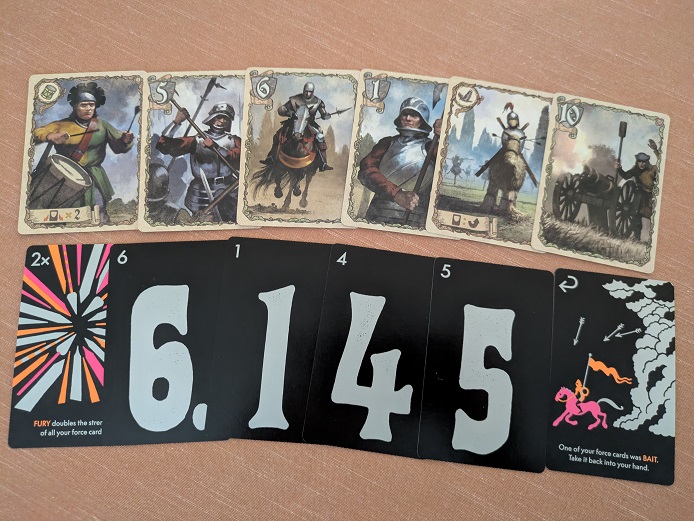
The throughline on these changes has been to make this design more accessible and widen its reach. Beyond streamlining the area control, the graphic design has greatly enhanced playability. Condottiere had an issue of not being able to read your opponent’s strength when seated across from them. The numbers were small and placed in the corner of the card. You’d often have to ask what their total was. While some will surely hate the lack of artwork on Hilt’s number cards, it’s an enormous UI improvement. This will greatly aid in learning the game and does wonders for enhancing the flow of play. Furthermore, all of the special cards have their effects clearly listed in text. That is an enormous boost for newcomers who would otherwise need to ask for the rulebook surprisingly often. Much like how I thought I’d miss Magical Athlete’s endearing lo-fi board and was completely convinced with CMYK’s execution, Hilt has won me over and skewers Condottiere in this regard.
This may sound crazy, but I was never immersed in the late Middle Ages setting of those older editions. I do think Condottiere is a strong game thematically – it showcases several of Sun Tzu’s aphorisms – but its expression of theme is not on the surface. It’s in the behavior and mentality of players. In this way, Hilt loses none of its predecessors’ thematic trappings.
Another intriguing tidbit riding alongside this release is the announcement that CMYK’s Magenta line of card games will now feature a second box size. Yes, the most commonly echoed criticism was that the Magenta boxes were too big and took up too much shelf space. Well, now you will have two options. The pre-existing Home Edition and the new deck-sized Standard Edition. I see merit in both, to be frank. The smaller boxes do not fit sleeved cards and make some component concessions. If portability is your main concern, however, they will certainly abide.
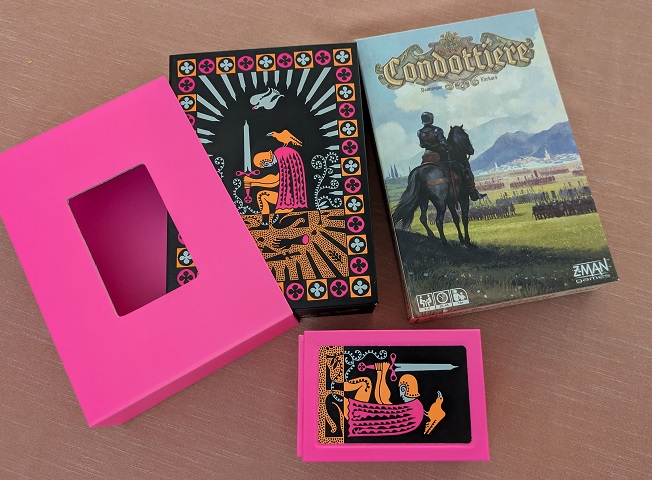
Hilt is one of the most interesting games I’ve had the pleasure of critiquing. Part of that is how it turns prior assumptions aside. Part of it is in how the holistic vision of the game has changed. It’s best summarized as moving Hilt towards the realm of traditional card game. The experience feels more classic in nature, less quirky. Condottiere is a weird design that occupies a unique headspace. It has elements of poker, push your luck, bidding, and even negotiation. It doesn’t have mainstream appeal. It always seemed more like the card game for grognards due to its idiosyncrasies.
Hilt is more traditional. A touch more casual. This flat-out works. It has been repurposed under CMYK’s brand and does not at all appear foreign in the Magenta line. It’s an effective rendition of an already stellar design, and I’m wholly impressed, even if I do find myself missing those bizarre nooks that were present in Condottiere.
A copy of the game was provided by the publisher for review.
If you enjoy what I’m doing and want to support my work, please consider dropping off a tip at my Ko-Fi or supporting me on Patreon. No revenue is collected from this site, and I refuse to serve advertisements.

